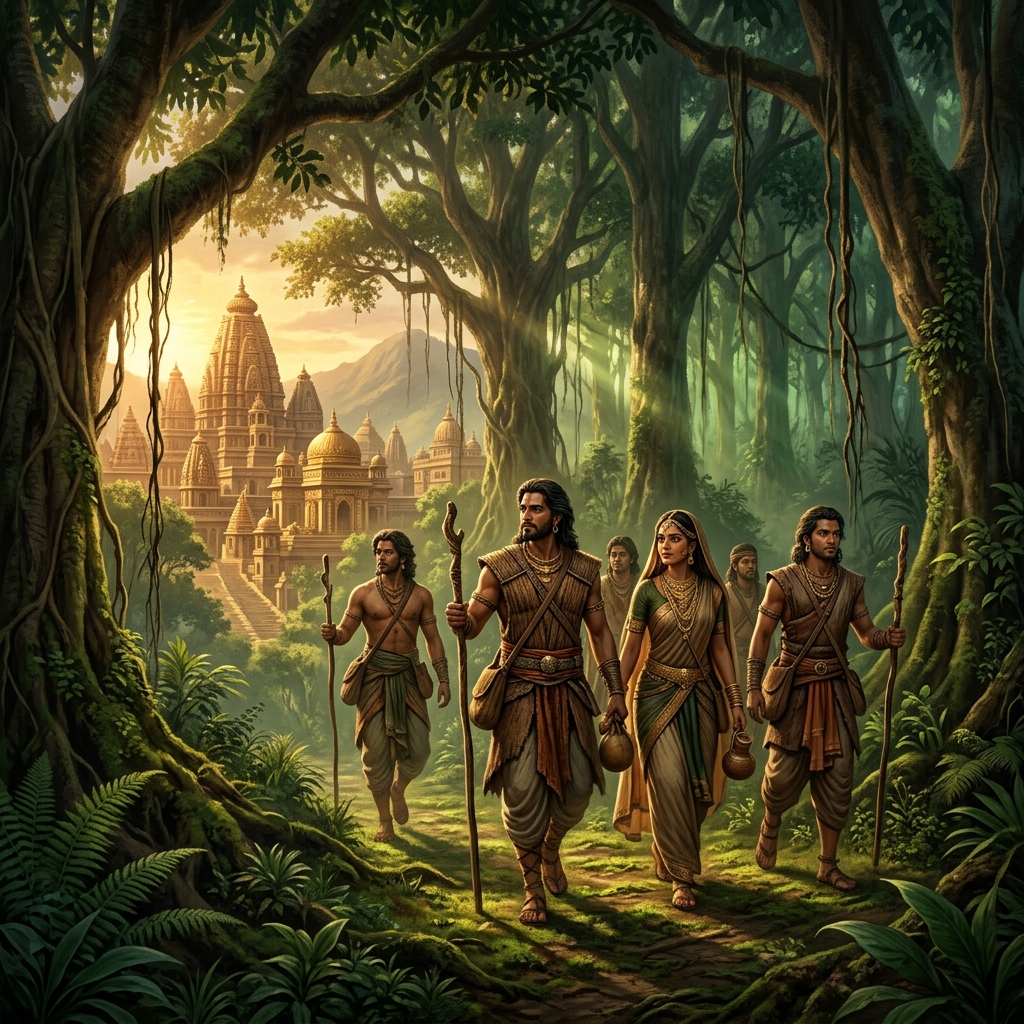
A Plainer Question Than Grief
The forest of Kamyaka held news of the exile's length well enough, twelve years spoken of everywhere it was thought of, but it held no answer to the plainer question that eventually surfaces in any camp that has stopped being new: where, in twelve years of forest, does a household actually go. Before the sage Lomasa descended from Indra's court with an invitation to travel the tirthas of the wider world, that smaller and more immediate question belonged to the family's own priest.
Yudhishthira put it to Dhaumya directly one evening, when the fires were low and the brothers had run out of the day's practical concerns. 'You have kept the household's rites since before any of us could recite them ourselves,' he said. 'Tell me plainly. If we are not to sit in one forest until the years run out, where does a family in our position walk?'
Dhaumya did not answer with comfort, which was not his habit, nor with vagueness, which would have served no one. He answered the way a priest answers a king who has asked a real question: with a map, spoken rather than drawn, because a spoken map is the kind that survives a burned camp and a broken fortune.
'Bharatavarsha has four quarters,' Dhaumya said, 'and each has its fords, its guardian sages, its seasons to travel in and its dangers to travel around. I will give you all four, and you will see that a road already exists for exactly this grief. It has existed as long as pilgrims have needed somewhere to carry what a house alone cannot hold.'
East to the Sea
'Begin at the east, since the sun begins there,' Dhaumya said. 'Follow the Ganga down from Prayaga, where her waters meet the Yamuna and a bather is cleansed of what a lifetime accumulates. The road runs on through Naimisha's forest, where the sages once sat in an assembly so long that time itself was said to pause for it, and it does not end until Gaya, where a son may offer the rites that free a father's spirit for good. Beyond Gaya the road runs out at the sea, and the sea is where the eastern quarter's pilgrimage properly finishes, because there is no further ford to walk to.'
He named the guardians as he went, the way a man names watchmen along a wall he trusts: sages who had kept those fords holy long enough that the water itself seemed to remember them, and who would know a genuine pilgrim from a wanderer merely passing through. The best season for the eastern road, he said, was after the rains had settled the dust and before the heat of high summer made the plains punishing to cross on foot; travel it wrong and the same road that cleanses a pilgrim could as easily exhaust one to death on the way.
Bhima, who had listened to the whole of it with more patience than anyone in the camp expected of him, asked the only question that mattered to him. 'And the danger,' he said. 'You have named the sages and the seasons. Name the danger too, or the map is only half a map.'
'Robbers on the forest stretches, where the sages' authority does not reach as far as their reputation does,' Dhaumya said. 'And further on, for those unused to it, the sheer scale of what the eastern quarter asks a mourner to feel all at once.'
South and West
'The southern road follows the Godavari,' Dhaumya went on, 'past the Vindhya range, which the sage Agastya is said to have humbled once so that it would let travelers cross rather than blocking the whole of the south from the north forever. The fords along that river keep his memory the way the eastern fords keep Gaya's, and the season to travel them is the cooler months, when the Vindhya's slopes are passable and the southern heat has not yet closed the road to anyone without a hardened constitution.'
Arjuna, who had traveled farther from Hastinapura than any of his brothers during his years of wandering before this one, recognized enough of the description to nod along with it, adding nothing, since he understood better than most in the camp that a priest's recitation was not improved by a warrior's corrections.
'From the south, cross west,' Dhaumya said, 'to Prabhasa, where the Sarasvati river is said to lose itself into the sea and where Krishna's own kinsmen keep the ford in trust. It stands near the Narmada's mouth, and pilgrims who reach it after the southern road often say it is the gentlest of the four quarters, water meeting water without violence, though gentleness is not the same as safety; the coast there has its own weather, and a pilgrim caught on it in the wrong season finds the sea a poor host.'
He paused there, letting the west settle in the listeners' minds before moving on, the way a good teacher paces a lesson too large to be absorbed in a single unbroken recitation. 'Two quarters remain,' Dhaumya said, 'and the fourth is the hardest of the four to reach and the hardest to leave once you have.'
North, Beyond Human Roads
'North, then,' Dhaumya said, 'up along the Sarasvati toward her own springs, higher than any of the other three quarters climb. The road narrows as the air thins, and the fords grow fewer and more sacred the further up you go, until it ends, or seems to end, at Badarikashrama, where Nara and Narayana are said to have kept their penance since before this age of the world began.'
He said the name carefully, the way a man says a place he considers more shrine than destination. 'Beyond Badari the road continues, but it stops being a road that any human traveler was meant to finish. The passes past it lead toward Gandhamadana and further still, into country the sages describe rather than the country a mortal body is built to survive. Few who go beyond Badari return to tell what they found there, and fewer still are meant to try.'
'Then why name it at all,' Bhima asked, 'if it is not a road for us to walk?'
'Because a map that hides its hardest quarter is not a map, it is a comfort,' Dhaumya said. 'You asked me where a family in your position walks. I will not tell you only the parts that are easy to hear. The season for the northern road is the brief window before winter closes the high passes, and its danger is not robbers or heat but the mountain itself, which does not distinguish between a righteous exile and any other traveler foolish enough to be caught above the tree line when the snow comes down.'
Yudhishthira, listening, understood that Dhaumya had answered a larger question than the one asked. He had not merely located four fords; he had described the whole shape of the years ahead.
A Road Already Walked by Grief
By the time Dhaumya finished, he had spoken all four quarters into the fire-lit clearing without a single scroll or drawn line, and the camp understood, better than a map could have shown them, that the itinerary he had recited was not an invention for their benefit. It was a road pilgrims had walked before any Pandava needed it, worn into the land's memory the way a name is worn into a family's, and the exile's years could be spent on it rather than merely endured against a tree.
That was the change Dhaumya's recitation actually made. A household sitting still in one forest counts days; a household walking toward Gaya, or Prabhasa, or the passes above Badari counts fords instead, and a ford, unlike a day, gives something back for the counting. Grief with an itinerary stops being only grief and becomes, however slowly, a pilgrimage, which is grief that has agreed to keep moving.
It was this recitation, plain and practical, that the brothers carried with them before the larger invitation ever arrived. When the sage Lomasa came down from Indra's court not long after with word that the Pandavas might travel the tirthas of the wider world under greater protection and grander company, he was extending a journey whose shape Dhaumya had already spoken aloud in this same clearing; the road he offered to walk with them was the road his priest had already named. And Bhishma, much later, on a very different bed, would speak of what the fords themselves were worth to a soul rather than where they stood on the land, a different teaching for a different hour.
None of that changed what Dhaumya had actually given his household on this ordinary evening: not comfort, not scripture, but a route, quarter by quarter, that the exile could walk instead of merely surviving.
Dharma Lesson
Grief that has nowhere to go curdles into despair, but grief given a direction becomes a pilgrimage, which is a form of endurance a person can actually walk. Dhaumya's recitation shows that practical knowledge, honestly delivered including its dangers, is itself a form of care. A teacher who withholds the hard parts of the road is not protecting the traveler, only delaying the harm.