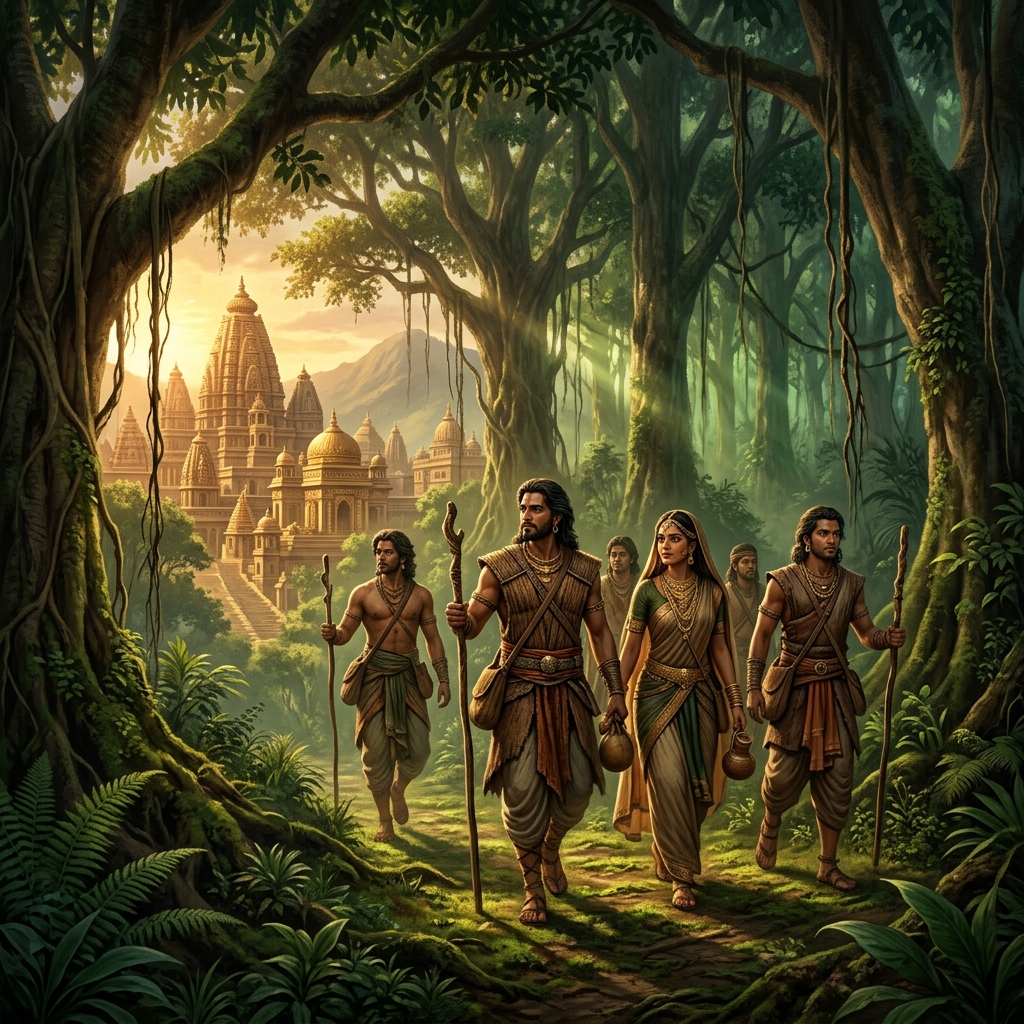
The Camp at Dvaitavana
Dvaitavana was where they had gone when Kamyaka had become too full of memory, and Dvaitavana had been kind to them. There was a lake. There were sal trees standing in ranks like a hall somebody had built and then forgotten about, and deer in the shade beneath them in numbers nobody had ever bothered to count, and for a while it had felt less like exile than like a long stay somewhere quiet.
The household was not small. Five brothers, Draupadi, Dhaumya, the charioteers and cooks who had refused to be dismissed, and always brahmins, sometimes a dozen and sometimes very many more, who had followed Yudhishthira out of his kingdom and treated his misfortune as a subject worth studying at close range.
The vessel Surya had given Draupadi fed the guests, but the vessel was not the whole of it. There were rites that wanted meat. There were hides to be cured for the ascetics and sinews to be replaced and a camp to be provisioned, and there were men who had been raised as princes and had, in the forest, exactly one skill left that produced anything at all.
So they hunted. All five of them, most days, with clean arrows and the old rules about which animals were not to be taken, because Yudhishthira would have kept the rules at the bottom of the sea. Arjuna hunted because he was the finest archer alive and it cost him nothing. Bhima hunted because he ate more than the rest of the camp together. The twins hunted because they had been trained to it since they could hold a bow, and because somebody had to bring back what the brahmins would eat that evening.
Nobody thought about it. That is the point of the story. It was not cruelty and it was not appetite. It was five expert hunters, in one forest, taking what a large household needs, every single day, for the better part of a year.
The forest noticed before the household did.
The Thinning
There had been a season when a man could stand at the edge of the water at dusk and watch the deer come down in lines, and the lines had taken a long time to pass.
Then the drink at dusk was a dozen animals. Then it was four, and they came late, and they came nervously, and they were back inside the trees before the light had properly gone. The tracks near the camp were old tracks. The paths that had been beaten flat between the lake and the thickets had grass growing in them again.
Bhima, who noticed the world through his stomach and was not ashamed of it, said that a man had to walk half a day now to bring back what used to be standing at the end of the clearing. He said it as a complaint about distance. Arjuna, who could read ground better than anyone in that camp, heard something else inside it and said nothing, which was what he generally did with things he had not finished thinking about.
Draupadi said once that the forest had gone quiet. Not silent. Quiet, the way a house goes quiet when the children have been sent away.
And Yudhishthira, who was a good man and a careful one and had spent that entire year arguing with sages about what a king owes and to whom, did not put those three things together. He was not being callous. He was a man with other business: an exile to survive, a brother away in heaven, a wife whose humiliation he had failed to prevent and could not undo, and a kingdom to plan for that he might never see again.
He was, in the meantime, quietly emptying a forest.
The Petition
He dreamed of them at the end of that year.
They were standing at his bedside. In the dream he was not surprised by that, the way one is never surprised in dreams, and he sat up on his mat of grass in the dark of the hut and looked at them, and they were deer, and they were thin.
He counted them. He always said afterwards that this was the worst part of it: that he counted them, and it did not take long.
'You are the king,' one of them said. 'Even here. Even in bark cloth. We have come to ask you for something, because there is nobody else to ask.'
'Ask,' said Yudhishthira.
'There were a great many of us in this forest,' the deer said. 'We are what is left of them. You are five brothers and all five of you shoot, and you shoot every day, and you are very good at it. We are not accusing you of a crime. You have taken nothing that is forbidden and you have broken no rule that we know of. But there is a number below which a kind does not come back, and we are near it. If you stay another season there will be no deer in Dvaitavana. Not fewer. None.'
'What is it you are asking me for?'
'Leave,' said the deer. 'That is the whole of it. Go and live somewhere else, and let the few of us that are still breeding do what we do. Give us a little time and this forest will fill up again. Nothing that you want is in danger. You would only have to hunt in a different place.'
Yudhishthira, in the dream, was a man who had been trained from childhood to receive petitions and answer them, and some part of him answered exactly as it would have answered in a hall at Indraprastha with the day's suppliants standing in front of him.
'You have come a long way to say this,' he said. 'It is granted.'
Then he woke, and the hut was dark, and there was nothing standing at the foot of the bed at all.
A Petition From My Subjects
He woke Bhima before dawn, which was not a thing anybody did lightly.
By the time the light came the whole household was up, and Yudhishthira was standing in front of them saying a sentence they did not immediately understand.
'I have received a petition from my subjects,' he said, 'and I have granted it. We leave Dvaitavana today.'
Bhima wanted to know which subjects, since as far as he was aware they had none.
So Yudhishthira told them the dream, plainly, without dressing it up. The deer had come. They were the remnant. Five hunters who ate every day had very nearly finished them, and a handful of breeding animals, given a little peace, would bring the forest back to what it had been.
'It was a dream,' said Bhima.
'It was,' said Yudhishthira. 'And everything inside it was true before I dreamed it. You told me yourself that you walk half a day now for what used to be at the edge of the clearing. I have lived here for a year with my eyes open and I had to be told this by the animals themselves, in my sleep, standing at my bed.'
Arjuna said that Kamyaka had game enough and the same water and better shade, and that he would take the twins ahead to look over the old site, which was his way of agreeing without making a speech about it.
Draupadi said the thing that settled it. 'You have lost the kingdom,' she said. 'You have not lost the office. There is nobody else in this forest deciding whether they live.'
And Bhima, who argued with his eldest brother about dharma roughly once a week and lost roughly once a week, picked up the cooking vessels and said that if they were going they had better go before the heat, because it was a long walk to Kamyaka and he intended to eat when he arrived.
There was no further discussion. That is the whole of the episode as the text has it. It is over almost before it starts.
The Walk to Kamyaka
They went that day.
It was not a small thing to move. The brahmins had to be gathered, the vessel packed, the carts loaded, the old and the slow among the ascetics put where they could be carried, and the whole long procession of them went out of Dvaitavana in the heat with the lake going gold behind their shoulders. They walked without any of the ceremony that had once attended the smallest movement of that family, and after some days they came again to Kamyaka on the bank of the Saraswati, where the exile had begun, and made their camp among trees they already knew by name.
Behind them the forest they had left began, very slowly, to fill up again. Nobody watched it happen. There is no scene in which anyone goes back to check.
It is one of the shortest episodes in the whole of the forest years and one of the strangest, and it sits among far louder things: a rakshasa at the gate, a demon wearing a brahmin's thread, a wife carried off by a king, and later, at a pool in that same wilderness, a voice out of the water that would test this same man's patience with a list of questions before it gave him back his brothers. Beside those it is nothing at all. A few deer at a bedside and a decision taken before breakfast.
But it is the only place in the epic where a king is petitioned by beings who cannot reach a court, cannot speak his language while awake, cannot bring a gift, cannot threaten him, and will never be counted among his people by anyone keeping records, and where he hears them out anyway and moves his entire household to grant what they asked.
Yudhishthira had no throne that year, no army, no revenue and no city. He was a man in bark cloth with a bow. He was still, every single morning, deciding who in that forest lived, and the moment he understood that, he got up and left.
Dharma Lesson
A king's duty does not stop at the edge of the group that can walk into his hall. Yudhishthira had broken no rule of the hunt, and that is precisely the difficulty: the harm was lawful, gradual and invisible, and nobody in the household was doing anything wrong on any particular day. What the deer ask for is not punishment but restraint. What makes him a king in that moment is that he treats a request from creatures with no standing exactly as he would have treated a delegation of citizens at Indraprastha.