Draupadi's Trials in Exile
The Sari, the Sage, and a Question to a Queen
The Unbound Hair
Draupadi walked into the forest with her hair unbound. That was the first thing the sages of Kamyaka noticed when the Pandavas arrived to begin their thirteen years of exile - the queen of Indraprastha, daughter of Drupada, born from sacred fire, walking among the trees with her long black hair loose and falling past her waist. It was not carelessness. It was a vow.
In the dice-hall of Hastinapura she had been dragged by that hair, in a single garment, in her time of impurity, before an assembly of kings who lowered their eyes and said nothing. Dushasana had laid hands on her. Duryodhana had slapped his thigh and invited her to sit on it. Karna had called her a woman of loose character because she had five husbands. And her own five husbands, the mightiest warriors of the age, had sat with their heads bowed because their elder had wagered them all away and then wagered her, and lost.
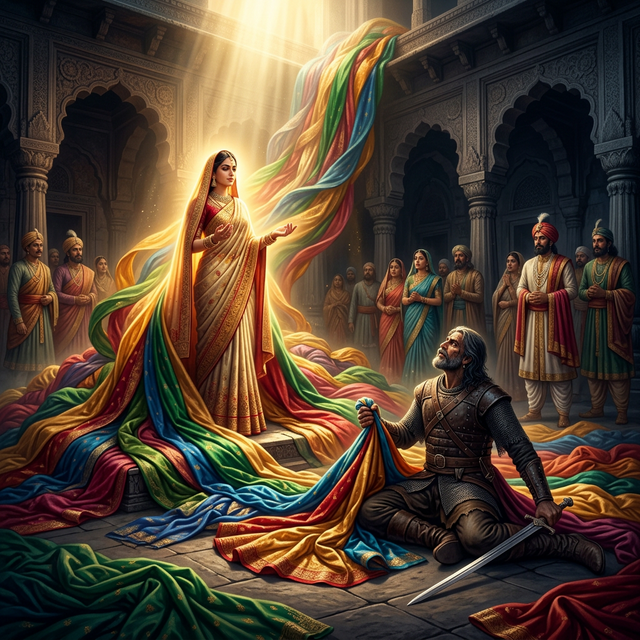
What had saved her was not a sword. It was the cloth that would not end - the sari that lengthened endlessly in Dushasana's tearing hands until he sank down exhausted in a sea of fabric, and she stood untouched. She knew who had given her that cloth. She had cried out to Govinda, who was far away in Dwaraka, and Govinda had answered.
So now, in the forest, she would not bind her hair again. Not until it had been washed in the blood of the man who had touched it. She told herself this each morning as she gathered her hair in one hand to keep it from the cooking fire, and let it fall again. Let it hang loose, she thought. Let it remind these five kings every single day of what was done to me, and what they swore to undo.
The forest was vast and green and indifferent. Birds called. The river ran. And Draupadi, who had eaten from golden plates and slept in the Maya-built palace of illusions, lay down that first night on a deerskin under the open sky and did not weep, because weeping was a thing she had decided not to give them.
Grief and Anger by the Fire
The days settled into a rhythm of hardship, and in the quiet of the camp the grief that Draupadi would not show in daylight came out at night. She would sit by the fire after the brothers slept, her chin on her knees, and let the anger move through her like a slow heat.
It was not only the humiliation. It was the injustice of it. She had been a queen and was now a forester. Her sons were being raised in their grandfather Drupada's house, far from her. Her hands, which had worn rings, now cracked from grinding grain. None of this would have happened if her husbands had risen in the hall when she was being dragged. None of it would have happened if Yudhishthira had not played a game he could not win against a man who could not lose honestly.
When she could no longer hold it, she went to Yudhishthira and spoke. She did not whisper. "You are the eldest, and you are called the righteous one," she said, "and I ask you - where is your anger? A king who feels no anger at an insult to his wife and his honor is not patient, he is dead. The scriptures praise forgiveness, yes, but they also say there is a time to strike. The deer that does not run is eaten. The fire that is not fed goes out. We have weapons. Arjuna has weapons that the gods themselves would fear. Why do we sit here in deerskin counting out twelve years and then a thirteenth, when across that forest sits the man who stripped me before an assembly and lives untouched?"
Her voice carried the controlled fury of someone who had thought about this for many nights. "I do not understand a dharma that asks the wronged to suffer and lets the wrongdoer feast. If this is what righteousness costs, then I have begun to hate the word."
The fire crackled. Bhima, half-awake nearby, stirred and growled his agreement, for nothing in him wanted to wait either. And Yudhishthira looked at his wife with a sorrow that did not defend itself, and waited for her to finish, because he loved her and knew that her anger was just even where he could not act on it.
The Debate on Dharma
Yudhishthira answered her slowly, because he was not a man who answered quickly. "You speak the truth about what was done to you," he said. "There is no part of me that does not burn. But anger, Panchali, is a fire that does not ask whose house it lives in before it burns it down. If I act from anger, I become Duryodhana. The only thing that separates us from them is that I keep my word even when it costs me everything, and they keep nothing.
"I gambled. I lost. I accepted the terms of the loss before all those kings. Thirteen years. If I break that word the day it grows inconvenient, then what is my word worth, and what is the kingdom worth that I would win back by breaking it? A throne taken by deceit rots the man who sits on it. I will not hand my sons a rotten throne."
Draupadi was not soothed, and she did not pretend to be. They argued long into the night, and others joined - sometimes Bhima, who sided with her openly and said he would crush Hastinapura tomorrow if only his brother would release him from his vow of obedience; sometimes the sage Markandeya, who told them ancient stories of kings who endured worse and were vindicated; sometimes the priest Dhaumya, who quietly reminded them that even the gods had served their terms of suffering.
It was the great debate that ran beneath the whole exile - patience against action, dharma against justice, the long game against the burning present. Draupadi never conceded that waiting was right. She only conceded, again and again, that her husbands had bound themselves and that she would not be the one to make them break their bond, because then the dishonor would be theirs and not Duryodhana's.
"I will wait with you," she told Yudhishthira at last, on one of those nights, "because I will not let it be said that the Pandavas lost their dharma over a woman's grief. But understand me. I wait the way a drawn bow waits. The waiting is not peace. When the thirteenth year ends, you will not need to remind me of this hair, or this anger, or this fire. I will remind you."
A Queen in the Forest
There is a particular hardship in being a queen brought low, and Draupadi lived it without complaint where others could see. She rose before dawn. She drew water from the river and carried it back in a clay pot balanced on her hip, the same hip that had once been belted with gold. She gathered firewood. She ground the wild grain and the forest roots into something that could be cooked. She tended the brothers when they came back torn from hunting, washed their wounds, fed them, and ate last and least.
The sages and Brahmins who followed the Pandavas into exile were many - hundreds of them, who would not abandon the righteous king even in his ruin - and they too looked to Draupadi. It fell to her to see that not one of them went hungry. A guest in the forest was as sacred as a guest in a palace; dharma did not bend for poverty. So the queen who had no kitchen made a kitchen of the open ground, and the queen who had no servants served.
Her beauty did not fade, and that was its own danger. Word of the lovely Pandava queen living unguarded in the woods spread among the kingdoms, and more than one passing prince let his eyes linger. She knew it. She kept close to the camp, kept her brothers and her husbands near, and carried herself with a stillness that warned men off better than any wall.
What sustained her was not hope of comfort, for there was none coming. It was faith. She had cried out once in the dice-hall and been answered. She had learned a thing that the comfortable never learn - that when every human protection fails, there is still one that does not. She thought of Krishna often. He came to the forest when he could, and sat by her fire, and never once spoke of the sari that did not end, and neither did she, because the gratitude between them was too large for any word and needed none.
She carried the camp on her back and the vow on her head, and she did not break.
The Inexhaustible Vessel
Feeding the multitude was beyond any forest. Hundreds of Brahmins, five great-bellied warriors, and a queen who would not let a guest go hungry - the wild fruits and the hunted deer could not stretch so far. It was Yudhishthira who found the answer, and he found it the only way he knew how, through devotion and discipline.
In the early days of the exile he had gone apart and worshipped Surya, the sun, the giver of all nourishment, the source of the food that grows from the earth. He fasted and prayed and offered the hundred and eight names of the sun, and Surya, pleased with the suffering king's steadfastness, appeared before him in his blazing form.
"Take this," the sun-god said, and placed in Yudhishthira's hands a copper vessel - the Akshaya Patra, the inexhaustible bowl. "For twelve years this will give you food without limit each day. Whatever is asked of it in cooked food, fruit, root, and grain, it will yield, enough to feed every guest who comes, until your queen has taken her own meal and washed the vessel. Once Draupadi has eaten and the bowl is cleaned, it will rest until the next sunrise. Let her eat last, as a good hostess does, and you will never see a guest turned away hungry."
It changed everything. Now the queen who had been grinding roots stood each day over a vessel that filled and filled. The Brahmins ate their fill; the brothers ate; and only then, when the last guest was satisfied, did Draupadi take what remained and finish her portion, and wash the copper clean for the night.
It was a fitting gift for her, though it was given through her husband. The whole arrangement turned on her - on her appetite being the last appetite, on her care being the measure of the day. A lesser woman might have eaten first and let the magic run all day. Draupadi ate last. The discipline of it suited her. She had always given before she took. Now the gods had built her habit into a sacred vessel of copper, and she carried it the way she carried everything in those years - as a duty she would not set down.
Durvasa at the Door
Duryodhana, in his palace, could not bear that his cousins suffered comfortably. When his spies told him of the inexhaustible vessel, he saw not only that the Pandavas were fed, but the one thread by which that gift could be unraveled - the vessel gave nothing more once Draupadi had eaten and washed it.
He needed a weapon that walked, that could not be refused, and that would arrive at exactly the wrong hour. He found one. The sage Durvasa, famous through the three worlds for the terrible speed of his temper and the ruin of his curses, came to Hastinapura, and Duryodhana served him and his ten thousand disciples with such flawless, fawning hospitality for so many days that the great rishi, pleased, offered him a boon.
Duryodhana asked his boon with the sweetness of poison. "Visit my cousin Yudhishthira in the forest, holy one. He is the most pious of men and loves nothing more than to serve sages. Go to him with all your disciples - but go, I beg you, in the afternoon, after the time when men have eaten and rested, so that he may have the full honor of feeding you when you come."
Durvasa, suspecting nothing, agreed.
So it was that on a still afternoon in Dvaitavana, Durvasa and ten thousand disciples descended on the Pandava camp. Yudhishthira received them with shaking joy and total dread, for he knew what they did not say aloud. Draupadi had already eaten. The vessel had already been washed. The sun would not rise again for many hours.
Durvasa, gracious for now, said that he and his disciples would go down to the river to bathe and perform their rites, and would return to eat. "Have a meal ready," he said, "a fine one, for ten thousand and one," and he went, with the host of his followers, toward the water - leaving behind him a hut with a clean and empty copper bowl, and a king with no way on earth to fill it.
The Single Grain
Yudhishthira stood in the empty hut and could not speak. To refuse a sage was to invite a curse that could turn the whole forest to ash. To feed ten thousand from a washed and resting bowl was impossible. Between the two impossibilities there was no room even to breathe.
It was Draupadi who acted, the way she always acted when every human door was shut. She did not run to her husbands; she had learned where help truly came from. She went into the hut, she folded her hands, she shut her eyes, and she called the one name that had answered her in the dice-hall when no king would. "Krishna. Govinda. Lord of Dwaraka. You came when I was being shamed before all those men. Come now. There is nothing left to me but you."
And between one heartbeat and the next, Krishna stood in the hut, three thousand miles from his city, smiling as if he had only stepped in from the next room. "I am terribly hungry," he said. "I have come a long way and I have not eaten. Sister, they tell me you keep a vessel that feeds the world. Show me. Feed me first."
Draupadi was stricken with embarrassment. "It is empty, Govinda. I have eaten, I have washed it, there is nothing in it until dawn. I called you for help and now I cannot even feed you."
"Bring it anyway," said Krishna.
She brought the copper bowl. He took it and turned it in the light and peered into it, and there, clinging to a fold of the rim, missed in the washing, was a single grain of rice and a small wilted leaf of greens - the very last residue of Draupadi's own meal.
Krishna plucked the grain free with two fingers and ate it. "Ah," he said, and set the bowl down, and laid his hand on his stomach as if he had risen from a feast. "That was a wonderful meal. I am full. May the Lord who dwells in all beings, who is fed when any creature is fed, be satisfied with this single grain."
The Sages Who Could Not Eat
Krishna stretched, content, and turned to Bhima. "Go down to the river," he said, "and tell the holy Durvasa and his disciples that dinner is waiting whenever they wish to come."
Bhima went down to the water and found a strange scene. The ten thousand disciples were rising from their bath one by one, and each of them, to his own bewilderment, felt as full as if he had just risen from the largest meal of his life. Their bellies were tight. The very thought of food was unbearable to them. They could not understand it - they had eaten nothing, and yet not one of them could swallow another mouthful if his life depended on it.
They went to Durvasa, baffled, and the great sage was the most baffled of all. He understood at once that something larger than himself was at work here, and that if he and ten thousand sated disciples now marched up to Yudhishthira's hut and refused the meal that the king had been told to prepare, the offense of spurned hospitality would fall on Durvasa's own head - and he had felt the weight of such things before. To demand a feast and then turn from it was an insult that could rebound as a curse upon the one who refused.
Durvasa, who had come to ruin the Pandavas at Duryodhana's bidding, now wanted only to be gone before the trap he had carried sprang shut on himself. He sent his apologies. He told Bhima that he and his disciples were unaccountably satisfied, that no meal would be needed, that the noble Yudhishthira should not trouble himself, and that they begged the king's pardon for the inconvenience of their coming. Then he gathered his ten thousand and left the forest in a quiet, confused hurry, never quite understanding what had emptied his hunger, nor whose hand had been laid over his plan.
When the camp was still again, Krishna was already gone. There was only the copper bowl, washed and resting, and Draupadi - who had cried out a second time and been answered a second time - laughing for the first time in a long while, with her unbound hair falling around a face that for one evening had forgotten its grief.
The Wolf at the Hermitage
Not every trial ended in laughter. There came a day in Kamyaka when the five brothers, with their priest Dhaumya, had gone deep into the forest to hunt, leaving Draupadi at the hermitage in the care of one elderly Brahmin, Trinabindu. The forest was quiet. The queen stood at the door of the leaf-hut watching the trees.
Along the forest road that day came a procession of kings. At its head, on a great chariot, rode Jayadratha, king of Sindhu, husband of Dussala - the only sister of the hundred Kauravas, and so a kinsman of Draupadi's enemies. He was traveling to the land of the Shalvas to seek a bride. And then, through the trees, he saw a woman standing at a poor leaf-hut, a woman whose beauty struck the whole company silent, a woman who shone in the rough forest like a flame on dark water.
Jayadratha could not believe such a creature belonged in such a place. He sent one of his companions, a prince named Kotika, to learn who she was. Kotika approached and asked, courteously enough, and Draupadi, schooled in the courtesy a guest is owed, came to the door and answered. She was Krishnaa, daughter of Drupada, wife of the five Pandavas, who were away in the hunt and would return shortly. She invited the travelers, as a host should, to wait and accept the hospitality of the hermitage until her husbands came back.
It was a fatal courtesy to offer a man like Jayadratha. He climbed down from his chariot. He came to the door of the hut. And instead of accepting the welcome of a hostess, he began to speak to her of his own greatness, of his kingdom, of how a woman so radiant was wasted on five beggars who had lost everything at dice and now slept on deerskin in the woods. "Leave them," he said. "Come with me. Be the chief queen of Sindhu. Why share five ruined men when you could rule beside one whole one?"
Jayadratha's Crime
Draupadi drew herself up, and the warmth of the hostess was gone in an instant. "You forget who you are speaking to, and who you are," she said. "You are married to Dussala. You are kin to my husbands by that marriage. It is a sin even to say what you have said, and a greater sin to think it. My husbands are the equals of the four guardians of the world. Arjuna alone would be enough to end you. Go now, while the offering you have made me is only words, and pray that I forget you said them."
But Jayadratha was a fool inflamed, and her refusal only hardened his want. Words turned to force. He seized her. She fought him, and cried out, and called for the old Brahmin Trinabindu, who ran shouting along the forest paths to raise the alarm. Jayadratha dragged her - she who had been dragged once before by the hair, in another hall, and had sworn it would never happen again - and threw her up onto his chariot, and lashed his horses, and fled down the forest road toward Sindhu with the queen of the Pandavas weeping and struggling at his side.
Draupadi, even then, did not lose her wits. She flung her words at him like stones as the chariot rocked. "You think you have won something. You have signed your death. When my husbands learn of this, no fortress and no kingdom will hide you. Bhima will break you across his knee. Arjuna will fill you with arrows until you are more shaft than flesh. You have not abducted a woman. You have abducted your own funeral."
Back at the hermitage, the brothers returned from the hunt to find the old Brahmin running toward them through the trees, his face grey, his voice cracking, pointing back down the road. The hunted deer fell forgotten from Bhima's shoulder. The exile, the patience, the long discipline of waiting - all of it burned away in a single breath when they understood. Draupadi was taken.
The Pursuit
They followed the chariot tracks at a run that the great deer could not have matched. Bhima led, his fury a thing the forest could feel, uprooting the brush in his path, and Arjuna ran beside him with his bow already strung. The other three came behind. They followed the broken branches and the torn earth where the wheels had cut deep, and they gained, and gained, until they saw the dust of Jayadratha's chariot ahead of them through the trees.
Draupadi, looking back, saw them come, and her heart, which had been a tight cold knot for hours, opened. "There," she said. "There they are. Now watch what you have done."
Jayadratha's escort of kings wheeled to make a stand and buy their lord time, and Bhima and Arjuna went through them the way a storm goes through standing grain. Arjuna's arrows took the chariot horses and the chariot wheels and the chariot's banner. The escort broke and fled. And Jayadratha, seeing his army scattered and his stolen queen about to be reclaimed, abandoned both his prize and his pride, leapt down from the wrecked chariot, and ran into the forest on foot like a thief.
Arjuna lifted Draupadi down from the broken chariot and set her safe, and she stood among the wreckage with her unbound hair wild from the chase and her eyes blazing, more queen in that ruined moment than she had been on any throne.
Bhima went after Jayadratha alone, hunting him through the trees the way Jayadratha had hunted nothing in his pampered life, and ran him down, and took him, and would have torn him apart on the spot. But Yudhishthira and Arjuna caught up, and Yudhishthira - even now the same man - stayed his brother's hand. "He is Dussala's husband," he said. "He is family, however vile. For our sister Dussala's sake, and for Gandhari's, do not kill him. Spare his life, but let him be marked."
Marked and Steadfast
So Bhima did not kill him, though the killing was in his hands and would have been just. Instead he humbled him as only Bhima could. He beat Jayadratha to the ground, dragged him before the others, and then, with his sword, shaved the king of Sindhu's head - leaving five tufts of hair standing, a public brand of disgrace that any man who saw him would read at once: here is one who was defeated and spared. Then Bhima made him bow at Draupadi's feet and declare himself, before all of them, the slave of the Pandavas.
Draupadi watched this, and it was Yudhishthira who turned to her. "He has been spared for our sister's sake," he said gently, knowing how the mercy must taste to her. And Draupadi, who had every right to demand his death, looked at the shaven, bowed, broken man at her feet, and let it be. She did not need his blood. She had only ever needed to know that the men who shared her exile would come for her, at a run, the moment she was taken - and they had. That was enough. Jayadratha was sent crawling back to his kingdom, alive, marked, and shamed, to nurse a hatred that would one day cost him his life on the field of Kurukshetra. But that was a debt for another day.
The brothers walked Draupadi back to the hermitage through the evening forest. No one spoke much. There was nothing that needed saying. She had been tested again - by grief, by hunger, by a sage's curse, by a king's lust - and each time she had stood, and each time, whether through her husbands' arms or through Govinda's grace, she had been answered.
That night she sat by the fire as she always did, after the others slept, her chin on her knees, her long hair loose around her. She gathered it in one hand and let it fall. Not yet, she thought. Not yet. But the vow held, and the faith held, and the queen who had been dragged from a dice-hall in a single garment had walked through her years of forest exile and bent for no one. She had endured. She would go on enduring, drawn like a bow, until the thirteenth year ended and the time of waiting became, at last, the time to strike.
Dharma Lesson
A queen's true gifts are often invisible: the steady attention that holds five husbands without contest, the bowl that feeds the world before it feeds her, the cry that brings a god across three thousand miles. And mercy is not always rewarded - Karna gave back ten cows and a year of food for the one he killed, and was cursed for it all the same. Some debts the world will not let you settle.