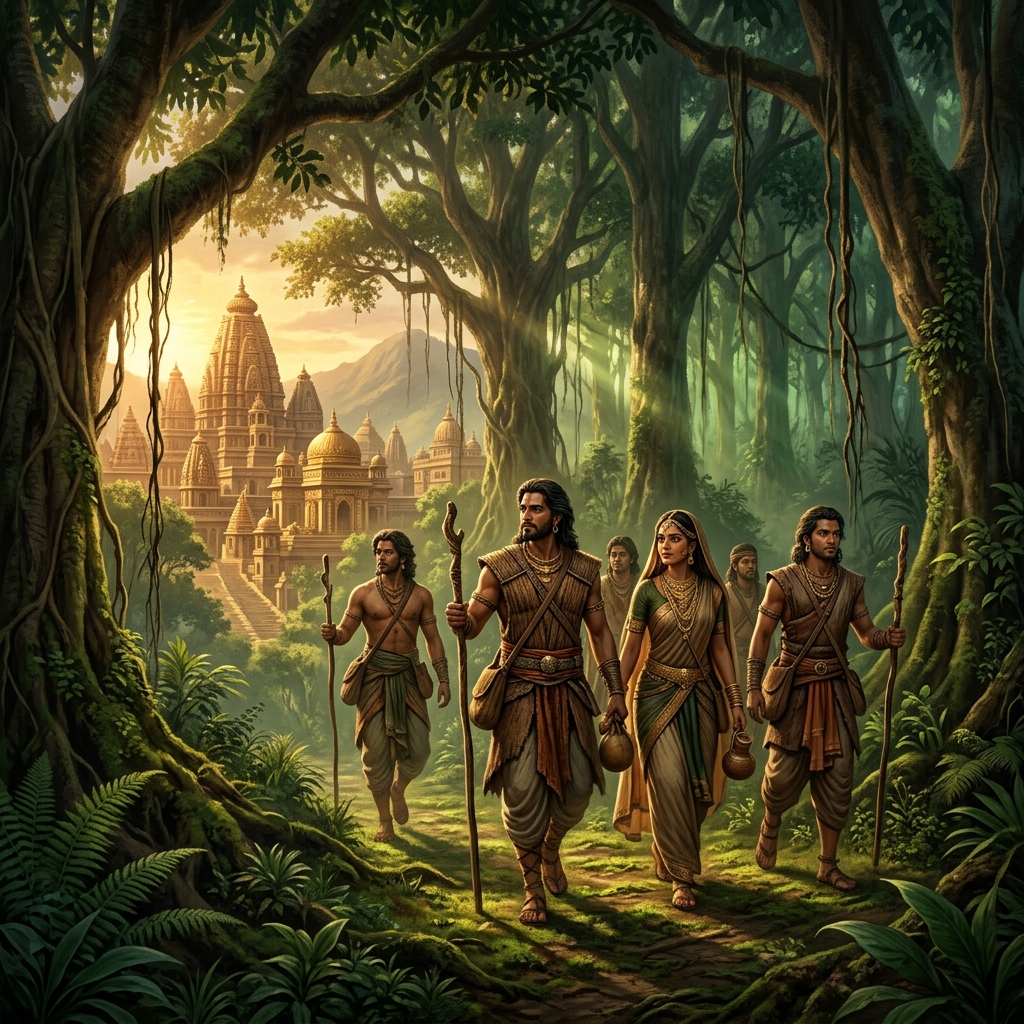
Adventures in the Forest
Twelve Years of Pandava Exile
Into Kamyaka, and a Demon at the Threshold
On the morning after the dice game, the Pandavas walked out of Hastinapura. They wore the dark deerskin of exiles, the garb of men who have lost everything but their oaths. Draupadi walked behind them, her unwashed hair still falling loose as she had vowed it would remain until she could bind it again with hands wet from Dushasana's blood. The road to the western forests was long. Townsmen along the route lined the way in tears, and old Brahmins who had served the court spat curses at the dice that had ruined the throne of Bharata.
They settled at last in the Kamyaka forest, on the bank of the Saraswati. They built simple huts of woven branches; they ate roots and wild fruit; they spoke little in those first weeks, each brother nursing a private wound. Brahmins followed them into exile - a great train of them, for sages preferred the company of the just to the company of the comfortable - and the Pandavas, though they had no kingdom to feed them, took the burden of providing for the sages upon themselves. Yudhishthira would later receive from Surya the Akshayapatra, the inexhaustible vessel, so that Draupadi might feed every guest who came.
It was at the very edge of Kamyaka, before they had even reached their chosen ground, that they first encountered Kirmira. He was the brother of the demon Bakasura whom Bhima had killed at Ekachakra years before, and the friend of Hidimba whom Bhima had also slain. Kirmira had been waiting in this stretch of forest, feeding on travelers, and his spies had told him that the sons of Pandu were coming his way.
He appeared at twilight across their path, blocking the road. He was ten cubits tall, his hair standing on end like a forest fire, his mouth red with the blood of his last kill, his eyes like two coals. He shouted his lineage and his vow of vengeance, and the Brahmins in the Pandavas' train scattered into the trees. The brothers reached for their weapons, but Bhima held up his hand.
"This one is mine," he said quietly. "Bakasura was my fight. Hidimba was my fight. So is this brother of theirs."
Bhima uprooted a great tree to use as a club, and Kirmira tore up another, and the two giants met in the dusk. They fought as wrestlers fight, with locked arms and driven knees and the whole weight of their bodies, and where they fell the trees split and the ground shook. The struggle lasted long into the night. At the end Bhima caught the demon, lifted him whirling over his head, and broke him against the earth, then snapped his neck with his bare hands. He flung the body aside and walked back to his family, bleeding and smiling, and asked Draupadi for water. The road into Kamyaka was open. Their exile had begun in blood, and it would not be the last.
Life Among the Sages
For a season Kamyaka was quiet, and the Pandavas learned the slow rhythm of forest life. They rose before dawn to bathe in the Saraswati and to make their offerings to the fire. The brothers hunted deer for the sages and for themselves; Draupadi cooked and tended the camp and never once let her bearing fall below that of a queen, though she lived now in a hut of leaves. The priest Dhaumya, who had followed them out of the city, kept the household's rites alive, chanting the morning and evening prayers as though they still stood in the great hall at Indraprastha.
In the evenings the rishis gathered around the Pandava fire, and the forest filled with old stories. They spoke of kings who had suffered and risen, of Nala and Damayanti, of Rama exiled into a different forest in an older age. Yudhishthira drank in these tales the way a thirsty man drinks, for in them he searched for the patience he needed. "Time turns," the sages told him. "What is taken is also returned. Hold to your dharma and the wheel will come back around."
But peace in the forest sat lightly on the brothers' shoulders. Bhima chafed and growled by the fire. "We sit and chew roots," he would say, "while Duryodhana wears our crown and our cousins laugh in our halls. Give the word, brother, and I will end this exile tonight with my two hands." And Yudhishthira would answer him always the same way, gently and immovably: "I gave my word before witnesses. A man who breaks his word is poorer than a man who loses a kingdom. We will wait the full term, all thirteen years, and then we will ask for what is ours, and if it is refused, then you may use your hands."
Draupadi too burned. She would sit with her loose hair and remind them all, without raising her voice, of the assembly hall and the laughter and the hand that had dragged her by the hair. She was the keeper of their anger when Yudhishthira's calm threatened to let it cool. Between the king's patience and the queen's fury, the brothers held their balance, and the years began their slow passage. Krishna came once to that forest camp, having heard only late of the dice game, and wept to see them so reduced, and swore that the wrong done to Draupadi would be repaid in full. His coming lifted them. After he left, the forest seemed darker, but they were no longer alone in the world.
The Sage With Painful News
One evening the sage Narada came to the Pandava camp in Kamyaka. He was the great traveler among the rishis - he carried news as bees carry pollen, from heaven to earth and back, never quite resting in any place. He sat by their fire and ate the wild rice Draupadi had cooked and praised it as if it were the food of a coronation feast.
Then his face grew grave, and he spoke. "I bring word from Hastinapura. Duryodhana cannot enjoy his throne while you live. He grows restless, and his counselors feed his pride. Worse than this: Karna has sworn an oath, sworn it at the dice game and not forgotten it. He will not wash his feet, will not drink wine, will refuse no man any boon he asks, until he has killed Arjuna in battle. He is gathering weapons. He is doing penance to the gods and to his teachers. He grows in power day by day. You must know this."
Arjuna heard the news without expression, but a hardness came into his eyes. "Then I must gather weapons too," he said at last. "Mortal arrows will not be enough when that day comes. Brother Yudhishthira, I have been thinking on this through many nights. Indra is my father. The divine weapons of heaven are mine to ask for if only I go and ask. Let me go now, while we have the years. Let me earn them. Twelve years is long enough to do this, and I cannot sit by the fire knowing Karna sharpens his arrows for me."
Yudhishthira looked long into the flames. He knew what the parting would cost them all, knew that to send Arjuna north was to send away their strongest arm and their dearest brother. But he also knew that the war was coming, and that they must be ready, and that no son of Pandu could meet the gods' weapons without weapons of his own.
"Go," he said. "Find the gates of the gods. Come back stronger than I can imagine. We will hold the forest, and we will wait." Draupadi said nothing, but she touched Arjuna's hand, and her eyes told him to return. That night Dhaumya taught Arjuna a secret science of memory and concentration, so that he might hold in his mind everything the gods would teach him. And in the gray before dawn, Arjuna took up his bow Gandiva, bowed to his brothers, walked once around Yudhishthira, and turned his face to the north and the high mountains where no road went.
The Penance on the Mountain
Arjuna walked north for many days. He passed the foothills where villages still clung to the slopes, then the high pastures where shepherds drove their flocks in summer, and at last he climbed into a region of snow and silence where no one lived and no birds flew. The gods sent an old ascetic to test him on the way, who tried to turn him back from the path; Arjuna answered every challenge with such resolve that the ascetic, well pleased, blessed him and revealed himself as a friend of heaven.
He found at last a clearing high on the slopes of Indrakila, where a small river was born from the melting ice, and there he sat down to do penance. He held his bow Gandiva across his knees. In the first month he ate fruit fallen from the trees, eating once in three nights. In the second month he ate only withered leaves. In the third he ate nothing but air, and lived on the cold and on the strength of his will. He stood on the tips of his toes, his arms raised, his eyes fixed on the sun, motionless as a dead tree.
So terrible grew the heat of his austerity that the very mountain seemed to glow, and the sages who lived in the lower valleys grew frightened. They climbed up to the throne of Indra in heaven and complained: "A mortal on the mountain burns the three worlds with his penance. We do not know what boon he means to seize, but his fire scorches us even here."
Indra knew very well who the mortal was, for Arjuna was his own son. But the King of the Gods would not give the celestial weapons to anyone who had not first proven himself against the highest of all. So he sent word down the mountain, and he arranged a test, and he went himself to speak with the great Lord Shiva, who dwelt upon the snows. The forest around Arjuna had grown strange and charged, the way the air grows heavy before a storm. He did not break his concentration. He waited, half god and half man, thin as a reed and hard as iron, for whatever heaven would send against him.
The Hunter and the Pashupata
On the day his penance came to its peak, a demon named Muka took the shape of a great wild boar and rushed at Arjuna, meaning to gore him as he stood in meditation. Arjuna, breaking his stillness, snatched up Gandiva and bent it to fire. But at the same instant, from the other side of the clearing, came a mountain hunter, broad and dark, dressed in rough skins, with a band of fierce followers behind him. The hunter, too, had his bow drawn at the boar.
Both arrows struck at once. The boar fell dead between them, and resumed its true demon shape as it died.
"That was my kill," called the hunter. "You shot at a beast I had already marked. Leave it."
"My arrow struck first," Arjuna answered, his blood still high. "The kill is mine by right of the bow."
They argued, and the argument hardened, and at last it became a duel. Arjuna loosed a storm of arrows, the same arrows that had emptied whole armies, and they vanished into the hunter's body and came out the other side leaving no wound at all. He shot until his two great inexhaustible quivers ran dry, and the hunter only laughed and asked if that was all. Arjuna seized Gandiva by its tip to swing it as a club; the hunter wrenched the divine bow from his grip as a man takes a stick from a child. They wrestled, body to body, and the hunter threw Arjuna down and crushed him until his senses faded and his body was beaten almost to ruin.
Bleeding, half-conscious, beaten as he had never in his life been beaten, Arjuna understood at last that this was no mortal hunter. He gathered a little clay and shaped a rough Shiva-linga, the only act of worship left to him, and laid upon it a garland of forest flowers in homage to the Lord. And the garland, in that instant, appeared instead around the neck of the hunter who stood before him.
Arjuna looked up. The dark hunter's body shimmered and dissolved, and in his place stood Shiva himself - three-eyed, blue-throated, the crescent moon caught in his matted hair, the goddess Parvati at his side. Arjuna fell at his feet.
"Forgive me, Lord," he whispered. "I struck at you. I did not see."
"You fought a god to a standstill and would not yield," Shiva said, and his voice was kind. "And at the end, beaten, you knelt and worshiped. That is the heart I wished to see in you. Rise, Arjuna. I give you the Pashupatastra - my own weapon, the weapon that can unmake the worlds. No god, no demon, no mortal can stand against it. But use it only when nothing else can save you, and never against a lesser foe, for it would destroy the universe entire." Shiva placed his hand on Arjuna's brow, and the knowledge of the dread weapon - its mantra, its summoning, its withdrawal - entered him as water enters dry cloth. Then the Lord and his consort vanished into the snow, and Arjuna sat alone on the high mountain, healed, and trembling with a power he was not yet sure he wanted to hold.
Arjuna in the City of the Gods
When Shiva had gone, the Guardians of the four directions came to Arjuna upon the mountain. Yama of the south, Varuna of the west, Kubera of the north, and Indra of the east each appeared in glory and each bestowed upon him their own weapon - the rod of death, the noose of waters, the wealth-bringing power, the thunderbolt's edge. Then a chariot of light came down the sky, drawn by tawny horses and driven by Matali, Indra's own charioteer, and Arjuna was lifted up from the world of men and carried to Amaravati, the celestial city of his father.
The gods rose to greet him. They set him upon half of Indra's own throne. For five years Arjuna dwelt in heaven, and the King of the Gods gave him the divine weapons one by one and taught him their use and their recall: the brahmastra, the agneyastra of fire, the varunastra of water, the vayavyastra of wind, weapons that obeyed thought and mantra and could turn the tide of any war. Arjuna mastered them all, for Dhaumya's secret science held them firm in his mind.
He learned more than war. The celestial musician Chitrasena taught him song and dance and the playing of instruments, skills that seemed useless to a warrior but that would one day save his life. For when the apsara Urvashi, the loveliest of the dancers of heaven, came to him one night with love in her eyes, Arjuna refused her gently, saying that she had been wife to Pururavas, his own ancestor, and was therefore a mother to him. Urvashi, scorned and stung, cursed him: he would live one year of his life as a eunuch, a dancer among women, his manhood lost. Indra softened the curse, declaring that Arjuna might choose the year himself - and so the curse became a gift, for in the thirteenth year of exile it would hide the greatest archer of the age, in skirts and bangles, where no spy of Duryodhana could find him.
Indra had one more task for his son. The demons called the Nivatakavachas and the Kalakeyas, dwelling in the depths of the ocean and in the floating city of Hiranyapura, had grown too strong for the gods to subdue. Arjuna mounted Indra's chariot and went against them, and with the celestial weapons he had been given he destroyed their armies and broke their sky-city and slew their thousands. The gods, who had failed where a mortal succeeded, honored him above all men. And when the five years were complete and his training done, Matali drove the chariot of light down the long sky and set Arjuna once more at the edge of the world of men, near the slopes of Gandhamadana, his hands now full of the weapons that would decide the war.
Grief in the Forest, and a Pilgrimage
While Arjuna learned the weapons of heaven, the years in the forest hung heavy on those he had left behind. The brothers grieved his absence as men grieve a death, for they did not know when or whether he would return. Yudhishthira would fall silent in the middle of a meal, thinking of the brother walking somewhere in the cold mountains. Bhima paced. Draupadi, who had been carried off and shamed and made to dwell in a hut of leaves, felt his absence sharpest of all, for Arjuna had been her dearest, and now even his shadow was gone from the camp.
Kamyaka itself grew unbearable to them without him, and they could not rest. The great sage Narada and the divine seer who guided them advised a pilgrimage: let them walk the sacred fords and tirthas of the whole earth, and so wear away the years and earn merit, and perhaps meet Arjuna again at the appointed place in the north. So the sage Lomasha came to lead them, sent by Indra himself with word that Arjuna was safe and learning the weapons of heaven, and would meet them in time.
They set out, the four brothers and Draupadi and their train of Brahmins, and they walked across the breadth of the land. They bathed at Pushkara where Brahma had made the world, and at Prabhasa where the western sea drank the desert, and at the source of the Ganga, and at countless lesser fords whose waters washed away sin. At each holy place Lomasha told them the old story that hung upon it - of Agastya who drank the ocean, of Rishyasringa who brought the rain, of the kings and rishis of long ago who had suffered and triumphed. The road was hard. Draupadi, unused to walking, grew weary, and once fainted on a steep mountain path, and Bhima carried her, and when the way was too rough even for him, Ghatotkacha his demon son was summoned and bore them all swiftly through the high passes on his broad shoulders. So they came at last toward Gandhamadana and the kingdom of Kubera in the far north, drawing near to the place where they would wait for Arjuna's return. The pilgrimage had taken the sting from their grief, but not the longing, and every traveler they met on the road they asked: have you seen a tall archer walking north?
Bhima and the Flowers of Heaven
In the high meadows below Gandhamadana, near the slopes that climbed toward the city of Kubera, a wind came down one day off the mountain and carried with it a flower - a saugandhika, a celestial lotus of a thousand petals, golden and fragrant beyond anything that grew in the world of men. It fell at Draupadi's feet, and she lifted it and breathed its scent, and her heart was caught.
"Bhima," she said, for he was nearest and dearest in such things, "bring me more of these. The wind carried this one a long way. Somewhere up there grows a whole pool of them. Bring me an armful, that I may carry their beauty back to our poor camp."
Bhima took up his club and went up the mountain alone, glad of an errand that asked for strength. He crashed through the forest, frightening the elephants and the lions out of his path, until he came to a stretch of plantain trees where an old monkey lay across the narrow road, its long tail thrown carelessly over the path, blocking his way.
"Move aside, monkey," Bhima said, "or I will step over you." The monkey, lazy and amused, said it was too old and weak to move, and bid Bhima simply lift its tail and toss it from the path. Bhima reached down with one hand to fling the tail aside - and could not move it. He gripped with both hands and put his whole back into it, the strength that had broken Kirmira and Jatasura, and the tail would not stir a hair's breadth. Sweating, astonished, Bhima at last understood that he stood before no ordinary creature, and he asked humbly who this was.
It was Hanuman, the son of the wind, the same wind that had fathered Bhima - so the two were brothers. Hanuman, the deathless servant of Rama from the age before, had taken this shape to humble Bhima's pride a little and to bless him. He embraced Bhima, granted him a boon that his strength would only grow, and promised that in the great war to come he would sit upon Arjuna's banner and roar to terrify the foe. Then he told Bhima the way to the lake of the saugandhika lotuses, guarded by the rakshasas of Kubera. Bhima went on, found the pool shining among the rocks, and when the guardian demons forbade him to pluck the flowers, he fought and scattered them and filled his arms with the celestial lotuses. He carried them down the mountain to Draupadi, who buried her face in their golden light, and for that one evening the grief of the forest was forgotten.
A King of the Gods in a Serpent's Coils
Not long after, in the same high country near Gandhamadana, Yudhishthira and Bhima walked together into a deep and sun-warmed valley, and there a great python lay coiled across a ledge of rock. It was an enormous serpent, golden-scaled, larger than any beast they had seen. As Bhima passed, the python uncoiled with terrible speed and seized him, wrapping him in folds he could not break. Bhima, whose strength had thrown demons and uprooted trees, strained against the coils and felt his power drain away as if the serpent drank it. He could not move.
Yudhishthira came running and stopped at the edge of the ledge. The python spoke, in a voice calm and old and weary. "Do not fear, Yudhishthira. I will not eat your brother, nor will I release him, unless you answer what I ask. I am Nahusha. Once I was a king of the earth, and so great grew my merit that the gods raised me to be their king when Indra hid himself in shame. But power made me proud. I had the seven sages carry my palanquin, and I kicked the sage Agastya in my arrogance, and his curse cast me down into this serpent's body to crawl the earth for an age. I was told I would be freed only when a man wise enough to answer my questions came to this valley."
"Ask, then," said Yudhishthira, "and I will answer as truly as I am able. But I beg you - whether I succeed or fail, do not harm a brother who has done you no wrong."
The python asked his questions, and they were not riddles of cleverness but the deepest questions of dharma. What makes a man a Brahmin - birth or conduct? What is the highest good? What is the soul, and what is its fate? Yudhishthira answered each one in his quiet, exact way, saying that conduct and not birth alone makes the true Brahmin, that truthfulness is the highest virtue, that the soul is neither slain nor born. He answered as one who had spent twelve years in the forest doing nothing but learning these very things from the sages.
Nahusha listened, and at the last answer he knew that the man the curse had waited for had come. The coils slid away from Bhima, who sat up gasping and rubbing his crushed ribs. The serpent's long body shimmered and rose into the air, and where it had been there stood a being of light, freed after his long penance in scales. Nahusha blessed the brothers and ascended to heaven, and Yudhishthira had won his brother's life with nothing but truth.
Reunion, and the Demon Jatasura
At last, on the slopes of Gandhamadana where they had waited and prayed, the brothers heard a sound like the wing-beat of a great bird, and the chariot of Indra came down out of the sky in a blaze of light. Arjuna stepped from it. Five years had passed since he climbed away from Kamyaka, and now he came back crowned with the favor of the gods, the Pashupata and the brahmastra and a hundred celestial weapons locked in his memory. His brothers ran to him and embraced him and wept, and Draupadi's long grief broke at last into joy. Yudhishthira held him a long time and said only, "Now we are whole again. Now I am not afraid of the war."
They lived on in that high country for a time, content, and Arjuna told them of Shiva on the mountain and of the city of the gods, and they told him of Bhima and the lotuses and of Nahusha freed from his curse. But the forest was never long at peace with the Pandavas.
One day a strange and learned Brahmin appeared at their camp and offered, with great humility, to be of service. Because he seemed a man of the books and the rites, the brothers welcomed him and trusted him. He waited, watching, until a day came when Arjuna was away and Bhima too had gone hunting, and only the wounded and the unwary were close at hand. Then the Brahmin's holy disguise fell from him like a cloak. He was a rakshasa named Jatasura, who had hidden among them for just this hour. He seized Yudhishthira and Nakula and Sahadeva and Draupadi all at once, snatched up their weapons too so they could not arm themselves, and ran with them toward the wilderness, meaning to carry Draupadi off and destroy the line of Pandu in one stroke.
But Sahadeva twisted free of his grip and cried out, and Yudhishthira, even as he was carried, spoke calmly to the demon, shaming him and slowing him with words, buying the precious moments they needed. Bhima, returning from the hunt, heard the shout and saw the trail and came on like a storm. He overtook Jatasura in a valley and roared his challenge, and the demon, forced to set down his captives and fight, turned to face him. The two crashed together. It was a hard fight, for Jatasura was strong and desperate, but Bhima was Bhima. He battered the demon down, lifted him, and dashed him against the rocks, then tore off his head and flung it aside. He freed his family and gathered up the stolen weapons. Once more the forest had tested them, and once more Bhima's arms had answered.
The Insolence of Jayadratha
The Pandavas came down at length from the mountains and returned to the lower forests, dwelling again in Kamyaka and in the Dvaita wood. The wandering years had hardened them and taught them, but they had not made the world any kinder.
One afternoon the brothers all went out together to hunt, leaving Draupadi alone at the hut with only the priest Dhaumya nearby. While they were gone, Jayadratha, the king of Sindhu, came riding through the forest with a great retinue. He was the husband of Dushala, the one daughter of Dhritarashtra and Gandhari, and so a brother-in-law of the Kauravas and a kinsman by marriage to the Pandavas themselves. He was on his way to the kingdom of Shalva to seek a bride, and as his chariots passed the Pandava hut he caught sight of Draupadi standing in the doorway - and even in deerskin, even with her hair unbound and her face worn by exile, her beauty stopped him cold.
He sent a companion to learn who she was, and when he heard that this was the famed Draupadi, wife of the five Pandavas, his pride and his lust got the better of his judgment. He went to her himself and spoke with insolence, telling her to leave her wretched exiles and beggared husbands and come with him to be a queen in a real palace. Draupadi answered him with cold scorn, reminding him of who her husbands were and what they would do to a man who laid hands on her. But Jayadratha would not be refused. He seized her, forced her struggling into his chariot, and drove off into the forest, certain that by the time the Pandavas returned he would be far away.
Dhaumya ran after the chariot on foot, calling out, and a serving woman fled to find the brothers. When the Pandavas came back to the empty hut and learned what had happened, their faces went still and cold. They took up their bows and followed the chariot tracks at a run, and they did not lose the trail.
The Branding of Jayadratha, and the Years Turn
Draupadi, jolting in the captured chariot, did not weep and did not break. She kept her dignity and kept her wits, and she spoke to Jayadratha the whole way, warning him of the doom riding behind him. "My husbands are coming," she told him. "Arjuna alone could shatter your whole escort. Bhima will tear you apart with his hands. You would do better to set me down and run while you still can." Her words frightened his soldiers, and they slowed his flight.
The Pandavas overtook the chariot before the day was out. Arjuna and his brothers fell upon Jayadratha's escort and scattered it like dry leaves; the soldiers of Sindhu fled or fell. Jayadratha, seeing his men destroyed, abandoned Draupadi and ran for the trees on foot. Bhima ran him down. He caught the king of Sindhu, threw him to the earth, and would have crushed the life from him then and there, his great hands already at the man's throat.
But Yudhishthira stayed him, and so did Draupadi, though her own honor had been wronged. "He is Dushala's husband," Yudhishthira said. "If we kill him, our sister is widowed, and Gandhari, who has shown us kindness, is wounded again. Let him live - but let him not go unmarked."
So Bhima did not kill him. Instead he beat him into submission, then took his knife and shaved the king's head, leaving five tufts of hair standing like a brand of shame, so that every man who saw him would know him for a coward and a thief of women. He bound him and dragged him before Yudhishthira, who made the king of Sindhu declare himself a slave of the Pandavas - and then, in mercy, set him free. Jayadratha crawled away humiliated, his head marked, his rage turned to ice. He went straightaway to do fierce penance to Lord Shiva, and won the boon that one day he would hold back four of the five Pandavas from the field - a boon that, on the day they slew Abhimanyu in the chakravyuha, would cost the Pandavas dearly and cost Jayadratha his own head at Arjuna's hands.
The forest years ran on toward their end. The Pandavas had killed Kirmira and Jatasura, freed Nahusha with the truth, won the weapons of heaven, gathered the lotuses of Kubera, and walked the sacred fords of the whole earth. They had been tested by demons and gods and kinsmen, and they had endured. Twelve years had passed in the wilderness. Lean now, and lined, and wiser than the proud princes who had walked out of Hastinapura, they prepared for the thirteenth year - the year of disguise, when they would lay down their names and their weapons and hide in plain sight at the court of Virata, and wait for the war that all their forest hardships had been preparing them to win.
Dharma Lesson
Exile is not pause, but training. The Pandavas spent twelve years gathering what they could not have gathered as kings: the divine weapons that Arjuna brought from heaven, the patience that Yudhishthira earned at the lake-side, the small kindnesses they could not have shown the sages had they been emperors. A forest can be a forge.