Thirteen Years of Fire
The exile teaches that suffering, accepted with dignity and used as a forge, transforms weakness into strength.
The House of Lac
Before the dice game, before the exile, before the war - there was a house designed to burn.
Duryodhana's first attempt to murder his cousins was not subtle. He built a palace in Varanavata - a beautiful, lavish structure with spacious halls and perfumed gardens - and invited the Pandavas to live there. The palace was made entirely of lac - a resin that was highly flammable, coated over wood and straw, disguised with plaster and paint. One spark, and the entire structure would become an inferno.
The Pandavas knew.
Vidura, the wise uncle who served as the Pandavas' secret guardian within the Kaurava court, had warned Yudhishthira in a coded message: "The one who knows the ways of fire survives. The way out is not through the door but through the ground."
Yudhishthira understood. While seemingly living in comfort and gratitude, the Pandavas secretly excavated a tunnel beneath the palace - working at night, removing soil in small amounts, disguising the entrance, preparing an escape route that Duryodhana's spies would never discover.
Purochana - the architect assigned by Duryodhana to manage the murder - was the man who would ensure the fire started at the right moment. He lived in the palace grounds, watching, waiting for the signal.
Bhima gave the signal first.
On a night when a festival had gathered the entire household in celebration, when Purochana had drunk deeply and slept soundly, Bhima set the fire himself. He fed the flames with the lac and resin that Duryodhana had so thoughtfully provided, then carried his mother Kunti on his back, gathered his brothers, and led them through the tunnel into the forest.
Behind them, the palace burned.
Purochana died in the fire he had planned for others - a symmetry that the Mahabharata presents without comment but with unmistakable satisfaction.
The Pandavas were presumed dead. Hastinapura mourned (or pretended to). Duryodhana's celebration was private but thorough.
And in the darkness of the forest, five brothers and their mother walked through the night - homeless, hunted, but alive.
"We will return," Yudhishthira whispered to the trees, to the stars, to the silent earth. "When we return, they will wish they had let us burn."
He did not know, then, just how prophetic those words would be.
Draupadi's Swayamvara
The Pandavas wandered the forests disguised as Brahmins - five princes in beggar's robes, hiding from an empire that wanted them dead. They performed rituals, begged for food, and waited for an opportunity that would announce their survival to the world.
That opportunity came in the form of a bow.
King Drupada of Panchala had organized a swayamvara - a bridegroom contest - for his daughter Draupadi, the most beautiful woman in the world. Draupadi had been born from a sacrificial fire, fully grown, dark-skinned and blazing with an inner radiance that made men forget to breathe. Drupada was using her marriage as a political tool - the swayamvara was designed so that only the greatest archer alive could win her.
The challenge: string a legendary bow - a massive, divine weapon that most warriors could barely lift - and shoot five arrows through the eye of a golden fish mounted on a revolving pole, using only the fish's reflection in a pool of water below.
Kings and princes came from every corner of Bharatavarsha. They came with armies and retinues, with golden chariots and mountains of bride-gifts. One by one, they attempted the challenge. One by one, they failed. Some could not lift the bow. Others could not string it. A few managed to string it but could not aim - the spinning fish, the wavering reflection, the pressure of a thousand watching eyes defeating their skill.
Karna stepped forward. The crowd held its breath. Here was a warrior who could match anyone - Draupadi spoke. "I will not marry a Suta-putra."
The words were sharp as a blade. Whether she truly knew Karna's worth and rejected him on principle, or was merely repeating the prejudice of her caste-bound world, the Mahabharata leaves ambiguous. But the rejection wounded Karna deeply - another scar added to the collection he wore like invisible armor.
Then a slim young Brahmin rose from the back of the hall. He was simply dressed, unremarkable in appearance among the glittering assembly - but when he walked to the bow, something changed in the air.
Arjuna lifted the bow as easily as lifting a bamboo flute. He strung it in a single, fluid motion. He nocked five arrows simultaneously - and fired them through the eye of the spinning golden fish so precisely that they entered through the same hole, one after another, without widening it by a hair's breadth.
The hall erupted. Draupadi placed the garland of victory around the Brahmin's neck - and the Pandavas' cover was blown. Their survival was now public knowledge. The game had changed.
But the most extraordinary development came later, when Arjuna brought Draupadi home to the family's forest dwelling. "Mother," he called out, "look what I've won!"
Kunti, without looking up from her cooking, said what she always said: "Whatever you've won, share it equally among your brothers."
And so, by the unbreakable law of a mother's word, Draupadi became the wife of all five Pandava brothers - a polyandrous marriage that would become one of the most debated aspects of the entire epic. One woman. Five husbands. An arrangement that violated every social norm but was sanctioned by fate, by a mother's inadvertent command, and by the acceptance of all parties.
The Jeweled Throne Lost
The Pandavas returned from their sojourn in the forests stronger than ever. Their marriage to Draupadi had brought them the powerful alliance of Panchala. Their friendship with Krishna had brought them the support of the Yadava confederation. They were no longer five hunted princes - they were a legitimate political force.
Dhritarashtra, pressured by Vidura and the court elders, was forced to acknowledge the Pandavas' survival and their rights. A compromise was reached: the kingdom would be divided. The Kauravas would keep Hastinapura - the ancient capital, the seat of power. The Pandavas would receive Khandavaprastha - a barren, forest-choked wasteland on the western bank of the Yamuna.
It was an insult disguised as generosity.
But the Pandavas transformed the insult into a miracle. With the help of the architect-god Vishwakarma, summoned by Krishna, they built Indraprastha - a city so magnificent that it became the envy of every king on earth. Its halls were made of crystal so clear that visitors walked into walls, mistaking them for open space. Its floors were polished so perfectly that they looked like pools of water. Its gardens were filled with trees that bore fruit in every season, tended by celestial gardeners.
Yudhishthira performed the Rajasuya Yagna - the great imperial sacrifice that declared him emperor of all Bharatavarsha. Kings from every direction came to pay tribute. Gold flowed into Indraprastha like water into the sea. The Pandavas stood at the pinnacle of power - beloved by their people, feared by their enemies, blessed by the gods.
And Duryodhana came to visit.
He walked through the crystal halls and fell into a pool, mistaking the reflective floor for solid ground. Draupadi laughed - or the servants laughed - or someone laughed. The exact source of the laughter is debated. But Duryodhana heard it, and it burned into his soul.
"A blind man's son thinks the whole world is blind," someone said - or he imagined someone said.
Duryodhana returned to Hastinapura humiliated, envious, and consumed by a rage that would not rest until every trace of Pandava glory had been destroyed.
That rage led to Shakuni. Shakuni led to the dice. The dice led to exile. And exile led to war.
Everything - the entire catastrophe of the Mahabharata - can be traced to a moment of laughter in a crystal hall.
Into the Wilderness
तपसा विन्दते मर्यं तपसा विन्दते दिवम्
Tapasā vindate maryaṃ tapasā vindate divam
The terms of the exile were brutal. Twelve years in the forest, followed by one year of living incognito in a populated area. If they were discovered during the thirteenth year, the cycle would reset - another twelve years of forest, another year of hiding. An exile designed to be permanent, disguised as temporary.
The Pandavas walked out of Hastinapura in the clothes they wore, with nothing - no army, no treasury, no palace. Draupadi walked with them, her hair unbound, her eyes burning with a fury that twelve years in the wilderness would not diminish by a single degree.
The forest received them.
For twelve years, the Pandavas lived in the deep forests of central India - the Kamyaka, the Dwaita, the Dandaka - sleeping on leaves, eating roots and fruits, bathing in rivers, practicing austerities that would make ascetics weep.
But the exile was not merely suffering. It was transformation.
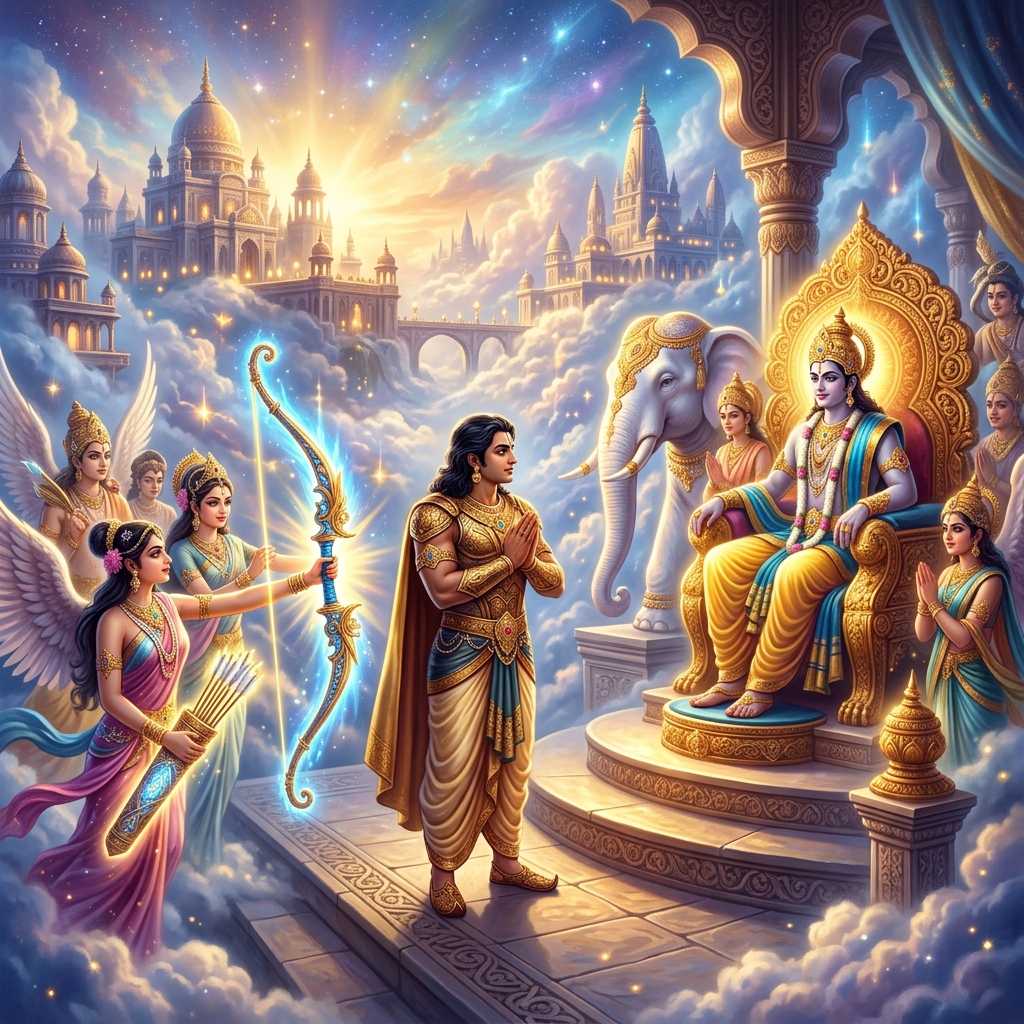
Arjuna departed on a solo pilgrimage that would last years. He traveled to the Himalayas, where he performed penances so severe that the gods themselves took notice. Shiva appeared to him, disguised as a tribal hunter - a test of Arjuna's humility and martial skill that ended with the god granting him the Pashupatastra, the most destructive weapon in existence.
From there, Arjuna traveled to Indra's heaven - Amaravati - where his divine father trained him in celestial warfare and gifted him divine weapons that no mortal had ever wielded. He spent five years in heaven, learning, growing, becoming the warrior who would one day duel Bhishma, Drona, and Karna.
Meanwhile, Bhima had his own adventures. He encountered the Rakshasa Hidimba, defeated her brother in single combat, and married her - producing Ghatotkacha, the half-demon son who would later play a pivotal role in the war. Bhima also traveled to the enchanted gardens of Kubera, fought Rakshasa armies, and discovered his own limitless strength through trials that would have killed any ordinary warrior.
Yudhishthira, Nakula, and Sahadeva stayed in the forest, protecting Draupadi, studying the scriptures, meeting sages and rishis who gave them knowledge and divine wisdom. They hosted Sage Vyasa himself, who told them stories of ancient kings and cosmic battles that mirrored their own struggles.
The forest years were the Pandavas' crucible. They entered as princes who had lost everything. They would emerge as warriors who had nothing left to lose - and that made them the most dangerous people in the world.
Arjuna's Penance
High in the Himalayas, where the air is thin enough to hear the thoughts of gods, Arjuna sat in meditation for months.
He ate nothing. He drank nothing but the moisture that condensed on mountain rocks. His body wasted away until he was more spirit than flesh - a skeleton of divine purpose wrapped in skin and silence. The forest animals gathered around him, sensing something cosmic in his stillness. Birds nested in his matted hair. Snow fell on his shoulders and did not melt.
The gods grew alarmed. Arjuna's penance was generating tapas - spiritual heat - so intense that it was disrupting the balance of the celestial realms. Rivers dried up in heaven. Celestial musicians forgot their songs. Even the throne of Indra trembled.
Shiva decided to test him.
The Lord of Destruction disguised himself as a Kirata - a tribal mountain hunter - and appeared before Arjuna at the same moment that a wild boar charged through the undergrowth. Both Arjuna and the Kirata shot the boar simultaneously.
"That is my kill," the hunter said, his eyes gleaming with supernatural intensity.
"It is mine," Arjuna replied, reaching for his Gandiva.
What followed was a duel between man and god - though Arjuna did not know it. They fought with arrows until Arjuna's quiver was empty. They fought with swords until both blades shattered. They fought hand-to-hand, wrestling on the mountain slopes with a ferocity that caused avalanches and sent tremors through the peaks.
Arjuna was losing. For the first time in his life, he faced an opponent he could not match. The tribal hunter was stronger than Bhima, faster than the wind, and impossible to wound. Every blow Arjuna landed seemed to be absorbed without effect.
In desperation, Arjuna created a garland of flowers and placed it as an offering before a small Shiva lingam nearby - a prayer to the god he worshipped above all others.
The garland appeared on the hunter's neck.
Arjuna understood. He fell to his knees.
"Mahadeva."
Shiva revealed his true form - the cosmic dancer, the destroyer of worlds, the three-eyed god whose third eye could reduce the universe to ash. But his smile, in that moment, was the gentlest thing in creation.
"You have passed every test, Arjuna. Your will is unbreakable. Your courage is absolute. Your devotion is pure. Take this - "
He gave Arjuna the Pashupatastra - the most terrible weapon in existence, capable of destroying worlds. It was to be used only once, only in the most extreme necessity, and never against those weaker than the wielder.
"Go now," Shiva said. "Your exile will end. Your war will come. And when it does, remember: the greatest weapon is not the one you carry in your quiver. It is the one you carry in your heart. Courage is the Pashupatastra that never misses."
The other gods followed. Indra came and took Arjuna to heaven. Varuna gifted him the Varunastra. Agni the Agneyastra. Vayu the Vayavyastra. Each god, moved by Arjuna's devotion, poured their power into him until he was, quite literally, a walking arsenal of divine destruction.
The boy who had dropped his bow in horror before the tournament had become the most heavily armed warrior in the history of the universe.
Draupadi's Unbound Hair
For twelve years, Draupadi did not bind her hair.
This was not vanity. It was a vow - the most visible, most public, most defiant vow of the entire Mahabharata. When Dushasana had dragged her by her hair in the sabha of Hastinapura, Draupadi had sworn that she would not tie her hair again until she had washed it in Dushasana's blood.
For twelve years in the forest, through rain and sun, through dust storms and river crossings, through nights of sleeping on hard ground and days of walking through thorned undergrowth, Draupadi's hair fell loose around her shoulders - a banner of rage, a reminder to every Pandava of what had been done to her and what remained to be done.
She was the fire that kept the Pandavas' anger alive. When Yudhishthira spoke of forgiveness, of peaceful resolution, of dharmic acceptance of their fate, Draupadi's voice cut through his philosophy like a blade.
"Forgiveness?" she would say, her eyes blazing. "You speak of forgiveness while I remember being dragged by my hair before a court full of men who called themselves righteous? You speak of peace while I remember their hands reaching for my sari, while I remember your silence, while I remember every elder who sat and watched and said nothing?"
She was the conscience of the Pandavas - the living reminder that some wounds cannot be healed by time, some injustices cannot be balanced by patience, and some crimes demand a reckoning that no amount of prayer or philosophy can substitute.
The forest tested her beyond endurance. There was the incident with Jayadratha - the king of Sindhu who attempted to abduct her while the Pandavas were away hunting. Bhima and Arjuna pursued him and would have killed him, but Yudhishthira counseled mercy. Draupadi accepted the decision in silence, but her eyes spoke volumes.
There were the countless nights when she cooked for five warrior-princes and their mother with whatever the forest offered - grinding grain between stones, cooking on open fires, serving food in palm leaves. A queen who had feasted in crystal halls now crouched over campfires and served gruel to her husbands.
And through it all, her hair fell unbound.
"I held my tongue in the sabha when they stripped me," Draupadi once told Bhima during a night when the forest was dark and the fire was low. "I held my tongue because I was told that silence was a woman's greatest virtue. Never again. No woman should ever be silent when her dignity is stolen. My hair will bind itself when Dushasana's blood makes it wet. Not before."
The vow lasted thirteen years. When it was finally fulfilled - on the battlefield of Kurukshetra, when Bhima tore open Dushasana's chest and brought his blood to Draupadi - the moment was not triumphant. It was terrible. It was the culmination of thirteen years of rage, and the satisfaction it provided lasted only as long as the blood was warm.
She bound her hair. And then she wept - for what she had become, for what they all had become, for the price of justice in a world that had made it so expensive.
Yudhishthira's Test - The Yaksha Prashna
अहन्यहनि भूतानि गच्छन्तीह यमालयम्
Ahanyahani bhūtāni gacchantīha yamālayam
Toward the end of the twelve-year forest exile, the Pandavas encountered their most mysterious and profound challenge.
A deer had stolen the fire-sticks of a Brahmin - an essential tool for performing sacred rituals. The Pandavas pursued the deer through dense forest but could not catch it. Exhausted and desperately thirsty, they came upon a crystal-clear lake surrounded by trees heavy with fruit.
Nakula went to drink first. A voice - disembodied, deep, carrying the authority of something ancient and powerful - spoke from the lake:
"Do not drink this water until you have answered my questions. I am the Yaksha who guards this lake. Those who drink without answering will die."
Nakula, desperate with thirst, drank anyway. He collapsed, dead, by the water's edge.
Sahadeva went to find him. He found his twin's body. The voice repeated its warning. Sahadeva, refusing to believe in mystical voices when his brother lay dead and his own throat burned with thirst, drank. He too fell dead.
Arjuna followed. The greatest warrior in the world, who had received weapons from gods and dueled with Shiva himself, could not bring himself to take a voice in a lake seriously. He drank. He died.
Bhima - mighty Bhima, who had killed Rakshasas and wrestled elephants - met the same fate. He ignored the warning. He fell.
When Yudhishthira arrived and found all four brothers dead by the lake, his grief was beyond expression. But where his brothers had responded with disbelief and defiance, Yudhishthira responded with what had always been his greatest strength: humility.
"I will answer your questions," he told the invisible Yaksha.
What followed was an extraordinary philosophical dialogue - one of the most celebrated passages of the Mahabharata.
"What is heavier than the earth?" asked the Yaksha. "A mother's love," Yudhishthira replied.
"What is swifter than the wind?" "The mind."
"What is more numerous than grasses?" "Thoughts."
"What is the greatest wonder in the world?" And Yudhishthira gave perhaps the most famous answer in all of Indian philosophy: "Every day, men see others carried to the burning ground, yet they think: 'I shall not die.' What greater wonder can there be?"
Question after question - on dharma, on duty, on the nature of happiness, on the path to heaven - Yudhishthira answered with the accumulated wisdom of twelve years in the forest, years spent in the company of sages and in the crucible of suffering.
The Yaksha was satisfied. He revealed himself as Dharma - the god of righteousness, Yudhishthira's divine father. He offered to revive one of the four brothers.
"Revive Nakula," Yudhishthira said.
"Why not Bhima, whose strength you need? Why not Arjuna, whose skill is irreplaceable?"
"Because Kunti has lost enough. She has three sons living - Bhima, Arjuna, and me. Madri has none. Let Nakula live, so that both mothers have surviving children."
Dharma, overwhelmed by his son's perfect sense of justice, revived all four brothers.
The Yaksha Prashna was the final test of the exile - the proof that twelve years of suffering had not diminished Yudhishthira's character but had refined it to diamond hardness. The king who had lost everything at a dice table had, through patience and wisdom, become worthy of winning it back.
The Thirteenth Year - Virata's Kingdom
The thirteenth year was the most dangerous. If the Pandavas were discovered during their year of incognito living, the entire exile would reset. Twelve more years of forest. One more year of hiding. A never-ending cycle of punishment.
They chose the court of King Virata of Matsya - a small, unremarkable kingdom that would draw no one's attention.
The disguises were as masterful as they were humiliating.
Yudhishthira - the emperor who had performed the Rajasuya, whose court had dazzled visiting kings - became Kanka, a humble dice-playing Brahmin who served as Virata's companion and advisor. The irony of a man destroyed by dice now using dice as his disguise was lost on no one, least of all Yudhishthira himself.
Bhima - the mightiest warrior alive, whose appetite was legendary and whose strength could shatter mountains - became Ballava, a cook in Virata's kitchen. He kneaded dough, prepared feasts, and endured the sneers of kitchen servants who had no idea they were giving orders to a man who could have broken their spines with one hand.
Arjuna became Brihannala - a eunuch dance teacher in the royal women's quarters. This was perhaps the most painful disguise of all. The greatest archer in the world, the man blessed by Shiva and trained in heaven, taught dance steps to princesses and braided their hair. He had been cursed by the celestial nymph Urvashi to live as a eunuch for one year - a curse that now served as the perfect cover.
Nakula became Granthika, a horse trainer. Sahadeva became Tantipala, a cowherd. Both worked in menial positions that kept them out of sight but within the court's orbit.
And Draupadi - queen of Indraprastha, daughter of fire, wife of five warrior-kings - became Sairandhri, a hairdresser and attendant to Queen Sudeshna.
The humiliation was complete. Five kings and a queen, reduced to servants in a court that would have trembled before them if it knew who they were.
But the thirteenth year was not without danger.
Kichaka - Sudeshna's brother, the commander of Virata's army - saw Draupadi and was consumed by lust. He pursued her relentlessly - at first with flattery, then with threats, then with physical force. When he cornered her in a dance hall and kicked her before the entire court, Draupadi looked to Yudhishthira for help.
The Dharma King sat motionless. He could not reveal himself. To protect Draupadi openly would expose their identities and restart the exile. The math was cold and the choice was agonizing - one woman's safety against thirteen years of sacrifice.
Draupadi turned to the only Pandava who had never, not once, failed to act when she was in danger.
Bhima met Kichaka in the dance hall at midnight - at a meeting that Draupadi had arranged under the pretense of a romantic assignation. The commander of Virata's army walked into the darkness expecting a lover. He found a titan.
Bhima killed Kichaka with his bare hands, crushing him so completely that the warriors who found the body the next morning could not identify which limb was which.
The murder raised suspicions across the kingdom. Rumors flew. But the disguises held - barely - for the final months of the year.
The Warrior Revealed
The final test came in the last weeks of the thirteenth year.
Duryodhana, suspecting the Pandavas might be hiding in Virata's court, orchestrated a cattle raid on Matsya's borders. The attack was designed to flush out the Pandavas - if they were there, their warrior instincts would compel them to fight, and fighting would reveal their identities.
King Virata's army rode out to meet the Kauravas, accompanied by Yudhishthira, Bhima, Nakula, and Sahadeva in their disguised roles. But the main Kaurava attack struck from a different direction - from the side of the kingdom defended only by Prince Uttara.
Uttara was young, brave in speech, and terrified in practice. When he saw the Kaurava army - an actual army, with real warriors who wanted to kill him - he panicked and tried to flee.
His charioteer did not let him.
Brihannala - the eunuch dance teacher - took the reins of Uttara's chariot and drove it toward the enemy army.
"Stop! What are you doing?" Uttara screamed. "Those are Bhishma and Drona and Karna! We'll be killed!"
"Your Highness," said Brihannala, with a calm that seemed cosmically inappropriate, "I need you to do one thing. Drive to that tree at the edge of the battlefield. There is something I left there."
Hidden in the hollow of a shami tree, wrapped in cloth and protected by enchantments, were the weapons of the Pandavas - Gandiva, Bhima's mace, Yudhishthira's sword, Nakula's and Sahadeva's blades. They had been hidden there at the start of the thirteenth year.
Brihannala unwrapped Gandiva. And the moment the divine bow was in his hands, the disguise fell away like a costume at the end of a performance.
The eunuch dance teacher became Arjuna.
He stood in the chariot - tall, focused, the peacock-feather cap replaced with a warrior's diadem, the dance teacher's gentle hands now gripping the most powerful bow in creation.
The Kaurava army saw him. Bhishma recognized him first - the grandsire who knew every movement of every grandson. Then Drona. Then Karna. Then Duryodhana, whose face went white.
Arjuna fired the Sammohana Astra - the weapon of unconsciousness - and the entire Kaurava army fell into an enchanted sleep. He then systematically stripped the unconscious warriors of their outer garments, collecting their silks and finery as evidence of his victory.
The Kaurava raid was defeated by one man, one bow, and one arrow.
The thirteenth year was over. The exile was complete. The Pandavas had survived.
Prince Uttara, who had entered the battle as a terrified boy clinging to a chariot rail, returned to Virata's court with the wild-eyed look of someone who has been in the presence of something far beyond his understanding.
"Father," he told King Virata, "your cook is Bhima. Your horse trainer is a prince. Your dice-playing Brahmin is the emperor Yudhishthira. And my dance teacher just defeated the entire Kaurava army single-handedly."
Virata stared at the young men standing before him - their disguises gone, their true natures blazing like five suns - and did the only sensible thing.
He knelt.
The Road to Kurukshetra
धर्मे चार्थे च कामे च मोक्षे च भरतर्षभ
Dharme cārthe ca kāme ca mokṣe ca Bharatarṣabha
The exile was over. The Pandavas emerged from thirteen years of suffering transformed - harder, wiser, more dangerous than they had ever been. Now came the reckoning.
Yudhishthira sent his message to Hastinapura: "We have fulfilled the terms of the exile. Return our kingdom."
Duryodhana refused. Of course he refused. He had spent thirteen years building alliances, strengthening his army, preparing for the confrontation he knew was coming. To give back the kingdom now - after everything - was unthinkable.
"The Pandavas fulfilled nothing," Duryodhana argued. "They were recognized before the thirteenth year ended. The exile resets."
It was a lie, and everyone knew it was a lie, but lies had served Duryodhana well before.
Negotiations began - and failed. Embassy after embassy traveled between the Pandava camp and Hastinapura, carrying offers and counter-offers that grew increasingly desperate. Yudhishthira offered to accept just five towns instead of half the kingdom. Then five villages. Then five houses. Each concession was rejected.
Krishna himself went as the final ambassador - God incarnate serving as a messenger of peace, the cosmic irony of which was not lost on anyone. He offered terms so generous that even the Kaurava elders - Bhishma, Drona, Vidura - urged Duryodhana to accept.
"Not enough land to place the point of a needle."
Peace was dead. War was born.
The Pandavas summoned their allies. Armies began to march from every corner of Bharatavarsha - drawn by loyalty, by obligation, by the promise of glory, or simply by the gravitational pull of the greatest confrontation the world had ever seen.
The thirteen years of fire - the burning of the lac palace, the dicing away of a kingdom, the humiliation of a queen, twelve years of exile in the forest, one year of serving as menials in disguise - had been the crucible that forged weapons. The Pandavas who had left Hastinapura after the dice game were princes who had lost. The Pandavas who now marched toward Kurukshetra were warriors who could not be broken - because everything that could break had already been broken, and what remained was pure, tempered steel.
Draupadi bound her sari tight. Her hair still hung loose - the unbound banner of a vow unfulfilled. Somewhere on the battlefield of Kurukshetra, Dushasana's blood waited to fulfill its appointment with her hair.
The thirteen years of fire were over.
The eighteen days of destruction were about to begin.
Dharma Lesson
The exile teaches that suffering, accepted with dignity and used as a forge, transforms weakness into strength. The Pandavas who lost everything at the dice table were not destroyed by their loss - they were refined by it. Every humiliation, every hardship, every night spent sleeping on forest floors became fuel for the fire that would eventually consume the Kaurava empire. But the exile also asks uncomfortable questions about justice delayed. Is it dharmic to wait thirteen years for justice when injustice happens today? Draupadi's unbound hair is the epic's most powerful argument that patience without anger is merely submission. The Pandavas survived the exile because they carried two opposing forces within them: Yudhishthira's patience and Draupadi's rage, acceptance and defiance, forgiveness and the absolute refusal to forget. Both were necessary. Neither alone would have been sufficient.