The Quiet Twin Rides South
Of the four Pandava brothers who rode out to gather tribute for Yudhishthira's rajasuya, Sahadeva was given the south, a road that would prove less a march than a series of riddles. He was the quietest of the five, given more to listening than to boasting, and it was that temperament, more than any strength of arms, that the southern road would test hardest, again and again asking him to set aside the sword before it would yield anything worth carrying home.
His first great destination was Mahishmati on the Narmada, ruled by King Nila, a city whose walls had never fallen to any army that had come against them, though none of the chroniclers who told the tale in later years could say at first why. Sahadeva made camp outside the city and sent heralds ahead with the customary demand: tribute for the emperor's sacrifice, or battle, expecting the usual answer of gates barred and warriors mustered along the ramparts.
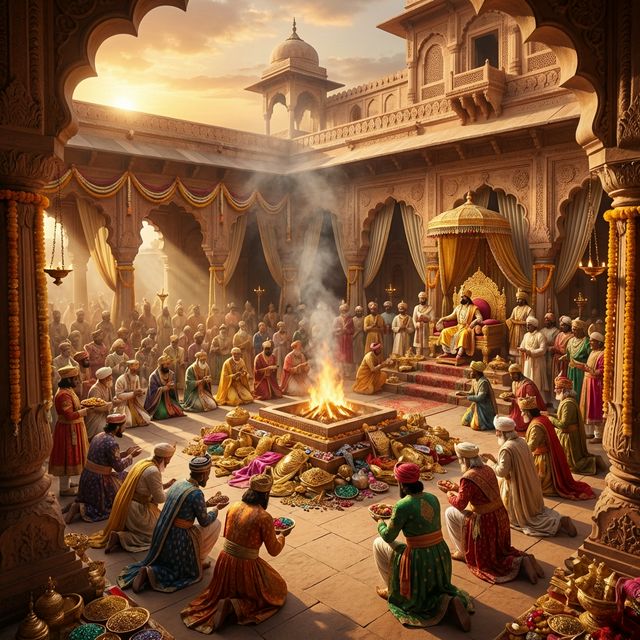
What came back was neither surrender nor an army. As Sahadeva's soldiers advanced at dawn, cook-fires and torches across the camp leaped up of their own accord, roaring far beyond any fuel that fed them, until the whole field seemed to catch and burn. Men who had marched through real battles without flinching broke and scattered from a fire that answered to no wind and no water thrown against it. Sahadeva reined in his own frightened horse and understood, watching the flames dance in shapes no ordinary blaze took, that Mahishmati was defended by no mortal general at all.
The Fire God's Walls
It was Agni himself who guarded Mahishmati, the priests of the city later told Sahadeva, for the fire god had long loved a woman of that place and had sworn her city would never fall while he burned in the world. No mace could break a wall defended by the god of fire, and no arrow, however blessed, would find purchase against flame that chose its own shape and hour.
Sahadeva did not order a second charge. He set down his weapons at the edge of the scorched field and sat instead in prayer, addressing the unseen god as one addresses an elder rather than an enemy. "I have not come to steal what love has promised," he said, when the fires at last quieted enough for a voice to carry over them. "I have come only for what King Nila can give freely, in honor of my brother's sacrifice, and I will take nothing that honor does not offer."
What prayer accomplished, iron never could have. The flames subsided, and King Nila himself came out from behind walls that had needed no further defending, moved as much by the humility of a general who had chosen supplication over a doomed assault as by any fear of what might follow if he refused. He gave Sahadeva tribute without further contest, gold and cattle and the goodwill of a kingdom that had turned away every army before this one not with strength but with the simple fact of being asked rather than commanded. Sahadeva left Mahishmati having learned, before his road south had properly begun, that some walls yield only to reverence.
Seven Days Among the Ape-Kings
South and west of Mahishmati lay Kishkindha, the forested realm the epic remembered as home to the ape-kings who had once helped Rama recover Sita from Lanka. Its rulers were no ordinary chieftains, quick with tricks and tests rather than open battle, and they received Sahadeva's approach with amusement more than alarm.
For seven days the ape-kings of that country neither fought him nor yielded to him, but circled his camp instead, appearing and vanishing among the trees, matching his soldiers in feats of strength and speed that left even hardened Kuru fighters bruised and laughing despite themselves. It was less a siege than a long and good-natured contest, each side testing what the other was made of before any tribute changed hands.
"You do not fight like men who mean to keep a war going," Sahadeva said on the seventh evening, when the ape-kings finally came forward openly to his fire rather than retreating into the trees at dusk as they had every night before. "Nor do I mean to. My brother asks only what Kishkindha can spare for his sacrifice, and I have watched enough of your strength this week to know you spare it because you choose to, not because I could take it."
The answer pleased them more than any threat would have. Kishkindha yielded its tribute not as a defeated kingdom but as an ally freely made, its rulers promising, and later sending, warriors of their own to stand among the guests at Yudhishthira's sacrifice, a friendship struck in seven days of testing that no battle could have earned so cleanly.
The Pandya and Chola Shores to Manalura
From Kishkindha's forests Sahadeva's road turned toward the sea, down through the long coastal kingdoms of the Pandyas and the Cholas, lands whose wealth lay less in fields than in the harbors that had traded with distant shores since before any Kuru genealogy remembered. Here at last the conquest ran closer to what Bhima and Nakula were finding on their own roads: kings who tested Sahadeva's army once, found it equal to their own, and settled their tribute rather than risk a longer war for a cause that was never truly theirs to lose.
He pressed on to Manalura, a southern port city where the coast narrowed and the sea itself seemed to gather the roads of many kingdoms into one crossing point. Ships bound for the island kingdoms further south rode at anchor there, and Sahadeva understood, standing on the shore, that his march by land had reached the edge of what land alone could carry him.
"There is water between here and the last kingdom on my road," he told his commanders, gazing south across the strait toward the shape of Lanka rising faint on the horizon. "An army that crosses uninvited crosses as a conqueror. I would rather cross as my brother's kinsman by old alliance, and be received as one." Manalura's own ruler, hearing the restraint in a general who had already shown he need not fight to win, gave his tribute freely and helped provision the envoys Sahadeva now made ready to send onward, by ship rather than by army, across the narrow sea.
Envoys to Lanka
Sahadeva did not carry his army across the strait to Lanka. He sent envoys instead, a handful of trusted men bearing gifts and a message rather than a demand, for Lanka was no ordinary conquest to be added to a tribute list. It was ruled by Vibhishana, brother of the rakshasa king Ravana whom Rama had slain in the age before this one, and Vibhishana himself had been raised to that throne only because he had chosen righteousness over blood loyalty, standing with Rama against his own kin.
The envoys found Lanka's ruler already disposed toward friendship. Vibhishana had never forgotten what alliance with the house that Rama's memory still touched could mean, nor the debt every king owed to a story where loyalty to dharma had cost a brother his throne and won him a better one. He received Sahadeva's message not as a summons from a stranger but as a courtesy from kin of a kind, and answered it with gifts that no army could have taken by force in equal measure: jewels drawn from Lanka's fabled hoards, sandalwood cut from groves the island alone possessed, sent freely and without a single soldier crossing the water to demand them.
When Sahadeva turned his column north again, his road complete, he carried home a tribute that told the whole shape of his march: gold pressed reluctantly from Mahishmati by prayer rather than by war, friendship won from Kishkindha by seven days of patient testing, and now Lanka's treasures given for a debt of honor two generations old. Of the four brothers who rode to the horizons for Yudhishthira's sake, none returned having drawn less blood, and none, the epic remembered, returned having proven more clearly that an emperor's true reach was measured in the loyalties he inspired rather than the walls his soldiers had broken.
Dharma Lesson
The quiet twin's road south shows that not every conquest is won by force, and the wisest general knows when to set down the sword and take up prayer or friendship instead. Where iron would only have burned Sahadeva along with the city, honor and patience won him what he came for. Strength restrained in the face of what it cannot rightly defeat is itself a form of the discernment his role among the Pandavas was known for.