A Sorrow That Asked for a Story
Deep in the years of exile, in the great forest where the Pandavas lived on roots and the kindness of sages, a heavier grief than hunger settled over Yudhishthira. Word had reached the brothers that Jayadratha, the king of the Sindhus, had carried off Draupadi by force from their hermitage while they were away, and though they had ridden him down and won her back and shamed him, the wound to their honor would not close. Yudhishthira sat by the evening fire with his head bowed.
"Is there any man," he asked at last, "more unfortunate than I am? A kingdom lost at dice, my brothers and my wife dragged through insult, and now even in the depths of the forest we are not left in peace. Tell me, holy one - has there ever lived a king whose fortune sank lower than mine, and who yet did not break?"
The sage who sat with them that night was Markandeya, the deathless rishi who had watched the ages of the world rise and fall like waves. He looked at Yudhishthira with the patience of one who has seen ten thousand sorrows, and he smiled.
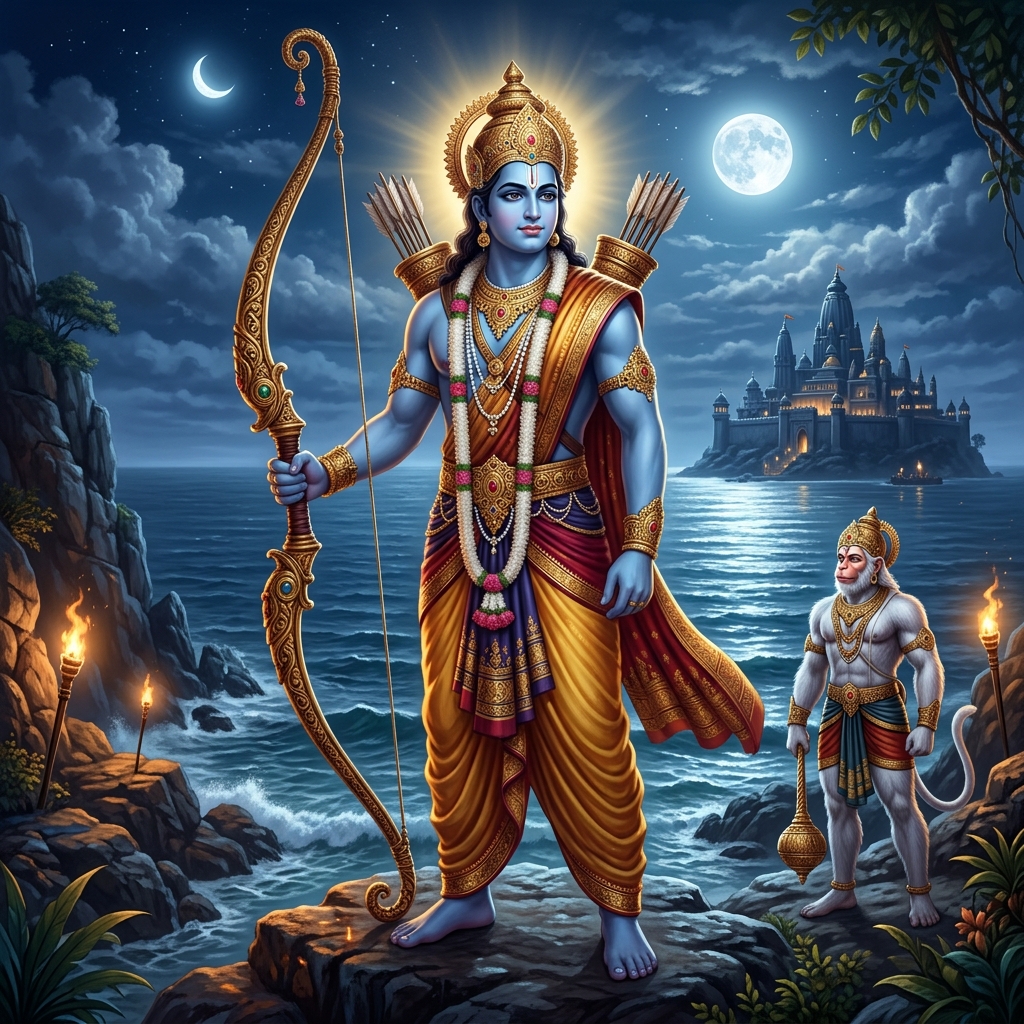
"Listen, son of Kunti," he said, "and do not think your grief is the heaviest the earth has carried. There was once a prince, the eldest son of a great emperor, born to inherit the finest kingdom under the sun. On the very eve of his crowning he was sent into the forest for fourteen years. His wife, gentle and faithful, was stolen away across the sea by the mightiest demon that ever lived. And he, with no army but the beasts of the wood, made war upon that demon in his island fortress and won her back. His name was Rama. Hear his story, and measure your sorrow against his, and take heart."
And the brothers and Draupadi drew close around the fire, and Markandeya began.
The Prince and the Broken Promise
In the city of Ayodhya, capital of the Kosala kingdom, there ruled an aged and righteous emperor named Dasharatha. He had four sons, but the eldest and dearest was Rama - a prince so noble, so brave, and so true that the whole people loved him as they loved the dawn. With Rama walked always his devoted brother Lakshmana, and at Rama's side as his wife was Sita, the daughter of King Janaka of Videha, a woman whose gentleness and purity were spoken of across the land. Rama had won her by lifting and stringing the great bow of Shiva that no other man could so much as move.
When Dasharatha grew old he resolved to crown Rama as the prince-regent, and the city was hung with garlands for the joyful day. But the emperor had once granted two boons to his youngest queen, Kaikeyi, and now, urged by a wicked servant, she called those boons in. She demanded that her own son Bharata be made king instead, and that Rama be banished to the wilderness for fourteen years.
Dasharatha was shattered. He loved Rama beyond all reason, yet he was bound by his given word, and to a king of that line a promise was a thing more sacred than life. He could not speak the cruel command himself; he could only weep. It was Rama who, hearing of it, set his father free from his torment in the simplest way - by obeying at once, gladly, without a flicker of resentment.
"A father's word," Rama said, "and a king's word, must stand though the heavens fall. I will go to the forest. Do not grieve."
Three Who Walked Into the Forest
Rama laid aside his princely silks and put on the bark garments of a hermit, and he prepared to go alone. But Sita would not be left behind. "A wife's place is at her husband's side," she told him, "in the palace or in the forest, it is all one to me. Without you, even heaven would be exile; with you, the wilderness is home." And though Rama warned her of thorns and beasts and the hardness of the road, she came. Lakshmana too refused to stay, taking up his bow to guard them both. So three royal figures walked out of Ayodhya, and behind them the whole city wept as if the sun were setting forever.
When Dasharatha's heart broke under the parting and he died of grief, the people sent for Bharata, who was away in another kingdom. But Bharata, learning what his mother had done, was filled with horror and refused the throne she had stolen for him. He hurried into the forest, fell at Rama's feet, and begged him to come home and rule.
Rama would not break their father's word even now. "Our father's promise binds me still," he said. "Go back and govern in my name until the fourteen years are spent." So Bharata took Rama's sandals, set them upon the throne as a sign that the kingdom belonged to his brother, and ruled as a servant in Rama's place, waiting.
Rama, Sita, and Lakshmana wandered deeper into the wild lands of the south, dwelling among the sages of the great Dandaka forest, until at last they built a leaf hut in a pleasant place and lived there in quiet, the years going by like slow water.
The Golden Deer and the Empty Hut
Far to the south, across the sea, there ruled a demon-king of terrible power named Ravana, lord of the island fortress of Lanka. He had ten heads and twenty arms, and by long penance he had won a boon that made him all but invincible; in his pride he had conquered gods and gandharvas and shaken the worlds. His sister, wandering in the Dandaka forest, saw Rama and desired him, and when she was driven off in shame she went to her brother and inflamed him with the tale of Sita's beauty, that there was no woman in all the worlds to equal her.
Ravana resolved to seize her. He came to the forest near Rama's hut and worked a cunning trick. One of his demons took the form of a wondrous golden deer, dappled with silver, and grazed enticingly before the hut. Sita, charmed, begged Rama to catch it for her. Against his own misgiving, Rama took up his bow and went after it, charging Lakshmana to guard Sita without fail.
The deer led Rama a long chase and, when at last he shot it, the dying demon cried out in Rama's very voice: "Ah, Lakshmana! Sita!" - a false call for help. Sita, hearing it, was seized by terror and ordered Lakshmana to run to his brother. He resisted, knowing it for a trick, but she pressed him with such bitter words that at last, against his will, he drew a line of protection around the hut, bade her not to cross it, and went.
And so, for one fatal moment, Sita stood alone.
The Abduction Across the Sky
Ravana came then in the guise of a wandering holy man, begging alms at the door of the hut. Sita, ever respectful of an ascetic, stepped across the line of protection to give him food - and in that instant the demon cast off his disguise and stood revealed in his vast and dreadful form. He seized her and rose into the air in his magic chariot, bearing her south through the sky while she screamed and struggled in his grip.
As they flew, an aged and noble vulture named Jatayu, an old friend of Rama's father, heard her cries and flung himself upon the demon's chariot to save her. The brave old bird fought Ravana with beak and talon and tore the chariot half to ruin, but in the end Ravana cut away his wings, and Jatayu fell dying to the earth. Sita, as she was carried on, tore off her ornaments and let them drop, one by one, among a band of monkeys on a far hilltop below, praying that they might mark the way she had gone.
Ravana bore her over the sea to Lanka and set her in a grove of ashoka trees, ringed with demon guards, and there he came to her day after day, by turns coaxing and threatening, demanding that she become his queen. But Sita, wrapped in her own purity as in armor, would not so much as look at him. She set a single blade of grass between herself and the demon and would not waver, holding in her heart the certainty that Rama would come.
The Search and the Monkey Friends
When Rama returned and found the hut empty, his grief was a thing terrible to behold. He and Lakshmana searched the forest, calling her name, until they found the dying Jatayu, who with his last breath told them which way Ravana had flown. The brothers pressed on south, half-mad with sorrow, and came at last to the wooded hills near a lake called Pampa, in the country of the vanaras - the forest people, the monkey-folk, who were strong and clever and could speak as men.
There they met Hanuman, the son of the wind, mightiest and wisest of the vanaras, who brought them to his exiled lord Sugriva on the slopes of Mount Rishyamuka. Sugriva had been driven from his kingdom of Kishkindha by his own brother, who had also stolen his wife. Rama and Sugriva, two princes each robbed of a wife and a home, made a pact of friendship at a sacred fire: Rama would help Sugriva regain his throne, and Sugriva in turn would send all the hosts of the vanaras to search the earth for Sita.
Sugriva showed Rama the ornaments Sita had dropped from the sky, and Rama knew them and wept over them. Then Rama, true to his word, slew the usurping brother and set Sugriva upon the throne of Kishkindha. And Sugriva, true to his, summoned the monkey armies from every quarter of the world and sent them out in their thousands to find the stolen princess.
The Leap to Lanka
The search bands ranged over the whole earth, and it was the company sent south, with Hanuman among them, that came at last to the very edge of the land and stood looking out over the great sea that separated them from the island of Lanka. A hundred leagues of water lay between the searchers and their goal, and the monkeys despaired - for who could cross so vast a gulf?
Then the others reminded Hanuman of his own nature. He was the son of the wind, born with powers he had half-forgotten under an old curse. As he remembered who he was, his body began to grow. He swelled until he stood like a mountain on the shore, and then, with a roar that shook the trees and a leap that cracked the rock beneath his feet, he hurled himself out over the sea, flying through the air the whole hundred leagues, brushing aside the sea-demons that rose to stop him.
He came down upon Lanka by night and shrank himself small as a cat, and slipped through the golden city of the demons unseen. He searched the palaces and at last found, in a grove of ashoka trees ringed with fierce guards, a wasted and sorrowing woman who could only be Sita. He waited until she was alone, then dropped before her Rama's own ring as a token, and told her softly that her lord lived, that he was coming, and that she had only to endure a little longer.
Sita wept for joy, and gave him a jewel from her hair to carry back to Rama, that he might know she still lived and still was true.
The Bridge of Stones
Before he left, Hanuman chose to leave the demons a warning. He let himself be captured and brought before Ravana, and when the demon-king ordered his tail set ablaze as an insult, Hanuman grew huge again and went leaping across the rooftops of Lanka with his burning tail, setting the golden city aflame, before he plunged into the sea to quench the fire and sprang back across the water to his friends.
He brought Sita's jewel to Rama and told him all - where she was held, how she suffered, how she stayed true. And Rama, his grief now turned to resolve, marched the whole vanara host down to the southern shore. There the army stood again before the impossible sea, and this time Rama himself prayed to the Lord of the Ocean for passage.
Then the vanaras set to a labor that became a wonder of the world. Under the direction of a great architect among them, they tore up trees and boulders and whole hills and cast them into the sea, building a mighty causeway, league by league, across the water toward Lanka. The monkeys wrote Rama's name upon the stones, and it was said that the stones so marked did not sink. For days they toiled, and at last the bridge stood complete, joining the mainland to the demon's island, and across it the army of Rama poured down upon Lanka.
The War Beneath the Walls
The war for Lanka was long and terrible. The vanaras, armed with nothing but boulders and uprooted trees and their own ferocity, threw themselves against the demon legions, who fought with sorcery and steel and changed their shapes and fought again though slain. Day and night the battle raged beneath the walls of the golden city, and the ground was heaped with the fallen of both hosts.
Ravana sent out his champions one by one. His monstrous brother Kumbhakarna, a giant so vast he slept for half a year at a time, was roused and strode into the battle, devouring monkeys by the score until Rama brought him down at last with a storm of arrows. Ravana's son Indrajit, a sorcerer who could fight unseen from the clouds, struck Rama and Lakshmana down with serpent-arrows and bound them in coils of magic, and the whole army despaired - until Hanuman flew to a far northern mountain and carried back the very peak, with its healing herbs growing upon it, and the brothers were revived. Again and again the tide turned and turned back.
Lakshmana, fighting Indrajit at the last in single combat, struck the sorcerer down and ended his terror. And one by one the great captains of the demons fell, until Ravana saw his sons and his brothers and his armies all destroyed, and knew that he must come out himself and face the prince he had wronged.
The Fall of the Ten-Headed King
Then Ravana rose in his wrath and came forth in his war-chariot, ten-headed and twenty-armed, and the earth shook under him. Rama, that the fight might be equal, was given a celestial chariot and the arms of the gods. The two met in the open field before the walls, and their duel was such as the worlds had never seen - arrows like rain, weapons of fire and wind and lightning loosed and answered, the sky darkened with the storm of their battle.
For a long while Rama could not kill the demon, for Ravana's many heads, struck off, grew again as fast as they were cut. At last a sage at Rama's side reminded him of the one weapon that could end it - the great arrow of Brahma, given to Rama for this hour, its point charged with the power of wind and fire and the weight of mountains. Rama set it to the string, drew the bow to its full, and loosed.
The arrow flew straight and unstoppable and struck Ravana through the heart, and the mightiest demon that had ever lived, the conqueror of gods, fell dead from his chariot upon the field of Lanka. A great cry went up from the vanara host, and flowers fell from heaven, and the long war was over.
The Return of the King
Sita was brought from the ashoka grove, and Rama looked upon the wife for whom he had crossed the sea and broken an empire of demons. The story tells that to silence forever any whisper against her honor after so long a captivity, Sita walked through fire itself, and the flames did not touch her, and the god of fire bore her up unharmed and gave her back to Rama, proclaiming her purity to all the worlds. So was her faithfulness made plain beyond all doubt.
The fourteen years of exile were now spent. Rama, with Sita and Lakshmana and his faithful Hanuman and the vanara lords, returned at last to Ayodhya, and Bharata ran to meet him and laid the kingdom, kept so long in trust, at his brother's feet. Rama was crowned emperor in the city of his fathers, and his reign became the very byword for a golden age - a time when the rains came in their season, the earth gave her harvests freely, no child died before its parents, and justice and plenty filled the land. Men called it Rama-rajya, the reign of Rama, and remembered it ever after as the pattern of how the world should be governed.
Markandeya let the fire burn low and turned to Yudhishthira. "There, son of Kunti, is the tale of a prince who lost more than you have lost - his crown on the eve of his crowning, his father to grief, his wife across the sea - and who bore it all without bitterness, and won everything back by holding to his dharma through every trial. Ravana fell because he seized another man's wife by force; remember it, when you think of those who wronged Draupadi. Wickedness, however mighty, carries its own destruction sewn into it. And the patient and the righteous, however low they are brought, rise again. So shall you. Take comfort, and wait."
Dharma Lesson
Rama bore the loss of his crown, his father, and his wife without a trace of bitterness, holding to truth and duty through every trial - and won everything back. Ravana, mightiest of beings, fell because he seized another's wife by force. Wickedness, however powerful, carries its own destruction within it; the patient and the righteous, however low they are brought, rise again.