The Voice That Named the Road
They had run out of holy places.
Standing by the unearthly lake above Badari, Yudhishthira counted them off for Bhima the way a man counts what he has spent. "At every place we have gratified the pitris. With the high-souled ones we have bathed in all the sacred mountains and lakes and in the ocean itself. With the brahmanas we have bathed in the Ila, and in the Saraswati, and in the Sindhu, and in the Yamuna, and in the Narmada, and in various other romantic tirthas. We have passed the source of the Ganga. We have seen the Himalaya and the jujube called Visala where the hermitage of Nara and Narayana stands. And now this lake, which the Siddhas and the gods and the sages hold in veneration.
"One by one, carefully, in company with the high-souled Lomasa, we have seen every celebrated and sacred spot there is."
Then he asked the question he had been working toward.
"Now, O Bhima. How shall we repair to the sacred abode of Vaisravana, that the Siddhas inhabit? Do thou think of the means of entering the same."
Bhima, who had never in his life been asked how to get into somewhere and answered that it could not be done, was opening his mouth when something else spoke.
It came out of the air above the lake and it addressed the king.
"Thou wilt not be able to go to that inaccessible spot."
Nobody moved.
"By this very way do thou repair from this region of Kuvera to the place whence thou hadst come, even to the hermitage of Nara and Narayana, known by the name of Vadari. Thence, O Kaunteya, thou wilt repair to the hermitage of Vrishaparva, abounding in flowers and fruit and inhabited by the Siddhas and the Charanas. Having passed that, O Partha, thou wilt proceed to the hermitage of Arshtishena. And from thence thou wilt behold the abode of Kuvera."
Just at that moment the breeze became fresh, and gladsome, and cool, and redolent of an unearthly fragrance, and it showered blossoms over all of them.
The rishis of earth and the brahmanas were more amazed than anyone. It was Dhaumya who found his voice first, and what he said was the whole of his profession in six words.
"This should not be gainsaid. Let this be so."
And king Yudhishthira obeyed him. He noticed, as they turned back, that the voice had given him a road with three stops on it and had not said what was at the end of the third, except that from there he would behold. Not enter. Behold.
Seventeen Days North
They went back to the hermitage of Nara and Narayana and dwelt there, and it was there, one evening, remembering his brother Jaya, that Yudhishthira called them all together with Draupadi and told them why they were going to move again.
"We have passed these four years peacefully ranging the woods. It hath been appointed by Vibhatsu that about the fifth year he will come to that monarch of mountains, the excellent cliff Sweta." He described it the way a man describes a place he has never seen and has thought about every day: graced with blooming plants and maddened kokilas and black bees and peacocks and chatakas, ranged by tigers and boars and buffaloes and deer, lovely with blown lotuses of a hundred and a thousand petals, frequented by the celestials and the Asuras alike.
"Partha appointed it with me. 'I shall remain abroad five years,' he said, 'with the object of learning military science.' In a place like the region of the gods we shall behold the wielder of Gandiva, come back with the weapons."
He summoned the brahmanas and told them. They went round the ascetics of rigid austerities and pleased them and told them also. And the brahmanas gave their assent in the form such men use, which is never quite a blessing and never quite a prediction.
"This shall be attended by prosperity and welfare. O foremost of the Bharatas, these troubles shall result in happiness. O pious one, gaining the earth by the Kshatriya virtue, thou shalt govern it."
So Yudhishthira set out with his brothers and those brahmanas, followed by the Rakshasa and protected by Lomasa. At some places they went on foot. At others the Rakshasas carried them, which is not a thing anyone enjoys and nobody complained about.
They went north, into country abounding in lions and tigers and elephants. They passed the mountain Mainaka and the base of the Gandhamadana and the rocky mass of Sweta, and higher and higher up they crossed one crystal rivulet after another, and on the seventeenth day they came out onto the sacred slopes of the Himalayas.
What They Left With Vrishaparva
Not far from the Gandhamadana, on those slopes, under trees and creepers and beside cascades that came down in white ropes, stood the holy hermitage of the royal sage Vrishaparva.
He received them as his own sons. There is no better way to say it and the account does not try. A king who had put off being a king met five men who had had it taken from them, and he took them in, and asked no questions about dice.
They stayed seven nights, duly regarded. On the eighth day they took his permission to go, and then came the part of the visit that mattered.
They brought the brahmanas to him one by one and introduced them, and left them there in his charge as friends, because what lay ahead was not a road for men whose work is recitation. They entrusted him with their remaining robes. And then, in a heap on the floor of a hermitage on the side of a mountain, the sons of Pandu left their sacrificial vessels, and their ornaments, and their jewels.
Every hard thing they still owned. Twelve years of exile had already stripped them of a kingdom and they had carried these last objects up the Himalaya, and here they set them down, and went on with nothing but weapons and what was on their backs.
Vrishaparva was wise and pious and versed in every duty, and he had knowledge of the past and of the future, and knowing both he still gave them instructions as he would to his own children, and did not tell them what he saw. He followed them a certain distance up the path. Then he entrusted them to the care of the brahmanas who went with them, and blessed them, and gave directions concerning their course, and turned and went back down.
They did not see him again.
The Forest at the Top of the World
Then Kunti's son and his brothers went on foot along a mountain path inhabited by every kind of beast, and on the fourth day they reached the Sweta mountain, which stood up like a mighty mass of cloud and was made, as far as anyone could tell, of gold and gems.
They went the way Vrishaparva had directed and came to the intended places one by one. Over and over they passed inaccessible rocks and caves that should have been impassable, and passed them with ease, which none of them could afterwards account for. Dhaumya and Draupadi and the sons of Pritha and the mighty Lomasa went on in a body, and none grew tired.
And then, with the down standing erect on their arms, they saw the Gandhamadana.
It is the abode of the Kimpurushas. Siddhas and Charanas frequent it and Vidyadharis and Kinnaris range it and there are herds of elephants in it and lions and tigers, and the roar of the sarabha comes off it. They went in as men go into the Nandana gardens. There were mangoes and hog-plums and pomegranates and citrons and jacks and plantains, champakas and asokas and ketakas and bakulas and punnagas and karnikaras, kadambas and salas and tamalas and devadarus, every one of them bearing flower and fruit in the same hour.
Yudhishthira walked through it talking, which he rarely did.
"Ah, Bhima. Beautiful is this forest of the Gandhamadana. There are no trees here that do not flower. Behold the lotus lakes, ringing with the hum of black bees, being agitated by elephants with their mates. Look at the karnikaras on the summits with their blossoms of a golden hue, like ear-rings of excellent make. Look at the tilakas, appearing like beauty-spots painted on the forehead of the forest.
"On this mountain there is collyrium in the rock, and gold, and yellow orpiment, and vermilion, and caves of red arsenic like the evening clouds. And hark to the peacocks crying with their hens. By coming here, brother, we have attained a state that is not human. Do thou behold the celestial river Mahaganga, with her swans, resorted to by sages and Kinnaras."
Bhima looked at the summits, where the Gandharvas and the Kimpurushas were visible in company with their loves, and did not say what he was thinking.
The Man With His Muscles Bare
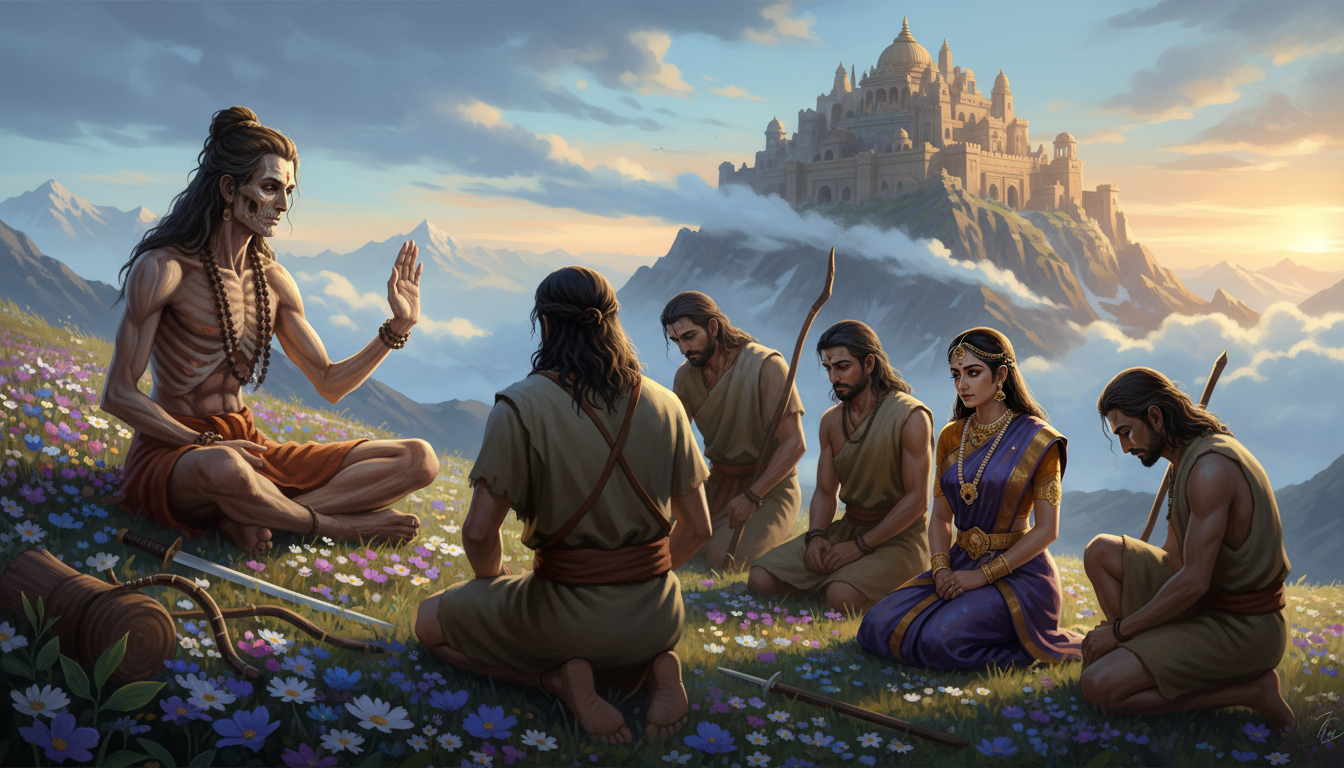
Thereafter they saw a hermitage furnished with flowers and with trees bearing fruit, and in it they found the royal sage Arshtishena.
The account gives him three words. Versed in all duties, of rigid austerities, skeleton-like, having his muscles bare. That is what was sitting there. A man whose sins had been consumed by asceticism and whose body had gone the same way as the sins, so that what remained was a frame with the cords standing out on it, holding still.
Yudhishthira approached and announced his own name and greeted him gladly, bending his head. Then Draupadi and Bhima and the devout twins bowed their heads to the royal sage and stood about him, and Dhaumya, the Pandavas' own priest, came up and made his own observance in the proper form.
By his prophetic eye the muni had known who they were before any of them opened their mouths. He had known since they were three ridges away. He let Yudhishthira say his name anyway, because it is good for a man to say his name aloud to somebody who already knows it.
"Be ye seated," he said.
They sat. And here was a king who had lost a throne at dice, and his queen who had been dragged into an assembly by the hair, and a brother who had sworn to drink a man's blood, and two young men who had grown up in the woods, and a chaplain who had held the whole household together for eleven years, all of them come up to the roof of the world after seventeen days of walking, sitting on the ground in front of a skeleton, waiting to hear what the holy man would ask them about.
The Examination
He asked them about home.
"Dost thou not turn thy inclination upon untruth? Art thou intent upon virtue? And, O Partha, hath not thy attention to thy father and thy mother diminished?"
Not one word about the dice. Not one about Duryodhana, or the thirteenth year, or the war that every ascetic on that mountain knew was coming.
"Are all thy superiors, and the aged, and those versed in the Vedas, honoured by thee? Dost thou not turn thy inclination unto sinful acts? Dost thou properly know how to perform meritorious acts, and to eschew wicked deeds?"
Then the one that went in deepest, put quietly, in the middle of the list where a man might miss it.
"Dost thou not exalt thyself?"
"And are pious men gratified, being honoured by thee? Even dwelling in the woods, dost thou follow virtue alone? And, O Partha, doth not Dhaumya grieve at thy conduct?"
Dhaumya, sitting to one side, kept his face entirely still.
"Dost thou follow the customs of thy ancestors, by charity, and religious observances, and asceticism, and purity, and candour, and forgiveness? And dost thou go along the way taken by the royal sages?"
Then Arshtishena told him why he was asking.
"On the birth of a son in their lines, the pitris in their own regions both laugh and grieve, thinking: will the sinful acts of this son of ours harm us, or will his meritorious deeds conduce to our welfare? He conquereth both the worlds who payeth homage unto his father, and his mother, and his preceptor, and Agni, and fifthly, the soul."
Yudhishthira answered him without any ornament at all.
"O worshipful one, those duties have been mentioned by thee as excellent. To the best of my power I duly and properly discharge them."
And that was the examination. A man had come to the last habitable place on the road to the city of the lord of treasures, and had been questioned on whether he was good to his mother.
It Is Impossible to Proceed Beyond This
Then the sage told them where they were.
"During the Parvas, sages subsisting on air and water come to this best of the mountains, ranging through the air. On the summits are seen amorous Kimpurushas with their paramours, mutually attached. Many Gandharvas, and Apsaras clad in white silk vestments, and lovely-looking Vidyadharas wearing garlands, and mighty Nagas, and Suparnas, and Uragas.
"And on the summits, during the Parvas, are heard sounds of kettle-drums and tabors, and shells, and mridangas. Even by staying here, ye shall hear those sounds."
He let that sit a moment before he finished the sentence.
"Do ye by no means feel inclined to repair thither."
And then, flatly, the thing they had come all this way to be told.
"Further, O best of the Bharata race, it is impossible to proceed beyond this. That place is the sporting-region of the celestials. There is no access thither for mortals. At this place all creatures bear ill-will to, and the Rakshasas chastise, that man who committeth aggression, be it ever so little.
"Beyond the summit of this Kailasa cliff is seen the path of the celestial sages. If any one through impudence goeth beyond this, the Rakshasas slay him with iron darts and other weapons."
He told them what they would see from where they sat, which was a great deal. During the Parvas the lord of treasures himself, who goes about on the shoulders of men, is seen there in pomp and grandeur surrounded by the Apsaras, and when that lord of all the Rakshasas is seated on the summit, all creatures behold him like a risen sun. Tumburu entertains him, and the sweet notes of his singing are heard all over the Gandhamadana.
"Here, during the Parvas, all creatures see and hear marvels like this. O Pandavas, till ye meet with Arjuna, do ye stay here, partaking of luscious fruits and the food of the munis."
And last, to Yudhishthira, in the tone a man uses for the one instruction he expects to be disobeyed.
"O child, as thou hast come hither, do thou not betray any impertinence. And after living here at thy will and diverting thyself as thou listest, thou wilt at length rule the earth, having conquered it by the force of thy arms."
Flowers of Five Colours
So they behaved accordingly, and it was, for a while, the best time any of them had in thirteen years.
They dwelt on the Himavan and ate what the munis ate, and luscious fruit, and the flesh of deer killed with unpoisoned shafts, and various kinds of pure honey. They passed the fifth year that way, listening to the stories Lomasa told, and there were a great many of them. Ghatotkacha had already gone, taking all the Rakshasas with him. "I shall be present when occasion ariseth," he had said to his father, which was the closest that particular son ever came to a farewell.
Months went by in the hermitage of Arshtishena and they witnessed many marvels. Complacent munis and Charanas of pure soul came to see them, and the foremost of the Bharata race sat and talked with them about earthly matters, which is what men do at the roof of the world.
Then one day Suparna came down on the great lake and took a mighty Naga out of it.
The whole mountain trembled. Gigantic trees came apart. Every creature there saw it, and the wind that the wings raised came off the brow of the mountain and brought a fall of blossoms down over the Pandavas where they sat, flowers of five hues, fragrant and unearthly, more than anyone could gather.
Bhimasena was sitting at his ease on the rock. Draupadi turned to him.
"O best of the Bharata race, in the presence of all creatures, these flowers of five hues, carried by the force of the wind raised by Suparna, are falling in amain on the river Aswaratha." She was looking up at the summit while she said it. "In Khandava thy high-souled brother, firm in promise, baffled the Gandharvas and the Nagas and Vasava himself, and slew fierce Rakshasas, and obtained the bow Gandiva.
"Thou also art of exceeding prowess, and the might of thy arms is great and unbearable, like the might of Sakra. O Bhimasena, terrified with the force of thy arms, let all the Rakshasas betake themselves to the ten cardinal points, leaving the mountain. Then will thy friends be freed from fear and affliction, and behold the auspicious summit of this excellent mountain furnished with variegated flowers.
"O Bhima, I have for long cherished this thought in my mind: that protected by the might of thy arms, I shall see that summit."
The Path Wide Enough for One
Like a high-mettled bull that has been struck, Bhimasena considered himself censured by Draupadi, and could not bear it.
He took up his bow, plaited at the back with gold, and his sword, and his mace, and he went. Every creature on that slope saw him go, equipped with bow and arrows, coming on like a lion or a maddened elephant, and free from fear and from affliction, and nobody put out a hand to stop him, and Arshtishena was in his hermitage and did not know.
He found the rugged path that afforded passage to one individual only, and went up it, and came out on the terrible summit that stands as high as several palmyra palms set one upon another. His arrival gladdened Kinnaras and great Nagas and munis and Gandharvas and Rakshasas alike, which is to say that all of them saw him and understood at once what was going to happen.
And there in front of him was the abode of Vaisravana.
Golden crystal palaces, surrounded on all sides by golden walls with the splendour of every gem in them. Gardens all round it. Ramparts and towers, doorways and gates, and rows of pennons waved by the breeze. Dallying damsels dancing in the courts. Heaps of gems, and variegated garlands. A breeze carrying every perfume there is, and trees of diverse hues sounding with dulcet notes.
Bhima stood with his arms bent, supporting himself on the end of his bow, and looked at it with eagerness, and renounced all care of his life.
Then he blew his shell.
He twanged his bowstring, and struck his arms with his hands, and the three sounds together unnerved every creature on the mountain, and the Yakshas and Rakshasas came, with their hair standing erect, rushing toward the noise with flaming maces and clubs and swords and spears and javelins and axes in their hands.
He cut the darts and javelins and axes out of the air with arrows and pierced the roaring bodies behind them, those in the sky and those on the ground both, until he stood deluged in a rain of blood that came from all sides at once, like the sun with clouds around him.
Either Through Rashness or Through Ignorance
The Yakshas broke and ran toward the southern quarter, leaving their maces and spears and swords and clubs and axes on the ground.
One did not run. Maniman, the friend of Vaisravana, broad-chested and mighty-armed, stood holding darts and maces, and he called after the ones who were fleeing with a smile on his face.
"Going to Vaisravana's abode, how will ye say unto that lord of wealth that numbers have been defeated by a single mortal in battle?"
Then he came on like a maddened elephant. Bhima pierced his sides with three choice arrows. Maniman took up a tremendous mace and flourished it and hurled it, and Bhima met it with shafts sharpened on stone and they were baffled and fell away and could not stop it, and he broke its flight with his own mace instead, being the better man at that particular trade. Then the Rakshasa discharged a terrible iron club with a golden shaft, belching flame and roaring, and it came through everything and pierced Bhima's right arm and fell to the ground.
Bhima's eyes rolled in anger. He took up his own mace, inlaid with plates of gold, and sprang into the sky, and hurled it with a shout, and it went down like the thunderbolt of Indra and destroyed the Rakshasa, and every creature there saw Maniman lying slain like a bull killed by a lion. The survivors went east, crying out.
Down below, Yudhishthira and the twins and Dhaumya and Draupadi and the brahmanas had been hearing sounds resounding in the caves of the mountain and could not find Bhima, and were filled with anxiety. They entrusted Draupadi to the charge of Arshtishena, took their arms, and climbed.
What they found on the summit was the abode of Kuvera, and the Rakshasas of mighty strength lying struck down in every direction, and their brother standing among them with his mace and sword and bow, looking like Maghavan after the slaughter of the danava hosts.
They embraced him. They sat down. And then the king said what he had been assembling on the way up.
"Either it be through rashness, or through ignorance, thou hast, O Bhima, committed a sinful act. O hero, as thou art leading the life of an anchorite, this slaughter without cause is unlike thee. Acts, it is asserted by those versed in duties, as are calculated to displease a monarch, ought not to be committed. But thou hast, O Bhimasena, committed a deed which will offend even the gods.
"He that, disregarding profit and duty, turneth his thoughts to sin must reap the fruit of his sinful actions. However, if thou seekest my good, never again commit such a deed."
Having said this to his brother, Yudhishthira ceased, and began to reflect upon the matter, sitting on the forbidden summit with the dead lying around him and the golden walls of the city of treasures shining a little way off, exactly where the skeleton on the lower slope had told them it would be, and exactly as far out of reach.
Dharma Lesson
A man is examined on the ordinary duties he left at home long before he is trusted with the road ahead: Arshtishena asked the king about his mother and his teachers and whether he exalted himself, and said nothing of dice or war. And a limit given in plain words is still a limit when the one who crosses it wins, which is why Yudhishthira called his brother's victory a sin.