The Flower on the Wind
The years of exile had carried the Pandavas far from the comforts of Indraprastha, through the forests of Kamyaka and at last into the wild, cold beauty of the Gandhamadana mountains. Here the air was thin and sweet, the slopes were heavy with deodar and pine, and the streams ran clear from the snows above. The brothers had wandered north past Badarikashrama, seeking the high country where the sages dwelt and where the boundary between the world of men and the world of the gods grew thin.
One afternoon, while Yudhishthira rested and Arjuna was away upon his own austerities, a gust of wind came down from the peaks. It carried a fragrance unlike anything of the lower world - a perfume so pure and so deep that it stilled the breath of all who caught it. And on that wind, tumbling and turning, came a single flower. It settled in Draupadi's lap as gently as if a hand had placed it there.
It was a saugandhika, a celestial golden lotus. Its petals were the color of molten sun, layered a thousandfold, and its scent seemed to wash weariness from the body and sorrow from the heart. Draupadi held it in both hands and gazed at it, and for a long moment the hardship of the forest fell away from her face.
No flower of this kind grew in the places men could reach. It had drifted from some sacred lake high in the realm of Kubera, lord of wealth, where the gods themselves came to bathe and worship. The wind had carried this one gift down to a queen who had lost a kingdom and kept her dignity through every humiliation.
Draupadi's Wish
Draupadi rose with the flower cradled against her and went in search of Bhima, who of all her husbands was the swiftest to act and the most devoted to her happiness. She found him near the edge of the camp, his great frame at rest but his eyes restless, for the idleness of exile sat ill upon a man built for storms.
"O son of Vayu," she said, holding out the lotus so that its fragrance reached him, "see what the wind has brought me. In all my days I have never beheld anything so lovely, nor breathed anything so sweet. One flower is a marvel, but my heart longs for more of them. If they can be found, bring them to me, and I will carry them to our eldest brother and gladden us all in this lonely place."
Bhima took the flower and turned it in his huge fingers as carefully as a man handles a newborn bird. He looked at Draupadi - at the woman who had been dragged by her hair into the assembly hall of Hastinapura, who had been gambled away and shamed before kings, and who had borne it all without breaking. Whatever she asked, he would have crossed fire to give her.
"You shall have a hundred of them, and a hundred more," he said, and his deep voice was gentle now, though it could shake the hills. "Rest, and tell the others I have gone to fetch what the queen desires."
He took up his golden mace, the weapon that had broken the bones of demons, and he turned his face toward the high peaks from which the wind had blown. Without waiting for counsel, without fear of what lay between him and the flowers, the mighty Bhimasena set off alone up the mountain.
Through the Wild Mountains
Bhima climbed in the manner of a man who has never learned to ask the land's permission. Where trees grew across his path, he tore them up by the roots and flung them aside. Where boulders blocked the way, he set his shoulder against them and rolled them down the slopes, and the crash of them echoed from ridge to ridge like thunder rolling between the mountains.
Herds of elephants fled before him. Lions and tigers slunk away into the thickets rather than test the strength of the giant who came roaring up their valleys. Great serpents drew back into their dens. Bhima laughed as he went, drunk on the joy of his own power, for here at last was a task worthy of his arms after the long, dull months of hiding and waiting.
Higher and higher he went, into country no woodcutter had ever seen, where the slopes glittered with snow and the rivers leaped white down the rocks. He passed through groves of plantain so vast that the trees stood like green pillars holding up the sky, and he trampled a road through them as easily as a child wades through tall grass. His war cry rang out again and again, announcing to every creature on the mountain that Bhima, son of the Wind, was passing through.
He did not pause to wonder whether pride was a fit companion for so sacred a quest. He had been told to fetch flowers for the woman he loved, and he would let nothing stand in his road. It did not occur to him that the mountain might hold someone stronger than himself, for in all his life he had never met such a being and had ceased to believe that one existed.
The Monkey Across the Path
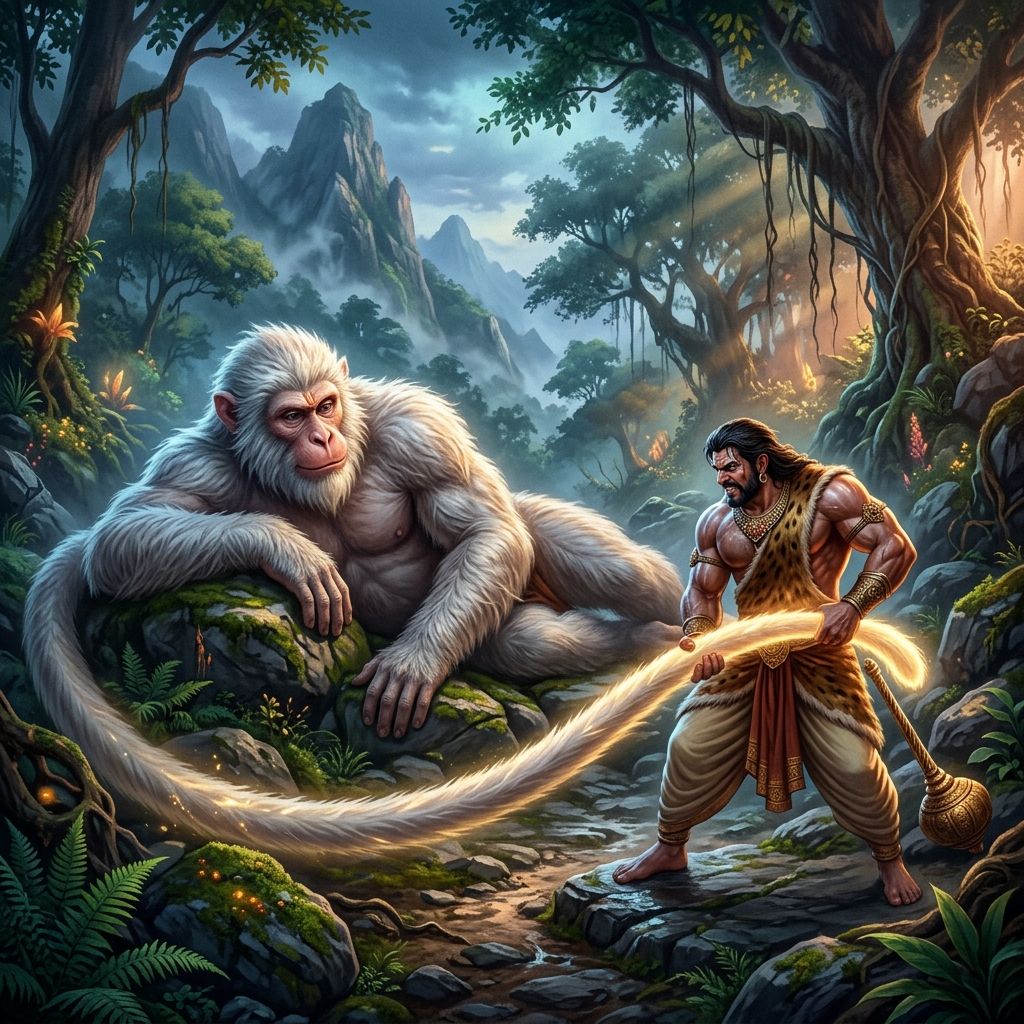
As the trail narrowed between two shoulders of rock, Bhima's headlong rush came suddenly to a halt. Stretched across the path before him lay an old monkey, sunning its tired bones in a patch of light. Its fur was thin and patchy, its limbs were wasted, and its eyes were half-closed with the heavy drowsiness of the very old. And across the whole width of the trail, lazily, lay its long tail, leaving no gap for a man to pass.
Bhima, impatient at the delay, raised his voice in the rough command he used on beasts of the forest. "Move aside, creature! Do you not know who travels this road? I am Bhima, son of the Wind God Vayu, brother of the emperor Yudhishthira. Take your tail from my path and let me by."
The monkey opened one eye, slowly, as though even that small effort cost it dearly. "I am old, traveler, and I am sick," it said in a voice thin and weary. "I was sleeping in peace until your shouting woke me. I have not the strength to rise. And it is no mark of a noble man to bark orders at the aged and the ailing. The path is wide enough. Step over me, or go around, and let an old monkey have his rest."
But Bhima frowned and shook his head. "To leap over you would be an insult, and I am a kshatriya. The scriptures forbid me to step over any living being in contempt. I cannot do it. Since you are too feeble to move your whole body, then at the least lift aside your tail, and I shall pass without troubling you further."
Lift It Yourself
The old monkey sighed, a long, rattling sigh, and let its eye fall closed again. "There is no strength left in these old bones of mine, mighty warrior. Whatever vigor I once had has long since drained away with the years. If you are in so great a hurry, and if it troubles you so to step over me, then do this simple thing yourself. Take my tail in your hand and set it gently aside, and the road will be open to you."
Bhima nearly laughed aloud at the suggestion. Here was a frail and shrunken creature asking the strongest man in the world to move a tail that any child might lift. He stepped forward, almost gentle in his contempt, and reached down with his left hand. He took hold of the tail, expecting to flick it from his path the way one brushes away a fallen twig.
It did not move.
The smile faded from Bhima's face. He set his mace upon the ground, planted his feet wide upon the rocky trail, and seized the tail with both his hands. These were the arms that had crushed the demon Bakasura, that had torn apart Hidimba in the forest of his youth, arms that no opponent had ever matched. He filled his great chest with mountain air and he pulled.
Nothing happened. The tail lay across the path as if it had been carved from the living rock of the mountain itself.
The Humbling of Bhimasena
Now there was no laughter left in Bhima, and no contempt. He braced his back, bent his knees, and heaved with the full and terrible strength that had no equal among living men. The muscles stood out upon his shoulders like coils of rope. His face turned dark with the effort, and the sweat ran down it in streams. He strained until the very ground beneath his feet began to crack and crumble, until trees on the slope above shivered with the force that ran through his body.
The tail did not stir. Not by the breadth of a single hair did it shift from its place.
At last Bhima released his grip and stood up, his chest heaving, his arms trembling, his pride lying in pieces about his feet. In all his life he had never met a force he could not overcome by strength, and now an old and dying monkey had defeated him with nothing more than the weight of its tail. He understood, in that breathless moment, that he had been in the presence of something far beyond an ordinary creature of the wood.
The arrogance that had carried him roaring up the mountain drained out of him and left only wonder, and in its place rose a deep and humble reverence. Bhima folded his hands before the monkey and bowed his head low.
"Forgive me," he said, and his great voice was soft now, almost shaking. "Forgive my pride and my rough words. I am beaten, and gladly so. Tell me, O wondrous one, who are you in truth? Are you a perfected sage, a god, a gandharva of the heavens? No mere beast could humble Bhimasena. I beg you, reveal yourself."
I Am Hanuman
The old monkey rose then, and as it rose the marks of age and sickness fell away from it like a cast-off garment. The patchy fur grew bright and golden, the wasted limbs filled out with power, and the half-closed eyes opened wide and shone with a light that was older than the kingdoms of men. Before Bhima stood a being radiant and mighty, and his voice when he spoke rolled out like distant thunder over the peaks.
"I am Hanuman," he said, "son of the Wind God Vayu, the same divine father who is yours. You and I are brothers, Bhima. I am the elder, and you the younger, both of us born of the breath of the world."
At these words Bhima's heart overflowed. He had heard since childhood the great tales of Hanuman from the age of Rama - how this very being had leaped across the ocean in a single bound to the island of Lanka, how he had found the captive Sita in the grove of demons and carried Rama's ring to her, how he had let himself be bound and had burned the golden city with his blazing tail, how he had carried a whole mountain through the sky to save the life of Rama's brother. To stand now before that living legend, and to be named his brother, filled Bhima with a joy he could not contain.
He cast himself down and clasped Hanuman's feet, and the great monkey raised him up and embraced him with deep affection. "Do not be ashamed," Hanuman said warmly. "I blocked your path on purpose, little brother, and I held my tail against your strength on purpose, so that you might learn a lesson you needed. Strength is a gift of the gods. It is given to be used in righteousness, never to be paraded in pride. The strongest man alive may still meet one stronger, and humility must always walk beside power. Carry that with you from this place."
Tales of the Age of Rama
Brother and brother sat together then upon the mountain trail, and Hanuman spoke of the age that had passed long before Bhima was born. He told of Rama, the prince of Ayodhya, who was Vishnu himself come down to walk the earth, and of his exile into the forests, and of how the demon king Ravana had carried away his faithful wife Sita to the island fortress of Lanka.
He told of the army of monkeys and bears that had gathered in the kingdom of Kishkindha, and of how he himself had searched the southern lands and crossed the wide ocean to learn that Sita lived. He told of the great bridge of stones that the monkey hosts had built across the sea, rock by rock, so that Rama's army might pass over dry-shod to the shores of Lanka. He told of the war that followed, of the fall of Ravana, and of the return of Rama to his throne, when the very heavens rained flowers upon the rejoicing world.
Through all of it, Hanuman spoke not of his own great deeds but of his master's glory, for his devotion to Rama was the whole foundation of his being. "There is no joy for me," he said, "like the joy of serving the one I love. Strength means nothing unless it is laid at the feet of righteousness. Remember that, Bhima, in the dark days that are coming for you and your brothers."
Bhima listened with the eagerness of a child and the gratitude of a warrior. He understood now that the power in his own arms, of which he had been so proud, was a small and borrowed thing beside the strength that flows from devotion.
The Promise of the Banner
When the tales were told, Hanuman grew grave, for he knew well the great war that waited at the end of the Pandavas' exile - the war upon the field of Kurukshetra, where the sons of Pandu and the sons of Dhritarashtra would settle their long quarrel in blood.
"I cannot fight that war in your place," Hanuman said. "That battle is your destiny, yours and your brother Arjuna's, and it must be fought by you. Yet I will not leave you to face it without me. Hear my promise, little brother."
He laid his hand upon Bhima's shoulder. "When the great war comes, Arjuna will ride into battle in a mighty chariot, and upon its banner will fly the figure of a monkey. In that banner I shall take my place. I shall sit upon the flagstaff of Arjuna's chariot, and my presence there shall steady it against every weapon and every curse hurled upon it. And when you raise your war cry upon that field, Bhima, my own roar shall join with yours, so that the sound of it will strike terror into the hearts of your enemies and turn their courage to water."
Bhima bowed his head in gratitude, for he understood the worth of such a gift. With Hanuman upon the banner and Krishna himself holding Arjuna's reins, the chariot of the Pandavas would be invincible. The strength that had failed to lift a tail would now be matched, in the hour of greatest need, by the strength of the one who had crossed the ocean.
The Form That Crossed the Ocean
Before they parted, Bhima made one last request of his brother. "You have told me how you leaped across the sea to Lanka in a single bound," he said. "My heart longs to behold that form with my own eyes - the shape you wore when you crossed the ocean. Show it to me, brother, if it is permitted, that I may carry the memory of it forever."
Hanuman smiled, and he began to grow. His body swelled and rose until it seemed to fill the whole valley, until his head was lost among the clouds that crowned the peaks and his shoulders blotted out the sun. He stood like a mountain of living gold, his eyes blazing now like two suns set in his face, his tail lashing across the sky. The earth trembled beneath the weight of him, and a wind rose from his breathing that bent the great trees of the slope.
Bhima, who had never in his life known fear, felt his courage shrink within him at the sight, and he was forced to lower his eyes and shield his face from the splendor. "It is enough, brother," he cried out. "I can look no longer. Forgive me - I cannot bear the glory of it."
At once Hanuman drew his vast form back into the shape of the old monkey, gentle and small again. He laughed kindly at his brother's awe. "Even this," he said, "is but a shadow of what I was in that age, when the strength of the righteous flowed through me without measure. Let it teach you how little your pride was worth, and how much greater are the powers of the world than any single man."
Then Hanuman blessed Bhima, granting him the boon that his strength would only increase, and that none upon the coming field would be able to stand against him.
The Lake of Kubera
Hanuman pointed the way onward, up to where the slopes gave way to a high and shining plateau, and there he told Bhima the celestial lotuses bloomed. "Beyond this rise lies a lake within the pleasure garden of Kubera, lord of wealth, guarded by the yakshas and the rakshasas who serve him. There the saugandhika flowers grow upon the water. Go, and gather what your queen desires. But go now in a different spirit than the one in which you came, with the lesson of this meeting in your heart."
Then, as gently as a mist dissolving in the morning sun, Hanuman vanished from the mountain, and Bhima stood alone upon the trail, changed.
He climbed the last of the slope and came at length to a wide and tranquil lake, its surface crowded with golden lotuses whose fragrance was the very perfume that had blown into Draupadi's lap. Crystal waters lapped against banks of pale stone, and lilies floated upon them, and the whole place seemed to belong more to heaven than to earth.
But Bhima was not the only one who guarded that water. The yakshas who served Kubera rose up in their hundreds and barred his way, demanding to know by what right a mortal dared to disturb the sacred lake of their lord. Bhima, humbled now but not weakened, answered them honestly that he had come to fetch flowers for his wife, the noble Draupadi, and that he would not be turned aside.
The Flowers for the Queen
When the yakshas would not yield, and reached for their weapons to drive the intruder away, Bhima took up his golden mace once more. But now his strength was tempered by all that the mountain had taught him, and he fought not in arrogant fury but in steady purpose, as a man who knows the worth of his power and the cause for which he spends it.
The battle was great. The guardians of Kubera fell upon him with clubs and spears, and the noise of the fight rolled across the plateau. Yet none of them could match the son of the Wind, blessed now by Hanuman and undimmed in his might. He scattered them as a storm scatters dry leaves, until the survivors fled back to their lord, and the way to the lake lay open before him.
Kubera himself, when he heard of the deed, was not angry. He knew the Pandavas and their long suffering, and he knew that the flowers were sought not out of greed but out of love for a wronged and faithful queen. He let Bhima gather what he had come for, and the strong man waded into the shining water and plucked the golden lotuses in armfuls, their fragrance filling the high cold air around him.
Bhima carried the flowers back down the mountain to the camp where Draupadi waited. He laid the celestial blooms before her, and her face lit with joy at the sight and scent of them. But he carried back something greater still than the flowers - the memory of an old monkey across a forest path, the lesson that no strength is so great that it cannot be humbled, and the promise of a brother who would ride upon the banner of his house in the war that was still to come.
Dharma Lesson
True strength is always accompanied by humility. Arrogance blinds a person to reality and leads to ultimate humiliation. Bhima, proud of his unmatched physical power, was humbled by a mere tail, teaching us that no matter how strong we are, there is always a power greater than ourselves.