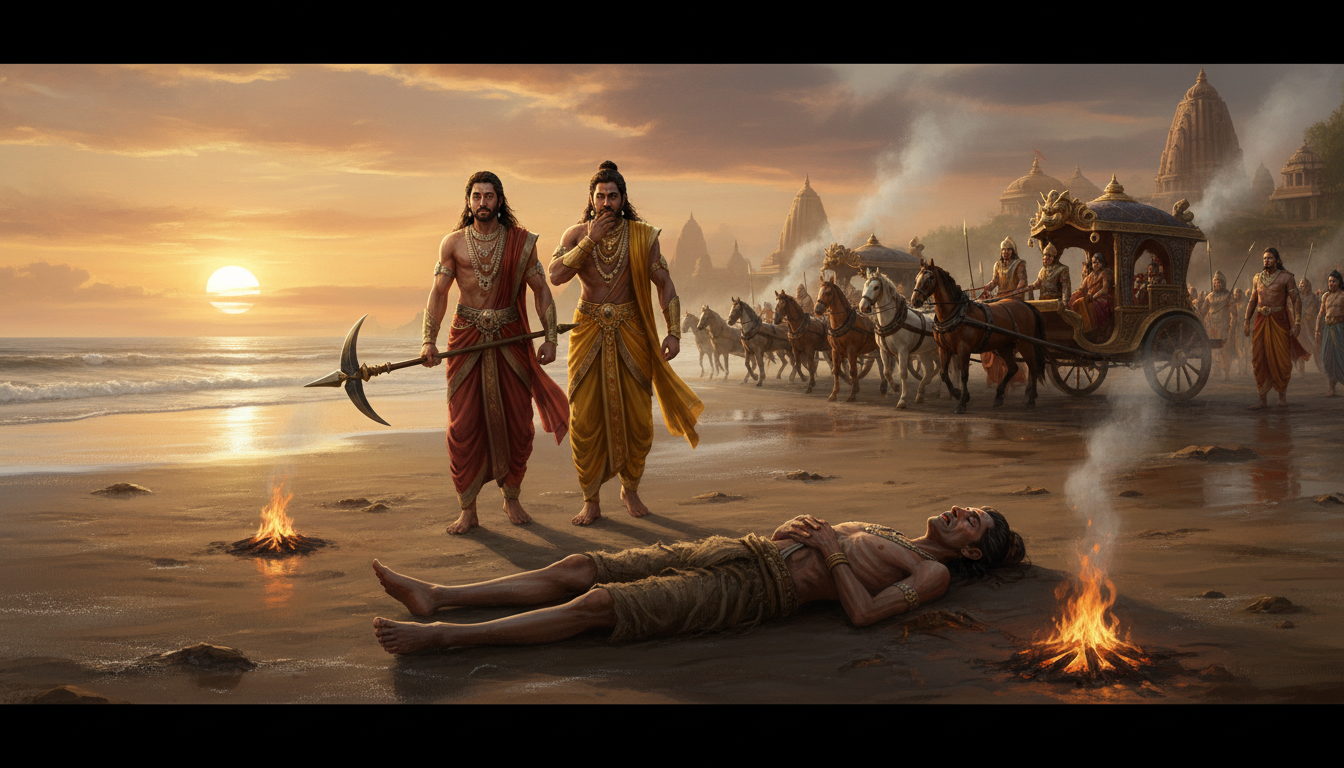
The Council at Prabhasa
The Yadavas find the exiles on the shore and argue about ending the exile by force
Down the Coast to the Salt Water
"The magnanimous monarch pursued his journey," said Vaishampayana, "and at different places on the shore of the sea he visited the bathing places, all of them sacred and pleasant and much frequented by men of the sacerdotal caste."
Yudhishthira took his plunge in each of them in proper form, with his younger brothers beside him, and offered libations to his forefathers and to the gods, and gave away riches to the leaders of the twice-born. At the Godavari, which falls directly into the sea, he bathed and was freed from his sins. He came down to the salt water in the Dravida land and saw the holy spot that passes under the name of Agastya, exceedingly sacred and exceptionally pure. He visited the feminine sacred spots.
And it was on that coast that he stood and listened to strangers tell him about his own brother.
The holy men of the place recited to him the well-known feat achieved there by Arjuna, chief of all wielders of the bow, which was beyond the power of human beings to perform, and the son of Pandu took the greatest delight in hearing it. He gave away thousands of cows at those spots. He walked along the sea road with Draupadi, telling his brothers all over again, and well pleased with the telling, how Arjuna had made his gift of kine.
A man who has lost a kingdom, walking the beach, hearing his absent brother praised by people who do not know who is listening. He was happy for the whole of that stretch of coast.
The Altar of Richika's Son
They came at last to Suparaka, holiest of all the coastal fords, and crossing a stretch of the shore beyond it they entered a forest celebrated over the whole earth, where the deities had practised asceticism in the old days and virtuous rulers of men had performed their sacrificial rites.
There, long-armed and travel-worn, Yudhishthira looked at the celebrated altar of Richika's son, that foremost of all wielders of the bow, with hosts of ascetics standing round about it. It was an altar fit to be worshipped by persons of virtuous life, and it belonged to a brahmana who had emptied the earth of kshatriyas twenty-one times over a single insult to his father. Yudhishthira, who had surrendered a kingdom rather than break a term of an agreement, stood in front of it a long while.
Beyond it lay the shrines: of all the gods, and of the Vasus, and of the hosts of the wind, and of the two celestial physicians, and of Yama the son of the sun, and of the lord of riches, and of Indra, and of Vishnu, and of the lord Creator, and of Shiva, and of the moon, and of the author of day, and of the lord of waters, and of the host of the Sadhyas, and of Brahma, and of the forefathers, and of Rudra with all his followers, and of the goddess of learning, and of the host of the Siddhas, and of many other immortal gods besides.
In those shrines the king observed various fasts and gave away large quantities of gems, and plunged his body in every holy spot there was, and then turned back and came again to Surparaka.
Twelve Days on Air and Water
From the same landing place he went on with his uterine brothers and came over to Prabhasa, whose fame the mighty brahmanas have spread throughout the world.
There, with his large red eyes, he washed himself with all his younger brothers and offered libations to the forefathers and to the celestial hosts, and Draupadi did the same, and so did all the brahmanas with them, and Lomasa among them.
Then he stopped eating.
For twelve days the king of the Kurus subsisted upon air and water. He performed ablutions through days and nights together, and he surrounded himself with fires kindled on every side and sat down in the middle of them under the coastal sun. That greatest of all virtuous men engaged himself in asceticism, at the edge of the sea, in the manner of a man who has decided that if he cannot act he will at least burn.
His brothers lay on the ground beside him and did not argue with him. Draupadi did not argue with him either. They had been in the forest long enough to know that there were two Yudhishthiras, the one who reasoned and the one who fasted, and that the second was not reachable by speech.
Word of what he was doing travelled north up the coast the way such news always travels, from ford to ford, from brahmana to brahmana, until it reached the two men in Dwaraka who could not hear it and do nothing.
What the Vrishnis Saw
Balarama and Krishna came with troops. The two leaders of the entire Vrishni tribe did not send a message and did not send an escort; they came themselves, down the coast to Prabhasa, to the Ajamidha king.
And when the Vrishnis got close enough to see, they stopped.
The sons of Pandu were lying on the ground. Their bodies were smeared all over with dirt. The daughter of Drupada, who had been queen in Indraprastha when the Vrishnis last stood in that hall, was in a state that the chronicler declines to describe beyond calling it sad. The grief of those armed men was so great that they could not hold it in, and they broke out into loud lamentations on the open shore.
Yudhishthira, whose courage was of the kind that misfortune can never cast down, got up and met them cordially. He greeted Rama, and Krishna, and Samva who was Krishna's son, and the grandson of Sini, and the other Vrishnis, and paid honour to each of them in a suitable form; and they paid honour in return to all the sons of Pritha, and were honoured back again. Then they seated themselves in a ring around Yudhishthira, as the celestial hosts seat themselves around Indra.
And he, highly pleased, told them everything. All the machinations of his adversaries. How he had lived in the forest. How Arjuna had gone up to Indra's abode to learn the science of arms. He told the last part with a gladdened heart, and they were happy to hear it.
Then they looked at him again, and at how exceedingly lean he and his brothers had become, and the majestic and magnanimous Vrishnis could not forbear, and the tears came out of their eyes of themselves.
Balarama Doubts the Whole Arrangement
"When the sons of Pandu and the Vrishnis reached Prabhasa," Janamejaya asked, "what did they do, and what was said there? For all of them were of mighty souls and proficient in every branch of science, and the Vrishnis and the sons of Pandu held one another in friendly estimation."
Vaishampayana said: they surrounded the sons of Pandu and waited upon them, and then Balarama spoke.
He was white as the milk of the cow, as the kunda flower, as the moon, as silver, as the root of the lotus. He wore a wreath of wild flowers. The ploughshare was his weapon, and he leaned on it and said something that nobody else in that circle would have dared to say aloud.
"Krishna, I do not see that the practice of virtue leads to any good, or that unrighteous practices cause any evil.
"Here is the magnanimous Yudhishthira in this miserable state, with matted hair, a resident of the wood, wearing the bark of trees for his garment. And Duryodhana is ruling the earth, and the ground does not yet swallow him up. From this, a person of limited sense would conclude that a vicious course of life is preferable to a virtuous one. When Duryodhana flourishes and Yudhishthira is robbed of his throne and suffering like this, what should people do? That is the doubt that is now perplexing everyone.
"Here is the lord of men, sprung from the god of virtue himself, holding fast to a righteous path, strictly truthful, of a liberal heart. This son of Pritha would give up his kingdom and his pleasure rather than swerve from the righteous path in order to thrive.
"And how is it that Bhishma and Kripa and the brahmana Drona and the aged king, the senior member of the house, are living happily, having banished the sons of Pritha? Fie upon the vicious-minded leaders of Bharata's race."
The Golden Trees on the Burning Ground
"What will that sinner, the chieftain of the earth, say to the departed forefathers of his race when he meets them in the world to come?" Balarama went on. "Having hurled his own inoffensive nephews from the throne, will he be able to stand there and declare that he treated them in a blameless way?
"He does not see, even with his mind's eye, how he came to be so sightless, or on account of what act he grew blind among all the kings of this entire earth. Is it not because he banished the son of Kunti from his kingdom?
"I have no doubt about what happened. When Vichitravirya's son and his sons perpetrated that inhuman act, he must have gone to the ground where the dead are burnt and seen flowering trees standing there of a golden hue. He must have asked them what they wanted, when they stood before him with their shoulders thrust forward and their large red eyes staring at him. And he must have listened to their advice. There is no other explanation for it. No man in his senses fearlessly sends Yudhishthira away into a forest with all his weapons of war about him and his younger brothers for company."
He turned and looked at the men lying on the sand.
"This Bhima, whose appetite is like a wolf's, can destroy a formidable array of hostile troops with the strength of his arms alone and no weapon in his hands. Whole armies in the field were unmanned by the sound of his war cry. And now the strong one is suffering hunger and thirst and is emaciated by his journeys. When he stands up for the fight at last, he will remember every day of this wretched forest life, and he will not leave one man alive out of his foes. Of that I am certain. There is not in the whole world a single soul whose strength and prowess is equal to his, and his body is wasted with cold and heat and wind.
"This Sahadeva vanquished all the kings of the south. Look at him now in an anchorite's dress. Nakula, valiant in battle, conquered single-handed the kings who ruled the west, and now he walks about the wood living on fruit and roots, with his hair matted and his body smeared with dirt.
"And this daughter of a king, who took her rise from beneath the altar during the pomp of the sacrificial rites, and who has been accustomed all her life to happiness. How is she enduring this?
"When the son of Virtue met with defeat, and his wife and his brothers and his followers and himself were all driven forth, and Duryodhana began to flourish, why did the earth not subside with all its hills?"
Satyaki Cuts Him Off
"O Rama, this is not the time for lamentation."
The grandson of Sini had heard enough. He got to his feet on the sand.
"Let us do the thing that is proper and suited to the occasion, even though Yudhishthira does not speak a single word. Those who have people to look after their welfare do not undertake anything themselves. They have others to do their work, as Saivya and the rest did for Yayati. Men who have appointed functionaries to take work upon their own responsibility may be said to have real patrons, and they meet with no difficulty, and they are not helpless beings.
"How is it, then, that the sons of Pritha have you and Krishna for their patrons, and Pradyumna and Samva, and myself, and that we five are able to protect all the three worlds between us, and the son of Pritha is living in a wood with his brothers?
"It is fit that this very day the army of the Dasarhas should march out, variously armed and in chequered mail. Let the sons of Dhritarashtra be overwhelmed by the forces of the Vrishnis and let them go with their friends to the house of the god of death. You alone, if you were roused, could surround the whole of this earth. He alone who wields the bow made of horn could do it. I ask you to kill Dhritarashtra's son with all his men, as the great Indra killed Vritra.
"Arjuna is my brother, and my friend, and my preceptor, and the second self of Krishna. This is why men desire a worthy son, and why a preceptor seeks a pupil who will not contradict him. The time has come for that excellent work, the best of all tasks and the hardest to perform.
"I shall baffle Duryodhana's volleys with my own weapons. I shall overpower everyone in the field. In my wrath I shall cut off his head with my shafts, which are little inferior to snakes and poison and fire, and with the keen edge of my sword I shall sever his head forcibly from his trunk in the field of battle, and then I shall kill his followers, and all of Kuru's race. Let the followers of Bhima look at me with joy in their hearts when I go on slaying the best fighting men on the side of the Kurus, as fire at the end of time burns vast heaps of straw."
The Killing Divided Among the Yadus
Having claimed Duryodhana for himself, Satyaki went on and gave the rest of the enemy away, name by name, as a quartermaster gives out stores.
"Kripa and Drona and Vikarna and Karna are not able to bear the keen arrows shot by Pradyumna. I know the power of Arjuna's son. He conducts himself on the field like the son of Krishna that he is.
"Let Samva chastise Dussasana by the force of his arms. Let him destroy Dussasana and his charioteer and his car together. When the son of Jamvavati becomes irresistible in a fight there is nothing that can withstand him. He routed the army of the demon Samvara when he was only a boy. He killed Asvachakra in a fight, whose thighs were round and whose muscular arms were of exceeding length. Who is there able to go forward against the car of Samva? As a mortal who comes under the clutches of death can never escape, so no man who comes under his clutches in the field returns alive.
"The son of Vasudeva will burn down with volleys of fiery shafts all the hostile troops, and Bhishma and Drona, who are great on a car, and Somadatta surrounded by all his sons. What is there in all the world, including the gods, that Krishna cannot encounter on equal terms once he has taken up his weapons?
"Let Aniruddha take his buckler and his sword, and let him cover the surface of the earth with Dhritarashtra's sons, their heads separated from their trunks and their bodies emptied of consciousness, as in a sacrifice the altar is overspread with the sacred grass laid upon it. And let Gada and Uluka and Vahuka and Bhanu and Nitha, and young Nishatha who is valiant in battle, and Sarana, and Charudeshna who is irresistible in war, perform feats befitting their race. Let the united army of the Satwatas and the Suras, with the best soldiers of the Vrishnis, the Bhojas and the Andhakas, kill those sons of Dhritarashtra in the field and swell their own fame throughout the world.
"And then let Abhimanyu rule the earth, for as long as this most excellent of virtuous men is engaged in fulfilling the vow he accepted and declared at the famous play of dice. Afterwards the virtuous king will protect the earth himself, all his foes having been defeated in battle by shafts discharged by us. Then there will remain no sons of Dhritarashtra on earth, and no son of the charioteer either. This is the most important work we have to do, and it will surely lead to fame."
It was a complete plan. It required nothing from Yudhishthira except that he sit still and let it happen, which was the one thing in it he could not give.
Won by His Own Arms or Not at All
"O scion of the race of Madhu," Krishna said, "there is no doubt that what you say is true. We accept your words, you of courage that is never weak.
"But this bull of the Kuru race would never accept the sovereignty of the earth unless it were won by the prowess of his own arms. Not for the sake of pleasure, nor out of fear, nor out of covetousness, would Yudhishthira ever renounce the rules of his caste. Neither would these two heroes who are mighty when mounted on a car, Bhima and Arjuna. Neither would the twins. Neither would Krishnaa the daughter of Drupada.
"He possessing the appetite of a wolf, and the winner of riches, are both unrivalled in fight throughout the world. Why should this king not rule the entire earth when he has the two sons of Madri to espouse his cause? Let the high-souled ruler of Panchala and the Kekaya king and ourselves put forth our united strength when the hour comes, and the enemies of Yudhishthira will be annihilated."
He had turned Satyaki's plan down without once saying that it would fail. It would not have failed. That was not the objection. The objection was that a kingdom handed to Yudhishthira by the Vrishni army in the eleventh year of a thirteen-year term would be a kingdom he had taken while his word was still lying broken on the ground behind him, and no throne set on that foundation would ever be worth sitting on.
Every Yadava on that shore understood it, and several of them were angry about it, and Balarama leaned on his plough and said nothing at all.
Truth Above Sovereign Power
Then Yudhishthira answered, and it was the shortest speech made on that shore.
"It is not strange that you should speak so, O scion of Madhu's race. But to me truth seems to be the first consideration, above the consideration of my sovereign power itself.
"It is Krishna alone who precisely knows what I am, and it is I alone who precisely know what Krishna really is. O most valiant of Sini's race, as soon as he perceives that the time has come for feats of bravery, he of the beautiful hair will defeat Suyodhana.
"Let the brave men of the Dasarha race go back today. They are my patrons, and they are the foremost of human beings, and they have visited me here. O you of immeasurable strength, never fall away from the path of virtue. I shall see you again when you are happily gathered together."
That was the whole of it. He did not thank Satyaki for the offer or apologize for refusing it, because to do either would have been to treat it as a thing that had been open to him.
So they made their mutual greetings, and did obeisance to the seniors, and embraced the youthful, and the valiant men of the Yadu race and the sons of Pandu separated on the sand at Prabhasa. The Yadus went home to Dwaraka. The Pandavas continued their journey to the sacred spots.
Having parted with Krishna, the virtuous king went on with his brothers and his servants and with Lomasa to the sacred river Payosini, whose fine landing place was built by the king of Vidarbha, and whose waters are mingled with distilled soma juice. He settled on its bank, and the many leaders of the twice-born who were delighted to find him there greeted him with excellent laudatory terms, and he had another year and more of it still to go.
Dharma Lesson
An oath that can be kept only when keeping it costs nothing was never an oath at all. Satyaki's plan would have worked, and that is exactly why Yudhishthira cannot take it; a throne won two years early is a throne standing on a broken word. Truth is the first consideration, above sovereign power itself.