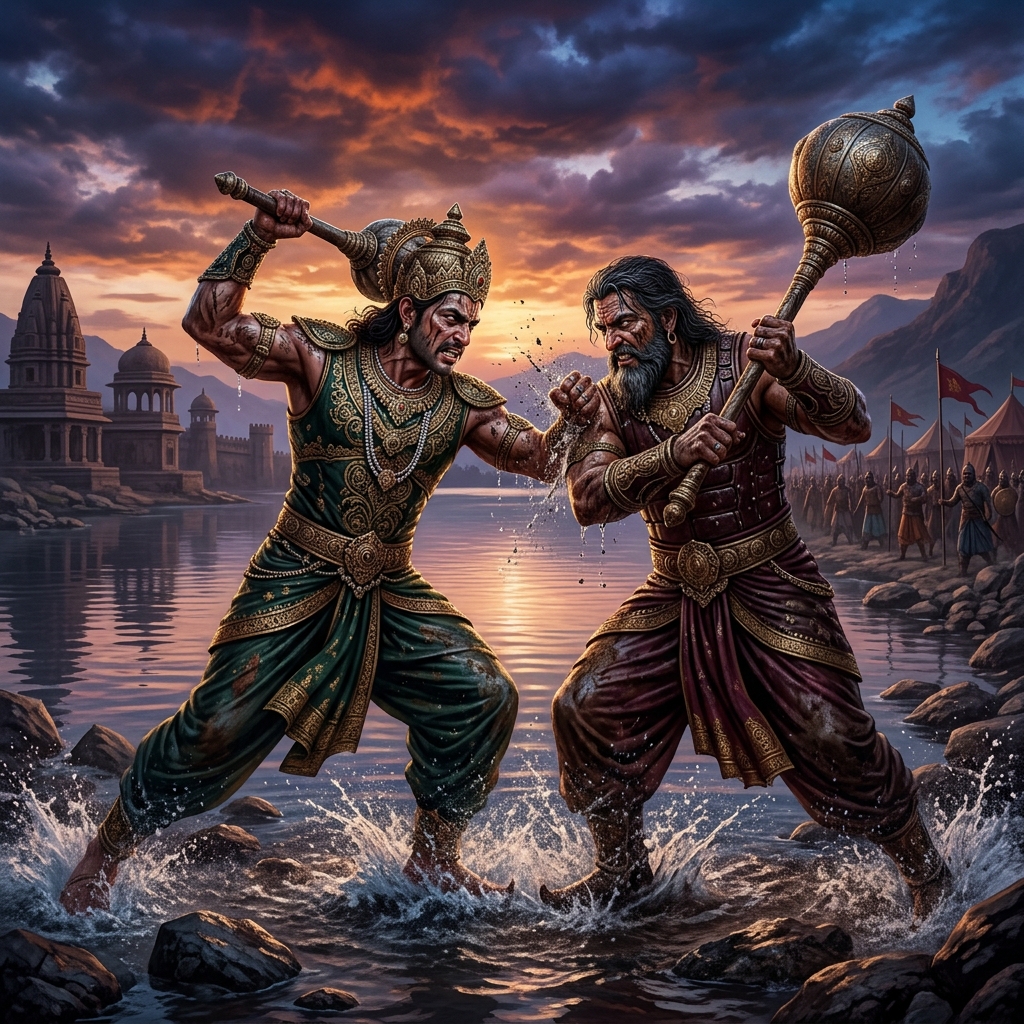
Balarama's Pilgrimage
Forty-Two Days on the Sarasvati While the World Burned
Neither Mace Will I Raise
As the armies gathered on the plain of Kurukshetra and messengers rode from camp to camp seeking allies for one side or the other, Balarama, elder brother of Krishna and greatest master of the mace in all the world, found himself courted by both Duryodhana and Bhima with equal urgency, for he had taught the art of gada yuddha to each of them in turn and each believed, not without reason, that his old teacher's blessing would tip the coming slaughter in his favor.
Balarama received them both, on separate occasions, in the same quiet hall, and gave them both the same answer. "You ask me to choose between my own pupils," he said, "as though a teacher's love were a coin that could be spent on one student without robbing the other. Duryodhana, you sat at my feet and learned the mace from my own hands. Bhima, you did the same, and you learned it well enough to make an old teacher proud even now. I will not lift my weapon against either of you. I could not do it and remain what I am."
Krishna, who had already committed himself wholly to the Pandava cause, understood his brother's refusal even as he could not share it. "You mean to stand aside entirely, then," he said, not as an accusation but as a statement he needed spoken aloud between them.
"I mean to leave," Balarama answered. "I will not stand at the edge of this field and watch kinsmen and pupils tear each other apart while I do nothing but witness it, as though watching were somehow less a betrayal than choosing. I will go instead where I can be of some use to my own soul, if to no one else. I have long meant to walk the Sarasvati from its mouth to its source, tirtha by tirtha, as our ancestors did. I will make that pilgrimage now, while the world settles what I cannot in conscience help it settle."
Yudhishthira, hearing of it, sent no reproach, understanding better than most the weight of a vow that cuts a man off from where he is most needed. Balarama took up his pilgrim's staff, left his mace and his golden plough behind in Dwaraka's keeping, and set out along the Sarasvati's bank as the drums of war began, at last, to sound behind him.
Upstream Against the Current
The Sarasvati in those days ran wide in places and thin as a thread in others, vanishing beneath the sand for long stretches only to surface again miles on, as though the river itself were a sage practicing austerities, disappearing from the world and returning renewed. Balarama walked its bank upstream, against the current, which the pilgrims of that country held to be the harder and more meritorious direction, since the river's flow tested the walker's resolve at every step rather than carrying him along for free.
At each tirtha, each sacred ford where the river widened into a pool fit for bathing, hermitages clustered on the banks, and ash-smeared sages came out to greet the tall stranger in pilgrim's cloth, not always recognizing at first that the man before them was Balarama of the Vrishnis, brother to Krishna, until something in his bearing or a word he let slip gave him away, and then they pressed him to stay, to hear the old stories of that particular ford, to bathe in its waters and receive whatever blessing tradition attached to the place.
He did not refuse them. At Prithudaka he heard the tale of how the river had once run in five channels before gathering itself back into one, a story the sages there insisted held some hidden teaching about how divided purposes must eventually rejoin a single course or come to nothing. At another ford, older even than that one, an ascetic told him of sacrifices performed there in the time before memory, when kings still walked among the rishis as equals and asked their counsel on matters of dharma too knotted for a kshatriya's blade to cut through alone.
Balarama listened to all of it with the attention of a man who genuinely wanted his mind occupied elsewhere, and if the sages noticed how often his gaze drifted eastward, toward the plain he had left behind, none of them remarked on it. He bathed at each ford as custom demanded, offered the prescribed oblations, and walked on the next morning before the sun had fully cleared the trees, driven by a restlessness that no tirtha, however sacred, could entirely still.
Forty-Two Days Against Eighteen
The war, Balarama knew even as he walked, would not wait on his pilgrimage, and news of it reached him anyway, carried by other travelers on the river road, by merchants and wandering ascetics who had heard rumors from the west of armies clashing on a scale the world had not seen before. He heard, days apart and always secondhand, of Bhishma's fall, of Drona's death, of Karna's rise and the terrible arithmetic of the war's mounting cost, and each report landed on him like a stone dropped into still water, sending ripples through a peace he had left Dwaraka specifically to find.
"Does it trouble you to hear it and do nothing?" a young hermit asked him once, at a tirtha somewhere past the river's midpoint, with the bluntness the very young sometimes mistake for wisdom.
"It troubles me more than anything I have known," Balarama admitted. "But doing something wrong troubles a man longer than doing nothing at all, and I judged, before I ever left, that I had no right action left to take on that field. My brother has chosen his side and I do not fault him for it; his path and mine were never required to run together. Mine is here, on this river, until my vow of forty-two days is spent."
So he continued, tirtha by tirtha, past the vanishing stretches where the Sarasvati sank beneath the earth and past the hermitages where old rishis still remembered the sacrifices of a more innocent age, while behind him, day by day, the war ground through its eighteen appointed days with a violence that would leave almost no one of that generation standing to remember it firsthand. He kept careful count of his own days as he walked, the way a man counts the strokes of an oar to keep from thinking of the distance still ahead, and as the fortieth day passed, then the forty-first, he understood that his pilgrimage and the war would very nearly end together, as though the two paths, one of penance and one of ruin, had been measured against the same clock from the very start.
Return to a Broken Field
On the forty-second day, his pilgrim's vow complete, Balarama turned east at last and walked from the river toward Kurukshetra, and what he found there was not the victorious camp of celebration he had half expected but a battlefield strewn with the debris of eighteen days' slaughter, silent except for a crowd gathered at the edge of Samantapanchaka, near the still waters of Dvaipayana lake.
He came upon them just as the last act of the war was beginning. Duryodhana, the sole surviving Kaurava of any consequence, had been found hiding in the lake's depths, drawn out by taunts he could not in honor ignore, and had agreed to settle the entire war's outcome in the oldest way his family knew: a single duel with the mace against Bhima, winner take the kingdom, loser take nothing at all. Krishna stood among the Pandavas watching, and when he saw his brother approaching across the ruined field, something like relief crossed his face, quickly replaced by a wariness Balarama did not fail to notice.
"You have come at the very end," Krishna said, "to watch the two men you refused to choose between settle it themselves."
"Then let me watch as a teacher watches his pupils," Balarama answered, "and judge the contest by the rules I taught them both, since apparently no one else here intends to enforce those rules on my behalf." He took his place at the edge of the dueling ground, still travel-worn, still carrying the dust of forty-two days on the Sarasvati's banks, and Yudhishthira came to stand near him, offering a grave nod of welcome that asked no explanation and received none.
The two combatants took up their maces. Bhima and Duryodhana circled each other on ground still soaked with the blood of everyone who had died to bring them to this single reckoning, and Balarama, who had shaped both their strokes with his own hands years before, watched with the particular dread of a teacher who suspects, already, that not everything he taught will be honored today.
The Crooked Blow and the Bitter Verdict
The duel ran long, both men matched almost too evenly for either to gain ground, until Krishna, watching Bhima tire against a Duryodhana who had always been the more graceful of the two with a mace, struck his own thigh in a silent signal that only Bhima, remembering an old vow, seemed to understand. Bhima's next blow came down not at the chest or head where gada yuddha permitted a strike, but below the navel, shattering Duryodhana's thighs and dropping him to the ground in a manner no fair contest of maces allowed.
Balarama's fury broke like a dam giving way. "You have struck him below the waist!" he roared, snatching up his plough where it lay bound to his side even in pilgrim's dress, advancing on Bhima with a violence that made the watching Pandavas scatter back. "I taught you the mace, not the butcher's cleaver! This is a crime against everything gada yuddha stands for, and I will not let it stand unanswered!"
It was Krishna who stepped between them, unarmed, one hand raised, his voice low and steady against his brother's rage. "Remember what this man did, before you weigh how he was brought down. Remember Draupadi dragged into the assembly hall by her hair while Duryodhana laughed and bared his thigh to her in insult. Remember the poison, the burning house, the cruelties this family never answered in kind, for thirteen years, waiting for dharma's proper season. Bhima swore an oath in that hall that he would break the very thigh Duryodhana showed Draupadi that day. He has only now kept a promise older than this war."
Balarama lowered the plough, but not his judgment. "Let history remember it plainly," he said, his voice cold and final. "Duryodhana will be remembered as a man who fell fighting gloriously, whatever his crimes, Bhima will be remembered as one who broke the rules to win. I do not say Bhima was wrong to hate him. I say a crooked victory is still crooked, whatever cause it serves." He would not stay to celebrate. He turned from the field that had swallowed a generation and walked back toward Dwaraka, carrying the memory of forty-two quiet days on a vanishing river, and the harder memory of the day he returned in time to see what the river could not wash away.
Dharma Lesson
Neutrality is itself a form of dharma when a duty cannot be honestly discharged both ways, and walking away from a war one cannot in conscience join is not cowardice but its own hard discipline. Yet neutrality does not exempt a witness from judgment: Balarama returns only to see, plainly, that even a just cause can be won by an unjust blow, and that walking the holy river does not spare a man the grief of what his kin did in his absence.