At the End of the Row
She had come to the end of the row. There was nothing beyond it but open ground and the birds.
Gandhari stood where her sons lay, and by the sight Vyasa had given her she saw them all at once, the whole hundred, spread across a stretch of Kurukshetra that a strong man could have walked in the time it takes to boil rice. The cloth was still bound across her eyes. She had tied it as a girl on the day she was given to a blind husband, so that she would take no pleasure of sight that he could not share, and she had worn it for a lifetime, and it had made her famous, and it had never once come off. It was wet through now, from the inside, and had been for some hours.
Krishna came across the field to her. He came alone, which was deliberate. He stopped a little way off and did not speak first, because there was nothing that could usefully be said first.
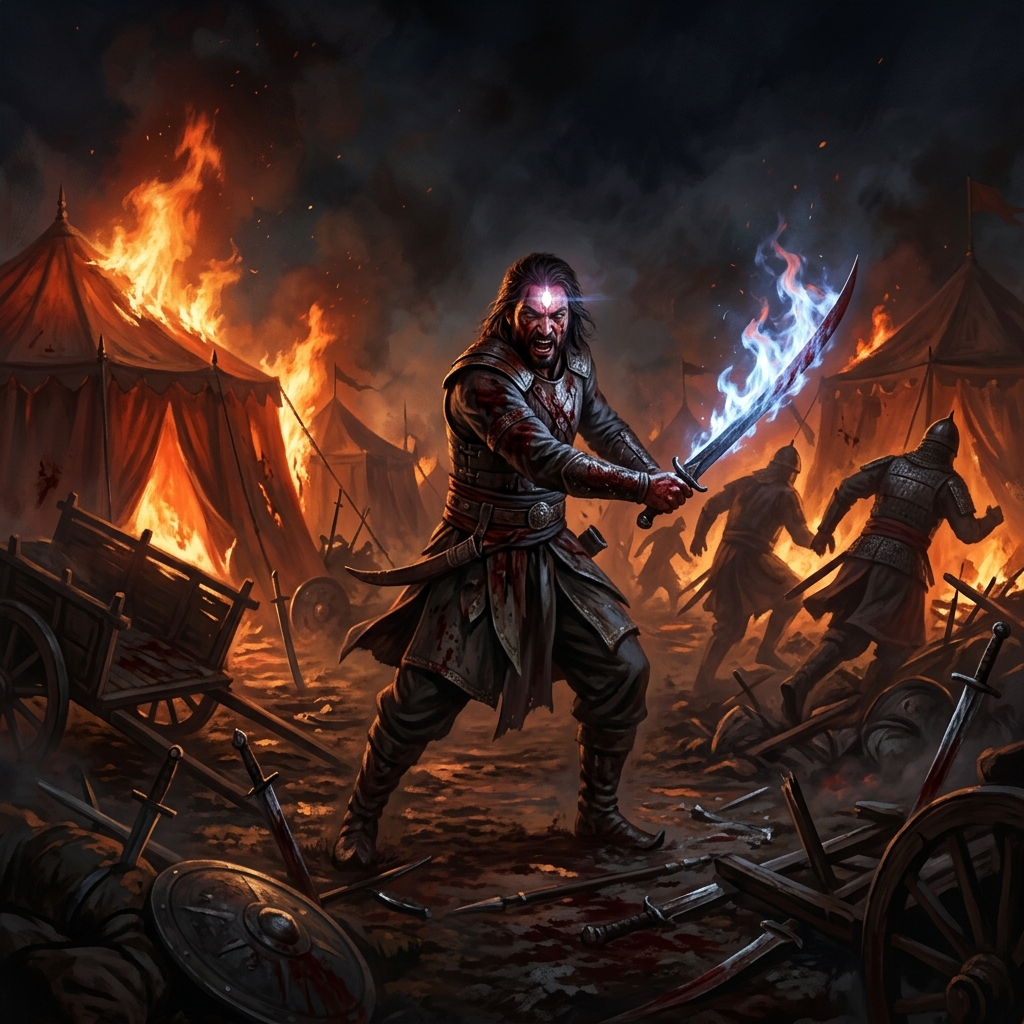
Around them the work of the field went on. Men were making pyres out of broken chariots. Somewhere a woman was still calling a name, patiently, the way one calls a child in from a garden at dusk.
Gandhari turned her covered face toward him with perfect accuracy.
"You came," she said. "I thought you might not. It would have been sensible not to."
"I would not have you say afterwards that I hid from you," Krishna said.
"No," she said. "You never hid from anything. That is exactly what I want to talk to you about."
You Could Have Stopped This
"You could have stopped this."
She said it quite evenly, as a person states a measurement.
"Do not tell me you could not. I have listened to men praise you for thirty years and I have believed rather more of it than you think. You are kin to both these houses. You were welcome in both. Kunti is your father's sister and my sons called you cousin, and every king on this field would have moved his army for one sentence out of your mouth. You went to Hastinapura as an envoy. You sat in that hall and you talked. And when the talking did not work you got into a chariot and you drove one side's horses for eighteen days.
"You had the strength, Krishna. There is not a man alive who thinks otherwise. You had the wisdom, and you had the standing, and you had the right, and you had every one of them together, which no one else in the world had. You did not lack anything at all. You watched the Kurus and the Pandavas walk at each other with their eyes open and you let them, and when it burned you kept your hands folded and your face pleasant.
"Another man I could forgive. A man who fails to stop a fire because he could not reach it is only unlucky. You could reach it. You stood beside it. You had water."
She stopped, and then went on more quietly, which was worse.
"And you knew. That is the part I keep returning to. You did not go to that hall hoping. You went knowing what would be refused, knowing what it would cost, knowing every name that would end up out here. You have been called the friend of both houses. Look at what a friend of both houses has arranged. There is my hundred. Count them for me, since I am told you see everything."
The Fruit of Indifference
"They tell me you are not a man," she said. "My daughters-in-law say it. The sages say it. My husband's brother said it to me once with tears in his eyes and I did not argue with him. Very well. Let us say it is true. Then I am not accusing a man of failing, I am accusing something else of choosing.
"If a man walks past a house that is burning with children in it and does nothing, we do not call him a bystander. We call him the one who burned it. He had hands and he had water and he chose the pleasure of watching over the labour of putting it out. What is the different word for it when the one who watches could have quenched it with a thought?
"You will tell me that they were free. That Duryodhana chose, and Karna chose, and Yudhishthira chose, and that you cannot take a man's choice from him without taking the man. I have heard the argument. I have made it myself, sitting in the dark, about my own son, for years, and it did not bring him in from the field.
"But you did more than let them choose, Krishna. You stood in the middle of it. You gave counsel. You turned wheels. You are not a stranger who happened to be passing the house.
"So here is what I am left with. If the strength of the Kurus and the strength of the Pandavas together, all of it in one place, all of it in front of you, could not be turned aside from ruin while you stood there and watched it, then the fault is not in their strength. Then you wanted this. And if a thing wants a harvest, let it eat the harvest.
"Take the fruit of your indifference. I am going to give it to you now, and you are going to take it, because I have spent a lifetime paying for the right to hand it over."
Thirty-Six Years
She took up water in her palm, and the men near enough to see what she was doing moved back from her.
"By whatever I have earned," she said. "By the service I have given my husband, who never once saw me. By the alms and the fasts and the vows. By the cloth on my eyes, which I have not lifted for a lifetime, not on my wedding day, not on the day my sons were born, not this morning. If any of it has any weight at all, let it all be spent on this one thing, and let me keep nothing back for myself.
"Thirty-six years from today, Krishna, you will stand where I am standing.
"Your own kinsmen will kill one another in front of you. Not strangers, not enemies, not an army come over the border. The Vrishnis and the Andhakas, your own house, your own sons and their friends, drunk, over nothing, with whatever comes to hand. You will watch it and you will not stop it, and this time it will be your hundred.
"The women of your city will come out onto the ground exactly as we came out this morning, without their ornaments, with their hair down, calling names that no one answers. The Vrishni women will weep as the Kuru women are weeping. Let them learn the sound from us.
"And you yourself, Janardana, will not die as kings die. No army, no chariot, no field with your friends around you. You will die alone in the wilderness with nobody to bring water, by the hand of a man of no importance who will not even know what he has done. That is my word. I have paid for it."
The water went out of her hand onto the ground, and for a moment nothing on that whole field made any sound at all.
So Be It
Krishna bowed to her. Then he smiled, and it was not a hard smile.
"So be it," he said. "Mother, so be it. I take it, and I thank you for it, and I want you to understand that you have not surprised me.
"There is no power anywhere that can destroy the Yadavas. I have seen men try. Gods have tried. They cannot be broken from the outside by anything that exists. That leaves one door, and it has always been standing open, and I have known which way it opens since long before this war was thought of. My people will end by their own hands or they will not end at all, and they must end, because they have grown too strong to be allowed to remain and too proud to be told so.
"You have not laid a fate on me. You have put words to a thing that was already standing in the road. I have been waiting for someone with enough merit to say it out loud, and it is fitting that it should be you, who paid for every syllable. You have helped me finish what has to be finished. What else was your austerity for?"
Then he said, more gently, "And you know as well as I do that when your son put his head in your lap and asked you to bless his victory, you did not bless it, but you did not stop him either. We are neither of us bystanders here."
Gandhari said nothing, because there was nothing in it that was untrue.
And so the seed of the last book was planted on the burning ground of the first, and in the thirty-sixth year it came up exactly as she had spoken it: the Yadavas at Prabhasa, the quarrel, the reeds turning to iron in their hands, the city taken by the sea, and Krishna alone under a tree with his foot showing through the leaves, and a hunter named Jara taking aim at what he thought was a deer.
For that afternoon there were only the two of them left standing on Kurukshetra: a mother with a wet bandage over her eyes and a hundred sons in the dust behind her, and the god who had let the age end the way an age must, and who had just been told the price, and had said yes.
Dharma Lesson
No one stands outside the consequences of a war he helped bring about, not even the divine. Krishna answers an accusation he could have crushed by accepting it, and by accepting turns a curse into a completion. Grief given a true target is not the same as grief given a just one, and he lets it land anyway.
Common Questions
What did Gandhari curse Krishna with?
Standing among her hundred dead sons, Gandhari spent every merit of her life on one curse: that thirty-six years later Krishna would watch his own kinsmen kill one another exactly as she had, that his city would be destroyed, and that he would die alone and unremarked in a forest.
Did Gandhari's curse come true?
Yes, exactly as spoken. In the thirty-sixth year the Yadavas quarreled at Prabhasa, reeds turned to iron clubs in their hands, and they destroyed one another; the sea took Dwarka; and Krishna, resting alone under a tree, was killed by a hunter's arrow that mistook his foot for a deer.
Why did Krishna accept Gandhari's curse without arguing?
He acknowledged that the end of his own house was already fixed and that nobody who helps bring on a war stands outside its consequences, not even the divine. By accepting a grief that had found a true target, he turned a curse into the completion of something already written.
Was Gandhari right to blame Krishna for the war?
The epic gives her the case: he had the power to stop the war and let it burn. Krishna's answer is that the Yadavas were doomed regardless and that Gandhari's own blindfolded silence let Duryodhana grow unchecked. Grief with a true target is not the same as grief with a just one.