The Ford Where the Moon Was Healed
At the place where the Saraswati river, after its long hidden course, at last opens into the western sea, the land forms a shore that the tradition ranks among the holiest tirthas in the world: Prabhasa, the shining ford.
The name remembers an old wound. Soma, the moon-god, married to the twenty-seven daughters of Daksha, favored one bride, Rohini, above her sisters and neglected the rest. Daksha, angered at the slight to his other daughters, cursed Soma to waste away, and the moon began to shrink night by night until it seemed the sky itself would go dark forever. The gods, seeing the world lose its light, begged Daksha to relent, and he allowed that the curse could not be undone but only eased: Soma would wane and then wax again, and here, where the Saraswati meets the sea, the god descended to bathe and was restored. The radiance he regained gave the shore its name, and pilgrims have come to that same water ever since, believing that what was broken here can be made whole.
It is fitting, then, that a shore devoted to healing and to endings in the same breath should thread itself through the whole span of the Mahabharata's story, touched by three of its central lives: an exile who found forgiveness here, a warrior who walked away from a war he could not bless, and finally the god himself, whose own long descent into a mortal body would end within sight of these same waters.
Arjuna's Wandering Year
Years before the war, when Arjuna was serving out a strange penance of his own making, - a year of exile he had sworn to himself after breaking in on Yudhishthira and Draupadi unannounced, for the five brothers had agreed that whichever of them intruded on another's private hour with their shared queen must leave the household for twelve months, - his wandering brought him at last down the western coast toward the sea.
He came to Prabhasa still travel worn, his bow across his back, a man observing his own vow more strictly than anyone had asked of him. Krishna met him there. The two had not seen each other in the months since Arjuna's road had carried him from one holy place to the next, and their meeting at that shore was without ceremony: an embrace, an exchange of news, the easy silence of a friendship that needed no repair no matter how long the gap between meetings.
Krishna would not let him pass by without turning the penance, for a little while, into something gentler. He carried Arjuna off up the coast to Dwaraka, where the Yadavas were keeping festival on Raivataka hill, torches strung through the trees, musicians competing with the surf, the whole clan turned out in its finest cloth. It was there, amid that same festival brightness, that Arjuna first looked on Krishna's sister Subhadra and could not look away; what followed between them belongs to another telling. For Prabhasa's part in the story, it is enough that the shore where Soma's light was restored also marks the place where an exile, walking his own penance to its end, was met by his dearest friend and given, for a season, something of that same restoration.
Balarama's River Pilgrimage
When the war at Kurukshetra could no longer be avoided, Balarama chose neither army. He loved Duryodhana as the finest student he had ever trained at the mace, and he loved Bhima as a kinsman of his own blood; asked to fight, he answered that he would rather absent himself entirely than see one pupil kill another under his own eyes.
So he left. On the day the two armies arrayed themselves for battle, Balarama set out instead from Prabhasa, at the mouth of the Saraswati, and began walking the river upstream, tirtha by tirtha, toward its source in the hills. He bathed at each holy ford in turn, fed brahmins, gave gifts, and let the war's whole eighteen days pass while he moved along that single thread of sacred water, deliberately out of reach of any message that might call him back to take a side.
He returned only at the very end, arriving in time to see Bhima and Duryodhana meet at last in the mace duel that would decide everything between them, and even then he came as a witness who could not fully forgive either the tactic that felled his student or the war that had made the duel necessary at all. But that quarrel belongs to the battlefield's own story. What Prabhasa keeps is the plainer fact beneath it: that this shore was the starting point of the one great absence in the whole war, the place from which a warrior capable of matching any man alive chose, quietly and without much explanation, to walk away.
The Last Festival
Thirty-six years after the war ended, the omens that had haunted Dwaraka for weeks turned from vague dread into open catastrophe, and Krishna, reading the signs as clearly as anyone, told his people it was time to leave the city and go to Prabhasa. He gave the command as a pilgrimage: let the clan travel down to the shore, bathe in the tirtha that had restored the moon's light, make offerings, and set their affairs in order.
At Prabhasa the Yadavas made camp along the same sand where Soma had once been healed, and for a while the mood was what any such gathering should have been, feasting, music, old warriors trading stories of the great war a generation behind them. But Krishna had forbidden wine in Dwaraka for exactly this reason, knowing his kinsmen's tempers, and on this shore, far from his direct eye, the prohibition slipped. Jars appeared. The Yadava chiefs, Andhakas and Vrishnis and Bhojas together, drank as they had not drunk in years.
It did not take much to light the old grievances waiting under the surface. Satyaki, deep in his cups, began needling Kritavarma over his part in the night raid on the sleeping Pandava camp after the war's last battle, a slaughter Satyaki had never forgiven. Kritavarma answered in kind, raising Satyaki's own killing of Bhurishravas in violation of the rules of combat. Voices rose. Hands went to sword hilts before any weapon had actually been drawn, and the festival that had begun as an act of devotion at the shore of healing tipped, in the space of a few furious sentences, toward something no one at Prabhasa that evening would survive to fully explain.
Eraka Grass and the End
The quarrel became a killing before anyone could stop it. Satyaki struck down Kritavarma where he sat, and the Bhoja warriors around Kritavarma turned on Satyaki at once; within moments the entire gathering was fighting, kinsman against kinsman, with no order and no side, only the drink-fed fury of decades of buried offense finally loosed all at once.
Weapons ran out fast in a camp meant for a pilgrimage rather than a war, but the shore itself supplied what was missing. Along the banks near Prabhasa grew thick stands of eraka grass, and when the Yadavas tore up handfuls of it in their rage, the reeds turned hard as iron clubs in their hands, the fulfillment of an old curse laid by sages the clan had once mocked, that a race grown too proud and too violent would one day destroy itself with weapons made from grass. Krishna's own son Pradyumna fell in that chaos, and so did Satyaki, and so, in the end, did most of the chiefs who had led the Yadavas since before the great war. Balarama, seeing the ruin around him and unable to bear it, withdrew to the sea's edge nearby and gave up his life in meditation, a great serpent said to leave his body as he did.
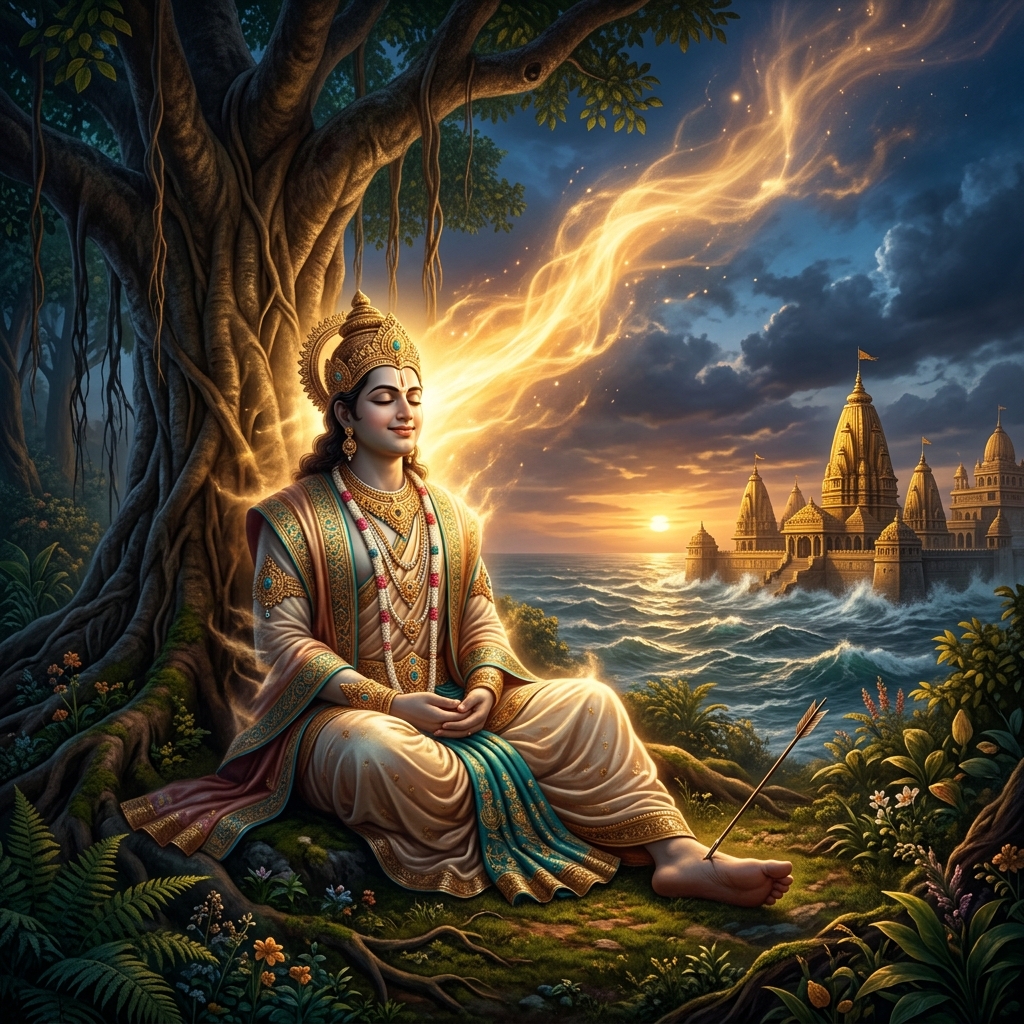
Krishna alone walked out of the massacre living, the last of a race he had ruled through both its glory and its undoing. He turned from Prabhasa's blood soaked sand into the quiet forest close by the shore, and there, seated in thought beneath a tree, his own end found him at last, the god's long sojourn among mortals closing within sight of the same water that had once restored the moon's stolen light.
Dharma Lesson
Even a place devoted to healing cannot undo what pride and old grudges have set in motion; the same shore that restores the moon's stolen light also receives the Yadavas' self-destruction, showing that no tirtha substitutes for the discipline a clan refuses to keep among itself. Krishna's own quiet end there teaches that even the divine, having taken a mortal life, must lay it down in the ordinary way.