The City of Widows
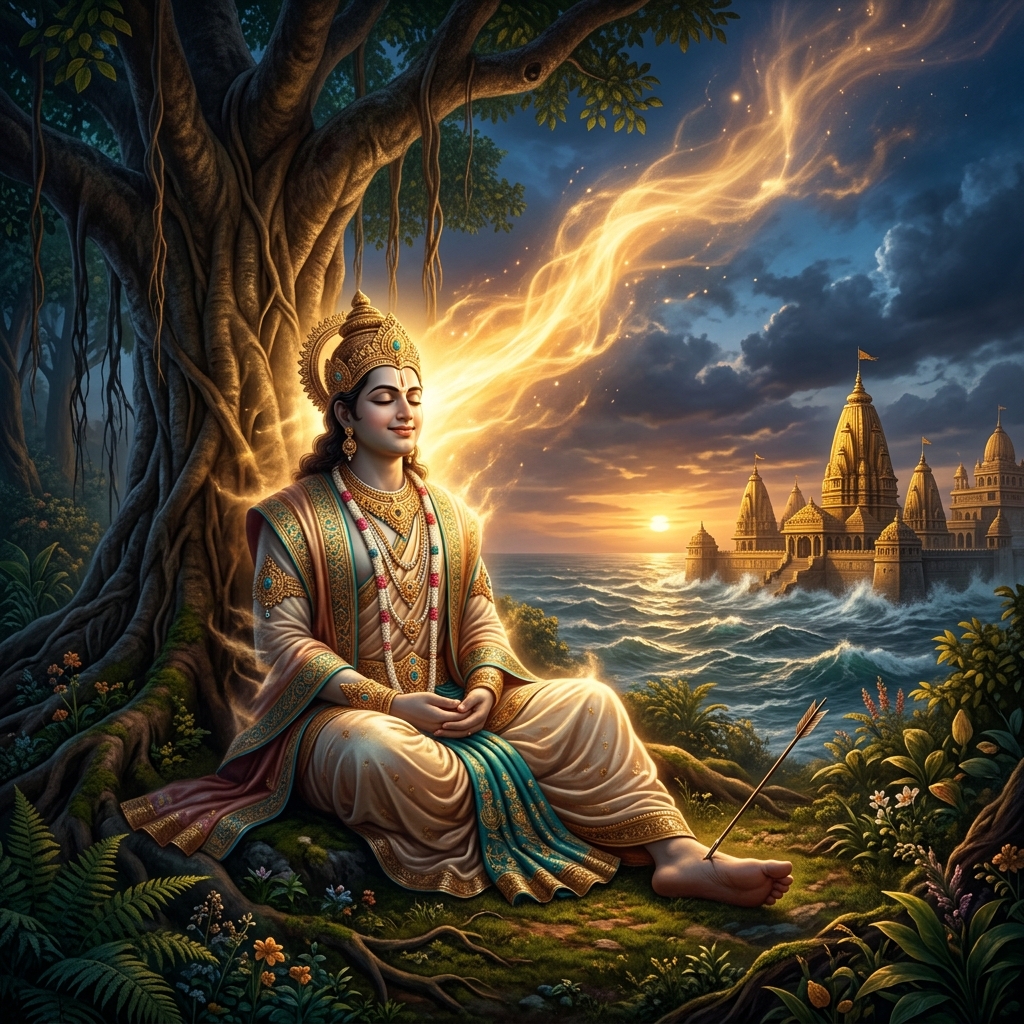
Word reached Arjuna in fragments before it reached him whole: that the Yadavas had turned upon each other on the shore at Prabhasa, clubbing one another to death with reeds that turned to iron in their hands; that Krishna himself had gone from the world, struck by a hunter's arrow as he sat in meditation in the forest; that the sea itself was rising to claim Dwaraka street by street. Arjuna had heard of catastrophes before. He had stood in the middle of catastrophe and lifted the Gandiva against it. This one he could not stop, because it was already finished by the time the news found him.
He drove to Dwaraka anyway, because someone had to see what remained.
What remained was a city of widows. Vasudeva, Krishna's father, was still living when Arjuna arrived, an old man made older by grief he had no more sons to carry, and it fell to Arjuna to sit with him through his last days and then to light his pyre. After Vasudeva he lit others - warriors he had fought beside, kinsmen he had dined with, men whose names Krishna had once used lightly across a hundred councils. The rites went on for days. Arjuna performed each one exactly, the water poured, the mantras spoken, because precision was the only comfort he had left to offer.
Between the funerals he walked streets he remembered full of noise and found them already lapped by seawater at the edges, the tide climbing a little further each evening as though counting down something. Dwaraka was being erased, not conquered - erased the way a name is rubbed from a tablet once its purpose is served. Arjuna understood, without yet being able to say it aloud, that he was standing inside a lesson about endings he had not asked to learn.
Sixteen Thousand Queens
When the last rites were done, Arjuna turned to the living. Sixteen thousand women remained in Dwaraka - queens of Krishna's household, wives of the dead, sisters, daughters, old attendants who had served three generations of the Yadava line - along with their children and whatever the city's elders could still carry. There was no fleet left to save them by sea, and the sea, in any case, was the enemy now, rising past the harbor walls a little more each tide. The only road open was the long one east and north, through the Five Rivers country toward Kurukshetra and Indraprastha, and Arjuna was the only warrior left standing who could walk it with them.
He had led armies before. This felt nothing like leading an army. An army moved at the pace of its fastest units; this column moved at the pace of its oldest grandmother and its youngest infant, and Arjuna set that pace himself, walking at the head of it with the Gandiva across his shoulder like a promise he intended to keep. Behind them, when he allowed himself to look back, Dwaraka was going under in earnest now, the golden gates and the high terraces where he had once sat drinking with Krishna sliding beneath grey water as though the city had never been anything but a story someone was closing.
He did not look back often. Ahead of him were sixteen thousand people who trusted that the man who had humbled Bhishma and Karna could certainly bring them safely home. Arjuna trusted it too, or told himself he did, and set his eyes on the road.
The Five Rivers
The column crossed into the country of the Five Rivers footsore and thinning, and it was there, in territory Arjuna had ridden through as a conqueror in his youth, that the Abhira herdsmen came down on them.
They were not an army. They were cowherds and cattle raiders armed with staves and slings, men who tended animals for a living and had likely never faced a warrior in their lives, drawn out of the hills by the sight of an unescorted column loaded with the ornaments of a fallen kingdom. Against any of the Kaurava host, against Karna or Bhishma or Drona, such men would have been nothing, a detail beneath a hero's notice. Arjuna had broken far worse than this in a single afternoon at Khandava, in a single hour on the field at Kurukshetra.
He turned to meet them without a second thought, the Gandiva already rising into his hands the way it always had, an extension of his arm that required no more effort than raising the arm itself. He set the string, drew, and reached for the mantras that called the Gandiva's arrows to their marks - the ones he had spoken since Drona first taught them to him, the ones that had never once failed to come when summoned.
They did not come.
He tried again, and the silence inside him where the mantras should have been was total, a room he had lived in for decades that had simply been swept empty overnight. The string would not draw fully. The arrows, when he managed to loose them, fell short or wide, the aim of a boy holding his first bow rather than the aim of Arjuna.
When the Gandiva Failed
The Abhira fell upon the column with sticks and slings and the confidence of men who sensed, faster than Arjuna himself could admit it, that something had gone fundamentally wrong with the world's greatest archer. His quivers, replenished a hundred times by the Gandiva's own inexhaustible power throughout every war he had fought, ran dry within the hour, arrow after arrow spent for nothing and none renewing behind them. He drew the string until his shoulders screamed and felt only an ordinary man's strength answering him, no more.
Around him the column broke. Herdsmen with staves waded into the ranks of terrified women and drove off whoever they could seize - queens of the Yadava house, some of them Krishna's own wives, wrenched from the column and herded away toward the hills while children screamed for mothers who could not reach them and mothers screamed for a protector who stood twenty paces off, bow slack in his hands, unable to loose a single shaft that flew true. Arjuna, who had turned back Bhishma's arrows in their thousands, who had faced Karna's Vasavi weapon and lived, who had held the middle of Kurukshetra's field against the world, could not drive off a band of cattle thieves.
He did not stop trying. He fought with the flat of the bow when the arrows failed him, with his hands when the bow failed him too, and still the raiders carried off what they wanted and vanished back into the hill country before what remained of the column could regroup. When it was over Arjuna stood in the dust among the survivors, the Gandiva hanging from his fist like a dead branch, and understood that whatever had left him was not coming back by force of will. Something larger than exhaustion had happened to him, and he did not yet have the word for it.
Time to Go
What remained of the column reached Indraprastha at last, thinned by grief and by the hill country's raiders, and Arjuna delivered the survivors into what safety the city still offered before he sought out the one man he trusted to tell him what had happened to him. He found Vyasa, as he so often had at the turning points of his life, ready and apparently waiting.
Arjuna told him everything without pride: the mantras gone silent, the string he could barely draw, the queens taken from under his hands while the greatest bow in the three worlds hung useless at his side. He asked, plainly, whether some sin of his had caused it, some fault in the rites he had performed at Dwaraka, some failure of nerve at the moment the Abhira came down on the column.
Vyasa's answer was gentler than the question deserved and harder than Arjuna wanted to hear. The Gandiva and the power to wield it as he had wielded it, Vyasa said, were never truly his - they had been lent to him by the gods for a single purpose, the purpose of Krishna's own work in the world, the burden the earth needed lifted from her at Kurukshetra and after. That work was finished now. Krishna had returned to his own place, and the loan that had made Arjuna its instrument for eighteen years had come due and been called in, the way every loan eventually is. There was no dishonor in a debt collected. There was only the plain fact of it, and the plainer fact that followed from it: it was time, Vyasa said, for the Pandavas to consider what came after mastery, and to prepare to go.
Arjuna listened, and for the first time since Dwaraka, the humiliation in his chest began to loosen into something closer to understanding.
Dharma Lesson
Every gift of power, even one won through austerity and divine favor, is given for a purpose and returns to its source when that purpose ends. Arjuna's shame was not weakness but proof the debt had been called in. Strength borrowed for dharma cannot be hoarded once its work is done.