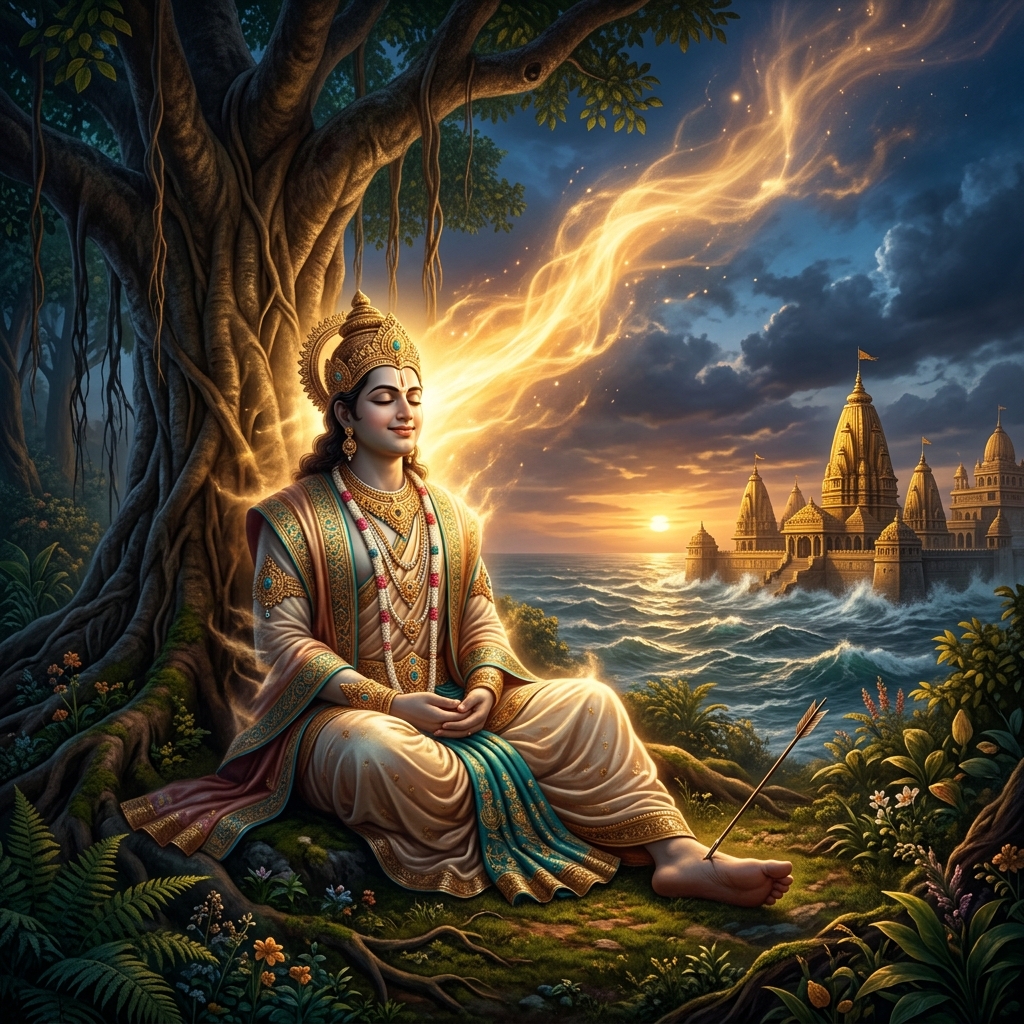
The Great Departure
Krishna's Death, the End of the Yadavas, and the Pandavas' Climb to Heaven
Thirty-Six Years of a Just Reign
For thirty-six years Yudhishthira had ruled the earth from Hastinapura, and the world had been at peace. The rains came in their season. The fields gave grain. No widow wept for want, and no orphan begged at a closed door. The son of Dharma had governed exactly as Bhishma had counseled him from the bed of arrows: with mercy toward the weak, firmness toward the proud, and a scrupulous honesty that had become a kind of legend among the people.
The brothers had grown old in their offices. Bhima, still the broadest-shouldered man in any room, oversaw the kingdom's strength. Arjuna, his hair silvered now, remained the bow of the realm, though the realm had not needed a bow in many years. Nakula tended the horses and the borders; Sahadeva, quiet and far-seeing, counseled in the inner chamber. Draupadi, queen of five kings, had borne the years with the same straight back she had carried into the gambling hall a lifetime ago. Their five sons were long dead, fallen in the night-slaughter at Kurukshetra, and the line of the Pandavas now ran through one slender thread only: Parikshit, the son of Abhimanyu and Uttara, a boy born from a dead father and a stricken womb, revived in the cradle by Krishna's own hand.
It was a good reign, and a quiet one. But Yudhishthira had begun, in those last years, to feel a strange weather moving in the world. Omens troubled the priests. The seasons slipped a little out of their courses. Men spoke more sharply to one another in the markets than they once had. The king said nothing of it, but he watched, and he waited, as a man waits who has been told a thing is coming and does not yet know its shape.
Far to the west, in the golden city of Dwaraka, the shape of it was already taking form. And one grey morning a single traveler, dust-grey to the knees, came up the road from the sea country and asked at the palace gate to speak with the king. It was the beginning of the end of an age, and only one man in Hastinapura yet knew it: the man at the gate, who had seen what the sea had swallowed.
The News From the Sea
The omens in Hastinapura had been growing for months. The fires on the altars burned with an evil colour and gave off no warmth. Jackals howled at the rising sun. Women dreamed of a black, toothless figure who walked through the city at night counting the houses. The cardinal directions seemed wrapped in a haze of dust, and the horizon at evening was the colour of old blood. Yudhishthira summoned the priests and the astrologers, and they could only repeat what their instruments told them: a great calamity had occurred, or was occurring, far away, and its long shadow had reached the Kuru land.
While the king sat with this dread, no caravan came from the west. For days no merchant, no pilgrim, and no letter arrived from Dwaraka. The road that had always carried the traffic of the Yadava country lay empty, and the emptiness itself became a kind of message that the king could not read but could not stop reading.
His unease sharpened into fear, and his fear took a single name: Arjuna. His brother had gone to Dwaraka months before, to be near Krishna, and had not returned, and had sent no word. "Something has happened in the country of the Vrishnis," Yudhishthira said to his brothers in the council chamber. "I feel it as a man feels a wound he cannot yet see. Krishna is the root of our house. If the root has been struck -" He did not finish.
Bhima rose and went himself to the western gate to watch the road, and Sahadeva, who read the sky better than any priest, said only, "The age is turning, brother. I have seen the constellations slip. What is coming, no man set into motion and no man can stop." They waited then in a silence that filled the great palace, the five aging brothers and their queen, while the dust-coloured days went by and the road from the sea stayed empty - until at last, gaunt and grey and changed beyond knowing, Arjuna came home.
Arjuna's Account of Dwaraka's Fall
Arjuna came through the gate on foot, leading no horse, carrying no weapon but the great bow Gandiva slung uselessly across his back. He had aged ten years in a season. His eyes were the eyes of a man who had stood at the edge of the world and seen it crumble. His brothers ran to him, and Draupadi came, and the whole house gathered, and for a long while the hero could not speak at all. When the words came they came in a low, broken voice, and the hall went utterly still to hear them.
"They are gone," Arjuna said. "All of them. The whole race of the Yadavas - the Vrishnis, the Andhakas, the Bhojas - every man of fighting age. They killed one another on the beach at Prabhasa. It began as a drunken quarrel at a festival and ended with brother butchering brother in a frenzy none of them could stop. There were no proper weapons. They tore up the iron-bladed grass that grew along the shore and it became, in their hands, maces and swords that cut like steel. By nightfall the sand was a field of the dead. Krishna's own sons. Satyaki. Kritavarma. The boys we played dice with. All of them."
He drew a long breath. "Balarama walked into the forest and gave up his body in yoga. And Krishna -" Here the great archer's voice failed entirely, and the queen herself reached out to steady him. "Krishna lay down beneath a peepal tree when it was over, and a hunter loosed an arrow into the brush thinking he saw a deer, and struck him in the heel. He smiled at the man. He told him not to grieve. And then he left his body, and the lord of all our days was gone."
No one in the hall spoke. Yudhishthira had gone white as ash. Bhima's great hands hung open at his sides. It was Krishna - the friend, the cousin, the charioteer, the god who had walked among them as a man - whose death the room could not contain. He had been the unseen pillar under everything they had built. Now Arjuna spoke the words that brought the pillar down. "And the sea has taken Dwaraka. I saw it with my own eyes. The waves came in and the golden city slid beneath them, street by street, tower by tower, until there was nothing but water where the home of Krishna had stood. The ocean reclaimed it within hours, as if it had never been."
The Gandiva That Would Not Draw
There was more, and the worst of it for Arjuna was not the dead but what had happened to himself. He told it haltingly, ashamed, as a man confesses a failure he cannot understand. "Krishna had charged me, before the end, to lead the women and children of Dwaraka to safety. The widows of the slain, the old men, the little ones - sixteen thousand and more. I gathered them and brought them out along the inland road toward Hastinapura, to bring them here, to give them homes among us."
He closed his eyes. "On the road we were set upon by bandits - common bandits, rough herdsmen with cudgels. Not warriors. Not kings. The kind of rabble I would once have scattered with a single quarter of my strength. And I could not. I reached for Gandiva and strung it, and I called for my celestial weapons - the Agneya, the Brahmastra, the divine missiles Indra and Shiva gave me, the weapons that won Kurukshetra. And nothing came. The mantras would not rise in my mind. The bow itself fought me. I could barely draw the string that I have drawn ten thousand times without thought. My arrows fell short, or fell limp, and the herdsmen drove through us and carried off the women - Krishna's own wives among them - before my eyes, and I stood there an old man with a dead bow, useless, unable to lift a hand to stop it."
The shame of it broke his voice again. "My strength is gone, brother. The strength that was never mine - I see that now - it was lent to me for the work of the age, and the age is over, and it has been taken back. The same hands that held back Bhishma and Karna could not hold back a band of cattle-thieves. Gandiva is wood again. I am an old man."
Yudhishthira listened to all of it without interrupting, and when his brother had finished, the king did not weep, and did not rage, and did not comfort. He sat very still, and on his lined face there came a strange, settled clarity, like the clarity of a man who has finally heard the answer to a question he had carried for years. He understood, now, what the omens had meant. Krishna gone. The Yadavas gone. Dwaraka gone. And Arjuna's divine power lifted away like dew off grass in the sun. These were not separate disasters. They were one thing, and it had a name.
Yudhishthira Reads the Age
When the hall had emptied of all but his brothers and Draupadi, Yudhishthira spoke at last, and his voice was quiet and certain. "Listen to me, all of you, and do not grieve more than is needful, for what has come was always going to come, and we have only failed to see it until now.
Krishna told us once, on the field at Kurukshetra and many times after, that he had a work to do upon the earth and that when it was finished he would go. The work is finished. He has lightened the earth of the burden that pressed upon her - the unrighteous kings, the arrogant clans, his own proud kinsmen last of all. He has set the world in order and then dismantled the instrument with his own hand, the Yadava race, lest it become in turn the very burden he came to lift. That is why they died on the beach. That is why he did not save them. He was the one who let the curse run its course."
Sahadeva nodded slowly, for he had read the same thing in the stars. Yudhishthira went on. "And Arjuna's bow - do you not see it? The celestial weapons came to us for one war, the war of the age. They are gone because the age is gone. The era we were born to serve, the Dvapara, the third age of the world, ended on the day Krishna closed his eyes beneath that tree. The Kali age has begun. It is the last and darkest of the four ages, in which dharma will stand on a single leg, and men will grow small and grasping and short of life and short of faith. The omens you have all seen - the bloody horizon, the cold altar-fires, the jackals at noon - these are the footfalls of Kali entering the world."
He looked around the circle of aged faces. "We do not belong to this age. We were made for the one that has ended. To stay now, to cling to thrones and gold while the world coarsens around us, would be to outlive our own purpose - to become old men feeding at a table that is no longer ours. Dhritarashtra and Gandhari and our mother Kunti understood this when they walked into the forest and gave their bodies to the fire. Bhishma understood it when he chose his hour upon the arrows. Now it is our turn to understand it. Our time is over. It is time to renounce everything and go."
The Resolve to Renounce
No one in that small circle argued with him. They had followed Yudhishthira through the gambling hall and the forest and the war and the long grey reign, and they had learned that when the son of Dharma saw a thing clearly, the thing was true. But the words had to settle in each of them, and they settled differently.
Bhima sat with his huge hands on his knees and stared at the floor for a long time. He had loved the world bodily - food, strength, the heat of battle, the weight of his mace, the laughter of a full hall. To renounce it all was harder for him than for any of them. But he had also loved his brothers more than the world, and he raised his head and said only, "Where you go, I go. I have never let you walk a road alone, brother, and I will not begin now."
Arjuna, already half a ghost since Dwaraka, gave a single nod. There was nothing left in the world he wanted. The center of it had been Krishna, and Krishna was gone. Nakula and Sahadeva, who had always taken their cue from their elder brothers, bowed their heads in assent. And Draupadi - the queen who had been dragged by her hair, who had vowed her vengeance and seen it fulfilled, who had borne five sons and buried all five - Draupadi looked at her five husbands and said, "I came into this house with you, and I will leave it with you. I have nothing more to want from the world either. Let us go while we can still walk out on our own feet, and not be carried out."
So it was resolved, in a quiet room, by six old people who had once shaken the earth. They would lay down the kingdom. They would distribute their wealth. They would set the next generation upon the throne and walk north into the Himalayas, toward the realm of the gods, on the journey called the Mahaprasthana - the Great Departure - from which they intended never to return. They would go not in defeat but in completion, the way a guest rises from a long feast and thanks the host and steps out into the night. The decision made, a strange lightness came over them, the lightness of men who have finally set down a load they did not know they were still carrying.
The Crowning of Parikshit
The first duty of a renunciate king is to leave the kingdom in safe hands, and Yudhishthira did this with the same care he had brought to every act of his reign. He would not let the throne fall empty into the new and dangerous age. He summoned the priests, the elders of the city, and the people, and before them all he named his successor: Parikshit, the son of Abhimanyu, grandson of Arjuna, the last living thread of the Pandava line.
The boy was young, but he had been raised within sight of the throne and tutored by Kripa in the arts of war and the arts of rule. The whole tragedy of the war had gathered itself into this one child - born of Abhimanyu who fell in the chakra-vyuha, carried in the womb of Uttara, struck even in that womb by Ashwatthama's last cruel weapon, and brought back to life by Krishna himself, who had vowed the line would not end. Now that line would carry the Kuru name into the Kali age. Yudhishthira anointed the boy's brow with the sacred water, set the crown upon his head, and seated him upon the lion-throne of Hastinapura, and the priests chanted the long mantras of consecration while the city stood witness.
But a boy-king needs a steady hand beside him, and Yudhishthira had thought of this too. He called forward Yuyutsu - the one son of Dhritarashtra who had crossed over to the side of dharma on the first day of the war, the half-brother of the hundred Kauravas who had refused to die with them. Yuyutsu was old now, sober, loyal, and untainted by the family's long crimes. "You will be the guardian and the minister of this boy," Yudhishthira told him. "Govern with him until his own judgment is full-grown. Keep the dharma of this house alive in him. I leave the kingdom in your two hands - the young king and the old counselor." Yuyutsu bowed and accepted the charge, and so the rule of Hastinapura passed, in a single unbroken motion, from the generation of the war to the generation that would have to live in its long aftermath.
The Distribution of Wealth
A renunciate keeps nothing, and so before he could leave, Yudhishthira gave away everything that was his to give. He opened the long treasuries of Hastinapura that had been filling for thirty-six years of peaceful reign, and he distributed their contents with the same exactness he had brought to justice. Gold and jewels and rich cloth went to the Brahmins, that the rites and the learning of the land might continue. Cattle and grain and tools went to the householders and the farmers, that the people he had governed would not be left poorer for his going.
He was careful and he was thorough. He arranged pensions for the old servants of the palace, dowries for the daughters of those who had served the house, provision for the widows and the maimed left over from the great war, who were the kingdom's permanent debt of honour. He confirmed the lands and the titles of those who held them justly. He settled disputes that had been waiting on his judgment, so as to leave no tangle behind him for the boy-king to inherit. He performed, with the priests, the great memorial rites - the shraddha offerings - for Krishna and for Balarama and for all the slain Yadavas, and for his own kinsmen, so that the dead would go fed and honoured into the next world.
The five brothers and Draupadi went through the rooms of the palace that had been their home, and one by one they laid down the things of their station. The treasury was emptied not in waste but in blessing; the king meant to walk out of his life owning nothing and owing nothing, leaving no man behind him the worse for having known him. When it was finished the great house stood lighter and barer, its wealth flowing outward into the city like water released from a dam, and the people understood at last that this was no festival of giving but a farewell - that their king was settling his accounts with the world because he meant to leave it.
The Farewell to the City and the Women
When the work was done the news ran through Hastinapura that the Pandavas were leaving, not for a season but forever, and the city poured into the streets to see them go and would not be comforted. These were the people Yudhishthira had governed all their lives. They had been born under his peace, married under his peace, raised their children under his justice. Old men who remembered the dice game and the exile, young men who knew the Pandavas only as the calm grey kings who had always been there, women holding up infants to see the great ones pass - all of them wept, and many fell at the brothers' feet and begged them not to go, or begged to be allowed to follow.
Yudhishthira moved among them and spoke to them gently. "Do not weep. We do not abandon you. We leave you a good king and a wise minister, and we leave you the dharma we tried to keep. A man cannot hold a kingdom past his hour any more than he can hold the sun in the sky past evening. Our hour has come. Live justly. Care for one another. Honour the gods. We carry the love of this city with us into the mountains, and you will carry our memory, and that is enough." Bhima, who could not bear weeping, embraced the men he knew and turned his face away.
Hardest of all was the parting from the women of the house who would remain behind. Subhadra, Krishna's sister, Arjuna's wife, the mother of the fallen Abhimanyu and grandmother of the new young king, came before her husband and her brothers-in-law. She had already lost her brother Krishna and her whole Yadava people; now she would lose her husband and the last of her family. Yudhishthira took her hands and gave into her keeping the thing that mattered most: the boy-king, her own grandson. "He is yours to watch over now, Subhadra. Be to Parikshit what a mother is. Guide him as we would have guided him. The line of Krishna and the line of the Pandavas meet in this child - keep it safe." Subhadra could not speak for her tears, but she bowed her head and took the charge, and the women of the inner palace gathered around her, weeping, as the men they had married and served and loved made ready to put off the world.
Casting Off the Robes of Kings
Then came the moment that made it real. In the inner courtyard, before the household priest and the assembled house, the five brothers and Draupadi put off, piece by piece, every mark of who they had been in the world.
Yudhishthira unwound the white royal turban from his head and laid down the crown he had worn for thirty-six years, and he took off the silken robes of a king and the gold of his office - the great necklace, the arm-rings, the rings, the sacred ornaments of the throne. Bhima set aside his royal mace and his jeweled belt. Arjuna unstrung Gandiva for the last time and laid the great bow down, and with it the two inexhaustible quivers that had been Agni's gift - for he had no more use for weapons where he was going, and the bow itself was only wood now. Nakula and Sahadeva put off their fine garments and their ornaments. And Draupadi, who had refused to bind her hair for thirteen years until it was washed in the blood of her insulters, who had stood in the gambling hall a queen draped in royal red, now took off the red and the gold and the jewels of her queenship and let them fall.
In place of all of it they put on the simple bark-cloth and the coarse undyed garments of the ascetic, the kusha-grass and tree-bark dress of those who have renounced the world. The transformation was startling to those who watched: where six kings and a queen had stood, blazing with the wealth of an empire, there now stood six gaunt grey pilgrims in the plainest cloth, owning nothing, their feet bare. They looked, suddenly, like what they had decided to become - not rulers but renouncers, not the masters of the earth but its humble guests preparing to take their leave. The robes of an age lay in a heap in the courtyard, and the people who had known them in their glory wept to see them so reduced and so free.
The Final Fires and the Last Prayers
Before they could turn their faces to the road, there were the fires to tend, the last sacred duty of householders laying down their household. The Pandavas had kept the sacred fires of their hearth and their kingship burning all their lives, fed each dawn and dusk with the prescribed offerings. Now those fires had to be released, for a renunciate carries no fire with him; he leaves the world of ritual behind and becomes himself the offering.
With the household priest the brothers performed the closing rites. They made the final oblations into the flames - clarified butter and grain offered with the ancient mantras, a last giving of thanks to Agni who had carried their offerings to the gods for so many years. They poured the closing libations of water for the ancestors. They circumambulated the fire-altars and bowed to them. Then, the rites completed, they cast the sacred fires loose, dissolving the formal worship that had structured every day of their lives, so that henceforth their only worship would be the discipline of the walk itself and the turning of the mind toward the divine.
The priests blessed them. The Brahmins they had honoured all their lives pronounced over them the prayers for travelers setting out on a journey of no return, the prayers for those who would seek the higher worlds by walking out of this one. The brothers and Draupadi bowed to the elders, took the dust of the priests' feet upon their heads, and stood for a long moment in the courtyard in the failing light, six figures in bark-cloth with the city of their reign behind them and the dark line of the mountains far ahead. There was nothing left to keep them. The kingdom had a king. The treasuries were emptied into the people's hands. The fires were released. The robes were cast off. The women were comforted as well as they could be. Every thread that had bound them to the world had been, one by one, cut clean.
Northward, and the Doors of an Age Close
At last they set out. In the grey light they passed through the eastern gate of Hastinapura and turned their faces toward the north, toward the great wall of the Himalayas, the abode of the gods, where the Mahaprasthana road climbed out of the world of men. The whole city followed them to the gate and stood there, and beyond the gate a little way, and then could follow no further, and stood watching the six small figures dwindle along the road until the dust and the distance took them. A thin village dog, brindled and ribby, fell in at Yudhishthira's heel as he walked, and the king did not drive it away, and it went north with them.
They walked in single file as the custom of that journey required, and they did not look back. Yudhishthira went first, then Bhima, then Arjuna, then Nakula and Sahadeva, and Draupadi last of all, and the dog beside them. They left behind the throne and the city and the names of kings; they left behind the war and the peace; they left behind everyone they had loved who still drew breath. Behind them in Hastinapura a boy now sat upon the lion-throne, and an old counselor stood at his shoulder, and a grandmother watched over him, and the long aftermath of the Kali age began its slow unfolding. Before them rose the white mountains, and somewhere beyond them the floor of heaven.
This was the renunciation, and this was the farewell, and this was the closing of an age. The men and the woman who had been the very center of the world's last great story now walked quietly out of it of their own free will, carrying nothing, owing nothing, wanting nothing, going toward the gods. The Dvapara age had ended on a beach by the western sea; the Kali age had opened over an empty road; and between the two, six pilgrims in bark-cloth climbed north into the silence, and the doors of an age swung slowly shut behind them. What befell them on that final road - the falling, one by one, and the last great test at the top of the world - is another tale. Here it is enough to say that they set out, and never came back, and that the world they left was no longer the world they had been born to save.
Dharma Lesson
Every great life ends in the same small act - letting go. Krishna let go of his body for a hunter's arrow. The old Kuru elders walked into the fire. The Pandavas walked into the snow. Each fell on the trail with a small flaw of their own. Yudhishthira alone climbed past the temptation of the chariot, the test of the dog, the illusion of hell. He gave up heaven rather than leave a dog or his brothers, and was given everything because he refused it.