The Morning He Chose
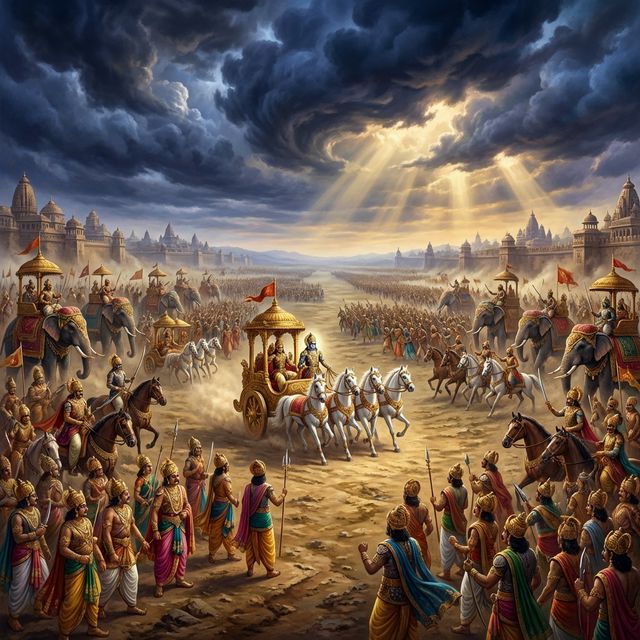
On the first grey morning of the war, when Yudhishthira rode alone along the enemy's front line and asked whether any man among the Kauravas would cross to the side of dharma before the killing began, only a single hand answered him. It belonged to Yuyutsu, Dhritarashtra's son by the maidservant Sughada, the one child of the old blind king willing to set aside brotherhood with ninety-nine and stand instead with five (yuyutsu_crossing_over - one clause).
What is less remembered is what that morning's choice actually purchased him: not glory, but eighteen days of unglamorous work. While his brothers rode toward their deaths on the field at Kurukshetra, Yuyutsu was set to guard what a war depends on just as surely as it depends on warriors, and honors far less - the stores of grain and weapons, the physicians' tents, the old men, the women, the children too young to fight, all of them shuttled for safety between Hastinapura and the Pandavas' own city of Indraprastha as the front lines shifted from day to day.
It was careful, thankless labor, done at a distance from any battlefield song would remember, and Yuyutsu did it without complaint, day after day, while the world he had grown up in tore itself apart a few days' ride away. Word came to him each evening of another brother dead - Duhsasana, then Duryodhana's dearest companions, then names he had known since childhood - and each time he set the report aside and returned to the ledgers, because someone had to keep the war fed while everyone else was busy dying.
He did not know, in those first days, that he was also being prepared, without anyone saying so, for something far larger than logistics: to be nearly the last man of his father's house left standing when the killing finally stopped.
The Only Son Left Standing
When the eighteen days ended, Yuyutsu returned to Hastinapura to find that he had become, without any battle of his own, the only son of Dhritarashtra still living. Duryodhana was gone, and Duhsasana, and every one of the ninety-nine others who had grown up beside him in the same palace, played the same games in the same courtyards, and, in most cases, despised him for what he had done on that first grey morning.
There was no time to grieve them privately. As the eldest surviving prince of the blind king's line, it fell to Yuyutsu, alongside Yudhishthira, to see that the last rites were properly performed for the hundred sons of Gandhari - the tarpana offered to each of them by name, the water poured, the ancestral debts paid in the old forms, however each of them had died and however many of them, while living, would have called him traitor to his face.
Yudhishthira did not spare him this duty out of pity. He asked it of him because it belonged to him, as it would have belonged to any surviving son, and Yuyutsu understood that being asked was itself an acknowledgment: whatever the war had made of him in other men's eyes, in this one office he was still, undeniably, Dhritarashtra's son.
He performed the rites without visible grief and without visible triumph, brother by brother, until the last name had been spoken and the last offering made. Those watching could not have said what he felt underneath it. He himself, in all the years that followed, never once spoke of it aloud.
In His Father's House
In the years after the war, while Yudhishthira ruled as emperor from the Hastinapura throne, Dhritarashtra lived on in the palace as an old blind king stripped of power, attended in his daily needs largely by Yuyutsu, the one son the war had left him. It was Yuyutsu who saw that his father was fed, who guided his hand at the ritual hours, who sat with him through the long silences a man carries when he has outlived a hundred children by his own fault as much as by fortune's.
The palace itself made this service harder than it needed to be. Every hall Yuyutsu walked still carried some trace of Duryodhana - a favorite doorway he had claimed as a boy, an armory he had filled, a garden he had planted and never lived to see grown - and Yuyutsu moved through all of it daily in his brother's place, without ever being allowed to forget whose place it properly was.
Dhritarashtra, for his part, rarely spoke to Yuyutsu as a father speaks to a son he is grateful for. Grief for the ninety-nine crowded out room for gratitude toward the one who remained, and some days the old king's silence toward him was its own kind of accusation. Yuyutsu bore it without argument, the way he had borne everything since that first morning at Kurukshetra, understanding that this too was part of the debt his choice had incurred: not just to have chosen rightly once, but to go on living daily beside those who could never quite forgive him for it.
When Dhritarashtra at last withdrew to the forest with Gandhari and Kunti to end his days as an ascetic, it was among the losses Yuyutsu carried quietly (ashramavasika_parva - one clause), one more departure in a life that had become mostly a practice in being left behind by people he still served.
Thirty Years of an Unsung Office
The years of Yudhishthira's reign that followed were not the kind that get sung. There were no more battles for Yuyutsu to sit out or administer around; there was only the long, ordinary work of keeping a kingdom that had lost most of a generation of men functioning at all. He settled disputes over land and grain between Hastinapura and the Pandavas' own holdings at Indraprastha, oversaw the training of the palace guard, and was among the few in the court steady enough in judgment that Yudhishthira, a king not naturally trusting of men who had once stood on the other side, came in time to rely on him without reservation.
He also, more quietly, became one of the small number of adults who watched over the boy who would eventually inherit everything the war had been fought over: Parikshit, grandson of Arjuna, born after the war to Abhimanyu's widow Uttara and, for a terrible hour, born dead, revived only by Krishna's intervention. Yuyutsu had no blood claim on the child and made none. He simply did, for this one boy, what steady men do for the children of houses they have served: he was present, reliably, for years no one else thought worth recording.
It was not the kind of loyalty that earns a warrior's title. It rarely does. But by the time Yudhishthira and his brothers began speaking of laying down the kingdom altogether, it was understood by everyone at court, without needing to be said aloud, whose hands the peace of the realm would rest in when the throne itself walked away into the mountains.
Left to Guard the Peace
When the day finally came that Yudhishthira determined to renounce the throne and walk with his brothers and Draupadi toward the Himalayas on the great final journey, the court gathered to hear who would be left to hold the kingdom for a child not yet old enough to rule it himself. Parikshit was named king, as Arjuna's line required. But a boy-king needs hands older than his own, and Yudhishthira, in his last acts as emperor, named those hands: Kripa, the old preceptor who had taught nearly every warrior the war had killed, and Yuyutsu (mahaprasthanika_parva - one clause), Dhritarashtra's last living son, the one man in the hall whose loyalty to the house of Kuru itself, apart from any single king or faction within it, had never once wavered since the morning he first proved it.
Yudhishthira did not explain the choice; by then no one at court needed it explained. Everyone remembered the morning of the crossing, the years of stores and ledgers, the rites performed brother by brother, the silent decades of service to a father who could rarely bring himself to say thank you. What Yudhishthira was recognizing, in naming Yuyutsu guardian of the realm's peace, was that choosing rightly on a single morning had been the easy part of the man's story; everything after it, thirty-odd years of unglamorous, unrewarded, uninterrupted fidelity, was the actual test, and Yuyutsu had passed it every single day without anyone thinking to keep score.
As the Pandavas walked out of Hastinapura for the last time, Yuyutsu stood at the gate beside Kripa and the boy-king, watching them go, already turning back in his mind toward the ledgers, the disputes, the ordinary work of keeping a kingdom standing that no bard would ever think to sing about.
Dharma Lesson
Choosing rightly in a single dramatic moment is only the beginning of a life, not its measure. Yuyutsu's true devotion to dharma was proved not on the morning he crossed sides but across thirty years of thankless service to people who rarely thanked him for it. Fidelity that no one applauds is still fidelity, and often the truer kind.