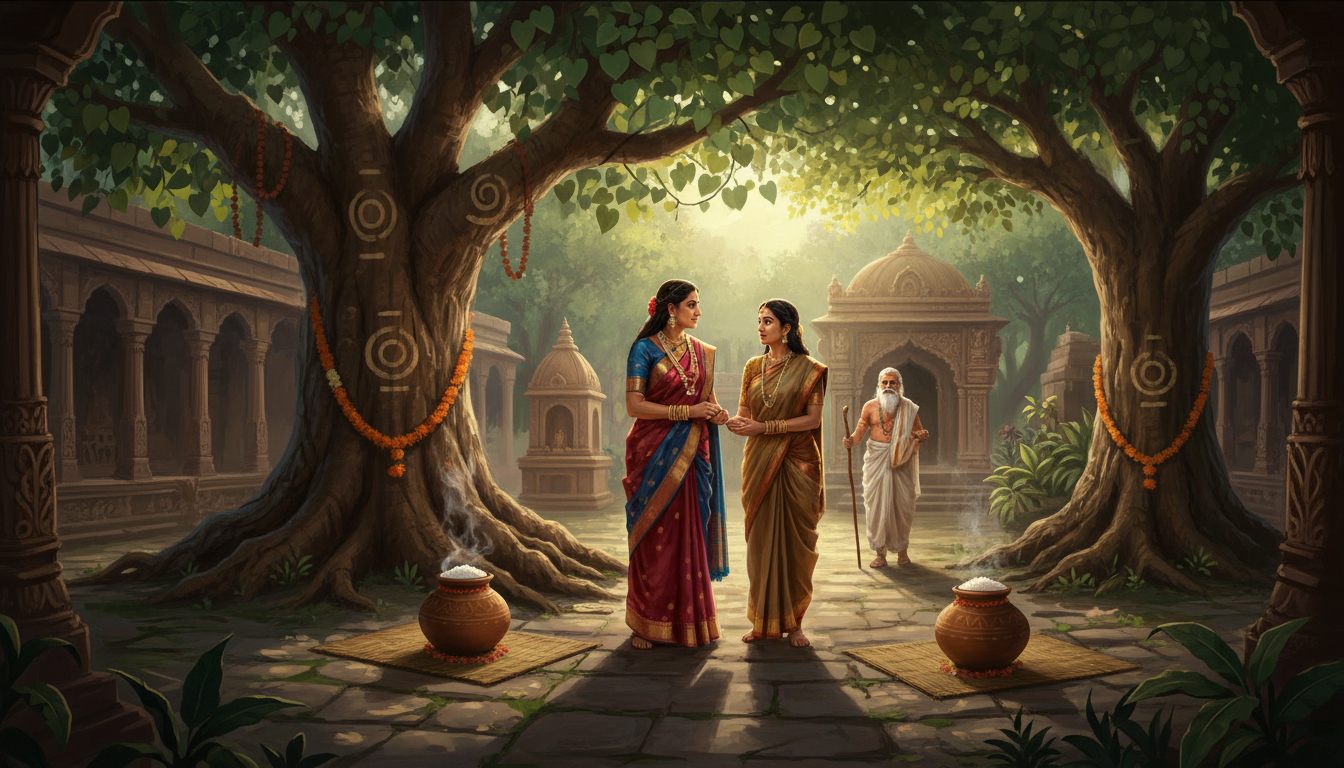
The Two Pots of Rice
A mother and daughter exchange their bowls and exchange their sons
A Single Night at the Foot of Mahendra
The protector of the earth spent a single night at the skirts of the Mahendra hill, and with his brothers he paid the highest honours to the religious men who lived there.
There were a great many of them. Lomasa walked Yudhishthira along the line of huts and made him acquainted with the names of all of them: these are of the Bhrigus, these of the Angiras, these the Vasishthas, these the Kasyapas. The royal saint went to each in turn and made obeisance with joined palms, and the sages blessed him, and none of them asked him about his kingdom, which he was grateful for.
At the end of the line stood a broad-shouldered man who did not look like an ascetic at all, and Lomasa named him: Akritavrana, a follower of Rama the son of Jamadagni.
Yudhishthira asked him the question he had been carrying up the hill. "When will the revered Parashurama show himself to the religious men here? It is desired on this occasion to obtain a sight of the descendant of Bhrigu."
"Thy journey to this spot is already known to Rama," said Akritavrana, "whose soul spontaneously knows everything. He is in every way well pleased with thee, and he will show himself readily to thee. The saints who practise penances here are permitted to see him on the fourteenth and on the eighth day of the lunar course. On the morrow, at the end of this very night, there will set in the fourteenth day. On that occasion thou wilt have a sight of him, clad in a sable deerskin and wearing his hair in the form of a matted mass."
So there was a night to be got through, and a fire, and a man beside it who had followed Parashurama for years.
Tell Me What Started It
"You have been a follower of the mighty Rama, Jamadagni's son," said Yudhishthira. "You must have been an eyewitness to all the deeds he achieved in former days. So tell me this. How were the members of the military caste vanquished by Rama on the field of battle, and what was the original cause of those conflicts?"
It was not an idle question and Akritavrana did not take it as one. The man asking it was a Kshatriya sitting in a forest with his kingdom gone, wanting to know why a Brahmana had once decided that men of his order should be cut off the earth twenty-one times over.
"With pleasure shall I recite to thee that excellent story, O chief of kings," he said, "the story of the godlike deeds of Rama, the son of Jamadagni, who traced his origin to Bhrigu's race. I shall relate also the achievements of the great ruler of the Haihaya tribe, that king named Arjuna, the mighty lord of the Haihayas, who was killed by Rama."
And then he did what the old tellers always do when they are asked about a war. He went back two generations before the war, to a marriage, and to a kitchen.
"But if I begin with the battle you will not understand the battle," he said. "The reason a Brahmana was born with a warrior's arm in him is older than the quarrel that arm was used in, and it comes down to two women, two trees, and two pots of boiled rice. Sit, son of Pandu. The night is long and the fourteenth day is not here yet."
The King With a Thousand Arms
Arjuna of the Haihayas (said Akritavrana) was endued with a thousand arms, and by the favour of Dattatreya he possessed a celestial car made of gold. His rule extended over the entire animated world, wheresoever placed upon this earth, and the car of that mighty monarch could proceed everywhere in an unobstructed course. Nothing stopped it. No wall, no boundary, no sky.
Grown resistless by the virtue of a granted boon, he ever mounted upon that car and trampled upon gods and Yakshas and saints on all sides round, and all the born beings, wheresoever placed, were harassed by him. He did not conquer countries. He rode over them.
So the celestials and the saints of rigidly virtuous life met together and went to Vishnu, the god of gods, the slayer of demons, whose prowess never failed, and they said one thing to him and no more than one thing. "O blessed and revered lord, for the purpose of preserving all the born beings, it is necessary that Arjuna should be killed by thee."
And while that petition was still being weighed, the lord of the Haihayas placed himself on his celestial car and went up and affronted Indra himself, while that deity was enjoying the company of Sachi his queen. A man who will do that will do anything.
Then the blessed god held a consultation with Indra with a view to destroying Kartavirya's son, and on that occasion the lord of the gods communicated everything that was for the good of the world of beings. And having heard it, the god worshipped by the world went away to do what was necessary. He went to the delightful Vadari wood, which was his own chosen retreat for the practice of penances, and there he began.
"Remember that," said Akritavrana. "The answer to the man with a thousand arms was not another army. It was a sage going quietly into a wood."
The King of Kanyakubja Goes to the Woods
At that very time there lived on the earth a mighty monarch in the land of Kanyakubja, a sovereign whose military force was exceedingly great, and his name of Gadhi was famous in the world.
He had everything a king is supposed to want and he put it down. He betook himself to a forest life, and while he was dwelling in the midst of the wood there was born to him a daughter, beautiful as a nymph of heaven. Her name was Satyavati. She grew up among the trees with a retired king for a father and no court around her at all.
And Richika, the son of Bhrigu, who led a rigidly austere life, came and asked for her, that she might be united with him in marriage.
It was an awkward proposal and Gadhi knew it while he was hearing it. Here was a Brahmana of the highest line asking for the daughter of a Kshatriya who had renounced his throne. The girl could not be refused to such a man. The girl also could not be given away in a manner that broke the usage of a royal house, retired or not, because a custom does not lapse merely because the man who keeps it has moved into a hut.
So Gadhi answered him carefully, and what he said became the hinge of everything that came after.
The Family Custom
"There is a certain family custom in our race," said Gadhi. "It was founded by my ancestors of a bygone age. Be it known to thee, O most excellent of the sacerdotal caste, that the intending bridegroom must offer a dowry consisting of a thousand fleet steeds, whose colour must be brown and every one of whom must possess a single sable ear."
Then he added, at once, the two sentences that made the demand impossible to walk away from.
"But a reverend saint like thee cannot be asked to offer the same. Nor can my daughter be refused to a magnanimous saint of thy rank."
That is a father telling a suitor, in the politest words available, that the door is open and the doorway is too small. He was not refusing. He was excusing. A poor ascetic could no more produce a thousand brown horses each with one black ear than he could produce a thousand mountains, and both men in the hut knew it, and the honourable thing was for Richika to accept the exemption and take the girl as a gift.
Richika did not accept the exemption.
"I will give thee a thousand fleet steeds, brown in hue and possessing a single sable ear," he said. "Let thy daughter be given in marriage to me."
He had no horses. He had no wealth of any kind. He had given his word in a hut in the woods to a man who had offered to let him off, and having given it, he got up and went out to find a thousand horses.
The Horses Come Out of the Ganga
He went to Varuna, lord of the waters, and asked him plainly, as one asks a neighbour for a tool.
"Give me a thousand fleet steeds, brown in colour, and each with one black ear. I want them as the dowry for my marriage."
To him Varuna forthwith gave a thousand steeds, and they did not come across a plain or down a road. They issued out of the river Ganga, climbing up out of the water at one place on the bank, a thousand of them, brown, and each with a single sable ear, shaking the river off their backs in the morning. Men gave that place a name for it, and it is called the horse's landing place to this day, and pilgrims still stop there.
So Richika procured his thousand steeds, and the daughter of Gadhi, Satyavati by name, was given to him in marriage in the city of Kanyakubja. The gods themselves were of the party of the bride, and stood on her side of the ceremony as her kinsmen, which is a thing that has happened at very few weddings.
That most excellent of the sacerdotal caste had thus done three things at once: he had procured a thousand horses out of a river, he had obtained a sight of the dwellers of heaven, and he had won a wife in the proper form, with no rule bent and no custom set aside. And he enjoyed himself with that girl of slender waist, and gratified in her every wish and desire that he had ever had.
The Father-in-Law's Boon
When the marriage had been celebrated, Richika's father Bhrigu came on a visit to see his son and his son's wife, and he was glad to see his praiseworthy son. The husband and wife together paid their best respects to him who was worshipped by all the gods, and when he had seated himself they both stood near him with joined palms, waiting to do his bidding.
Bhrigu was glad at heart. He looked at his daughter-in-law standing there and said, "O lovely daughter, I am ready to grant thee any object of thy wish."
Satyavati did not ask for wealth, or long life, or a great son for herself alone. She asked for a favour with two names in it: that a son might be born to her, and a son also to her mother.
Her mother was the wife of Gadhi, a Kshatriya queen living in a forest hut, who had borne one daughter and no boy, and who was watching that daughter marry into the first family of the Bhrigus. Satyavati thought of her, and asked for her, and that generosity is the beginning of all the trouble that follows, which is worth saying aloud, because the story is usually told as though the fault were entirely at the other end.
Bhrigu granted the favour thus asked for. Then he gave the instructions, and he gave them with great care, because what he was about to hand these two women was not an ordinary blessing.
Two Trees and Two Pots
"During the days that your season lasts," said Bhrigu, "thou and thy mother must take a bath, with the ceremony for bringing forth a male child. And ye two must then separately embrace two different trees. She a peepal tree, and thou a fig tree.
"And, O dutiful girl, here are two pots of rice and milk, prepared by me with the utmost care. I have ransacked the whole universe to find the drugs, the essence whereof hath been blended with this milk and rice. It must be taken as food with the greatest care."
He set the two pots down, one for the mother and one for the daughter, and said which was which, and then he vanished from sight, as he had come.
What he had not said, because he had not thought it needed saying, was that the two pots were not the same. One had been charged for the wife of a Bhrigu and would bring forth a Brahmana. The other had been charged for the wife of a king and would bring forth a Kshatriya of enormous power. The trees were paired to the pots. Everything had been weighed and matched and set down in order by a sage who had ransacked the universe for the ingredients, and then left in the keeping of two women who loved each other and were about to make a small, warm, disastrous decision.
For the queen looked at her daughter's pot, and at her daughter's tree, and thought what any mother in her position might think: that the sage had kept the better portion for his own son's wife, and that her own child was to have the lesser one.
The Exchange
The two ladies made an interchange. They made it in both things: in the matter of the pots of rice, and likewise as regards the trees to be embraced by each. The mother took the daughter's pot and the daughter's tree. The daughter, who had asked for her mother's son in the first place, gave them up without an argument.
Then a very great many days passed, and nothing whatever seemed to be wrong.
And then the revered saint came once more, and he came knowing, by his attribute of divine knowledge, exactly what had happened in his absence. Bhrigu, possessed of mighty strength, looked at his daughter-in-law and spoke to her.
"O dutiful girl. O my daughter of a lovely brow. The wrong pot of rice thou tookest as food, and it was the wrong tree which was embraced by thee. It was thy mother who deluded thee."
Then he told her what it had cost, and it is one of the coldest sentences in all the old books, because there is no anger in it at all, only arithmetic.
"A son will be born of thee who, though of the priestly caste, will be of a character fit for the military order. And a mighty son will be born of thy mother who, though by birth a Kshatriya, will assume a life suitable to the sacerdotal order. His power will be great, and he will walk on the path trodden by righteous men."
The grasp had not created anything. It had not made a better son for the queen and a worse one for the girl. It had only reversed them, so that the fire meant for a throne would now be born into a hermitage, and the calm meant for a hermitage would be born into a royal house and would have to fight its way out.
Let It Fall on My Grandson
Satyavati did not defend her mother and she did not blame her. She asked for the only thing that could still be changed, and she asked for it again and again.
"Let not my son be of this character," she entreated. "Let my grandson be such."
She could not stop the warrior fire from entering the line of the Bhrigus. She could ask that it skip a generation, so that the man who carried it should at least be born already knowing what he was, and not be a scholar surprised by his own hands. Bhrigu heard her out, and was pleased to grant her prayer.
"So let it be," he said.
Then she brought forth on the expected day a son by name Jamadagni, and this son of Bhrigu's line was endowed with both splendour and grace. He grew in years and in strength, and he excelled the other saints in the proficiency of his Vedic lore. And to him, rivalling in lustre the author of light, there came spontaneously and without instruction the knowledge of the entire military art and of the fourfold missile arms.
No one taught him. He simply had it, the way a man has his father's face. Her mother, in the same season, bore the son who would be Vishvamitra, a Kshatriya who would spend his life climbing toward the priesthood.
"And Jamadagni's son," said Akritavrana, "is the man you are waiting to see in the morning. That is what he is. He is the grandson of the woman who let her mother take the better bowl and then begged that the price be charged one generation later. Everything you have heard of him after this, the axe and the twenty-one slaughters and the earth given away to Kasyapa, comes out of a swap made in a forest kitchen by two women who each wanted the other to have the finer thing."
The fourteenth day of the moon was not far off. Yudhishthira sat and waited for it.
Dharma Lesson
A grasp at someone else's better share does not enlarge the share, it only reverses who carries it. The queen took the pot meant for a Brahmana's wife and got a son who would spend his life climbing toward the priesthood, while the warrior fire she meant to keep went into a hermitage and came out as an axe. Satyavati could not undo the swap; she could only ask that the cost fall one generation later, and it did.