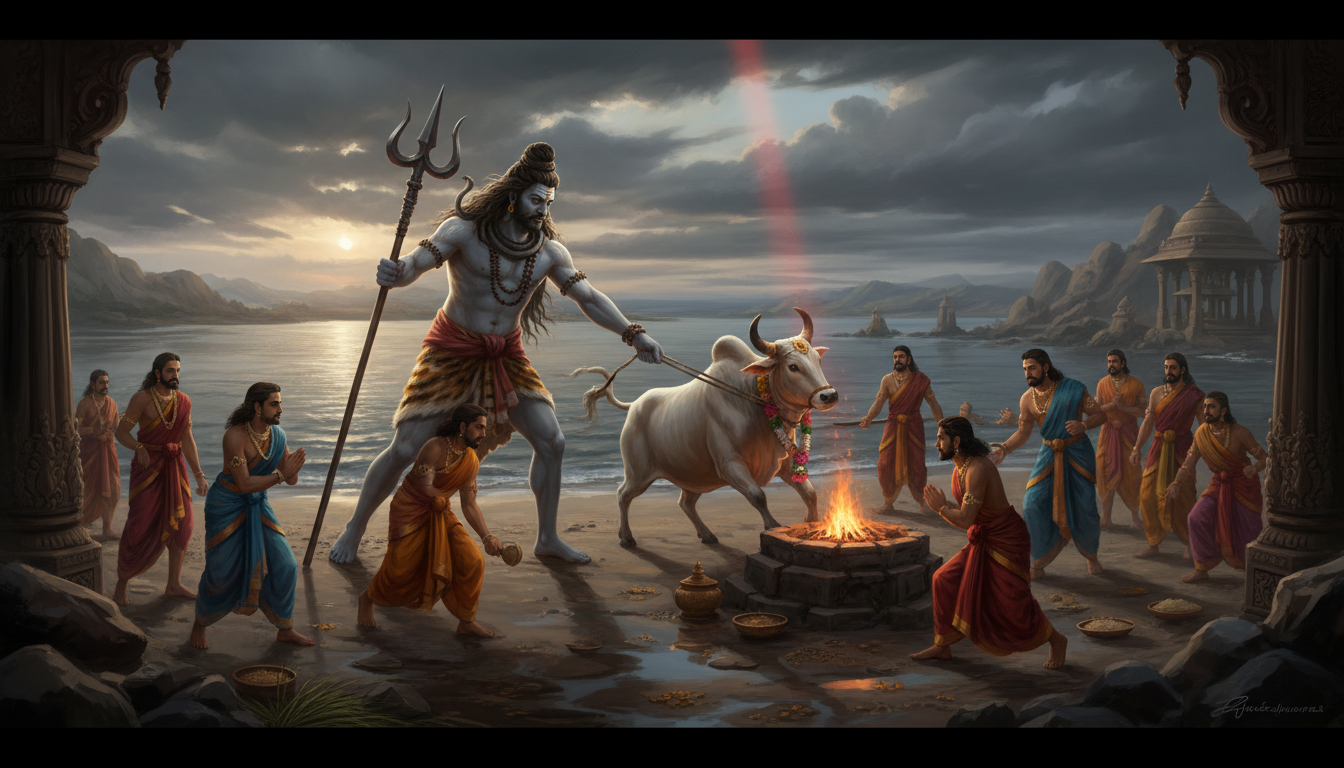
Rudra's Share and the Sinking Earth
Two quarrels over what may be given away, on the Kalinga shore
Down the Coast from the Kausiki
They left the Kausiki and the lake by Rishyasringa's old hermitage, and after that the son of Pandu went, one after another, to all the sacred shrines there were, in the order in which Lomasa named them, until the pilgrimage stopped being a journey and became a habit.
Then the land ran out. They came to the place where the Ganga falls into the sea, and there, in the centre of five hundred rivers, the prince performed the holy ceremony of the plunge.
It is not a river's mouth so much as a country of water. The great stream lets go of its own banks miles inland and comes apart into channels that come apart again, and the fresh runs into the salt through reed and silt and sandbar, and a man standing waist-deep at the middle of it cannot say with certainty which of the five hundred he is standing in.
When he had bathed, Yudhishthira came up out of it and they went on, all the brothers together, and Drupada's daughter with them, walking south along the shore of the sea with the water always on their left hand, towards the land where the Kalinga tribes dwell.
Lomasa walked at the king's shoulder. He had been sent to them out of heaven with a message and had stayed to be their guide, and he had a habit that Yudhishthira had come to depend on: he never let them walk over a place without telling them what had happened there.
It was not idleness on the sage's part and Yudhishthira had worked out what it was for. A man who has lost a kingdom walks with his own grievance going round and round in him like a wheel that will not stop, and the only thing that stops it is being told, at every ford and every hill, that somebody stood here before you and had a worse morning. By the time they reached the Kalinga country the eldest son of Pandu had begun to hear his own case as one entry in a very long list.
The Land Where the Kalingas Dwell
"There is the land, O Kunti's son," said Lomasa, "where the Kalinga tribes dwell. Through it passes the river Vaitarani, on the banks whereof even the god of virtue performed religious rites, having first placed himself under the protection of the celestials."
Yudhishthira turned that over as they walked. Even the god of virtue. Even Dharma himself, coming to this water to make an offering, had not simply come and made it. He had put himself under the protection of the gods before he began. If the lord of righteousness took a precaution before opening a sacrifice on that bank, then something had once happened there that made precautions reasonable.
"Verily, this is the northern bank," the sage went on, "inhabited by saints, suitable for the performance of religious rites, beautified by a hill, and frequented by persons of the regenerate caste. In holiness this spot rivals the path by which a virtuous man, fit for going to heaven, repairs to the region inhabited by gods. And at this very spot, in former times, other saints likewise worshipped the immortals by the performance of rites."
The river ran below them, dark and unhurried, with the low hill standing over the far bank and smoke going up in threads from a dozen fires among the trees where men who had given up everything were doing the same small exact things their fathers had done.
"And at this very spot," said Lomasa, "the god Rudra, O king of kings, seized the sacrificial beast, and exclaimed, 'This is my share!'"
This Is My Share
Understand what a sacrificial beast is, before you decide how large the offence was.
It is not a thing anybody owns in the ordinary way at the moment it is taken. It has been washed, and bound, and consecrated, and by the consecration it has stopped belonging to the man who bought it and has not yet been given to anybody. It stands at the post for that one interval, in the hands of the ritual, and the whole enormous apparatus of the sacrifice exists to determine, by rule, which god is to receive which portion of it and in what order and after what words are said.
Into that interval Siva put out his hand and took it, and said aloud what he was doing.
He did not make a case. He did not say that the portion allotted to him was too small, though every telling of every other quarrel about him says exactly that. He said four words, and the four words were a claim of right and not a request.
Then when the beast was carried away by Siva, the gods spoke to him, saying, "Cast not a covetous glance at the property of others, disregarding all the righteous rules."
It is worth hearing what is in that sentence, because it is the whole of their case and they never improve on it. They do not deny that he is a god or that gods receive shares. They say two things only: that the beast was somebody else's property at the moment he took it, and that there are rules for the taking, and that he went around them. That is the entire indictment. Not greed. Procedure.
How a Seizure Is Made Lawful
They did not take it back from him.
That is the part of the story Lomasa wanted the king to notice, and he said it plainly. There was no contest on that riverbank, no weapon lifted, no reversal. What the celestials did instead was to speak to Rudra words of glorification of a pleasing kind, and to satisfy him by the offering of a sacrifice, and to pay him honours suitable to what he was.
And thereupon he gave up the beast, and went away by the path that is trodden by the gods.
"So he returned it," said Yudhishthira.
"He returned an animal," said Lomasa. "Look at what the animal was when he let go of it. He had taken it out of the rite by force and it went back into the rite as the honoured portion of a god who had just been praised, and sacrificed to, and given the courtesies of his rank, in front of everyone who had seen the seizure. The beast stood where it had stood before. Nothing else in that field stood where it had stood before.
"This is a thing kings should know and mostly learn too late. What is taken by force has afterwards to be regularised, and the regularising is never free. The gods paid for that beast twice: once in the sacrifice they had already prepared, and once again in the sacrifice they had to offer to get it back. And the second one bought them the animal for that afternoon. It did not buy them the precedent."
Fresh, and Not Stale
"Learn now what happened to Rudra after that," said Lomasa, "for it is the reason you will see what you are about to see at every altar between here and the western sea.
"Influenced by the dread of him, the gods set apart for evermore, out of all shares whatsoever, the best allotment, such as was fresh and not stale, to be appropriated by that god."
Yudhishthira asked him to say the words again, and he said them again, and the king counted what was in them.
For evermore: not once, not that afternoon, but permanently and by standing rule. Out of all shares: not out of some particular sacrifice but out of every one. The best allotment: the first and highest portion, taken off the top before anything is apportioned. Fresh, and not stale: nothing left over, nothing that has waited, nothing that has already been offered elsewhere and passed along.
And the reason given for the whole arrangement, in the only words the story allows, is the dread of Rudra.
"They made him a rule," Yudhishthira said slowly, "so that he would never again have to make himself an exception."
"That is what a first portion is," said Lomasa. "Every offering you have ever poured out with the first of it set aside was poured out in the shape this quarrel left behind on this bank. And whosoever performs his ablutions at this spot, reciting this ancient story while he does it, beholds with his mortal eyes the path that leads to the region of the gods."
Libations to the Names of Their Fathers
Then all the sons of Pandu, and likewise the daughter of Drupada, all of them favoured of Fate, went down to the Vaitarani and made libations to the names of their fathers.
They stood in the current with their sacred threads shifted over the right shoulder and let the water go out of their cupped hands, naming as they poured, and the names went down the dark river towards the sea: Pandu, and the fathers behind Pandu, and Drupada's dead, and the whole long line of people who had died expecting the family to hold together.
When Yudhishthira came up out of the water he was not the same as he had been on the bank.
"O Lomasa," he said, "how great must be the force of a pious deed! Having taken my bath at this spot in the proper form, I seem to touch no more the region inhabited by mortal men. I am beholding all the regions. And this is the noise of the magnanimous dwellers of the wood, who are reciting their audible prayers."
He said it easily, like a man remarking on birds.
"O Yudhishthira," said Lomasa, "the place whence that noise comes and reaches thy ears is at a distance of three hundred thousand yojanas, to be sure."
The king stood still in the shallows with the water running past his ankles.
"O lord of men, rest thou quiet," said the sage, "and utter no word."
And the king, who had spent thirteen years being told what he was no longer permitted to say, stood in the shallow water of the Vaitarani and kept his mouth shut, and listened to men praying three hundred thousand yojanas away.
The Forest of the Self-Existent One
"This, O king," Lomasa said when he judged the king could hear ordinary speech again, "is the divine forest of the Self-existent One, which has now come into our view. There Viswakarma, of a dreaded name, once performed religious rites.
"On the mighty occasion of that sacrifice, the Self-existent One made a gift of this entire earth, with all its hilly and its forest tracts, to Kasyapa, by way of gratuity, for ministering as a priest."
Yudhishthira had been a giver of fees himself. He had held a sacrifice at which the kings of the earth stood in line with tribute, and he knew what a priest's gratuity is: it is the closing of the rite, the thing that makes the whole enormous business valid, and it is fixed by custom and paid without haggling, and no man who has ever performed a great sacrifice would think of underpaying it.
But he also knew what the gift consisted of here.
"He gave away the earth," he said. "The whole of it, hills and forests, at the end of a sacrifice, to a brahmana, as a fee."
"He did," said Lomasa. "And on that occasion, O Kuru's son, as soon as that goddess was being given away, the Earth became sad at heart, and she spoke wrathfully to that great lord, the ruler of the worlds."
The Earth Goes Down
"O mighty god," said the Earth, "it is unworthy of thee to give me away to an ordinary mortal. And this act of gift on thy part will come to nothing. For here am I, going to descend into the bottom of the nether world."
And she went down.
Notice what her objection is, because it is not the one that would be expected. She does not say that she is not his to give; she does not dispute his title. She says that the recipient is beneath the gift, and that she will not be handed to a man, and that the transfer will therefore fail. She does not appeal, she does not curse, and she does not stay to argue. She simply removes the thing that was given, by taking it into the water with her, and leaves the giver holding a promise with no earth under it.
Then the blessed saint Kasyapa beheld the goddess Earth despondent and sad, and he did the only intelligent thing that was left to do. He did not go after his fee. He performed a propitiatory act calculated to appease her wrath.
And then, O Pandu's son, the Earth was pleased with his pious deed.
She uprose again from within the waters, and showed herself, and she came up in a shape that had not been discussed by either of them: she rose in the form of a sacred altar.
"This, O king, is the spot which distinctly manifests the form of an altar," said Lomasa, and there it was in front of them, a long level shelf of ground running out from the shore, exact as masonry. "Ascend over it, and thou wilt gain valour and strength. And this is the very altar which reaches as far as the sea, and rests itself upon its bosom."
The Words of Truth Before the Sea
"May good luck be thine," said Lomasa. "Mount up on it, and cross the sea of thyself. And while thou mountest it this day, I shall administer the ceremony for averting all evil from thee. For this altar, as soon as it gets a mortal's touch, at once enters into the sea."
He made the aversion over him where he stood. Then he taught him what had to be said, because the ocean is not a thing a man may simply walk into.
"Salutation to the god who protects the universe. Salutation to thee that art beyond the universe. O Lord of gods, vouchsafe thy presence in this sea.
"And then, O son of Pandu, these words of truth must be audibly recited, and while reciting them thou must quickly ascend: The god of fire, and the sun, and the organ of generation, and water, and the goddess, and the seed of Vishnu, and the navel of nectar. The god of fire is the organ that generated the ocean. The earth is thy body. Vishnu deposited the seed that caused thy being, and thou art the navel of nectar.
"Thus the words of truth must be recited aloud, and while so reciting, one must plunge into the lord of rivers. Otherwise, O most praiseworthy of Kunti's sons, this lord of waters of divine birth, this best storehouse of all the waters of the earth, is not to be touched, not even with the end of a blade of sacred grass."
So the ceremony for averting evil was completed on his behalf, and the magnanimous Yudhishthira went into the sea and did all that the saint had bidden him do: mounted the altar that was the body of the goddess, and said aloud that the earth was her body and the fire her begetter, and went down into the water holding nothing back.
The Night on Mahendra
From the sea he went inland to the skirts of the Mahendra hill, and there the protector of the earth spent a single night.
He had bathed that day at a river where a god once took what had not been given to him and was afterwards paid for evermore to stop taking it; and he had climbed an altar that was a goddess who had gone down into the water rather than be handed over as a fee. Two quarrels on one shore, and both of them about the same question, which is what a man may give away and what is not his to give.
In the morning, with his brothers, he paid the highest honours to the religious men on that hill, and Lomasa made him acquainted with the names of all of them: the Bhrigus, the Angiras, the Vasishthas, and the Kasyapas, sitting among the rocks in their hundreds, the descendants of the very priest to whom the earth had once been given and had refused to go.
The royal saint paid a visit to every one of them and made obeisance with joined palms. And then he asked Akritavrana, who was a follower of Parasurama, when the revered Rama, Jamadagni's son, would show himself to the religious men there, for it was his great desire to obtain a sight of the descendant of Bhrigu.
And Akritavrana said that the fourteenth day of the lunar course would set in at the end of that very night, and that on that day he would see him, clad in a sable deerskin and wearing his hair in a matted mass; for Rama already knew of his coming, and was in every way well pleased with him.
Dharma Lesson
What is taken by force has to be regularised afterwards, and the regularising is never free. What is given away over the objection of the thing given simply refuses to arrive, and comes back only when the receiver stops pressing his claim and attends to the wrong instead.