Why Rudra Broke the Sacrifice
Krishna explains who really emptied the camp
How Could a Man of No Great Skill Do It
Vaishampayana said, "After all the troops had been slain during the hour of sleep by those three car-warriors, king Yudhishthira, in great grief, said these words unto him of Dasharha's race.
'How, O Krishna, could my sons, all of whom were mighty car-warriors, be slaughtered by the sinful and wretched Ashvatthama, of no great skill in battle? How also could Drona's son slay the children of Drupada, all of whom were accomplished in weapons, possessed of great prowess, and capable of battling with hundreds of thousands of foes? How could he slay that foremost of car-warriors, Dhrishtadyumna, before whom the great bowman Drona himself could not appear? What act was done by the preceptor's son, O bull among men, in consequence of which he succeeded in slaying, single-handed, all our men in battle?'
Mark the question, O Janamejaya. It is not the question of a man asking who is to blame. He knew who had done it. He had seen the camp. What he could not get past was the sum: one middling swordsman, and every skilled man he loved dead in a single night, and no account of the world that he had been taught would make those two facts sit down together.
Draupadi was sitting on the ground not far from them, refusing food, waiting for a gem off a man's head. The bodies of five young men lay where they had been carried in. Nakula's son had been killed with a car-wheel in his hands. Prativindhya had been struck in the abdomen and had fallen without a sound. Every one of them had been a trained warrior, and every one of them had been taken by a man whom Yudhishthira, who had watched him fight for eighteen days, considered ordinary.
And Krishna did not answer him with the camp, or with the gate, or with the sword. He answered with a quarrel among the gods that was older than the Kurus and older than the earth they had been fighting over."
I Know Mahadeva Truly
The holy one said, "Verily, Drona's son had sought the aid of that highest of all the gods, the eternal Mahadeva. It was for this that he succeeded in slaying, single-handed, so large a number of warriors.
If Mahadeva be gratified, he can bestow even immortality. Girisha can give such valour as will succeed in checking Indra himself. That is the whole of the mechanism you are asking about, O son of Pandu, and it is a very short answer. The skill of the hand had nothing to do with it. The god was pleased, and a man of no great skill went through your camp like a fire through dry grass.
I know Mahadeva truly, O bull of Bharata's race. I know also his various acts of old. Others adore him and get what they ask for; I have adored him with truth and purity and austerities from a long way back, and what I have of him is not a boon but an acquaintance. He is the beginning, the middle and the end of all creatures. This entire universe acts and moves through his energy.
But you will not understand what happened at that gate unless you understand what kind of power that is, and what it is like when it is left out of a reckoning. So hear how he came to be what he is, and hear what he did the first time the gods forgot him. It begins before there were any creatures at all."
So Be It, He Said, and Went Into the Water
"The puissant Grandsire, desirous of creating living creatures, saw Rudra. And the Grandsire asked him, saying, 'Create living creatures without delay.'
Thus asked, Rudra of tawny locks said, 'So be it.'
And then he plunged into the water and practised austerities there for a very long time, inasmuch as he was sensible of the defects of living creatures.
Sthanu they call him for that, O king, which is to say the motionless one, the post driven into the ground; and Girisha, and Sharva, and Bhava, and Kapardin, and each of those names is a different age of him, and one of them is this one. Before he was the god at the burning-grounds with the skulls and the ashes, he was a workman who had been given a commission and had gone away to think about it properly.
Understand that, O king, before you judge anything that follows. He did not refuse the work. He agreed to it, and then he went under the water to prepare himself for it, because he had looked ahead at what he was being asked to make and had seen the flaws in it. Hunger was in it. Weakness was in it. Everything that would have to eat something else in order to go on living was in it. He would not put his hand to that until he had made himself equal to it, and there is no measure given for how long he stayed down there, only that it was long.
And while he was under the water, being thorough, the work was given to somebody else."
Is There Anyone Born Before Me
"Having waited in expectation of Rudra for a very long time, the Grandsire, by a fiat of his will, invoked into existence another being, for the purpose of making him the creator of all kinds of living things.
That second being was no fool, and the first thing he did was ask the one question that mattered.
Beholding Girisha plunged into the waters, he said unto his sire, 'If there be no being born before me, then I will create living creatures.'
His sire replied unto him, saying, 'There is no other first-born being besides thee. This Sthanu has plunged into the water. Go and create living creatures, without any anxiety.'
So the Grandsire told him that there was nobody before him, and in the same breath told him where the somebody before him was. Both halves were true and the two halves together were a falsehood, and the second being took the answer he wanted, as men do, and went away and began to work.
And from that moment there were two makers in the world with a claim on the same office, one of them busy, and one of them under the water and not yet finished.
Nothing in what followed was a plot, O king. Nobody in this part of the story intends any harm. The Grandsire wanted the work begun. The second being wanted to be certain he was entitled to begin it, and asked, and was answered, and believed the answer. The first-born wanted to do the work well. Every one of them behaved reasonably, and out of the four reasonable acts came an injury that has never entirely healed, and a god who has to be counted in every reckoning ever afterwards because of the one time he was not."
The Creatures That Ran at Their Father
"That being then created many living creatures, having Daksha for their first, and Daksha created all these creatures of four kinds.
As soon, however, as they were created, they ran, O king, toward their sire, afflicted with hunger and desirous of devouring him.
There is the flaw that Rudra went into the water to think about, and there it is on the very first day, running at the man who made it with its mouth open. The second being, who had asked no questions about defects and had wanted only the office, fled from his own offspring and ran to the Grandsire for protection.
'O illustrious one,' he said, 'protect me from these, and let these creatures have their food assigned unto them.'
Then the Grandsire assigned herbs and plants and other vegetables as their food, and unto those that were strong he assigned the weaker creatures as the means of sustenance. That is the arrangement you live under, O son of Pandu. It was not designed. It was an emergency measure, taken by a creator who was being eaten by his own work and needed the problem to stop that afternoon.
Their sustenance having been thus assigned, the newly-created creatures all went away to the regions they desired, and cheerfully multiplied by union with their respective species.
And so the world you and I stand in was settled in a single afternoon, by a frightened maker and an obliging grandfather, on the principle that whatever cannot be fed shall be food. Eighteen days of this war have been the working out of that principle among kings. You are asking me, O son of Pandu, why a camp full of sleeping men was eaten in the dark, and I am telling you that the rule was written before there were men, by somebody who was in a hurry."
What Purpose Would Be Served by This Limb of Mine
"After the creatures had multiplied and the Grandsire had become well pleased, the first-born rose from the water.
He beheld the living creation. He saw that diverse kinds of creatures had been created, and that they had multiplied by their own energy. Everything he had gone down to prepare for had been done, badly, and finished, and populated, and nobody had come to the water to tell him.
At this sight Rudra became angry, and caused his procreative limb to disappear in the bowels of the Earth.
The unfading Brahma, soothing him by soft words, said unto him, 'O Sharva, what wert thou doing so long within the water? For what reason also hast thou caused thy limb of generation to disappear in the bowels of the Earth?'
Thus questioned, that lord of the universe wrathfully answered the lord Brahman, 'Somebody else has created all these creatures. What purpose then would be served by this limb of mine? I have by my austerities, O Grandsire, created food for all these creatures. These herbs and plants also will multiply like those that will subsist upon them.'
Hear what he says he was doing down there. He was making the food. All that time under the water, while the office was being given away, he was making the thing that would let the creation eat without eating itself, and it was already done, and it was the one part of the arrangement that worked.
Having said these words, Bhava went away, in cheerlessness and rage, to the foot of the Munjavat mountains, for practising severer austerities."
A Bow Made Out of the Sacrifice
The holy one said, "After the krita-yuga had elapsed, the gods, desirous of performing a sacrifice, duly made preparation for one according to the directions laid down in the Vedas. They collected clarified butter and the other requisites. And they not only devised what the requisites of their sacrifice should be, but also determined those amongst themselves that should have a share in the sacrificial offerings.
Not knowing Rudra truly, the celestials, O king, assigned no share for the divine Sthanu.
They did not refuse him. That is worth having exactly right. There was no debate in which his claim was heard and dismissed. They sat down and made a list of who was to be given a portion, and he was not on it, because they did not know him, because he had been under the water and then on a mountain and had never been at any of their gatherings. He was left out the way a name is left off a list.
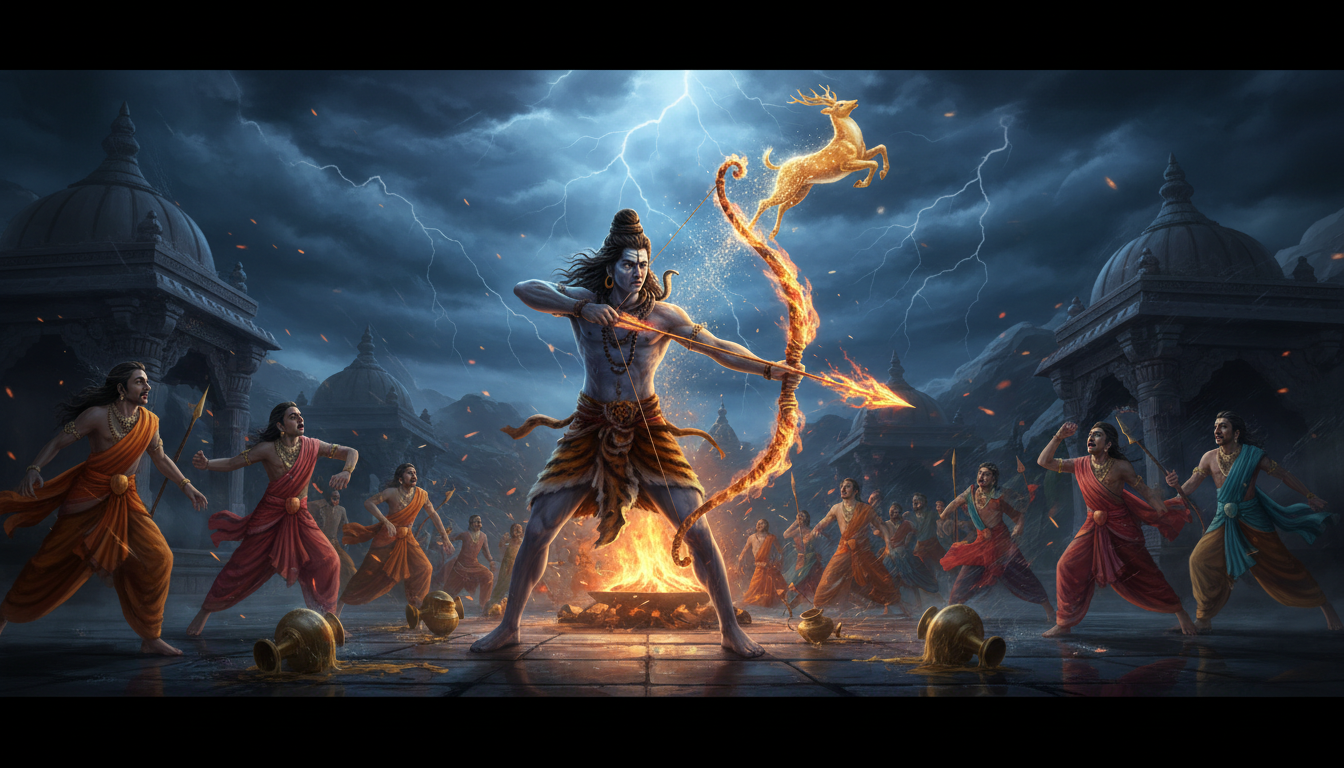
Seeing that the celestials had assigned to him no share in the sacrificial offerings, Sthanu, clad in deer skins, desired to destroy that Sacrifice, and with that object he constructed a bow.
There are four kinds of Sacrifice: the loka Sacrifice, the Sacrifice of special rites, the eternal domestic Sacrifice, and the Sacrifice consisting in the gratification derived by man from his enjoyment of the five elemental substances and their compounds. It is from these four kinds of Sacrifice that the universe has sprung. Kapardin constructed that bow using as materials the first and the fourth kinds of Sacrifice.
The length of that bow was five cubits. The sacred mantra 'vashat,' O Bharata, was made its string. The four parts of which a Sacrifice consists became the adornments of that bow. He built the weapon out of the rite itself. When it was finished he took it and walked to where they were sitting."
The Sacrifice Ran Away as a Deer
"Then Mahadeva, filled with rage, and taking up that bow, proceeded to that spot where the celestials were engaged in their Sacrifice.
Beholding the unfading Rudra arrive there attired as a brahmacari and armed with that bow, the goddess Earth shrank with fear, and the very mountains began to tremble. The wind ceased to move. Fire itself, though fed, did not blaze forth. The stars in the firmament, in anxiety, began to wander in irregular courses. The Sun's splendour decreased. The disc of the Moon lost its beauty. The entire welkin became enveloped in a thick gloom. The celestials, overwhelmed, knew not what to do. Their Sacrifice ceased to blaze forth. The gods were all terrified.
Consider what they were looking at, O king. They had assembled to perform a rite, and the rite was walking toward them in the shape of a young man with a bow, because that is what he had made the bow out of. Their own ceremony had been taken apart and bent into a weapon and strung with the word that they themselves shout when the butter goes into the fire, and it was five cubits long, and it was coming across the sacrificial ground toward the offerings they had just finished dividing among themselves.
Rudra then pierced the embodiment of Sacrifice with a fierce shaft in the heart.
The embodied form of Sacrifice, assuming the shape of a deer, fled away with the god of fire. Approaching heaven in that form, he blazed forth in beauty. Rudra, however, O Yudhishthira, pursued him through the skies. After Sacrifice had fled away, the gods lost their splendour. Having lost their senses, the gods were stupefied.
Then the three-eyed Mahadeva, with his bow, broke in rage the arms of Savitri, and plucked out the eyes of Bhaga, and knocked out the teeth of Pushana.
The gods then fled away, as also all the several parts of Sacrifice. Some amongst them, reeling as they sought to fly away, fell down senseless. The blue-throated Rudra, having agitated them thus, laughed aloud, and, whirling the horn of his bow, paralysed them."
The Settlement
"The celestials then uttered a cry. At their command, the string of the bow broke. The string having broken, the bow became stretched into a line.
The gods then approached the bowless god of gods and, with the embodied form of Sacrifice, sought the protection of the puissant Mahadeva, and endeavoured to gratify him.
Gratified, the great god threw his wrath into the water, O king; and that wrath, assuming the form of fire, is always employed in consuming that liquid element. He then gave unto Savitri his arms, and Bhaga his eyes, and Pushana his teeth. And he also restored the Sacrifices themselves, O Pandava. The world once more became safe and sound. The arms went back onto Savitri. The eyes went back into Bhaga's head. Pushan got his teeth. The deer came down out of the sky and was a Sacrifice again, and the fire was fed, and the gods sat down.
And the gods assigned unto Mahadeva all the libations of clarified butter as the share of that great deity.
That is the settlement, O son of Pandu, and I want you to look at what it cost and what it bought. It bought him a share. It is exactly what he would have had if his name had been written on the list at the beginning, at no cost at all, before the arms were broken and the eyes were plucked out and the Sacrifice itself was shot through the heart and driven into the sky in the shape of an animal. Nothing else was gained by anyone. When Mahadeva had become angry, the whole world had become agitated; when he became gratified, everything became safe."
It Was Not Drona's Son
"Possessed of great energy, the god Mahadeva was gratified with Ashvatthama.
It was for this that thy sons, those mighty car-warriors, could be slain by that warrior. It was for this that many other heroes, the Pancalas with all their followers, could be slain by him.
Thou shouldst not suffer thy mind to dwell on it. It was not Drona's son that accomplished that act. It was done through the grace of Mahadeva.
Do now what should next be done."
Vaishampayana continued, "And there the answer ended, O Janamejaya, and it is an answer that has been argued over ever since by men who were not on that field and did not have to get up the next morning.
Yudhishthira had asked how a middling swordsman had killed everyone he loved. He was told: a power was left out of a reckoning once, at the beginning of the world, and it has never been safe to leave out since, and last night it was standing at a gate in the dark and a man walked up to it and offered it everything he had, and it took him.
And having said it, Krishna gave him the only instruction that was any use to a king with a kingdom of corpses and a wife sitting in praya on the ground. Not that it was just. Not that it was undeserved. Only that grief was not now the business in front of him, and that there were rites to be performed and water to be offered and the living to be seen to.
Do now what should next be done."
Dharma Lesson
A power left out of the reckoning does not go away; it comes back armed, and the only settlement is to give it its share. What the gods finally hand Rudra is exactly what he would have had for nothing if his name had been on the list, and everything broken in between was the price of the omission.