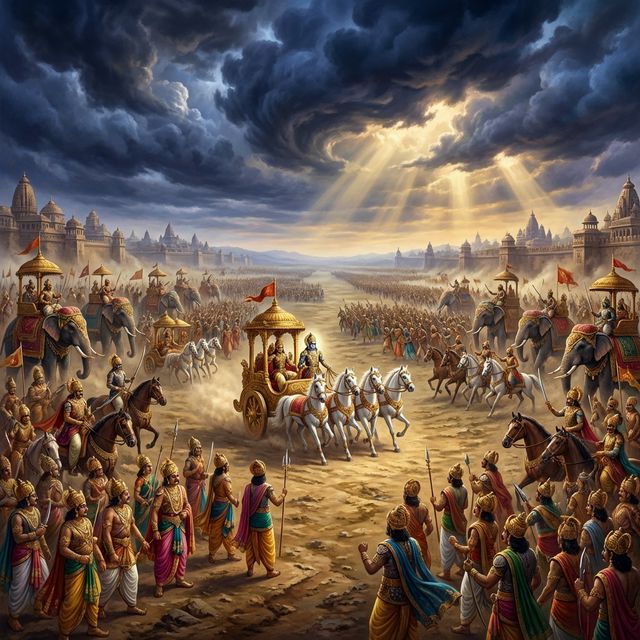
The Gem on Ashwatthama's Head
Draupadi sits down to starve until the stone is brought to her
The Sole Survivor Comes at Dawn
Vaishampayana was telling it to Janamejaya, and this is the part of the telling where the night finally ends.
After that night had gone away, one man came into the Pandava quarters with the news. He was the driver of Dhrishtadyumna's car, and he was the only person still alive who had been inside the camp when it happened.
He gave his intelligence to king Yudhishthira standing up, in order, the way a driver reports.
"The sons of Draupadi, O king, have been slain, with all the children of Drupada himself, while they were heedless and trustfully asleep in their own camp. During the night your camp has been exterminated by the cruel Kritavarma, and Kripa, the son of Gautama, and the sinful Ashwatthama. Slaying thousands of men and elephants and steeds with lances and darts and battle-axes, those men have exterminated your army. While your army was being slaughtered like a forest cut down with axes, a loud wail was heard rising from your camp. I am the sole survivor, O monarch, of that vast force. I have, O you of virtuous soul, escaped with difficulty from Kritavarma at a time when he was heedless."
Every clause of it was worse than the one before, and the man said it all.
Yudhishthira had borne the news of Abhimanyu and the news of Ghatotkacha and the news of his own preceptor's death, and he had stood up under each of them. He did not stand up under this. He fell down on the earth where he was, afflicted with grief at the loss of his sons.
Satyaki came forward first and held the king in his embrace. Bhimasena and Arjuna and the two sons of Madri stretched forth their arms and took hold of him, five men in a war camp with nothing left in it to defend.
When his senses came back to him he began to speak, and the words came out indistinct with sorrow.
Victory in the Shape of Defeat
"Alas, having vanquished the foe, we have ourselves been vanquished in the end."
That was the first sentence, and the king turned it over and over that morning like a man examining a coin that has come back to him from a place where he never spent it.
"The course of events is difficult to be ascertained even by persons endued with spiritual sight. The foes who were vanquished have become victorious. Ourselves, again, while victorious, are vanquished. Having slain brothers and friends and sires and sons and well-wishers, and kinsmen, and counsellors, and having vanquished them all, we ourselves are vanquished at last."
Eighteen days had gone into the account. The grandsire on his bed of arrows, the preceptor, Karna, Shalya, Duryodhana with his thighs broken in the shallow water. Every name on the ledger had been paid for at the price agreed. And in one night, while the winners slept, the balance had reversed itself without a single new battle being fought.
"Misery looks like prosperity," Yudhishthira said, "and prosperity looks like misery. This our victory has assumed the shape of defeat. Our victory, therefore, has ended in defeat. Having won the victory, I am obliged to grieve as an afflicted wretch. How, then, can I regard it as a victory? In reality, I have been doubly defeated by the foe."
Doubly, because there were two defeats in it and he could see both. There was the kingdom, which was his, and there was the reason he had wanted the kingdom.
"They for whose sake we have incurred the sin of victory by slaying our kinsmen and friends, alas, they, after victory had crowned them, have been vanquished by defeated foes that were heedful."
The war had been fought to seat five men on the earth and to leave that earth afterwards to their sons. The sons were on the ground in the camp behind him with their heads off. What he had won was a country and nobody to give it to.
There Is No More Powerful Cause of Death
Then he began naming what those boys had already come through, which is the cruellest arithmetic a mourner can do and the one every mourner does.
"Alas, through heedlessness have they been slain that had escaped from even Karna. That warrior who had barbed arrows and nalikas for his teeth, the sword for his tongue, the bow for his gaping mouth, and the twang of the bowstring and the sound of palms for his roars. That angry Karna who never retreated from battle, and who was a very lion among men."
They had walked out of that mouth alive. They had done more than that.
"Alas, those princes that succeeded in crossing, by boats constituted by their own excellent weapons, the great Drona-ocean, having cars for its deep lakes, showers of arrows for its waves, the ornaments of warriors for its gems, car-steeds for its animals, darts and swords for its fishes, elephants for its alligators, bows for its whirlpools, mighty weapons for its foam, and the signal of battle for its moonrise causing it to swell with energy. Even those princes have from heedlessness been slain."
And then the sentence the whole lament had been walking toward.
"There is, in this world, no more powerful cause of death, as regards men, than heedlessness. Prosperity abandons a heedless man from every side, and every kind of misery overtakes him."
He had one more fire to name. The tall standard with its excellent top that had stood on Bhishma's car was the wreath of smoke that infallibly indicated the fire beneath. Shafts were its flames. Wrath was the wind that fanned it. The twang of that formidable bow and the sound of those palms were its roar, armour and weapons the homa libations poured into it, and the whole hostile army the heap of dry forest-grass it was set among.
"Alas, even they that had endured that fierce fire have at last fallen through heedlessness. A heedless person can never acquire knowledge, asceticism, prosperity, or great renown. They have perished like merchants with rich freight perishing through carelessness in a shallow stream after having crossed the great ocean."
I Grieve for the Princess Krishna
"They whose bodies are now lying on the bare ground, slain by those vindictive wretches, have without doubt ascended to heaven," the king said. "I grieve, however, for the princess Krishna."
Krishna is her other name, the dark one, the name her father's fire gave her before anybody thought to call her Draupadi. She was not in the camp. She had been left at Upaplavya, the garrison town in Virata's country where the alliance had been assembled and where the women had stayed while the war ran its eighteen days, and she did not yet know that she had no children.
"Alas, she will be plunged today in an ocean of grief. Hearing of the slaughter of her brothers and sons and her venerable sire, the king of the Panchalas, without doubt she will fall down senseless on the earth. Her body emaciated by grief, she will not rise again. Unable to bear the grief resulting from such affliction, and worthy as she is of happiness, alas, what will be her plight? Cut to the quick by the slaughter of her sons and brothers, she will be like one scorched by fire."
He was right about all of it except the last clause, and about that he was wrong in a way he could not have guessed.
Having indulged in those lamentations he turned to Nakula, the fourth brother, the one they sent when a thing had to be done quickly and well.
"Go and bring the unfortunate princess Draupadi here, along with all her maternal relations."
Nakula obediently accepted the command of the king who equalled Yama himself in righteousness, and went to his car, and drove for Upaplavya to fetch a woman to the place where her sons were lying.
And Yudhishthira, crushed, with tears in his eyes and his friends around him, walked out to the field where his sons had battled and which still teemed with diverse kinds of creatures. He entered it. He saw them, well-wishers and friends and children together, covered with blood, their bodies mangled, their heads separated from their trunks.
That foremost of righteous men began to weep aloud, and fell down on the earth deprived of his senses, and all his followers fell with him.
The Car of Solar Effulgence
Beholding his sons and grandsons and friends all slain in battle, Vaishampayana said, the king's soul became overwhelmed. He lay there recollecting them one after another, senseless and trembling, his eyes bathed in tears, and his friends, who were themselves filled with anxiety, began to comfort him because there was nothing else to be done with their hands.
At that time Nakula came back.
He arrived on his car of solar effulgence, skilled in executing errands as he had always been, and the errand was finished: the princess Krishna was with him. On the road from Upaplavya she had received that heartrending intelligence about the slaughter of all her sons, and she had become exceedingly agitated, and she had made the rest of the journey knowing.
She came into the presence of Yudhishthira trembling like a plantain tree shaken by the wind, and fell down where she stood, afflicted by grief. Her face was adorned with eyes resembling a couple of full-blown lotuses, and Vaishampayana says that it seemed darkened, like the Sun himself when he is enveloped in darkness.
Of the five men standing there, it was Bhima who moved.
The wrathful Vrikodara, of prowess incapable of being baffled, came forward hastily, and raised her up off the ground, and clasped her with his arms.
He had done this before, or something like it, and both of them knew the count. The lac house at Varanavata, when he carried the whole family out of a fire lit for them. The forest of Hidimba, when he stood between her and the rakshasa. Virata's city, when Kichaka put his hand on her and did not live out the night. Bhima had been the answer every time this woman was in danger for thirteen years, and here he was again, holding her up in a camp full of her dead children, with nothing to hit.
Comforted by Bhimasena, the beautiful lady began to weep. Then she turned toward the eldest son of Pandu, who was standing among his brothers, and she began to speak, and what came out of her was not a lament.
By Good Luck
"By good luck, O monarch, having obtained the whole earth, you shall enjoy her after the slaughter of your brave sons in the observance of kshatriya duties."
She said it standing in front of him with Bhima's arm still under her.
"By good luck, O son of Pritha, you are happy at the thought of having obtained the whole earth. By good luck, your thoughts do not dwell on Subhadra's son, whose tread resembled that of an infuriated elephant. By good luck, you do not, like myself while residing at Upaplavya, recollect your heroic sons slaughtered in the observance of kshatriya duties."
Four times, by good luck. It is the phrase a wife uses to congratulate a husband on a piece of fortune, and she laid it over the top of every loss in his house until the politeness of it was unbearable. She was not accusing him of not grieving. She had seen him on the ground. She was telling him what his grief had so far produced, which was speeches.
Then she stopped saying it that way.
"O son of Pritha, hearing of the slaughter of those sleeping heroes by Drona's son of sinful deeds, grief burns me as if I were in the midst of a fire."
And she named her terms, in front of the four brothers and Satyaki and whoever else was within hearing, the way a plaintiff names them.
"If Drona's son be not made to reap the fruit of that sinful deed of his, if, putting forth your prowess in battle, you do not take the life of that wretch of sinful deeds, along with the lives of all his followers, then listen to me, you Pandavas. I shall sit here in praya."
Praya is the fast unto death. A person who sits in praya sits down deliberately in one place, takes nothing, and does not get up, and the sitting is not a threat made to be argued out of. It is a judgment entered against the living by someone who is prepared to leave them.
Having said these words, the helpless Krishna, the daughter of Yajnasena, sat down on the ground by the side of the eldest son of Pandu, king Yudhishthira the just.
And she was silent.
The Gem He Was Born With
The royal sage, seeing his dear queen sit in praya, spoke to her carefully, because a man in that position has to.
"O auspicious lady, O you that are conversant with morality, all your sons and brothers have righteously met with a noble death. It behoves you not to grieve for them."
That was the consolation, and he did not linger on it, because he knew it would not hold. Then came the practical objection, which was real.
"As regards Drona's son, he has gone to a distant forest, O beautiful princess. How shall you, O lady, make yourself sure of his fall in battle?"
It is a fair question. The man was gone into the woods before dawn with two companions and a night's start. If she was going to sit without food until he was dead, what would tell her that he was dead? A brother's word? A shout in a camp? She had been given news before.
Draupadi had already thought about it.
"I have heard that Drona's son has a gem on his head, born with him. I shall see that gem brought to me after the slaughter of that wretch in battle. Placing that gem on your head, O king, I shall endure to live. Even this is my resolve."
She had asked for the one thing that could not be faked and could not be taken off a living man. The gem had grown with Ashwatthama out of his own skull; it was the thing about him that everyone had always mentioned first. She wanted it in her hand, and then she wanted it set on the head of the king she had married, and only then would she eat.
It is worth noticing what she had not asked for. Not that the man be captured. Not that he be brought to her. Not vengeance in any form she would have to watch. One stone, carried back down the road, and a king wearing it, and food after that.
Nakula at the Reins
Then she turned away from Yudhishthira and went to Bhimasena, and spoke to him of high purpose.
"Remembering the duties of a kshatriya, O Bhima, it behoves you to come to my rescue. Slay that man of sinful deeds like Maghavat slaying Samvara. There is no one in this world who is equal to you in prowess. It is known throughout the world how on an occasion of great calamity you became at the town Varanavata the refuge of all the Parthas. When again we were seen by Hidimba, it was you that became our refuge in the same way. Like Maghavat rescuing the daughter of Puloma, you rescued my afflicted self, in Virata's city, from a great calamity. Like those great feats, O Partha, that you did achieve in former days, slay now, O slayer of foes, the son of Drona, and be happy."
Bhimasena of great might could not endure to hear any more of it.
He mounted upon his great car adorned with gold and took up his beautiful bow with the arrow already placed on the string. He made Nakula his charioteer, which meant that the brother who had gone to fetch her was now driving the brother who would answer her. He began to stretch the bow while the car was still standing. He had the steeds urged without delay, and they went, fleet as the wind.
Bhima set out from the Pandava camp with great celerity, and proceeded along the track of Ashwatthama's vehicle, which was still there in the dust of the road, going toward the forest.
Dharma Lesson
Yudhishthira's answer to grief is a speech about heedlessness, and it is a good speech, and it feeds nobody. Draupadi's answer is a condition and a proof: a named object, brought back and laid where she can see it, or she does not eat. She had spent the whole war being told that her losses were the price of dharma, and at the end she declined to accept any more accounting she could not verify. The gem is not a trophy. It is the receipt.