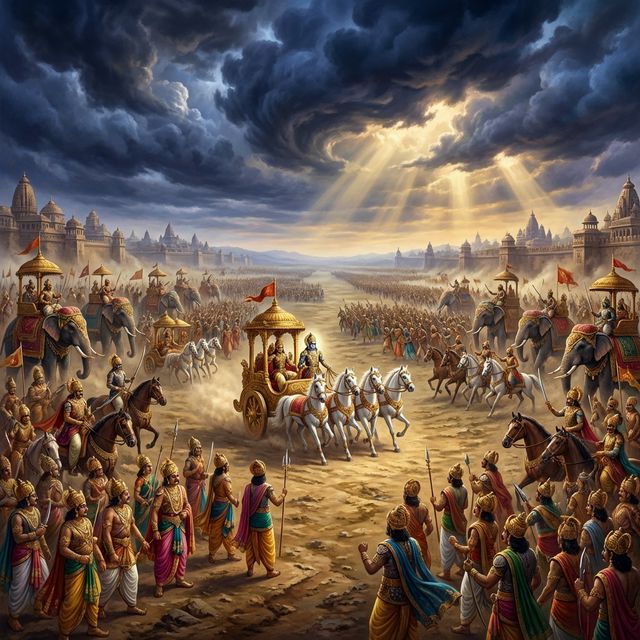
The Duel of the Brahmashira Weapons
Ashwatthama and Arjuna loose the world-ending astra at Vyasa's hermitage
The Warning on the Road
Vaishampayana was telling the whole of it to king Janamejaya, and he had come to the morning after the worst night the Kuru race ever had.
Bhimasena had already gone. He had learned where the son of Drona was, and he had taken his car and driven out alone, ahead of everybody, with his sons and his nephews lying dead behind him in a camp that had been asleep when the killing started.
Krishna did not like it at all. He turned to Yudhishthira, and what he said was not about grief.
"O son of Pandu, this brother of thine, overwhelmed with grief at the slaughter of his sons, proceedeth alone to battle, from desire of slaying the son of Drona. Of all thy brothers, Bhima is thy dearest. Beholding him fallen into a great danger, why dost thou not stir thyself?"
Then he named the thing he was actually afraid of.
"The weapon called brahmashira, which Drona communicated to his son, is capable of consuming the whole world."
Drona had given that astra to Arjuna first, being delighted with him. His own son, unable to endure that, had begged it of him, and Drona had imparted the knowledge unwillingly, because he knew the restlessness of the boy. And with it he had laid down a command.
"Even when overtaken by the greatest danger, O child, in the midst of battle, thou shouldst never use this weapon, particularly against human beings."
A little while afterwards the preceptor had spoken again, and this time it was not an instruction but a verdict.
"O bull among men, thou wilt not, it seems, walk in the path of the righteous."
Krishna had met the son in Dwaraka in the years of the exile, and had watched him try with both hands to lift the discus he wanted in trade for that astra, and fail to move it off the ground. He knew what kind of man was sitting somewhere ahead of them on the road.
"He is wrathful, wicked-souled, restless, and very cruel," he said. "He knows the weapon called brahmashira. Vrikodara should be protected from him."
Then he mounted his car, and Arjuna and Yudhishthira came up after him.
A Blade of Grass by the Water
The car was equipped with every kind of powerful weapon, and to it were yoked two pairs of foremost steeds of the Kamboja breed adorned with garlands of gold. The dhur of it was the colour of the morning sun. Shaibya was on the right and Sugriva on the left, and Meghapushpa and Balahaka bore the traces. The standard had been made by the divine Artificer and stood up decked with gems and gold, and Vinata's son Garuda was perched upon it, that enemy of snakes, shining.
Seated on either side of the wielder of sharnga, the two sons of Pandu looked like the twin Ashvinis seated beside Vasava. The horses went out at speed, and the noise of their rush was like the noise of birds coursing through the air.
They came up with Bhima on the road. They could not stop him. Three of the greatest car-warriors alive rode alongside that man and said what they had to say, and he went on past them in his wrath towards the bank of the river that Bhagiratha brought down out of heaven, and they followed him there.
On the edge of the water sat the island-born Vyasa, dark-complexioned, in the middle of many rishis. And beside them, in among the holy men, sat Drona's son of wicked deeds. He was covered with dust. He was attired in a piece of cloth made of kusha grass and smeared all over with clarified butter, which is the dress of a man performing an expiation, and he was sitting there as though he belonged in that company.
Bhima took up his bow with a shaft already fixed on it and rushed at him.
"Wait," he said. "Wait."
Ashwatthama looked up at the terrible bowman coming at him bow in hand, and at the two brothers standing on Janardana's car behind him, and became exceedingly agitated, and thought his hour had come.
His soul was incapable of being depressed. He called to mind the high weapon his father had given him. He took up a blade of grass from the ground with his left hand, and, fallen into great distress, inspired it with the proper mantras until the grass was the astra.
Then he said, in wrath, in the hearing of the rishis, "For the destruction of the Pandavas."
And he let it go. A fire was born in that blade of grass which seemed capable of consuming the three worlds, like the all-destroying Yama at the end of the yuga.
Two Ends of the World
Krishna understood from signs, at the very outset, what the son of Drona intended.
He did not speak to Bhima, who could do nothing about it. He spoke to the man who had been given the same weapon by the same teacher.
"O Arjuna, O son of Pandu, the time is come for the use of that celestial weapon which is in thy memory, knowledge of which was imparted to thee by Drona. For protecting thyself as also thy brothers, shoot in this battle that weapon which is capable of neutralising all weapons."
Arjuna got down off the car with his bow and a shaft already on the string, and then he did a strange thing for a man standing in front of the murderer of his son's brothers and his own children.
He softly wished good unto the preceptor's son.
Then good unto himself, and then unto all his brothers. Then he bowed unto all the gods and unto all his superiors, and thinking of the welfare of all the worlds he let his weapon go with these words: "Let Ashwatthama's weapon be neutralised by this weapon."
What came out of Gandiva blazed up with fierce flames like the all-destroying fire that appears at the end of the yuga. What Drona's son had shot blazed up in the same way, within a huge sphere of fire, and the two of them stood in the sky over a riverbank in front of a company of seated rishis.
Numerous peals of thunder were heard. Thousands of meteors fell. All living creatures were inspired with great dread. The entire welkin was filled with noise and took on a terrible aspect with those flames in it, and the whole earth, with her mountains and her waters and her trees, trembled.
This is what the two men had between them at that moment. Not a duel. Two ends of the world, lit and facing each other, with the ordinary countryside underneath.
And it had happened after the war was over. Duryodhana was already down in the dust with his thighs broken. Every commander on both sides was dead. There was no army left to defend and no field left to win, and the sky above the Ganga was burning anyway, because one man could not stop and the other could not let him go on.
The Rishis Between the Fires
Then two rishis showed themselves there.
Narada, who is the soul of every creature, and the grandsire of all the Bharata princes, the island-born Vyasa, beheld those two weapons scorching the three worlds, and they came and stood in the middle of them.
Conversant with all duties and desirous of the welfare of all creatures, incapable of being overwhelmed by any force, incapable of being checked by any creature endued with life, the two of them placed themselves between the weapons and stood there like two blazing fires, neutralising the energy of both.
Then they spoke, and what they said was not a benediction.
"Those great car-warriors who have fallen in this battle were acquainted with diverse kinds of weapons. They, however, never shot such a weapon upon human beings. What act of rashness is this, ye heroes, that ye have done?"
Every man who had died at Kurukshetra in eighteen days had known astras. Bhishma had known them, and Drona, and Karna. Not one of them had ever put a brahmashira into a human being. The two youngest of that line had done it inside a single hour, on holy ground, in front of witnesses.
At the very sight of those two rishis, Dhananjaya resolved to take his shaft back. He joined his hands.
"I used this weapon saying, let it neutralise the enemy's weapon. If I withdraw this high weapon, Drona's son of sinful deeds will then, without doubt, consume us all with the energy of his. Ye two are like gods. It behoveth you to devise some means by which our welfare as also that of the three worlds may be secured."
Having said that, he withdrew it.
It should be understood what that took. The withdrawal of that weapon is exceedingly difficult even for the gods in battle. Not excepting the great Indra himself, there was nobody except the son of Pandu capable of calling it back once it had been loosed. It is born of Brahma energy, and no person of uncleansed soul can bring it back. Only one who leads the life of a brahmacari can do it, and if a man who has not kept that vow tries, the weapon strikes off his own head and destroys him with all his equipments.
Arjuna was a brahmacari and an observer of vows. He had held that almost unobtainable astra for years and had never used it, not once, even when plunged into situations of the greatest danger. He was submissive and obedient to all his superiors.
That was why the fire came back to his hand.
What He Could Not Take Back
Drona's son stood there looking at the two rishis and could not do it.
He put out his energy and his weapon did not answer him. It was in the air and it was his, and it was no longer his. With a cheerless heart he said to the island-born what a man says when he is caught.
"Threatened by a great danger, and desirous of protecting my life, I let off this weapon, through fear of Bhimasena, O sage. This Bhimasena of false behaviour acted sinfully, O holy one, while slaying the son of Dhritarashtra in battle. It is for this, O regenerate one, that of uncleansed soul as I am, I let off this weapon."
"I dare not, however, withdraw it now. Having inspired this irresistible and celestial weapon with the energy of fire, I let it off for the destruction of the Pandavas. Contrived for the destruction of the Pandavas, that weapon will take away the lives of all the sons of Pandu. O regenerate one, I have, in wrath, done this sinful deed."
Vyasa answered him, and he began by defending the man who had shot back.
"Pritha's son Dhananjaya, O child, was acquainted with the weapon called brahmashira. Neither from wrath, nor for thy destruction in battle, did he shoot it. Arjuna used it for baffling thy weapon. He has again withdrawn it. Having obtained even the brahmastra through thy sire's instructions, the mighty-armed Dhananjaya did not fall off from a kshatriya's duties. Why dost thou seek to compass the destruction of such a person with all his brothers?"
Then he told them both what the sky over their heads had been about to cost the countryside.
"That region where the weapon called brahmashira is baffled by another high weapon suffers a drought for twelve years, for the clouds do not pour a drop of water there for this period. For this reason the mighty-armed son of Pandu, although he had the power, would not, from desire of doing good to living creatures, baffle thy weapon with his."
So Arjuna had not fought the thing. He had cancelled it and swallowed it again, because twelve years without rain falls on farmers and not on kshatriyas.
"The Pandavas should be protected," Vyasa said. "Thy own self should be protected. The kingdom also should be protected. Withdraw this celestial weapon of thine. Dispel this wrath from thy heart and let the Pandavas be safe. The royal sage Yudhishthira never desires to win victory by perpetrating any sinful act. Give unto these that gem which is on thy head. Taking that, the Pandavas will in return grant thee thy life."
The Gem and the Wombs
Ashwatthama had been born with a gem on his head. It was the one thing about him that had never had to be earned.
"This my gem," he said, "is more valuable than all the wealth that has ever been earned by the Pandavas and the Kauravas. If this gem is worn, the wearer ceases to have any fear from weapons or disease or hunger. He ceases to have any fear of gods and danavas and nagas. His apprehensions from rakshasas as also from robbers will cease. Even these are the virtues of this gem of mine. I cannot, by any means, part with it."
And then, in the next breath, he parted with it.
"That, however, O holy one, which thou sayest, should be done by me. Here is this gem. Here is myself."
He surrendered the stone and his life in one sentence, obediently, to the rishi, exactly as he had been told. Everything Vyasa had asked for he gave. What he would not give was the weapon, because he could not, and being unable to give it he chose where to put it down.
"This blade of grass will, however, fall into the wombs of the Pandava women, for this weapon is high and mighty, and incapable of being frustrated. O regenerate one, I am unable to withdraw it, having once let it off. I will now throw this weapon into the wombs of the Pandava women. As regards thy commands in other respects, O holy one, I shall certainly obey them."
The night before, he had gone through a sleeping camp cutting down men who never got up. Now, standing on a riverbank with a sage in front of him and his own life given away, he looked for what was left of the line he had failed to kill, and found it in the unborn.
Vyasa did not stop him. That is the hardest part of the passage to sit with, and it is what the text says.
"Do then this," said Vyasa. "Do not, however, entertain any other purpose, O sinless one. Throwing this weapon into the wombs of the Pandava women, stop thyself."
The son of Drona, having heard those words of the island-born, threw that uplifted weapon into the wombs of the Pandava women.
Three Thousand Years
Krishna understood what had been done, and his heart was cheerful.
"A certain brahmana of pious vows, beholding Virata's daughter who is now daughter-in-law to Arjuna, while she was at Upaplavya, said, while the Kuru line will become extinct, a son will be born to thee, and this thy son for that reason will be called by the name of Parikshit."
Uttara was carrying Abhimanyu's child. That was the whole of the future of the house, and the whole of the target.
Drona's son, filled with wrath, answered him.
"This, O Keshava, that thou sayest from thy partiality for the Pandavas, shall not happen. Uplifted by me, this weapon of mine shall fall on the foetus that is in the womb of Virata's daughter, upon that foetus which thou, O Krishna, art desirous of protecting."
"The fall of this mighty weapon will not be fruitless," said the holy one. "The foetus will die. But being dead, it will live again and have a long life."
Then he turned from the child to the man.
"As regards thyself, all wise men know thee for a coward and a sinful wretch. Thou art the slayer of children. For this reason thou must have to bear the fruit of these thy sins. For three thousand years thou shalt wander over this earth, without a companion and without being able to talk with anyone. Thou shalt have no place in the midst of men. The stench of pus and blood shall emanate from thee, and inaccessible forests and dreary moors shall be thy abode. Thou shalt wander over the Earth with the weight of all diseases on thee.
"The heroic Parikshit, attaining to age and a knowledge of the Vedas, shall obtain all weapons from the son of Sharadvata. That righteous-souled king shall rule the earth for sixty years, before thy very eyes, O thou of wicked soul. Though burnt by the energy of thy weapon's fire, I shall revive him. O lowest of men, behold the energy of my austerities and my truth."
Vyasa let it stand.
"Since, disregarding us, thou hast perpetrated this exceedingly cruel act, and since thy behaviour is such although thou art a good brahmana by birth, therefore those excellent words that Devaki's son has said will, without doubt, be realised in thy case."
And Ashwatthama, who had been given his life, accepted the sentence in the only words he had left.
"With thyself among all men, O holy one, I shall live. Let the words of this illustrious and foremost of men become true."
Then he made over his gem to the Pandavas, and cheerlessly, before their eyes, walked away into the forest.
The Gem on the King's Head
They rode back to the encampment with Govinda and the island-born and the great ascetic Narada at their head, on horses like wings, carrying a stone that had been born on another man's head.
Draupadi was sitting where they had left her, in the observance of the praya vow, which is the fast a person takes when they have decided not to go on living. Her five sons had been killed in their sleep in one night, and her father's house with them. The great car-warriors got down off their cars, more afflicted than she was, and sat round her.
Then Bhima, at the king's desire, put the celestial gem into her hands.
"This gem, O amiable lady, is thine. The slayer of thy sons hath been vanquished. Rise, casting off thy sorrow, and recollect the duties of a kshatriya lady. O thou of black eyes, when Vasudeva was about to set out on his mission of peace, thou hadst said even these words unto the slayer of Madhu: I have no husbands, I have no sons, nor brothers, nor art thou alive, O Govinda, since the king desires for peace. Those bitter words were addressed by thee to Krishna. It behoveth thee to recollect those words of thine.
"The wretched Duryodhana, that obstacle on the way of our sovereignty, has been slain. I have quaffed the blood of the living Dushasana. We have paid off the debt we owed to our enemy. People, while talking, will not be able to censure us any longer. Having vanquished Drona's son, we have set him free for the sake of his being a brahmana and of the respect that should be shown to our deceased preceptor. His fame hath been destroyed, O goddess. Only his body remains. He has been divested of his gem, and on earth he has been reft of his weapons."
Draupadi looked at the stone that had been cut out of the head of the man who killed her children.
"I desired to only pay off our debt for the injury we have sustained," she said. "The preceptor's son is worthy of my reverence as the preceptor himself. Let the king bind this gem on his head, O Bharata."
So Yudhishthira took it and set it on his own head, at her desire, regarding it as a gift from his teacher. Holding that excellent and celestial gem, the king looked beautiful like a mountain with the moon above it.
And Draupadi, though stricken with grief on account of the death of her sons, possessed of great mental strength, gave up her vow and got to her feet.
Dharma Lesson
Arjuna and Ashwatthama were taught by the same man and given the same weapon, and the difference between them showed only at the moment of recall. One had kept his vows and could take the fire back; the other had not, and so his rage went where he could no longer follow it, into the wombs of women he had never seen. A weapon is not the sin. The sin is having nothing inside you strong enough to stop it once it is out of your hand.