After Bhima Had Set Out
Vaishampayana said, "Draupadi had come from Upaplavya to the field where her five sons lay. Nakula had brought her, on his car of solar effulgence, and she had arrived trembling like a plantain tree shaken by the wind, and had fallen down before Yudhishthira.
'By good luck, O monarch, having obtained the whole earth, thou shalt enjoy her after the slaughter of thy brave sons,' she said. 'By good luck, thy thoughts do not dwell on Subhadra's son, whose tread resembled that of an infuriated elephant. Hearing of the slaughter of those sleeping heroes by Drona's son of sinful deeds, grief burns me as if I were in the midst of a fire. If Drona's son be not made to reap the fruit of that sinful deed of his, then listen to me, ye Pandavas: I shall sit here in praya.'
And she sat down beside the eldest son of Pandu and would not rise.
'O auspicious lady, O thou that art conversant with morality,' Yudhishthira said, 'all thy sons and brothers have righteously met with a noble death. It behoves thee not to grieve for them. As regards Drona's son, he has gone to a distant forest, O beautiful princess. How shalt thou make thyself sure of his fall in battle?'
She had her answer ready, and it was a price. 'I have heard that Drona's son has a gem on his head, born with him. I shall see that gem brought to me after the slaughter of that wretch in battle. Placing that gem on thy head, O king, I shall endure to live.'
Then she had turned to the one man who would not argue with her. 'Remembering the duties of a kshatriya, O Bhima, it behoves thee to come to my rescue. At Varanavata thou wert the refuge of all the Parthas. When we were seen by Hidimba, thou becamest our refuge in the same way. In Virata's city thou didst rescue my afflicted self from a great calamity. Slay now the son of Drona, and be thou happy.'
Bhimasena, hearing those and other piteous lamentations, could not endure them. He mounted upon his great car adorned with gold, took his beautiful bow with the arrow already placed on the string, made Nakula his charioteer, and had the steeds urged without delay along the track of Ashvatthama's wheels.
After he had set out, that bull of Yadu's race, possessed of eyes like lotus-petals, addressed Kuru's son Yudhishthira.
'O son of Pandu, this brother of thine, overwhelmed with grief at the slaughter of his sons, proceeds alone to battle from a desire of slaying the son of Drona. Of all thy brothers, Bhima is thy dearest. Beholding him fallen into a great danger, why dost thou not stir thyself?'
Yudhishthira looked at him, and Krishna went on, and what he said next was not about tonight at all. It was about a conversation on a beach, years ago, that nobody else had heard."
The Weapon Drona Did Not Want to Give
"'The weapon called Brahmashira,' said Krishna, 'which that subjugator of hostile towns, Drona, communicated to his son, is capable of consuming the whole world. Understand where it came from and how it passed.
The illustrious and highly blessed preceptor, that foremost of all wielders of bows, obtained it from Agastya after performing the austerest penances. And being delighted with Dhananjaya, he gave that very weapon to him. Arjuna had it first, and had it as a gift, freely, because his teacher was pleased with him.
His only son, unable to endure that, then begged it of him. He begged, O king; he did not receive. Unwillingly Drona imparted the knowledge of that weapon to Ashvatthama. Mark the word, O king. Unwillingly. The father who had given it gladly to a pupil gave it grudgingly to his own child, and everyone standing there understood the difference and nobody said anything about it.
There is no defence against the Brahmashira and there is no calling it back. It does not answer to the merit of the man who looses it. It answers to the syllables, and the syllables can be spoken by anyone who has been taught them, in any temper, on any night. Drona understood that difficulty perfectly, which is why he never once made the mistake of thinking that teaching a weapon and trusting a man were the same act.
The illustrious Drona knew the restlessness of his son. So, acquainted with all duties as he was, the preceptor laid this command upon him. He said, "Even when overtaken by the greatest danger, O child, in the midst of battle, thou shouldst never use this weapon, particularly against human beings."
Even thus the preceptor Drona spoke unto his son. And a little while after, he spoke again, and said a second thing, which was worse.'"
Thou Wilt Not Walk in the Path of the Righteous
"'He said, "O bull among men, thou wilt not, it seems, walk in the path of the righteous."
That is what a father said to a son on the day he handed him the most terrible weapon in the world. Not a curse. Not a prohibition. A prediction, spoken in the ordinary voice of a man who has watched a boy grow up and has finally admitted to himself what he has been watching.
Hearing those bitter words of his sire, the wicked-souled Ashvatthama, in despair of obtaining every kind of prosperity, began in grief to wander over the earth. He did not stay in his father's house. He had the weapon and he had the sentence that came with it, and he carried both of them about with him from country to country like a man carrying two vessels he cannot set down. Understand that this was said before any of it happened, O king. Before the dice. Before the exile. Before Drupada's son was born to kill his father, and before his father's head was taken while it sat in meditation in a chariot. Whatever Ashvatthama did afterwards, he did with that sentence already spoken over him, and there is a question in that which I do not propose to settle for you: whether a father who says such a thing to a son is describing him, or making him.
Then, O chief of the Kurus, while you were living in the woods, O Bharata, he came to Dvaraka and took up his abode there, and the Vrishnis worshipped him. He was the son of the preceptor of the Bharatas. He was held in high respect by all the Yadavas. He was given a house and honour and the freedom of the city, and nobody in Dvaraka asked him why he had left home. He lived among the Vrishnis for a long while, and he was pleasant to them, and they thought well of him.'"
Alone on the Seacoast
"'One day, after he had taken up his abode in Dvaraka, he came to me. He came without a companion, and he came at a time when I myself was without anybody by my side, on the seacoast. I have thought since that he must have waited some while for such a time, because in that city it does not often happen. There is always a kinsman, an errand, a child, a petitioner. That morning there was the water and the sand and the two of us.
And there, smilingly addressing me, he said:
"O Krishna, that weapon called Brahmashira, worshipped by gods and gandharvas, which my sire, the preceptor of the Bharatas, of prowess incapable of being baffled, obtained from Agastya after performing the austerest penances, is now with me, O Dasharha, as much as it is with my sire. O foremost one of Yadu's race, in exchange for that celestial weapon, give me thy discus, which is capable of slaying all foes in battle."
He stood there on the sand with his palms joined, importuning me for it, as a man asks a favour of a friend he has come a long way to see. And he was offering, in trade, the one thing his father had been unwilling to give him and had told him never to use. He described it accurately and at length. He named Agastya. He named the penances. He was careful to say that the weapon was as much with him as it was with his sire, which was the very point his father had doubted. A man selling something always tells you the parts of the story that flatter him.'"
Take Whichever You Can Lift
"'While he with joined palms and great importunity thus begged of me my discus, I, from a desire of gladdening him, told him these words:
"Gods, danavas, gandharvas, men, birds and snakes, assembled together, are not equal to even a hundredth part of my energy. I have this bow, this dart, this discus, and this mace. I will give thee whichever among these thou desirest to have from me. Without giving me the weapon thou wishest to give, take from among these weapons of mine whichever thou mayest be able to wield and use in battle."
Understand the terms, O son of Pandu, for I meant them exactly as I said them. I did not ask him for the Brahmashira. I told him to keep it. I told him to take whatever of mine he could carry, and I named four things and set them in front of him, and I laid no condition on the choosing except the one condition that cannot be argued with.
Thus addressed, the illustrious son of Drona, as if challenging me, solicited at my hands my discus of excellent nave, hard as thunder, possessed of a thousand spokes, and made of iron. He did not take the bow. He did not take the mace. He looked at the four and asked for the one that I had not offered to give him and had only offered to let him lift.
"Take it," I said.
And notice, O king, that I did not refuse him. Men will tell this story afterwards as though I set a trap on that beach. I did not. The discus lay on the sand between us and I told him to take it, and I meant it. Had he lifted it he would have carried it away with my blessing, and my kinsmen would have stood in the road and watched him go.'"
The Left Hand, Then Both
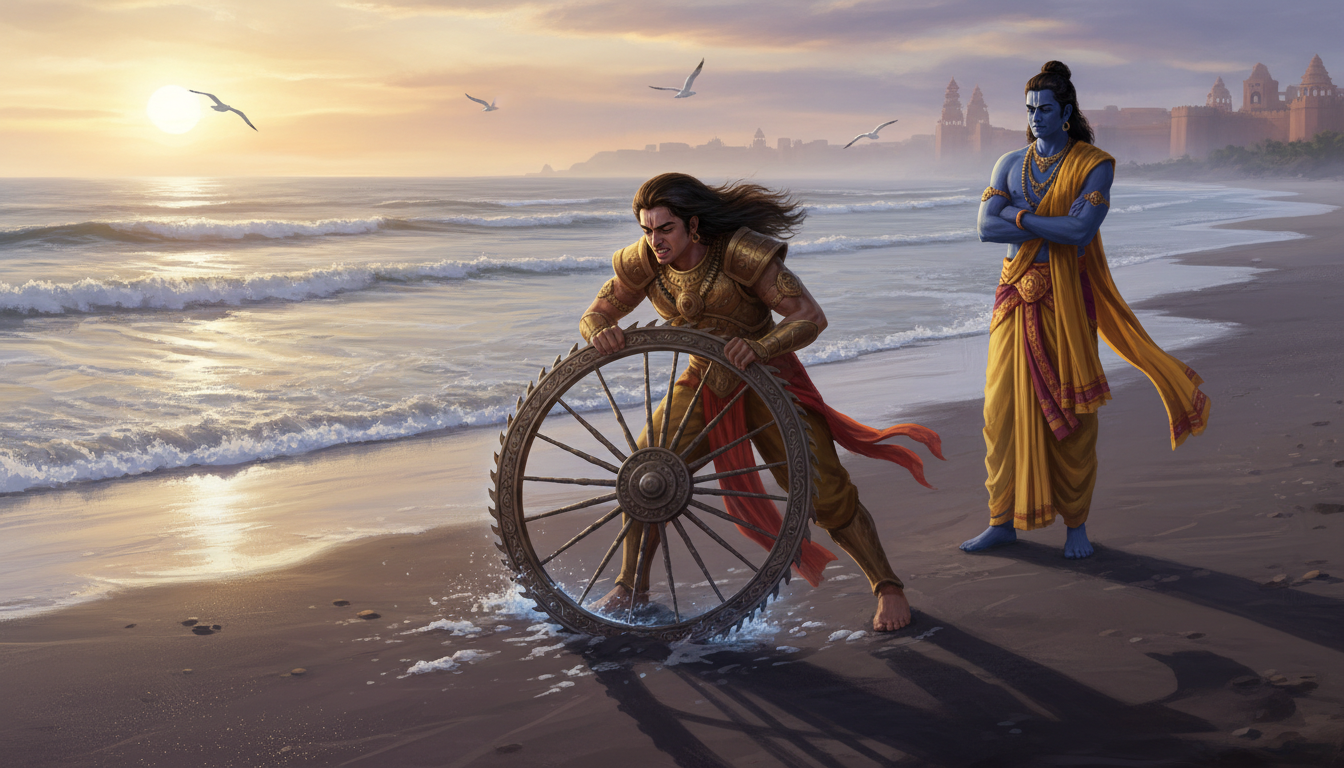
"'Thus addressed, he rose suddenly and seized the discus with his left hand.
He failed, however, to even move the weapon from the spot on which it lay. Not to raise it. To move it. It did not shift on the sand.
He then made preparations for seizing it with his right hand. Having seized it very firmly, and having put forth all his strength, he still failed either to wield it or to move it. He set his feet. He bent his back over it. He was a great warrior, the son of the greatest teacher of arms in the world, and he stood on a beach in front of me sweating over a wheel of iron that would not come off the ground.
At this, Drona's son became filled with sorrow. After he was tired with the exertions he had made, he ceased, O Bharata. He let go of it and stood up and would not look at me for a while.
I have seen men fail at things, O son of Pandu. What was in his face was not the failure. It was the arithmetic he was doing behind the failure, and I could watch him do it: if it will not come up for me, then it will never come up for me, and therefore this thing that I planned is finished, and therefore I must plan another thing. There was no moment in it at which he considered that the wheel had answered him.
And when he had withdrawn his heart from that purpose, I addressed him, and I did not spare him, because by then I had understood what the request had been.'"
Nobody Ever Asked Me for It
"'I said to him:
"He who is always regarded as the foremost of all human beings, that wielder of Gandiva, that warrior having white steeds yoked unto his car, that hero owning the prince of apes for the device on his standard, that hero who, desirous of vanquishing in a wrestling encounter the god of gods, the blue-throated lord of Uma, gratified the great Shankara himself, that Phalguna than whom I have no dearer friend on earth, that friend to whom there is nothing that I cannot give, including my very wives and children, that dear friend Partha of unstained acts, never said unto me, O brahmana, such words as these which thou hast uttered.
That son whom I obtained through ascetic penances and the observance of austere brahmacarya for twelve years on the breast of Himavat, whither I had gone for that purpose, that son of mine of great energy, begotten upon my wife Rukmini who had practised vows as austere as mine, even he never solicited this best of objects, this unrivalled discus, which thou of little understanding hast solicited.
Rama of great might never said such words to me. Neither has my son Samba, nor Gada, ever asked that of me which thou hast asked. No one among the other great car-warriors of the Vrishni and the Andhaka races residing in Dvaraka has ever asked this of me which thou hast asked.
Thou art the son of the preceptor of the Bharatas. Thou art held in high respect by all the Yadavas. Let me ask thee, O foremost of car-warriors, with whom wouldst thou fight using this weapon?"
I asked it plainly, O king, and I waited, standing on the sand with the sea behind me, to hear what he would say. I had given him every road out of the question. He might have said that he wanted it for the honour of holding it, or to defend the Kurus, or because a young man wants what he sees. He had lived in my house. He knew what answer would have cost him nothing.'"
The Answer He Gave
"'Thus addressed by me, Drona's son replied, saying:
"After offering worship to thee, O Krishna, it was my intention to fight thee, O thou of unfading glory. It was for this, O Krishna, that I solicited thee for thy discus, which is adored by gods and danavas. If I had got it I would then have become invincible in the world. Having failed, O Keshava, in obtaining my almost unattainable wish, I am about to leave thee, O Govinda. Address me in fair words now. This terrible weapon is held by thee that art the foremost of all terrible persons. Unrivalled art thou for this weapon. There is none else in this world capable of possessing it."
There it is, O son of Pandu. He had lived in my city and eaten at my table and been honoured by my kinsmen, and what he wanted from me, when the two of us were alone and no one was listening, was the means to kill me. He said it without shame and without much heat, as one states an ordinary intention that has merely gone wrong. Then he asked me to speak kindly to him, and I did, because he was my guest and the son of a teacher, and because there is nothing to be gained by anger with a man who has just told you the truth.
Having said these words unto me, the son of Drona, taking many couples of steeds and much wealth and diverse kinds of gems, left Dvaraka.'"
Why Bhima Must Not Ride Alone
"'He is wrathful, wicked-souled, restless, and very cruel,' said Krishna. 'He knows the weapon called Brahmashira. Vrikodara should be protected from him.'
And there was the whole of the argument, O Janamejaya, laid out in front of the eldest son of Pandu on the evening of the worst day of his life. Bhima had gone out alone after a man who had once tried to buy the means of killing Krishna, and who carried in his memory a weapon capable of consuming the whole world, and who had been told by his own father, on the day he received it, that he was not the kind of man who would keep such a promise.
Draupadi wanted a gem off that man's head. Bhima had gone to fetch it. And Krishna, who had stood on a beach in Dvaraka years before and watched Ashvatthama's hands go white on a wheel of iron that would not move, knew better than any of them what Bhima was riding toward.
Having said these words, that foremost of all wielders of weapons, that delighter of all the Yadavas, mounted upon his excellent car equipped with every kind of powerful weapon. Two pairs of foremost steeds of the Kamboja breed were yoked to it, adorned with garlands of gold. On the right was yoked the steed known as Shaibya; on the left was placed Sugriva; the Parshni was borne by two others called Meghapushpa and Balahaka. Upon the standard was Vinata's son, that enemy of snakes, shining with great splendour.
Then Hrishikesha mounted upon that car, and after him Arjuna of irresistible feats and Yudhishthira, the king of the Kurus, ascended the same vehicle, and he urged those foremost of steeds, and they flew."
Dharma Lesson
What a man asks for when he thinks nobody is listening is the truest account of him, and a weapon refuses the hand that wants it for the wrong reason. Krishna set no trap on that beach; he offered four weapons and one condition, and the condition simply told the truth about the man in front of him.