The Mountain That Answers Speech
Where a sage's temper made silence the price of passage
At a Slow Pace to the Nanda
Lomasa had just finished telling them how Ganga was brought down: the penance of Bhagiratha, the god standing on the snowy mountain with his attendants about him to take the weight of her fall on his head, the river coming out of the sky in three streams with her whirlpools raging and her foam lying on her like a robe, going forward, said the sage, like a woman drunk.
The Pandavas had listened to it sitting on stones, which was how they listened to everything now.
Then the son of Kunti went at a slow pace to the two rivers Nanda and Aparananda, which had the virtue of destroying the dread of sin.
Slow, because there was no reason any longer to be fast, and because the party he was leading was not an army. Bhima went ahead and broke the road. The twins came behind with the brahmanas, who were old, and who had followed a landless king out of a forest rather than eat in a palace, and who were not to be hurried. Draupadi walked, and did not say that she was tired. Dhaumya kept the fires. Arjuna was not with them; he was in the sky, at his own long errand, and there was a hole in the middle of every camp where he should have been.
They came down at last to water, in a country of thin bright air, and washed off the road in two rivers that were said to take away not sin only but the fear of it, and went on north and up, into the last hills before the great ones.
And the protector of men, having reached the healthy hill Hemakuta, beheld there very many strange and inconceivable sights.
The Hill That Threw Stones
It was a healthy hill. That was the first strange thing about it. The air on its lower slopes was clean and cold and good to breathe, the water ran clear, and nothing in the look of the place gave any warning at all.
One of the party said something. It does not matter what, and nobody afterward could remember; it was the sort of remark a tired man makes when he sees the top of a climb.
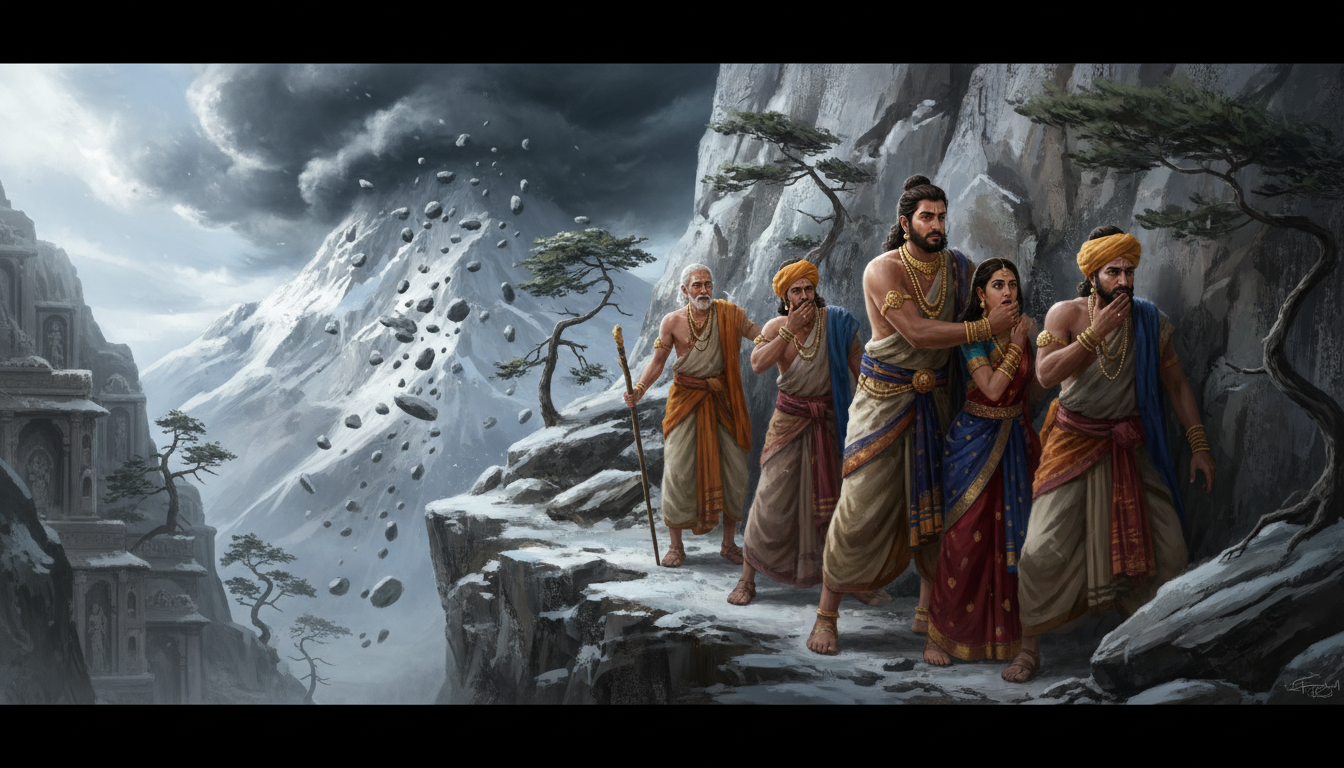
The sky over the ridge went white, then grey, then black, in the time it takes to draw three breaths. Cloud came up out of nothing directly above them and stood there, and out of it, without thunder, without wind, without any of the ordinary furniture of a storm, came stones. Not a stone. A thousand volleys of them, rattling down the scree, cracking off the rocks, filling the whole basin with a noise like an army at work.
There the very utterance of words caused the gathering of clouds and a thousand volleys of stones.
When it stopped, nobody spoke, for the excellent reason that everyone had understood the rule in the same instant. Bhima, who was the least governable tongue in that company and knew it, put the back of his hand across his own mouth and left it there.
And people at its sight were struck sad, and were unable to ascend the hill. That was the second strange thing, and the worse one. It was not that the way up was steep; they had come over worse. It was that when a man looked at the slope, something went out of him. The wish to climb it simply was not there any more, and could not be found by searching for it.
A Catalogue of Impossible Things
They made camp below it, and in the days they spent under that hill they counted the rest of the wonders.
There the winds blew for aye, and the heavens always poured down rains. Not weather, which comes and goes and can be waited out, but a settled condition of the place: wind across the ridge without pause, and rain falling on the upper slopes at every hour they looked at them, in sun and in cloud alike.
And likewise the sounds of the recitation of the sacred writ were heard, yet nobody was seen. It came from up the slope, in the ordinary early morning, the ordinary cadences, one voice leading and others answering. The Kuru brahmanas stopped what they were doing and listened, and one or two of them wept, because a man will know the tune of his own line's recitation anywhere. There was no smoke on that hillside, and no path, and no one.
In the evening and in the morning would be seen the blessed fire that carries offerings to the gods, burning on the mountain at exactly the two hours when a fire ought to burn, tended by nobody.
And there flies would bite and interrupt the practice of austerities. That was the wonder nobody makes songs about. The ascetics of the party would settle to their meditation at the proper hour and be driven off it, again and again, not by demons or by fear but by small stinging insects, until they gave up.
And there a sadness would overtake the soul, and people would become sick. It arrived without cause and sat on the chest. Men who had walked out of a burnt house of lac and slept in the open through the wet season came to that hill in health and lay down in the camp weak and grieving, and could not say what for.
The son of Pandu, having observed very many strange circumstances of this character, again addressed his questions to Lomasa with reference to these wonderful things.
As We Heard It Before
"O slayer of foes, O king," said Lomasa, "I am going to tell you as we heard it before. Do you attend to the same with intent mind."
It is worth marking how the sage began, because he was a man who had been in the sky and back and could have claimed to speak from sight. He did not. He said, as we heard it before, and put the story down in front of them at the value it carried, which was the value of a thing handed along.
Yudhishthira attended. He had asked his question quietly, and had asked it two days after he first wished to, because he had wanted to be sure of what a raised voice would cost.
"In this peak of Rishava," said Lomasa, "there was once a saint known by that name."
They looked up at it with a different set of eyes then: not a hill any more but a monument, and a monument with a man's name on it.
"And his life had lasted for many hundred years. And he was devoted to penances, and was greatly wrathful."
The sage set the two facts side by side and did not soften the join between them, because that join is the whole of the story. Hundreds of years of austerity had made the man immensely powerful. They had not made him patient. Whatever else penance had burnt out of Rishabha, it had left the temper exactly where it was, and had handed it a mountain to use.
The Order Given in Anger
"And he, forsooth, for having been spoken to by others, from wrath addressed the hill thus."
That is the entire provocation, and Lomasa reported it without embroidery. Nobody struck the saint. Nobody drove him from his seat or fouled his water or mocked his vows. People spoke to him. Travellers came past the peak where he sat and did what travellers do, which is to greet a holy man and ask him the way and tell him the news from below, and he had been at his penances for several hundred years and could not bear the sound of a human voice one more time.
So he turned and gave an order to the mountain, as a master gives an order to a servant, and the mountain took it.
"Whoever should utter any words here, you must throw stones at him, and you must call up the winds to prevent him from making any noise."
"This," said Lomasa, "was what the saint said. And so at this place, as soon as a man utters any words, he is forbidden by a roaring cloud."
Bhima laughed, once, before he could stop it, and every head in the camp turned to the sky. Nothing came. The rule, it seemed, had its own opinion about what counted as words.
"O king, thus these deeds were performed by that great saint," said Lomasa, "and from wrath he also forbade other acts."
He did not list them. He did not have to. The party had spent four days under a hill where the rain never stopped and the flies would not let a man sit and a sadness came down on the soul for no reason, and they understood that they were living inside the leavings of somebody's bad afternoon, several hundred years old, still running.
The Gods Who Did Not Wish to Be Seen
"O king," Lomasa went on, "tradition says that when the gods of yore had come to the Nanda, suddenly came over there a number of men to look at the celestials."
He let them picture it, and it was not hard to picture, because it is the most human scene in the story. Word gets about that the immortals are down at the river. And the people come. Not to worship, particularly, and not to ask for anything. To look. They came over the passes in numbers, craning, pointing, jostling for a place on the bank, exactly as a crowd gathers anywhere for a spectacle.
"Those same gods, at whose head stood Indra, did not, however, like to be seen."
That is all the reason there is, and Lomasa gave no other. Not anger. Not any offence committed. The gods had come there for their own purposes and found themselves an exhibition, and they did what the powerful do when they want privacy.
"And so they rendered this spot inaccessible, by raising obstructions in the form of hills. And from that day forward, O son of Kunti, men could not cast their eyes at any time on what looked like a hill, far less could they ascend the same."
So the sadness had a name now, and the stones had a reason, and the whole apparatus of the place resolved itself into two facts laid on top of one another: a hermit who wanted quiet, and a company of gods who wanted to be left alone, and between them a mountain instructed to refuse.
"This big mountain is incapable of being seen by one who has not led an austere life," said Lomasa, "nor can such a one ascend it."
The brothers looked up at it again, and found, as they had found every day, that they could not hold it in the eye for long.
Keep Your Tongue Under Control
"Therefore, O son of Kunti," said Lomasa, "keep you your tongue under control."
It was the only instruction he gave them at that place, and he gave it to a man whose truthfulness was famous in three worlds and whose ruin had come out of a hall of talk: a wager accepted because it would have been discourteous to decline, a question about whether he had staked himself first, a silence in a court where somebody should have shouted. Yudhishthira received the sentence without any expression at all.
"Here, at that time, all those gods performed the best sacrificial rites. O son of Bharata, even up to this day these marks thereof may be seen."
And the sage walked them over the ground and showed them, and this was the part the brahmanas of the party would talk about for the rest of the journey. This grass here has the form of the sacred kusa grass, he said, and it did; the ground here seems to be overspread with the sacred grass, laid down as it is laid down for a rite, in a place where no hand had laid it. And, O lord of men, many of these trees here look like the spots for tying the sacrificial beasts, standing where the stakes stand, at the distances the stakes are set.
"Still the gods and saints have residence here, and their sacred fire is observed in the morning and in the evening."
They had seen it. They had been seeing it since the day they arrived, twice a day, exactly at the hours, and had taken it for a wonder. It was not a wonder. It was somebody's evening worship, and they had been camped at the edge of a household that had been keeping its hours since before the Kuru line had a name.
"Here, if one bathes, his sin is forthwith destroyed, O son of Kunti. O most praiseworthy of the race of Kuru, do you therefore perform your ablutions, together with your younger brothers."
The Silent Bath
So the king went down to the Nanda with his younger brothers and washed his body there, and the whole thing was done without a word spoken.
That is a harder discipline than it sounds. A bath in cold water among brothers is a noisy business by nature, and Bhima in particular had never in his life entered a river quietly. They went down the bank in a line and in order. They put their bark garments on the stones. They went into water that came off snow, and the shock of it took the breath out of them, and not one of them let out the sound a man lets out when cold water reaches his chest.
Around them the mountain went on with its business. The wind came across the ridge without pausing. The rain fell on the upper slopes. Above the peak the cloud stood where it had stood all week, loaded, patient, listening, and it threw nothing, because there was nothing to throw at.
Draupadi bathed apart, and the brahmanas after, and Dhaumya poured what was to be poured, and the whole camp came up out of that river clean of the fear of sin and stayed silent while it dressed.
Yudhishthira stood a moment on the bank looking up at the peak of Rishabha. He had been given, in his life, a great deal of instruction about speech. He had been told what a king may say and what he must never say, and he had held to it so exactly that men called him the son of Dharma and meant it. And it had all been instruction about not lying. Nobody, until this week, had thought to teach him that there are places where the correct and honest thing is also to say nothing, and that the whole difference between being admitted and being driven off with stones can be a man's willingness to shut his mouth in a country that is not his.
Then he turned and went up the bank, and the party struck camp, still without talking, and got out from under the hill.
The Road On to the Kausiki
Then the king with his attendants, having washed his body there, proceeded to the river Kausiki, which was pure and delightful and pleasant with cool water; and the party came out of that place the way men come out of a sick room, breathing differently. On the second day somebody made a joke, and the sky did nothing about it, and after that they all talked at once for an hour like released prisoners.
"This is the pure divine river by name Kausiki," said Lomasa. "O chief of Bharata's race, and this is the delightful hermitage of Vishvamitra, conspicuous here. And this is a hermitage with a holy name, belonging to Kasyapa of mighty soul, whose son was Rishyasringa, devoted to penances and of passions under control. He by force of his penances caused Indra to rain; and that god, the slayer of the demons Vala and Vritra, dreading him, poured down rain during a drought. That powerful and mighty son of Kasyapa was born of a hind. He worked a great marvel in the territory of Lomapada. And when the crops had been restored, king Lomapada gave him his daughter Santa in marriage, as the sun gave in marriage his daughter Savitri."
Yudhishthira, who had four days of unasked questions saved up and a river bank to ask them on, began at once. How was the son of Kasyapa born of a hind? How was he endowed with holiness, being the issue of such a connection? For what reason was Indra, the slayer of Vala and Vritra, afraid of that sagacious boy, and poured down rain in a drought? And since the royal saint Lomapada is said to have been of a virtuous disposition, why was rain withheld from his territory at all?
Lomasa began to answer, and the pilgrimage went on down the water.
But the king kept what the hill had taught him, and it was this. A saint of many hundred years had once been spoken to by strangers, and had lost his temper, and had left that temper standing across a mountain pass where it would go on throwing stones at travellers long after every man who had ever annoyed him was dust. And the gods, who could have scattered the crowd that came to stare at them with a gesture, had chosen instead to raise a wall of hills and go quietly on with what they were doing. Both had bought their silence with power. Only one of them had made a country sick to get it.
Dharma Lesson
Some places, and some people, are entered only by those willing to stop talking. A saint of many hundred years kept his austerities and lost none of his temper, and left that temper standing across a pass to stone strangers for centuries after the offence was forgotten. Power that has not been taught patience does not become harmless; it only acquires a longer reach.