The Weapons That Must Not Be Shown
A demonstration the three worlds could not survive
The Last Thing Said That Night
They had him back, and they could not stop looking at him.
Five years Arjuna had been gone, and he had come down onto the lower shoulder of Gandhamadana out of a chariot none of them could look at directly, wearing a diadem Indra had set on his head with his own hands, with a golden garland at his throat and a celestial mail on his body that no weapon on earth would open, and the conch Devadatta at his hip. He had talked most of the night. Matali at the reins and the sky-ranging city of Hiranyapura crushed out of the air. The Nivatakavachas in their thousands under the sea. The wives of the Danavas coming out of the broken city with their hair down, crying like kurari birds, falling on the ground and beating their breasts, and the place standing afterwards like a lake with the elephants gone out of it. Indra saying, twice, Well done.
Yudhishthira heard the whole of it with his hands folded.
"By fortune it is that the weapons have been obtained by thee," he said at last. "By fortune it is that the master of the immortals hath been adored by thee. By fortune it is that Sthanu himself with the goddess became manifest to thee and was gratified by thee in battle. By fortune it is that thou hast met the Lokapalas. By fortune it is that we have prospered, and by fortune it is that thou hast come back. Today I consider that the entire earth, garlanded with its cities, is already conquered, and the sons of Dhritarashtra already subdued."
Then he said the thing that would nearly undo the world in the morning, and he said it as any elder brother says such a thing, warmly, over a low fire, with his family around him.
"Now I am curious to behold those celestial weapons wherewith thou didst slay the powerful Nivatakavachas."
Arjuna considered a moment.
"Tomorrow in the morning," he said, "thou wilt see all the celestial weapons with which I slew the fierce Nivatakavachas."
And having related the whole matter of his arrival, Dhananjaya passed that night there, together with all his brothers.
The Necessary Duties
When the night had passed, Yudhishthira the just arose, and together with his brothers performed the necessary duties.
That is how the account puts it and the flatness of it is worth noticing. They washed. They said the morning prayers. Dhaumya set the fire and made the offering into it and the smoke went up straight in the cold air off the snow. Draupadi came back from the water with her hair wet. Somebody built up the cooking fire. The mountain stood over them with its blue rock and its cascades and its trees full of birds making the noise they made every morning.
Everything about that hour was ordinary, and it is the last ordinary hour in the story.
Then Yudhishthira spoke to Arjuna, that delight of his mother.
"O Kaunteya. Do thou show me those weapons with which thou vanquished the Danavas."
Arjuna did not say no.
This is the thing that has to be sat with, because he was not a fool and he was not vain in that particular way. He had spent five years being taught by the guardians of the four quarters. He had been told what he was holding. But the man asking was his eldest brother, who was also his king, who had been sleeping on the ground for eleven years because of a game of dice, and who had asked for one morning's sight of the only good thing that had happened to any of them since.
So Arjuna went apart and purified himself with extreme care, as such a thing requires. He bathed, and touched water, and put on the unearthly apparel Sakra had given him, and stood a long time with his eyes shut before he came back down the slope, and none of them thought anything of the delay, because a man who has been five years in heaven is entitled to his own ceremonies.
What none of them knew, and what he had not thought to say the night before because the question had not come up in Indra's hall, was that he had been given the weapons and had never once been shown what the middle world does when they are all present in it at the same time. Heaven is a place built to hold them. Nobody had told him that the earth was not.
A Chariot Made Out of a Mountain
He had no car. He had left Indra's car in the sky where it belonged.
So he took the earth for his chariot.
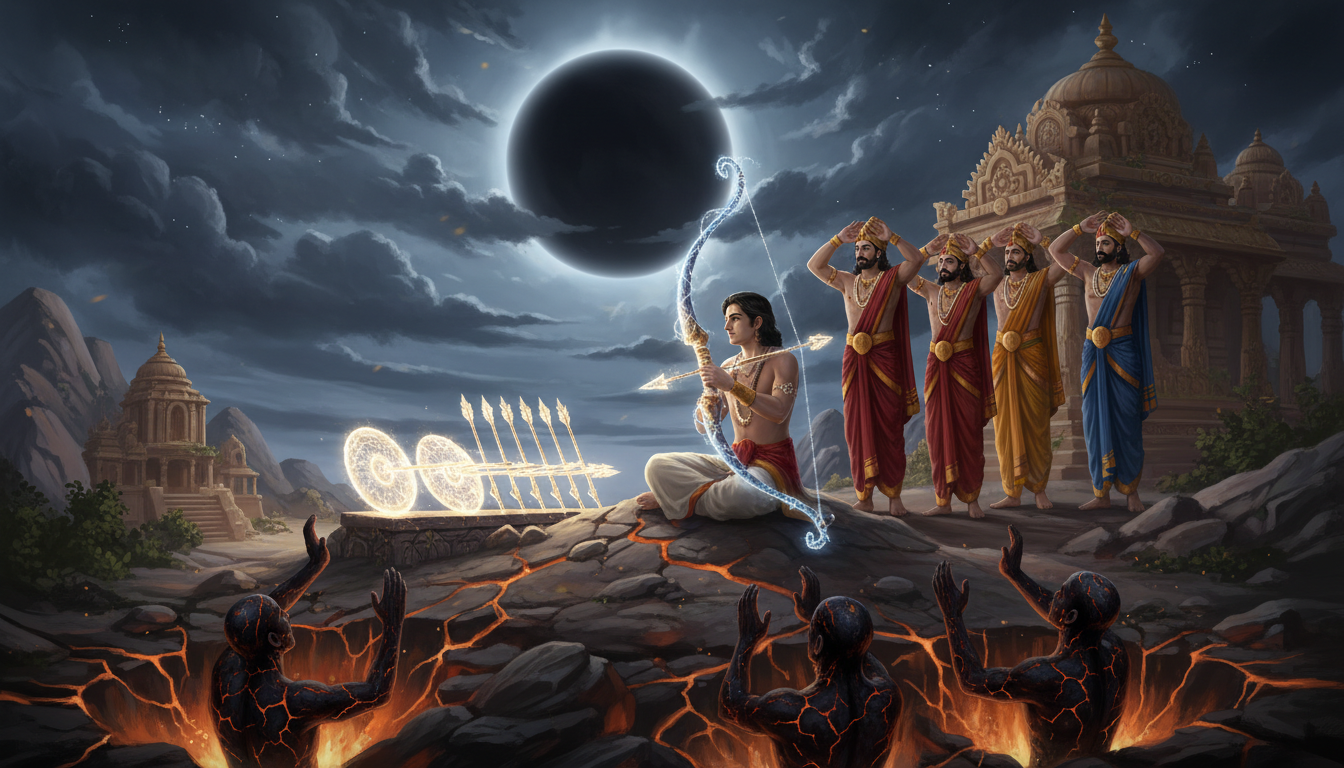
He seated himself on the ground and the ground became the floor of it. The mountain itself served him for the pole, its whole mass running out ahead of him in the direction he faced. The base of the axle was the rock under him. For the socket-pole he had a cluster of tall bamboos standing in a clump at the mountain's shoulder, and the wind moved in them, and that was the chariot: a man sitting on a hillside in the morning, and the hillside doing the work of the gear he did not have.
Upon him was the celestial armour of great lustre, and it threw the sun back at the sun. In his hands was Gandiva. At his side was the conch given him by the gods.
His brothers sat down along the slope to watch. Bhima had come away from the fire with his hands still wet. Nakula and Sahadeva sat together the way they always sat. Draupadi stood a little above them with her palm on a rock. Dhaumya, who had a priest's instinct for the difference between a ceremony and an exhibition, was the only one who was not entirely comfortable, and he did not say anything, because a king had asked and a brother had agreed and there was no procedural ground on which a chaplain could object.
Arjuna took up the first of them and commenced to exhibit those celestial weapons in order.
In order. Not one of them. Not a demonstration of the useful ones. In order, from the beginning, the way a man recites what he has learned to the teacher who taught him it.
The Earth Under His Feet
The first thing that went wrong was the ground.
As those celestial weapons had been set, the earth, being oppressed with the feet of Arjuna, began to tremble. Not shaken by them. Oppressed. The weight that came into him as he called them up was more than the place he was sitting on had been built to carry, and the mountain answered the way a floor answers a load, from underneath, with a long grinding shudder that came up through everyone sitting on it.
The trees went with it. The whole forest on that slope, the salas and the tamalas and the flowering kadambas that Yudhishthira had been admiring aloud a few days before, began to sway together in a wind that was not there, and their blossoms came off in sheets.
Bhima put his hand flat on the rock and looked at it.
Below them and away in every direction the rivers went out of their beds. The account says the rivers and the mighty main became vexed, and vexed is a mild word for what the water did: the streams off the Himavat ran backward in their channels, the lakes tipped, and far off past the plains the sea itself stood up and came inland and hung there without breaking.
And the rocks were riven. Cliffs on the far side of the valley opened along seams that had held since the mountain was made, and the sound of it arrived a long moment after the sight.
Then the air was hushed.
That was worse than the noise. Every wind in the world stopped at once. The blossoms that had been coming off the trees hung where they were. Nothing moved on the whole mountain except one man's hands.
The Sun Did Not Shine
And the sun did not shine.
It was there. Nobody could point at a cloud. The disc stood where it had stood, in the ordinary place for that hour, and no light came off it, as though the business of shining had been suspended pending some other matter.
And fire did not flame. Dhaumya turned to look at his own altar and the offering lay in it and the coals were red and there was no flame on them at all. He put his hand near and there was heat. There was simply no fire, anywhere on that mountain, in any hearth, at the same moment.
And then, by no means did the Vedas of the twice-born once shine.
Of everything that happened that morning, this was the thing the brahmanas who had come north with the Pandavas could never afterward describe without their voices changing. They had been reciting, some of them, because that was what one did while sitting on a hillside. And the recitation went out. The words were still in their mouths. They could still say them, in the correct order, with the correct accents. But whatever it is in a mantra that makes it a mantra and not a sentence had gone dark, the way a lamp goes dark, and they were left saying syllables into a stopped morning.
Dhaumya stood up.
"Yudhishthira," he said. It was the first time in twelve years he had used the name without a title in front of it.
But Yudhishthira was watching his brother, and his brother was not finished, because Arjuna had said in order, and he was a man who did what he had said he would do.
The Creatures From Under the Earth
Then the ground opened, and the ones who live inside it came up.
The creatures peopling the interior of the earth, on being afflicted, rose and surrounded the Pandava. Nobody who was there had ever seen most of them. They came out of the riven rock and out of holes at the roots of trees and out of places that had not been holes a moment earlier, in their hundreds and then in numbers no one tried to count, and they came straight to him and made a ring around him and stopped.
They were trembling. Their hands were joined. Their faces, the account says, were contorted, which is what a face does when the thing happening to it has no name.
And they were burning.
That was the part. Being burnt by those weapons, they besought Dhananjaya. Not one weapon had been loosed. Not one arrow had left the string. Arjuna had done nothing but call them into presence and set them out in their order on a hillside, and the mere fact of them, standing there unlaunched, was cooking the world from below.
They begged him for their lives. That is the phrase. Small things and old things and things with no shape a man could hold in his mind, holding up their joined palms to a mortal sitting on a rock, and asking him to please stop, and not knowing his name, and using the one they had heard the others shout.
Bhima was on his feet. Draupadi had come down the slope. Yudhishthira had gone the colour of the stopped sky, because he was a man who understood exactly what he had asked for the moment it was too late to unask it, and that particular understanding was the one thing his life kept teaching him.
Everything That Could Come, Came
And then the sky filled up.
The Brahmarshis came, and the Siddhas, and the Maharshis, and the mobile beings, all of them at once, appearing on the mountainside and above it. The foremost of the Devarshis came, and the celestials, and the Yakshas, and the Rakshasas, and the Gandharvas, and the feathered tribes, and the other sky-ranging beings, until there was no clear air left over Gandhamadana.
The Great-sire came, and all the Lokapalas with him, the four guardians of the four quarters, and Arjuna had eaten at the table of every one of them within the last five years. And the divine Mahadeva came, together with his followers, down onto a mountain that stood in sight of his own.
They did not come to punish anyone. That is the strangest thing about the crowd that gathered. They came because a display of that order had never been made in the middle world before and would not be made again, and everything in creation with the power to be present was present, and none of them intervened.
Vayu came bearing unearthly variegated blossoms and fell to strewing them around the Pandava, and the flowers came down on the still air onto the man and the rock and the ring of burning creatures with their hands joined.
And the Gandharvas, sent by the celestials, chanted various ballads, and hosts of Apsaras danced.
They were applauding. The three worlds were coming apart at the seams by the minute and the sky over that mountain was full of music and dancing, and Yudhishthira stood in the middle of it understanding, for the first time in his life, that being admired by heaven is not the same as being told you are right.
Arjuna, Arjuna, Do Not Discharge Them
At such a moment, sent by the celestials, Narada arrived.
He came through the singing and the falling flowers and did not look at any of it, and he addressed Partha in words the account calls sweet, which they were, and they were also the only order given by anyone that day.
"O Arjuna, Arjuna. Do thou not discharge the celestial weapons."
Arjuna's hands stopped.
"These should never be discharged when there is no object," said Narada. "And when there is an object present, they should also by no means be hurled, unless one is sore pressed. For, O son of the Kurus, to discharge the weapons without occasion is fraught with great evil."
He said it as a rule, not as a rebuke, and that is how it went in.
"And, O Dhananjaya, being duly kept as thou hast been instructed, these powerful weapons will doubtless conduce to thy strength and thy happiness. But if they are not properly kept, they, O Pandava, will become the instrument for the destruction of the three worlds."
Then the sentence that Arjuna would carry the rest of his life.
"So thou shouldst not act in this way again."
Not again. Not in a worse hour, not for a better reason, not once. The greatest archer alive had performed his whole learning perfectly, in order, without a flaw, and the verdict on it was that it must never happen a second time.
And Narada turned to the man who had asked for it, and he was gentle with him, which was somehow the hardest part.
"O Ajatasatru. Thou too wilt behold even these weapons, when Partha will use them for grinding thy enemies in battle."
You will see them, he was saying. You will see all of them, and you will not have to ask.
After They Had All Gone
Arjuna put them away.
One by one, in the reverse of the order he had called them, he sent them back to wherever such things wait, and as he did it the world came back through the same door it had gone out of. The air moved. The blossoms that had been hanging finished falling. The sun found its light again and put it on the snow. Down at the fire pit a flame stood up out of the coals of its own accord, and Dhaumya, who had been standing over it for a long while, sat down rather suddenly. Far away and unheard by anyone on that mountain, the sea went back into its bed.
The creatures of the interior of the earth unjoined their hands and went down into the ground and closed it after them.
Having prevented Partha, the immortals and the others that had come there went, each to his own place. The Great-sire went. Mahadeva went with his followers. The Gandharvas stopped singing in the middle of a measure and were not there. Narada, who had come the last, went with the rest and did not say goodbye to anybody, having done the one thing he had been sent to do.
And after they had all gone, the Pandavas began to dwell pleasantly in the same forest, together with Krishna of the Panchalas.
That is the whole of the ending, and it is deliberately small. They stayed on. They ate the fruit of that place and the honey of that place. Nobody spoke about the morning.
But Yudhishthira did not ask his brother to show him anything again, for the rest of the exile or after it. He had learned the thing the account was built to teach, and it had cost him one morning and very nearly everything else: that a power held in reserve is a shield, and the same power brought out to be looked at is already an act of harm, and that the last discipline a fighting man learns, long after he has learned to hit what he aims at, is how to leave a thing in its case when the person asking is someone he loves.
Dharma Lesson
Power kept in reserve is a shield, but power exhibited for its own sake is already an act of harm, and Arjuna loosed nothing at all before the world began to come apart. The last discipline a warrior learns, long after he can hit what he aims at, is how to leave a thing in its case when the person asking is someone he loves.