The Muni Who Would Not Stay Dead
A hunting accident, a vanished body, and an answer about fear
We Long to Hear of the Greatness of the Brahmanas
Markandeya had been talking for a long while about what happens to a man after he dies, and it had not been comfortable listening.
He had told them that a man quits his frail outer body and is immediately born again in another order of beings, never remaining non-existent for a single moment; that in the new life his actions follow him invariably as a shadow follows, and, fructifying, make his destiny happy or miserable. He had catalogued the four sorts of men there are: those who find happiness in this world and not the next, those who find it in the next and not this, those who find it in both, and those who, having neither learned anything nor given anything away nor practised anything, find it in neither.
And then he had turned to the five men sitting in front of him in deerskin, in a forest, in the tenth year of an exile they had not earned, and had said: O ornament of Kuru's race, may no doubts cross your mind on account of these your sufferings, for this affliction is for your good.
The fire had settled. Draupadi had said nothing, which she did in a way that could be heard.
Then the sons of Pandu said to the high-souled Markandeya, "We long to hear of the greatness of the brahmanas. Do you tell us of it."
And thus asked, the revered Markandeya, of austere virtue and high spiritual energy, and proficient in all departments of knowledge, replied. He did not begin with a doctrine. He began with a young man on a horse, who had a good morning ahead of him and no idea at all what was coming.
A Prince of the Haihayas Goes Hunting
"A strong-limbed, handsome young prince of the race of the Haihayas," said Markandeya, "a conqueror of hostile cities, once went out hunting."
Every word in that description is doing work, and it is worth slowing down over. He was strong-limbed, so his arm was reliable. He was handsome, so he had been indulged. He was young. And he was already a conqueror of hostile cities, which in a man of that age means he had been very good at the one thing he had been trained for, early, and had been told so.
The Haihayas were a great house and a hard one, and their princes were not raised to hesitate. That is not a fault in a soldier. On a field, the man who checks his stroke to make certain is the man who is carried off it. Everything about this young man's education had been arranged to remove exactly that half-second.
He went out at the good hour, when the light is low and long and every shape in the brush is half a guess. And while roaming in the wilderness of big trees and thickets of grass, with the ground broken and the cover high and the eye working hard, he saw, at no great distance from him, something dark standing among the stems.
A hide. Black, with the sheen an antelope's coat has when the sun comes across it. Motionless in the grass, at the range where a man shoots without dismounting.
The half-second his whole life had removed would have been enough.
The Skin of a Black Antelope
He shot.
And he had killed, said Markandeya, a muni with the skin of a black antelope for his upper garment; he killed him for a deer.
The prince rode up to collect his kill the way a hunter does, easily, already thinking about the rest of the day, and the shape in the grass resolved as he came, the way a shape does, into something that was not going to be an antelope. The hide was over a shoulder, not on a back. It was worn the way an ascetic wears it, the way ten thousand ascetics in the world wore it that morning, and beneath it there was a man's grey hair, and a man's thin arm, and a man's face.
He had done nothing wrong that anybody would have named wrong, and he had killed a brahmana in a forest, which is the one act in the world that his order had no ceremony for and no excuse for and no remedy for.
The prince got down.
There is nothing in the account about what he said, and Markandeya did not supply any. He gave instead the state the young man was in, and it is the exact phrase that everyone who has ever done irreparable harm by accident will recognise: pained at what he had done, and his senses paralysed with grief.
Not weeping. Not raving. Stopped. The whole apparatus of a competent and confident young man, standing in high grass at the good hour of the morning, simply ceasing to work.
What He Carried Back
He did not hide it. That is the first decent thing in the story, and it is worth saying plainly, because a great many men in that position have chosen the other road, and there was nobody in the grass to contradict him.
He repaired to the presence of the more distinguished of the Haihaya chiefs. Not to his friends. To the elders: the men whose faces he would least have chosen to stand in front of, the ones who had watched him grow into a conqueror of cities and had been proud of him.
And the lotus-eyed prince related to them the particulars.
All of them. The hour. The light. The thickets of grass. The dark hide at no great distance, and how certain he had been, and how little he had waited, and what he had found when he walked up to it.
They heard him out. Then, said Markandeya, they went and looked, because men of that rank do not take a thing of this size on report; and on hearing the account, O my son, and beholding the body of the muni who had subsisted on fruits and roots, they were sorely afflicted in mind.
That detail about the fruits and roots is the one that broke them, and Markandeya put it in for that reason. It was written on the body. You could see what the man had lived on, in the thinness of the arms and the emptiness of the belly; you could read a whole austere and harmless life off him at a glance, and know that he had never in his years taken from the forest anything that had blood in it, and had been shot in it for meat.
The whole clan stood around him in the grass and understood what had come into their house.
Whose Son Was He
What they did next was not a rite, and not a penance, and not a payment. It was a search.
And they all set out, enquiring here and there as they proceeded, as to whose son the muni might be.
They wanted a name and they wanted a father. Because the killing of a brahmana is a thing done to a family before it is a thing done to the order of the world, and there was, somewhere out in that country, a household that did not yet know it was short a man. Somebody was keeping food back for him. Somebody would go on keeping it back for days.
So the Haihayas went from hermitage to hermitage across the forest, a body of armed princes moving very carefully through a country of unarmed men, and at each place they asked the same question, and the answer was no. Nobody knew him. And with each no the thing they were carrying got heavier, because it began to look as though they might have to leave the country without ever putting a name to what was on that ground, and there is no worse ending than that.
And they soon after reached the hermitage of Arishtanemi, son of Kasyapa.
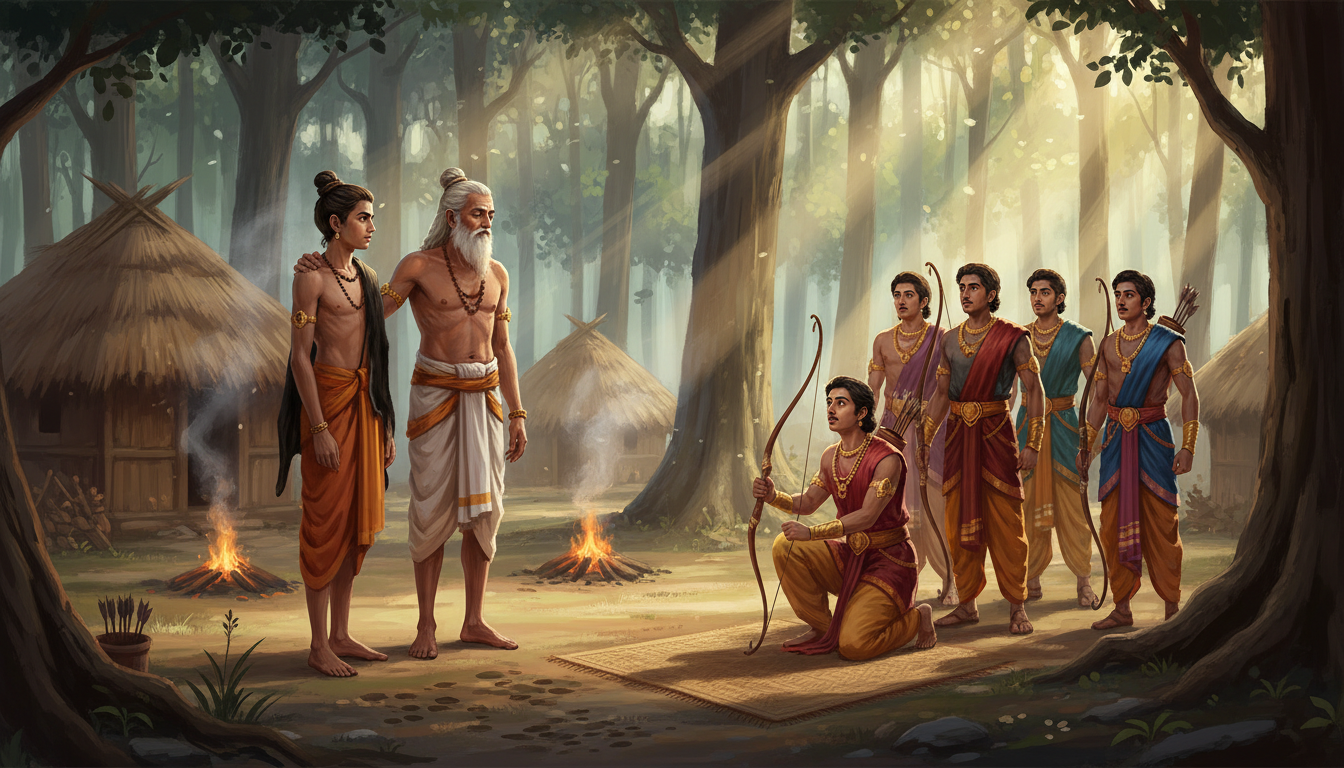
They had almost ridden past it. It stood back off the track, a few huts, a swept yard, a fire trench, the water carried up from somewhere below; the kind of place a column of horsemen goes by without turning its head. That is worth holding on to, because everything that follows happened in that yard, and not in a temple or a court or anywhere that a man would have gone looking for a wonder.
It was an ordinary hermitage, and there was nothing about it that announced anything. The muni who came out to them was constant in austerity and unhurried, and had no idea who they were, and they got down off their horses at the edge of his ground.
The Welcome They Had Come to Refuse
And saluting that great muni, so constant in austerity, they all remained standing, while the muni, on his part, busied himself about their reception.
That sentence contains the most painful minute in the story, and Markandeya did not hurry through it.
The princes stood. They would not sit down, because they had come to confess a killing and a man does not take a seat first. And the muni, seeing guests at his door, did what a householder of that order does without thinking about it: he began the reception. Water for the feet. A seat brought out. Something to eat, from a store that plainly had nothing in it. He moved about his ground doing the ordinary honours, cheerfully, to a party of armed men who were standing there in silence waiting for him to finish so that they could tell him what they had done, and every kindness he offered went into them like a nail.
At last one of them found his voice, and they said to the illustrious muni:
"By a freak of destiny, we have ceased to merit your welcome. Indeed, we have killed a brahmana."
They put it in the plural. Not the boy. We. Whatever else the Haihayas were, they did not hand over one of their young men to carry a thing of that size alone, and the whole clan had come to say it standing up.
And the muni set down what he was holding and looked at them.
Witness the Power of My Ascetic Practices
"How has a brahmana come to be killed by you," said the regenerate rishi, "and say, where may he be?"
They began to explain, and he did not let them get far before he added a sentence that made no sense to anybody standing there.
"Do you all witness the power of my ascetic practices."
It was not the reply they had braced for. They had ridden all day expecting one of two things: a curse, which would have been just, or a silence, which would have been worse. Instead the muni had asked them, in effect, to go and look at something.
So, having related everything to him as it had happened, they went back.
And they found not the body of the dead rishi on the spot where they had left it.
The grass was as they had left it. The trees were the trees. Some of them could put a hand on the place where he had lain. There was no body there, and no drag-mark, and no beast's sign, and nothing at all to say that anything had ever happened in that patch of ground on that morning.
And having searched for him, they returned, ashamed and bereft of all perception, as in a dream.
That is exactly the condition. Not frightened. Not exalted. Emptied: men walking back to a hermitage through a forest that had stopped agreeing with their memory, unable to say to one another whether they had spent the day confessing to a murder or inventing one.
This Brahmana Is My Son
The muni was waiting for them when they came back, and he was not alone.
Then, O conqueror of hostile cities, the muni Tarkshya, which was the other name of that son of Kasyapa, addressed them, saying: "You princes, can this be the brahmana of your killing? This brahmana, endowed with occult gifts from spiritual exercises, is indeed my son."
And there he stood: a young ascetic with a black antelope skin over one shoulder, alive, unmarked, and mildly curious about the visitors, in the ordinary evening light, at the edge of his father's ground.
Seeing that rishi, O lord of the earth, they were struck with bewilderment.
Somewhere in that party was a strong-limbed young man who had spent the day in a condition beyond grief, and who now had to look at the face he had seen in the grass, upright and unbothered and belonging to somebody, and there is no account of what he did and Markandeya offered none.
The rest of them found words at last, and what came out of them was not thanksgiving. It was a question, and it was asked with the greed of men who have just been shown a door.
"What a marvel! How has the dead come to life again? Is it the power of his austere virtue by which he has revived? We long to hear this, O brahmana, if indeed it can be divulged."
If indeed it can be divulged. They expected a secret. They expected the thing to be a technique, guarded, expensive, and probably not for them.
Why Death Has No Hold Here
"Death, O lords of men, has no power over us," he replied. "I shall tell you the reason briefly and intelligibly."
And then he gave it, and there was not one miracle in the list.
"We perform our own sacred duties; therefore have we no fear of death." Not great duties. Not somebody else's more impressive duties. Our own, the ones that fall to us, done at the hours they fall.
"We speak well of brahmanas, but never think any ill of them; therefore has death no terror for us." Mark the second half of it. Not merely that they say nothing ill. That they do not think it, which is a discipline nobody can audit and nobody can fake, and which has to be kept alone.
"Entertaining our guests with food and drink, and our dependants with plenty of food, we ourselves then partake of what is left; therefore we are not afraid of death." The princes had watched this one being performed on themselves that same afternoon, by a man who did not yet know whether they were murderers.
"We are peaceful, and austere, and charitable, and forbearing, and fond of visiting sacred shrines, and we live in sacred places; therefore we have no fear of death. And we live in places inhabited by men who have great spiritual power; therefore has death no terror for us."
That was the whole of it. Duty, speech, guests, temper, and the company you keep. Five ordinary things, kept without exception, for a whole life, until there was no crack anywhere in the day for fear to get in at.
"I have briefly told you all. Return you now, all together, cured of all worldly vanity. You have no fear of sin."
Cured of All Worldly Vanity
Saying amen, O foremost scion of Bharata's race, and saluting the great muni, all those princes joyously returned to their country.
They had ridden out that morning to find a family to answer to and had found instead a household where the thing they most feared had no purchase, and had been sent home absolved by the very people they had wronged; and there is no record that any of them ever asked for the technique again, because they had been told it plainly and it was not a technique.
Markandeya stopped there, and the fire in the Kamyaka forest was low.
The brothers had asked to hear the greatness of the brahmanas, and had expected, most likely, thunder: curses that split kings, penances that shook the seat of Indra, the sort of story in which a holy man is dangerous. They had been given instead a man who ran to meet armed strangers with water for their feet, and whose son could not be killed because of the way the household ate its meals.
Yudhishthira sat with it. He had spent ten years now watching every visible thing be taken from him, and the sage's list had not one visible thing in it: no wealth, no arms, no kingdom, no title, nothing that could be staked at dice or lost in a hall. Perform your own duties. Think no ill. Feed the guest before yourself. Keep your temper. Live near better men.
Bhima, who had killed more men than anyone sitting at that fire and had never once mistaken what he was aiming at, said nothing for a long while either. He had a good deal of sympathy to spare for a strong young man with a fast hand and no habit of waiting.
That, said the deathless sage, is the greatness of the brahmanas: not that death is defeated at the moment it arrives, but that a life can be so ordinarily and so unbrokenly kept that when death does arrive there is nothing in the house for it to take hold of.
Dharma Lesson
What protects a life is not a charm against death but the ordinary daily order of it, kept without exception until fear has nowhere left to enter. Perform your own duties, think no ill of anyone, feed the guest before yourself, keep your temper, live near better people. Not one item on that list can be staked at dice or taken by an enemy, which is why it holds.