The Rule Narada Left Behind
Narada came to Khandavaprastha as sages come, without warning and without luggage, and stayed long enough to tell the brothers a story about two asuras.
Sunda and Upasunda were the sons of Nikumbha, of the race of Hiranyakasipu, and they were so wholly of one mind that they seemed to be one person divided into two parts. Each spoke and did what was agreeable to the other. Neither went anywhere unless the other went with him. They performed their penances together on the Vindhya mountains, standing on their toes, living upon air, throwing pieces of the flesh of their own bodies into the fire, until the mountains steamed with the heat of it and the gods grew frightened. When the Grandsire came to them at last and refused them immortality, they asked instead that they should have no fear from any created thing, mobile or immobile, in the three worlds, except only from each other, and it was granted. They emptied heaven. They killed the sacrificers on their own altars and threw the sacred fires into the water, and the curses of the Rishis came off them like arrows shot at stone, and when there was nobody left to fight they took up their abode in Kurukshetra with no rival anywhere.
"And the Grandsire called Viswakarman," said Narada, "and had him build a woman out of the smallest particles of every gem there is, and named her Tilottama for the measure of those particles, and sent her walking past them in a single piece of red silk, plucking wild flowers. Within the hour those two lay on the ground in their own blood with their maces beside them. One of them had taken her by the right hand, and the other had said, 'She is my wife and therefore your sister in law,' and the first had said, 'She is mine, not yours,' and each of them went on saying, 'I was the first,' until neither of them could say anything.
"That is why I have told it," he said, when the five of them were quiet. "From affection I say this to you, foremost ones of Bharata's line. If you wish to do anything agreeable to me, make some arrangement among yourselves now, while you are still fond of one another, so that you may never quarrel for the sake of Draupadi."
They withdrew and consulted and came back and made their rule in the presence of the celestial Rishi himself, so that it should have a witness who could not be argued with. It was short. When one of them was sitting with Draupadi, any of the other four who saw that one thus must retire into the forest for twelve years and pass those years as a Brahmacharin.
Narada was gratified with them and went away to whatever place he wished, and for a long time afterward the rule did what it had been made to do. No dispute ever arose between the sons of Pandu.
One Room for the Bows
Those were the good years, and they had the shape that good years have when nobody is writing them down. The brothers brought many kings under their sway by the prowess of their arms. The whole race of Kurus, free of sin and happy, grew in prosperity around them. Draupadi took delight in her five heroic husbands and they took delight in her, and she moved among them the way the Saraswati moves among the elephants that come down to her water and are pleased with the river that is pleased with them.
The rule sat over the house so quietly that it stopped being a rule and became a habit. The hours were known. Everyone in the palace, from the queen's women to the men at the stables, knew whose hours these were, and doors were not opened without a reason, and the household moved around those hours the way a stream moves around a stone, without resentment and without much thought.
There was one detail of the arrangement that nobody had examined, because it was too ordinary to examine.
The weapons of the five were kept in one chamber. All the bows in the house lay in that room together, strung and unstrung, with the mail and the quivers and the standards, because it is a soldier's habit and a soldier's convenience to keep such things in one place and not scattered through a palace where a man must hunt for his own gear in an emergency. And that same room, at certain hours, was where the eldest brother sat with their wife.
So the covenant that had been made to keep peace among five men, and the door behind which those five men kept their arms, were the same door. There was no reason to notice it. Nobody did, until a morning when a man at the gate began to shout.
The Man at the Gate
Robbers had come down on a brahmana's herd and driven the cattle off, and while they were still on the road with the booty the brahmana, out of his senses with anger, walked to Khandavaprastha and stood at the gate of the Pandavas and reproved them in the accents of a man weeping.
"Ye Pandavas, out of this your own dominion my kine are being taken away by force at this moment by despicable and wicked wretches. Pursue the thieves.
"Alas, the sacrificial butter of a peaceful brahmana is being taken away by crows. The wretched jackal invades the empty cave of a lion.
"A king who takes the sixth part of the produce of the land and does not protect his subjects has been called by the wise the most sinful person in the whole world. The wealth of a brahmana is being taken away by robbers. Virtue itself is sustaining a diminution. Take me up by the hand, ye Pandavas, for I am plunged in grief."
He was not begging, and he named no sum, and he did not ask for a gift of other cows to replace the ones he had lost. He had paid the sixth share into their granaries like every other man in the country, year after year, without argument, and what he had bought with it was the one thing a king sells. His cows were his sacrifices. Milk and butter and the fire on his hearth and the offerings he was obliged to make for the sake of everybody else's welfare, all of it walking away northward with men who had counted, correctly so far, on nobody coming after them.
So he stood at the gate of the finest new city in the world and told its owners, in front of whoever was standing there, that they were at that moment the most sinful persons alive.
No Fear
Dhananjaya heard those accents. He was the nearest of the brothers and the first to reach the courtyard, and he did what he had done all his life without being told to do it.
"No fear," he called out to the man, loudly, so that the whole gate heard it. "No fear."
It is a short sentence and it is a promise, and once a son of Pandu had said it in a public courtyard it was as good as a treaty. Then he turned to go and get his bow.
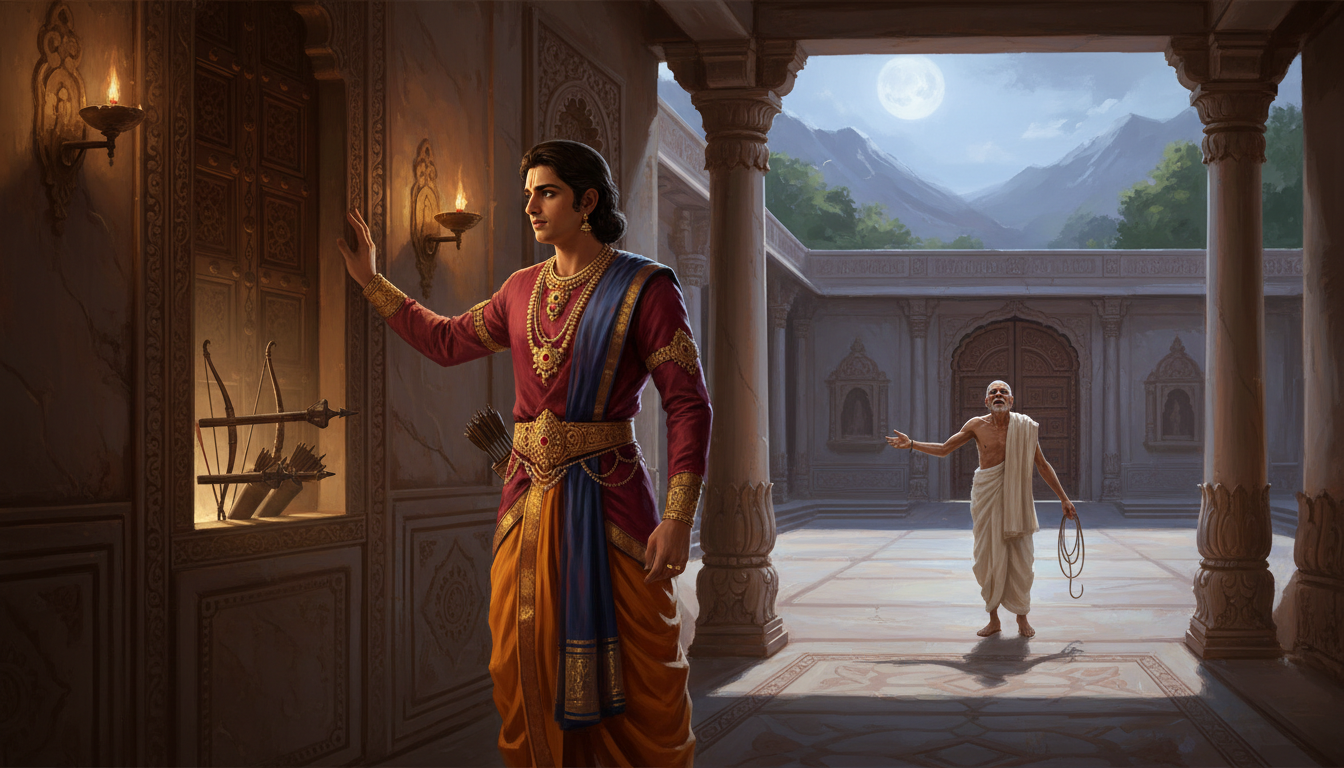
The chamber where the weapons of the illustrious Pandavas were kept was occupied. Yudhishthira the just was within it, and Draupadi was with him.
Arjuna stopped in the passage outside.
Behind him in the courtyard the brahmana was still weeping and still calling on them by name, urging him to come, urging him to go on alone with him at once if he would not wait, saying the same things over and over in the way of a man whose property is walking away over a hill while he talks. Every repetition was another furlong of road.
And every bow that Arjuna owned was on the other side of that door. There was no second armoury in the palace, no hunting bow hanging in a hall, nothing borrowed that would answer to his draw, and no time at all in which to send anywhere for one. The rule had been made in the presence of Narada, with a Rishi for its witness and the corpses of two asuras for its argument, and it did not contain a clause about doors. It said nothing about cattle. It made no provision whatever for a brahmana standing in a courtyard on a particular morning.
The Weighing
He stood there with a sorrowful heart and did the arithmetic aloud to himself, and it is worth setting down exactly as he did it, because it is the plainest reckoning of its kind that anybody in this whole history ever made.
"Alas, this innocent brahmana's wealth is being robbed. I should certainly dry up his tears. He has come to our gate, and he is weeping even now.
"If I do not protect him, the king will be touched with sin in consequence of my indifference. Our own irreligiousness will be cited throughout the kingdom, and we shall incur a great sin.
"If, disregarding the king, I enter the chamber, then without doubt I shall be behaving untruthfully towards the monarch who has no foe. By entering the chamber I incur the penalty of an exile in the woods.
"But I must overlook everything. I care not if I have to incur sin by disregarding the king. I care not if I have to go to the woods and die there. Virtue is superior to the body, and lasts after the body has perished."
Notice what he does not do. He does not tell himself that the case is exceptional. He does not decide that a rule made about jealousy cannot have been meant to cover an armoury. He does not send a servant in to ask permission, which would have taken a moment and would have saved him twelve years, because the rule was written about seeing and not about asking, and he knew quite well that a man who goes hunting for the crack in his own promise has already broken it.
He simply set the two sins side by side and looked at their weights. One of them would fall on a stranger who had lost everything he owned. The other would fall on himself. Having arrived at that resolution, Dhananjaya put his hand on the door and went in.
What Was Said Inside
He entered the chamber, and he talked with Yudhishthira.
That is the whole of the record of it. Nobody who was in that room ever repeated a word of what passed between the two brothers, and the sages who preserved everything else about this house, the boasts and the curses and the exact wording of oaths sworn in anger, preserved of this only that Arjuna went in and spoke with the king and came out again carrying his bow.
Perhaps there was very little to repeat. Yudhishthira could hear the shouting at the gate as well as anyone else in the palace, and he knew what his brother had come in for, and he knew, as he watched him lift the bow down, exactly what it had cost him to walk through that doorway, and what he would be asked to do about it before the day was over. Draupadi was there and said nothing that anybody thought to write down.
Arjuna came out cheerfully. That is the word the story uses, and it is a strange word for a man who has just sentenced himself, and it is the right one, because the cheerfulness was not about himself at all. He went straight across the courtyard to the man at the gate.
"Proceed, brahmana, and quickly," he said, "so that those wretched robbers do not get too far ahead of us. I shall come with you, and I shall restore to you your wealth that has fallen into the hands of thieves."
And the man who had been weeping since sunrise wiped his face and went out in front of a chariot to show it the road his cows had taken.
The Kine Brought Back
He cased himself in mail and mounted his war chariot with its standard, and took up the bow that had already cost him twelve years, and went after the thieves.
It did not take long, and there was nothing remarkable in it. He was the son of Kunti who could use either arm as well as the other, and the men ahead of him were cattle thieves moving at the pace of a stolen herd, looking behind them and seeing dust. He came up with them and pierced them with his arrows until they let go of the booty and scattered off the road, and then he turned the cows around, which is slower work than the fighting, and drove them back the way they had come, and made them over to the brahmana in the man's own field, every animal that had been taken.
The man had his herd back before the sun was down. Whatever he said then is not preserved either. He is not named anywhere in the story. He arrives, he grieves, he is answered, and he goes home with his cows, and nobody ever hears of him again, and the whole of the rest of this episode happens because of him.
When Arjuna came back into the capital he was met the way men are met who have done a plain thing well. There was great renown in it and the citizens came out into the streets. He bowed to all the elders as he passed them and was congratulated by everybody, and everybody agreed that it had been a good morning's work and that the kingdom was in the right hands.
He let all of it go past him. Then he went to find his brother.
The Reading of the Rule
"Give me leave, O lord," said Partha, "to observe the vow I took. In beholding you sitting with Draupadi I have violated the rule we established ourselves. I shall therefore go into the woods, for this is even our understanding."
Yudhishthira had been waiting for it all afternoon and it still went into him like a spear. He was afflicted with grief, and the only word he could get out came in an agitated voice.
"Why?"
He sat with it for a while. Then the eldest of them found the argument he wanted, and it was a good argument, and he was the one man in the world entitled to make it. He was a king. He was the son of Dharma. He had spent his whole life reading rules closely and he read this one closely now.
"O sinless one, if I am an authority worth regarding, listen to what I say. Full well do I know the reason why you entered my chamber and did what you take to be an act disagreeable to me, and there is no displeasure in my mind, none at all.
"And consider the rule itself, since it is the rule you are appealing to. The younger brother may without fault enter the chamber where the elder brother sits with his wife. It is only the elder brother who acts against the rules of propriety by entering the room where the younger brother sits with his wife. The prohibition runs in one direction, and it does not run against you. You came in upon me. I did not come in upon you.
"Therefore, O you of mighty arms, desist from this purpose. Do what I say. Your virtue has sustained no diminution. You have not disregarded me."
It was not a bribe, and it was not a favour done quietly between brothers. It was a reading of the letter of the covenant offered by its highest authority, delivered in the hearing of the household, and by that reading Arjuna had committed no offence whatever and was free to stay.
Truth Is My Weapon
Arjuna heard the whole of it out. He did not dispute any part of it. He did not say that the reading was wrong, because it was not wrong. He answered with one sentence and a half.
"I have heard, even from you, that quibbling is not permitted in the discharge of duty. I cannot waver from truth. Truth is my weapon."
There was nothing to say to that. The man who had taught him that a duty is not a contract to be searched for its loopholes had just had his own teaching handed back to him across a room, in front of everybody, by the brother least given to argument in the family. Yudhishthira gave his permission.
So Arjuna prepared himself for a forest life. He put away the mail and the chariot and the standard that had been out on the road that morning, and he went into the woods to live there twelve years as a Brahmacharin, for having opened a door to fetch a bow for a man whose cows had been stolen.
Weigh what he refused. He had walked in knowing the price, in the interval between one cry and the next, and having walked in he would not be let off, and the letting off was legitimate. Nothing forced him out of the gate except the plain meaning of a promise he had made in front of Narada, and the plain meaning is exactly what a clever reading is for dissolving.
A rule kept only when keeping it is convenient is not a rule but a preference, and a man who allows others to argue him out of his own forfeit has quietly moved the cost of his choice onto them. Arjuna would not have it moved. He went out through the gate the brahmana had come in by that morning, and the road he took was the long one, and it would be twelve years before this city saw him again.
Dharma Lesson
Where two duties collide, choose the one that protects another person, and pay the price out of your own life rather than out of his. And when a rule you have broken for a good reason is read back to you in a way that lets you off, refuse the reading. Quibbling has no place in the discharge of duty, because a rule kept only when it is convenient is not a rule at all.