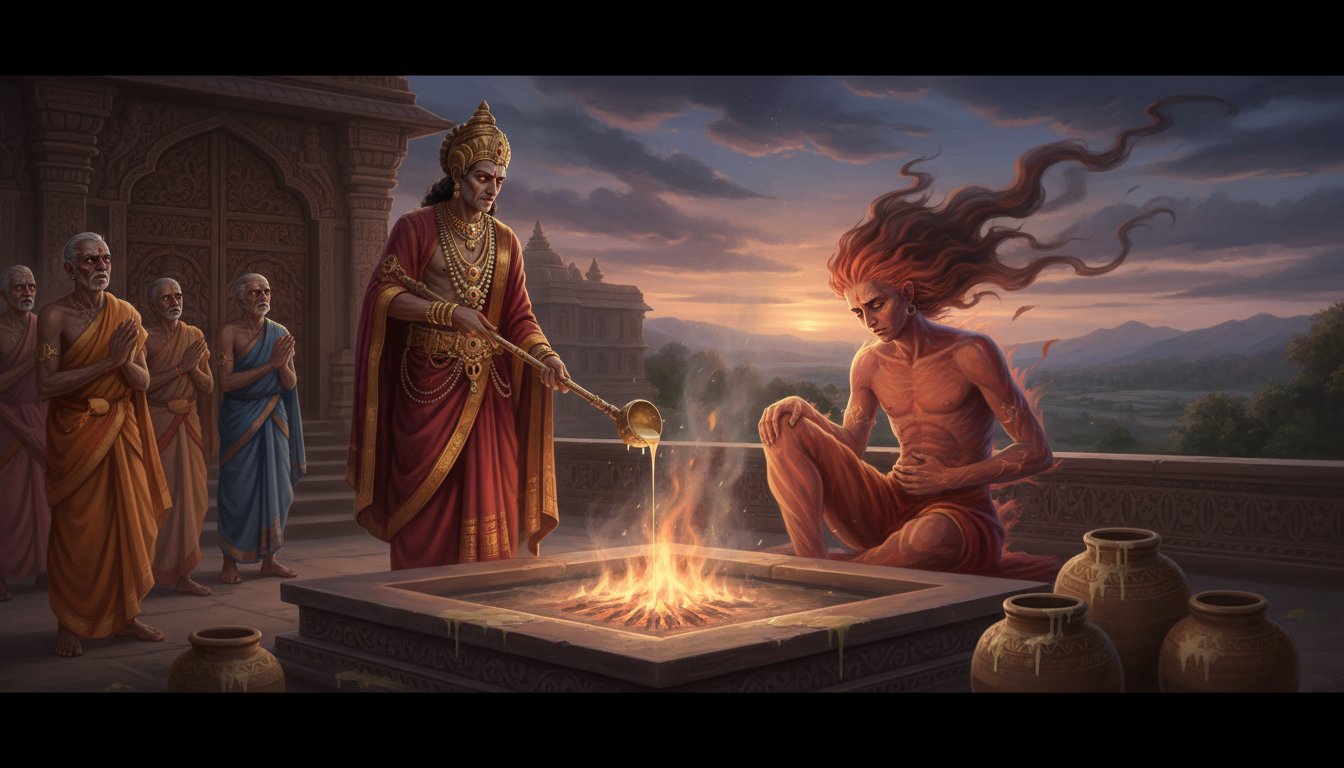
The King Who Made Fire Sick
Twelve years of butter and the appetite it ruined
A Hungry Brahmana at the Edge of Khandava
The summer had set in, and Arjuna had said to Krishna that they should go to the banks of the Yamuna and sport there with their friends and come back in the evening, and Krishna had said that this was his wish also. So they went, with Yudhishthira's leave, to a fine spot among tall trees near the forest of Khandava, where the mansions had been stocked for them with viands and drinks and floral wreaths and perfumes; and while the rest of the party sang and danced and quarrelled in the water, the two of them walked off a little way to a charming spot in the woods and sat down on two costly seats and talked about old feats of prowess, happily, like the Aswins in heaven.
And to those two happily sitting there a certain brahmana came.
He looked like a tall Sala tree. His complexion was like molten gold and his beard was bright yellow tinged with green, and the height and the thickness of his body were in just proportion. He wore matted locks and was dressed in rags, and he resembled the morning sun in splendour. His eyes were like lotus petals and of a tawny hue, and he seemed to be blazing with effulgence.
Beholding that foremost of brahmanas approach them, Arjuna and Vasudeva both rose hastily from their seats and stood waiting for his commands.
"You two who are staying near Khandava," he said, "are the foremost of heroes on earth. I am a voracious brahmana. I always eat much. O you of the Vrishni race, and O son of Pritha, I ask you to gratify me by giving me sufficient food."
They answered him as men answer a brahmana at their door. "Tell us what kind of food will gratify you, and we will make an effort to give it."
"I do not desire to eat ordinary food," said the brahmana. "Know that I am Agni. Give me the food that suits me."
And he told them what he wanted and why he could not have it. "This forest of Khandava is always protected by Indra, and while it is protected by that illustrious one I always fail to consume it. There dwells in it, with his followers and his family, a Naga called Takshaka, who is the friend of Indra, and it is for Takshaka's sake that the wielder of the thunderbolt guards this wood, and many other creatures are protected here on his account. Whenever I blaze up he pours water on me out of the clouds. Seven times I have tried. I have come now to you, who are skilled in weapons. Keep off the rain, and keep the creatures from escaping, and I will consume this forest, for that is the food I desire."
Janamejaya Stops the Story
Here Janamejaya raised his hand, and the recitation halted.
"Why," said the king, "did the illustrious Agni desire to consume the forest of Khandava, that was filled with various living creatures and was protected by the chief of the celestials? When Agni consumed that forest in wrath, it is evident there was a grave cause. I desire, O brahmana, to hear all of this from you in detail. Tell me, O sage, how the Khandava forest came to be consumed in days of yore."
It is a good question, and it is the question nobody asks. Men tell the burning of Khandava as a tale of two heroes and a great fire and the animals that could not get out. They do not ask what was wrong with the fire.
"O chief of men," said Vaishampayana, "I will narrate to you the story of the conflagration of Khandava as the rishis tell it in the Purana. And it does not begin with Agni at all. It begins with a king who could not stop making offerings, and with the priests whose eyes he ruined."
The King Who Could Not Stop
It has been heard in the Purana that there was a celebrated king by the name of Swetaki, endued with strength and prowess, and equal to Indra himself. No one on earth had ever equalled him in three things: in sacrifices, in charity, and in intelligence.
He performed the five great sacrifices and many others besides, and at every one of them the presents made to the brahmanas were large. He did not economise and he did not delay. The heart of that monarch was always set on sacrifices, on religious rites, and on gifts of every kind, and there was no season of the year in his capital when the smoke was not going up from some enclosure or other.
And assisted by his ritwiks, the priests who do the actual work of such things, that king of great intelligence performed sacrifices for many long years together.
Understand what that is, O king, from the inside of it. A ritwik does not stand at a distance and pronounce. He sits at the pit. He feeds it, tends it, keeps the flame at the right pitch for hour after hour and day after day, and the smoke goes into his face the entire time. One rite is an honour. A season of them is an ordeal. Many long years of them, without a gap, is an injury that accumulates in the body, and it accumulated in theirs.
Their eyes went first. Afflicted by the continued smoke, and grown very weak with it, those sacrificial priests at last left that monarch, wishing never more to assist at his sacrifices.
The Priests Walk Out
The king, however, repeatedly asked those ritwiks to come back to him.
They did not come, in consequence of the painful state of their eyes. So the monarch, at the direction of his own priests, invited others like them, and with those others he completed the sacrifice he had already begun.
And then, after some days had elapsed, king Swetaki desired to perform another sacrifice, and this one was to extend for a hundred years.
He could not find a single priest to assist him in it.
That illustrious monarch, with his friends and his relatives, casting off all sloth, courted his priests again with great persistence. He bowed down to them. He spoke to them conciliatingly. He offered them gifts of wealth, and the wealth of Swetaki was not a small thing, and he made these offers repeatedly and in person, a king going from asylum to asylum to ask brahmanas for a favour.
All of them, without exception, refused to accomplish the purpose that king of immeasurable energy had in view.
He had given away more than any king of his age. He had never once cheated them of a fee or slighted them at a rite. And not one of them would sit down at his fire again, because the truth was very simple and nobody wished to say it to his face: he was not asking for a sacrifice. He was asking for a hundred years.
Go Unto Rudra
Then that royal sage got angry, and stood before the brahmanas sitting in their asylums, and made them a speech that is worth having in full, because it is the speech of a genuinely good man who has understood nothing.
"If, ye brahmanas, I were a fallen person, or if I were wanting in homage and in service to you, then I should deserve to be abandoned without scruple by you and by all other brahmanas at the same time. But I am neither degraded nor wanting in homage to you. It does not become you to obstruct the performance of my sacrifice, or to abandon me thus, ye foremost of brahmanas, without adequate reason.
"I seek your protection. It becomes you to be propitious to me. But if you abandon me out of enmity alone, or from any improper motive, then I shall go to other priests for their assistance in this sacrifice of mine, and conciliating them with sweet words and with gifts, I shall lay before them the business I have in hand, so that they may accomplish it."
Having said this, the monarch became silent.
And when those priests well knew that they could not assist at the king's sacrifice, they pretended to be angry, and addressing that best of monarchs they said: "O best of kings, your sacrifices are incessant. By assisting you always we have all been fatigued. And as we have been wearied in consequence of these labours, it becomes you to give us leave. O sinless one, from loss of judgment you cannot wait, but urge us repeatedly.
"Go unto Rudra. He will assist at your sacrifice."
It was said to get rid of him. There is no other way to read it. They sent a man they could not refuse to the one door in the three worlds where they were confident he would be turned away, and they went back to their asylums and thought no more about it.
Six Months Like a Column
Hearing those words of censure and of wrath, king Swetaki became angry. And the monarch went to the mountains of Kailasa, and devoted himself to asceticism there.
He began to worship Mahadeva with fixed attention, observing the most rigid vows. He gave up food for long stretches. When he ate at all he ate only fruits and roots, and he took them sometimes at the twelfth hour of the day and sometimes at the sixteenth, which is to say once in the afternoon or once well after dark, as it happened, without regularity and without much interest.
And king Swetaki stood for six months, rapt in attention, with his arms upraised and his eyes steadfast, like the trunk of a tree, like a column rooted into the ground.
Six months. On Kailasa, where the wind comes off the ice. A man who had been refused by every priest in the world standing with his arms over his head on a crystal mountain, not asking to be made immortal, not asking for a son or a kingdom or vengeance on the brahmanas who had mocked him, but simply waiting to be allowed to perform a rite.
And Sankara, at last gratified with that tiger among kings who was undergoing such hard penances, showed himself to him, and spoke in a calm and grave voice.
"O tiger among kings, O chastiser of foes, I have been gratified with you for your asceticism. Blessed be you. Ask now the boon that you desire."
The royal sage bowed to the deity and replied: "O illustrious one, O you that are worshipped by the three worlds, if you have been gratified with me, then, O god of gods, O lord of the celestials, assist me yourself in my sacrifice."
Six months of standing, for that.
The Condition of the Twelve Years
The illustrious god was gratified, and he smiled, which is not the safest thing that Rudra does.
"We do not ourselves assist at sacrifices," he said. "But as you, O king, have undergone severe penances desiring a boon, I will assist at your sacrifice, O chastiser of foes, upon this condition.
"If you can, for twelve years, pour without intermission libations of clarified butter into the fire, yourself leading all the while the life of a Brahmacharin with rapt attention, then you shall obtain from me what you ask."
Read the condition carefully, O Janamejaya, because everything that follows comes out of it and out of nothing else. Not a great gift. Not a hard journey. Not a fast. Twelve years of pouring butter into a fire without a single break, while living continent and attentive, which is the discipline of a student and not of a king.
It was not designed to be impossible. It was designed to be tedious, and to a man with Swetaki's disease it was not even that. He had been looking for something to pour into a fire for his entire life. He had just been handed twelve years of permission.
King Swetaki, thus addressed by Rudra, did all that he was directed to do by the wielder of the trident.
And for twelve years, without intermission, in an unbroken stream, clarified butter went into the mouth of the fire.
Durvasa Is Sent Down
After twelve years had elapsed, Swetaki came again to Maheswara. And Sankara, the creator of the worlds, seeing that excellent monarch, said at once in great gratification:
"I have been gratified by you, O best of kings, by this act of yours. But the duty of assisting at sacrifices properly belongs to brahmanas. Therefore, O oppressor of foes, I will not myself assist at your sacrifice today. There is on earth an exalted brahmana who is even a portion of my own self. He is known by the name of Durvasa. That brahmana, endued with great energy, will assist you. Let every preparation be made."
So the god kept his word by the letter and handed the work to the most dangerous man alive.
The king returned to his own capital and began to collect what was necessary, and when everything had been collected he presented himself before Rudra again and said, "Every necessary article has been gathered, and all my preparations are complete, through your grace, O god of gods. Let me be installed at the sacrifice tomorrow."
Then Rudra summoned Durvasa before him and said, "This, O Durvasa, is that best of monarchs called Swetaki. At my command, O best of brahmanas, assist this king in his sacrifice."
And the rishi Durvasa said unto Rudra: "So be it."
Two words. The sage whose displeasure had ruined kingdoms and would one day be brought into Duryodhana's schemes as a weapon, agreeing without argument, because the one being who could command him had commanded him.
The sacrifice took place according to the ordinance and in its proper season, and the gifts made to the brahmanas on that occasion were large. When it was over, all the priests who had come to assist went away with Durvasa's leave, and all the Sadasyas of immeasurable energy who had been installed at it went away also. That exalted monarch entered his own palace, worshipped by brahmanas conversant with the Vedas, praised by the chanters of hymns, congratulated by his citizens.
Such was the history of that best of monarchs, the royal sage Swetaki, who when the time came ascended to heaven, having won great renown on earth, accompanied by the ritwiks and the Sadasyas who had helped him in life.
He got everything he wanted. He is not the one who paid.
The God Who Could Not Eat
At that sacrifice of Swetaki, Agni had drunk clarified butter for twelve years. It had been poured into his mouth in a continuous stream for the whole of that period.
Having drunk so much butter, Agni was satiated, and did not desire to drink butter again from the hand of anybody else at any other sacrifice.
Then the sickness came on him. He became pale, having lost his colour. He could not shine as he had shone before. He felt a loss of appetite from the surfeit, and his energy itself decreased, and illness afflicted him. The eater of oblations went off his food; and there is nothing in the three worlds that Agni is except appetite, so what was being described was not an indisposition but a dissolution.
When the drinker of sacrificial libations perceived that his energy was gradually diminishing, he went to the sacred abode of Brahman, that is worshipped by all. Approaching the great deity seated on his seat, Agni said:
"O exalted one, Swetaki has gratified me to excess. Even now I am suffering from a surfeit that I cannot dispel. O lord of the universe, I am being reduced both in splendour and in strength. I desire to regain, through your grace, my own permanent nature."
Hear that, O Janamejaya, and hear who is saying it. Not a starving god. A god complaining that he has been fed too well by a man who meant nothing but good, for twelve unbroken years, at the command of another god, in a rite that everybody afterwards described as a triumph. Nobody in this account did anything wrong. That is the difficulty with it.
The Fat of Every Creature in Khandava
Hearing these words from Hutavaha, the illustrious creator of all things smiled and answered him.
"O exalted one, you have eaten for twelve years a continuous stream of sacrificial butter poured into your mouth. It is for this that illness has seized you. But grieve not for it, O Agni. You shall soon regain your own nature. I shall dispel this surfeit of yours, and the time for it is even come.
"The dreadful forest Khandava, that abode of the enemies of the gods, which you once of old consumed to ashes at the request of the gods, has now become the home of numerous creatures. When you have eaten the fat of those creatures, you shall regain your own nature. Proceed there in haste, and consume that forest with its living population. You will then be cured of your malady."
That is the prescription, O king, and I will not pretend it is anything else. A god made ill by twelve years of butter was told that the cure was every living thing in a forest.
Hutasana went with great speed and reached Khandava in great vigour, and blazed forth there in anger, assisted by Vayu. And the dwellers in that forest made great efforts to put him out. Elephants by hundreds of thousands, speeding in anger, brought water in their trunks and scattered it on the fire. Thousands of many-hooded snakes, mad with anger, hastily scattered water on him out of all those hoods at once. The other creatures in that wood, by various appliances and various efforts, soon extinguished the fire.
Seven times Agni blazed up in Khandava. Seven times the animals put him out.
Then Havyavahana went back to the Grandsire in anger and disappointment, with his ailment uncured, and represented all that had happened. The illustrious deity reflected for a moment and said:
"O sinless one, I see a way by which you may consume the forest of Khandava today, in the very sight of Indra. Those old deities Nara and Narayana have become incarnate in the world of men to accomplish the business of the celestials. They are called on earth Arjuna and Vasudeva, and they are staying even now in the forest of Khandava. Solicit them."
And that, O Janamejaya, is why a tall brahmana of the colour of molten gold came out of the trees toward two young men with nothing to do.
Arjuna heard him out and answered him without any horror at all.
"I have numberless excellent celestial weapons, with which I could fight even many wielders of the thunderbolt. But I have no bow suited to the strength of my arms, and capable of bearing the might I may put forth in battle. In consequence of the lightness of my hands I require arrows that must never be exhausted, and my car is scarcely able to bear the load of arrows I would desire to keep by me. I desire celestial steeds of pure white, possessing the speed of the wind, and a car possessing the splendour of the sun, the clatter of whose wheels should resemble the roar of the clouds. And there is no weapon suited to Krishna's energy, with which Madhava can slay Nagas and Pisachas.
"Give us the means, O Pavaka, and we are ready to do all that manliness and prowess can do."
And not one of the three of them said a word about the animals.
Dharma Lesson
A devotion pressed past all measure exhausts even the god it is offered to, and nobody in this account meant any harm at all. The cure for excess is never more of the same, and when the bill for one man's piety finally comes it is presented to a forest full of creatures who were never asked.