The Seventh Day
Seven days earlier, a curse had been spoken over King Parikshit by a boy barely old enough to carry his own water pot: Shringin, son of the sage Shamika, enraged that the king, tired and thirsty from a hunt gone wrong, had draped a dead snake across his silent, meditating father's shoulders as a cruel joke and ridden on without waiting for an answer that never came. The boy's curse had been simple and absolute. On the seventh day from that morning, the serpent king Takshaka himself would bite Parikshit dead, wherever in the world he tried to hide.
Parikshit, grandson of Arjuna, had not taken the curse lightly. He had ordered a single stone pillar built and raised on legs too high for any snake to climb unnoticed, ringed it with physicians skilled in every antidote known, and surrounded it with guards who watched the sky as much as the ground. Six days had passed there uneventfully, the king growing more hopeful with every sunset that the curse might, after all, be turned aside by ordinary caution.
It was the seventh and last day when word reached the pillar of a physician traveling toward Hastinapur from the forest roads to the south, a brahmin named Kashyapa, said to know cures for every venom that had ever entered a human body, coming, though no one had summoned him, purely on the strength of his own confidence and the fortune a grateful king might pay him. If he arrived before sundown, the guards told each other, the curse might yet be answered by skill rather than by luck.
The Old Man on the Road
Kashyapa walked fast and alone, sure enough of his own gift that he had not bothered to bring an escort or so much as a servant to carry water for him. He had learned his medicine the old way, from roots and mantras and long nights sitting with the dying, watching which cures held and which failed and asking the dead, in his own fashion, to teach him what the living could not. In all those years no venom, however swift or however sacred its source, had ever outlasted his hands, and he saw no reason to think a king's poison would prove any different from a farmer's.
An old brahmin stepped into the road ahead of him, leaning on a staff, and asked, mildly enough, where a man walked in such haste on a day that heat alone should have slowed him.
"To Hastinapur," Kashyapa said, "to save King Parikshit, who is fated to die of snakebite before the sun sets."
"A fine errand," the old man said. "And what does it pay?"
Kashyapa saw nothing shameful in the question and answered it plainly, a fortune, whatever a grateful king judged fair for his own life, more gold than a country physician could earn treating the poor across three lifetimes, enough to build a second hermitage and never turn away a patient too poor to pay again.
The old man's eyes, when Kashyapa looked at them properly for the first time, held something that no honest brahmin's eyes ever held: a stillness too old, and a patience too hungry. "Before you spend your confidence on a king," he said, "let me see it spent on something smaller. There is a banyan by the road. Watch what my bite does to it, and then tell me truly whether your hands can undo what mine can do."
Ash and Leaf
The banyan was old, wide enough at the trunk that three men could not have circled it with joined hands, its roots dropped down from high branches like a second forest growing out of the first, older by far than Hastinapur's palace and older, perhaps, than the road itself. The old man, Takshaka, though Kashyapa did not yet know the name he wore beneath the disguise, laid his hand flat against the bark for no longer than a breath.
The tree did not fall. It simply stopped being a tree. Bark, leaf, root and branch collapsed inward and downward all at once, the way a fire collapses when the last log gives way, until where the banyan had stood there was only a low, gray mound of ash settling slowly in the windless air, no smoke rising from it, no heat left to feel.
Kashyapa did not flinch, and did not hesitate either. He knelt at the ash, spoke the mantras he had spoken over dying men a hundred times before, and worked his hands through the gray until they found what he already knew, by faith and by craft, must still be there, the seed of the tree still folded somewhere inside its own ruin. The banyan came back the way it had gone, all at once, not sapling first and trunk later, but whole, trunk and root and crown restored together, a single new leaf unfurling at the very top as if the tree had simply blinked.
The old man studied the restored banyan for a long moment, walking once around its trunk as though counting rings that had not had time to form, and then studied Kashyapa rather longer.
A Higher Bid
"You could save him," Takshaka said. It was not a question, and he did not trouble any longer to keep the old man's voice. "I felt it in how you called that tree back. Whatever poison reaches Parikshit today, your hands could turn it before it reached his heart."
"I could," Kashyapa said, and for the first time that day something in his certainty wavered, because there was no reason for a stranger on a forest road to know the name of the very king he had told no one but that stranger he was traveling to save.
"Then I will pay you not to," Takshaka said, and named a sum that made the fortune Kashyapa had imagined from a grateful king sound like the wages of a single afternoon's labor. "Turn around. Go home. Tell yourself, if you need a reason, that you tried and the roads were too long, or that your gift failed you once as every gift fails eventually. No one will ever know the difference, and you will be wealthier than any physician in the kingdom besides."
Kashyapa did not answer at once. He was a man who trusted his own sight above every other sense he owned, and so, standing in the road with that impossible fortune laid open in front of him, he turned that sight inward and searched, honestly, for the true shape of Parikshit's fate, not the curse alone, but the deeper thread beneath it, the span of years a man is given at his very birth and cannot be argued past by any physician living. What he saw there, or what he allowed himself to see there, was an ending already arrived, a thread already run to its final inch, no matter whose hand released the poison that finished it.
He took the gold.
What the Fire Received
Kashyapa turned back toward his hermitage that same afternoon, wealthy and, he told himself the whole way home, no more guilty than any physician who declines a case he privately judges hopeless. Whether his sight had shown him a true ending or only the ending that a bag of gold made convenient to see, no one who watched him walk away could say, and he never spoke of the road to anyone who might have asked him to explain it.
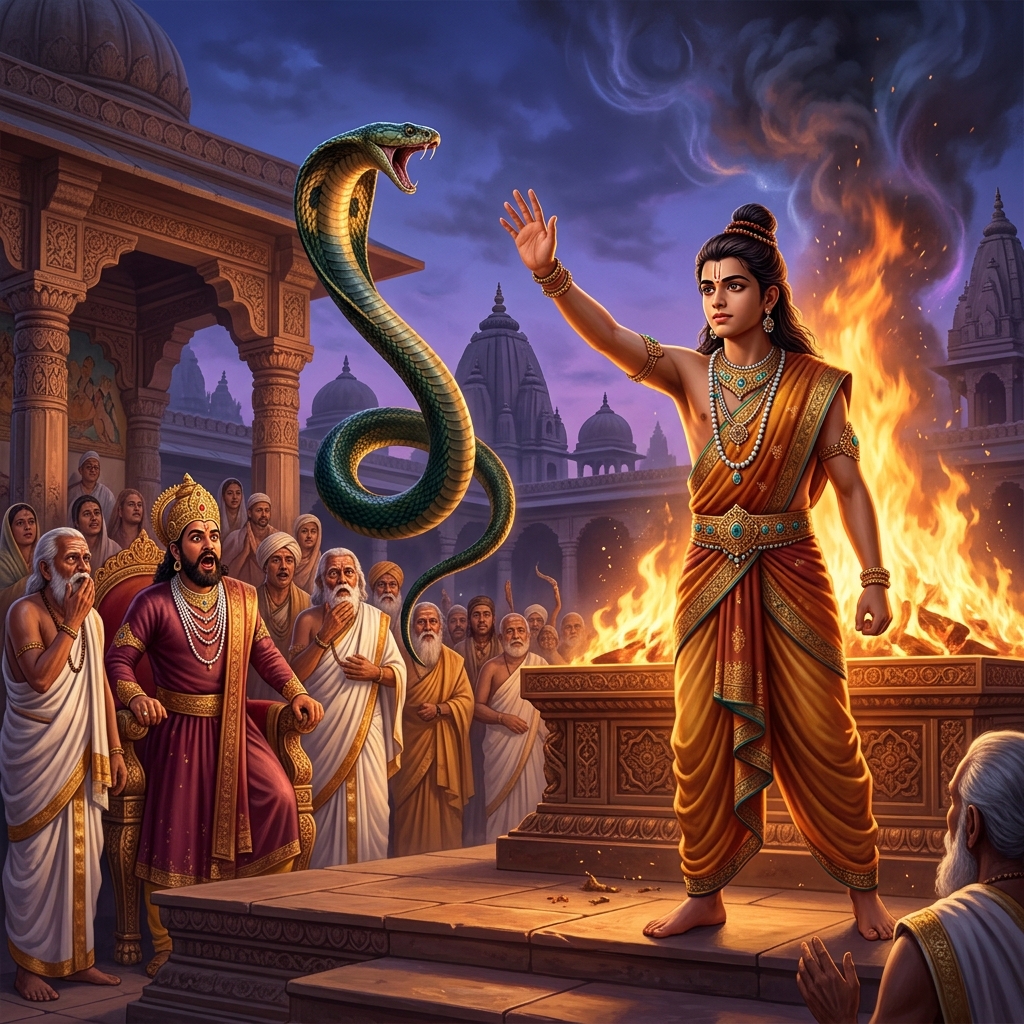
Takshaka reached the pillar before sundown, past every guard and every antidote the king's physicians had prepared, and did what seven days of caution had been built to prevent. How exactly the last stroke found the king, in a worm coiled inside a piece of fruit, or in a shape too quick for the watching eyes to follow, is told elsewhere and does not need retelling here. It is enough to say that by nightfall Parikshit, grandson of Arjuna, was dead, exactly as a boy's grief-stricken curse had promised seven days before.
In Hastinapur, his young son Janamejaya was crowned before the mourning rites for his father had even finished, a child made king by a curse he had played no part in and a bribe he would never learn the name of the physician who took. He would grow into that anger slowly, over years, until it became a fire vast enough to call every serpent under heaven by name into it, but that fire, and what stopped it, belongs to another telling.
What belongs to this one is smaller and colder: that the ugliest bargain of all is not the one forced on a man at the point of a blade, but the one a good man, given time enough to look for a reason, can talk himself into by daylight.
Dharma Lesson
Kashyapa's skill was real, and his reasoning sounded sober: a fixed doom cannot be turned aside by any physician's hand. But the sight he used to confirm that arrived only after Takshaka's gold had already tempted him, and a truth reached at so conveniently is still worth doubting. The ugliest bargains are the ones a good man can justify to himself before he ever signs them.