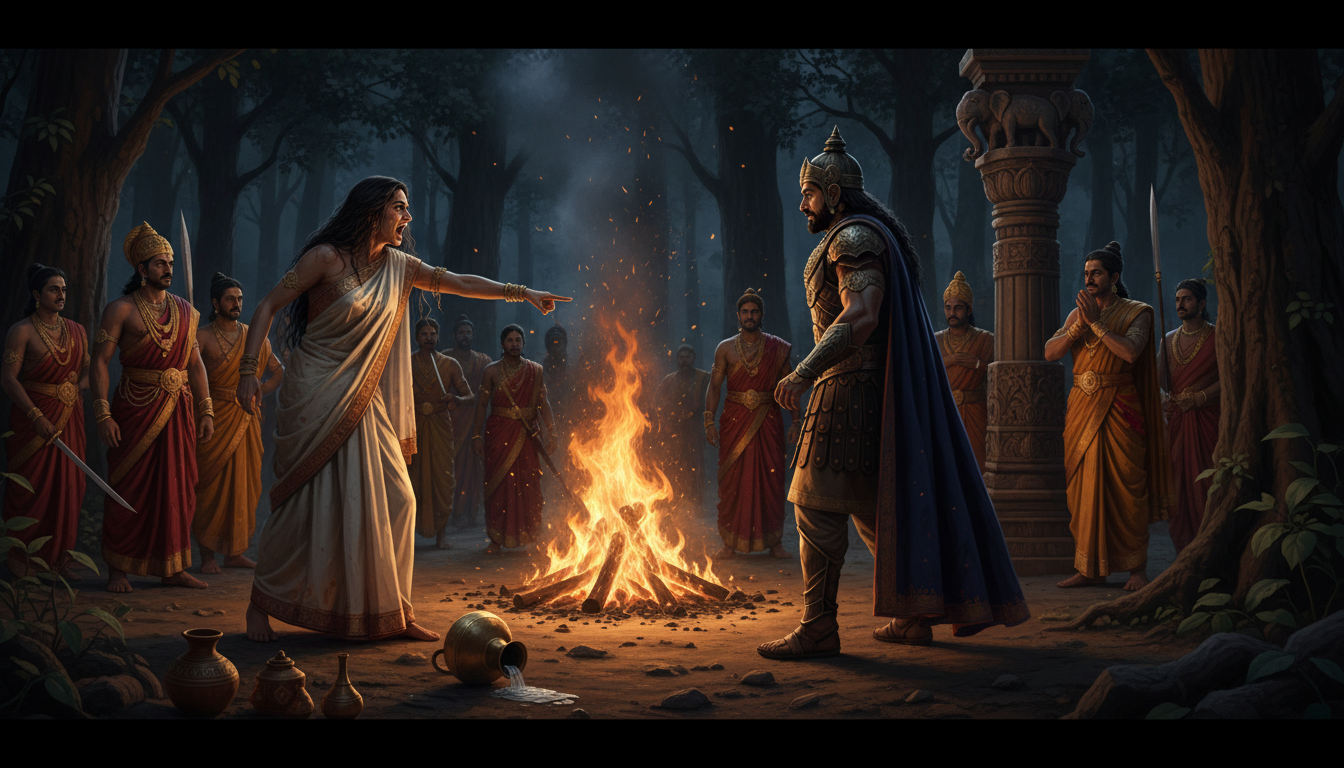
The Widow at the Fire
A curse spoken before the flames took her, and the heir it forced
The Question at the River
The fires had burned down to embers on the bank of the Ganga, and the gandharva sat with the sons of Pandu in the dark and answered whatever they put to him. He had been Angaraparna when the day began, lord of a burning chariot; he was Chitraratha now, and a friend, because Arjuna's fire-weapon had taken the chariot and spared the man.
Arjuna had been silent a long while. When he spoke it was not about horses or weapons.
"You have told us," he said, "how Saktri cursed king Kalmashapada on the narrow path, and how the king in the shape of a rakshasa devoured the hundred sons of Vasishtha one after another, and how the sage tried to end his own life and the world would not let him die. That much I have followed. But you finished by saying that the king afterwards commanded his own queen to go in to Vasishtha, and there I lose the road entirely."
"Ask it plainly," said the gandharva.
"Then plainly. Why did Kalmashapada send his wife to the one man on earth whose sons he had eaten? And Vasishtha - he is the foremost of all who are conversant with the Vedas, he is acquainted with every rule of morality that exists - why did that great rishi know a woman he should not have known? Was there sin in him? The doubt sits in me, friend, and I bring it to you rather than carry it."
The gandharva was quiet for the space of several breaths.
"O irrepressible Dhananjaya," he said at last, "you are asking after the end of a thing whose beginning you have not heard. Neither the king decided it nor the sage. It was decided in a forest by a woman whose name nobody troubled to remember, of the house of Angira, who had perhaps an hour of her life left when she opened her mouth. Sit still, best of the Bharatas, and I will tell you what she did."
Out of the Capital
When Saktri's curse came down on him (said the gandharva) the king did not fall at once. It worked in him the way a poison works in a well, slowly, until one morning the household found that the water was no longer drinkable.
His eyes were the first thing to change. They began to roll and whirl in his head with an anger that had no object in the room, and the ministers who had brought him petitions for thirty years learned to set the palm leaves down and back away. He was of the solar race, of the line of Ikshvaku, the son of Sudasa, and he had been famous for two things: that he cherished his friends, and that he kept the observances. Neither of those men lived behind those eyes any more.
He did not wait to be deposed. He walked out of his own capital, past his own gate guards, and took the road toward the wild country, and his queen Madayanti walked out after him.
They tried to stop her. She was the wife of Kalmashapada, a queen of Ayodhya, and there were women in that palace who would have gone into the fire before they went into a forest with a man in that condition. She went anyway. She left the swept streets and the banners and the beds she had slept in every night of her life, and she followed her husband into the solitary woods, and she stayed with him there while the thing inside him finished eating him from the inside out.
Remember that she did this, Partha. It matters later, and everybody who tells this story forgets it.
Hunger in the Deep Woods
The forest they entered was not a hermit's grove with paths worn between the huts. It was the real thing: deer of a dozen kinds moving through it in herds, and the other animals that follow deer; trees standing so thick and so old that a man walked in green twilight at noon; shrubs and creepers knotted between the trunks until the way closed behind you as soon as you had passed through it. All day and all night it made noise. Birds screamed in it. Things called to each other in the dark that had never had a name given to them by anyone.
The king wandered in it without direction. He was not hunting and he was not travelling. He simply moved, because the curse would not let him sit down.
And then one day the hunger came on him.
It was not the hunger of a man who has missed a meal. It came up out of the ground of him, and it was enormous, and it had a shape: it wanted one particular kind of food and no other, and the king who had once been vigilant in the practice of morality began to quarter that forest looking for it. He went through the thickets with his head down. He went into the parts of the woods where nothing goes.
"He was pinched with hunger," said the gandharva, "and he began to search. Understand that I am not excusing him. I am telling you the order in which things happened, because the woman who is coming knew the order too, and it did not save anybody."
The Brahmani's Plea
In a very solitary part of the woods, far from any road, the king came upon a brahmana and his wife lying together in the privacy that a husband and wife are owed.
They saw him before he reached them. Whatever it was they saw in his face, it was enough: they broke apart and ran, their desire ungratified, the woman calling to her husband to go faster. The king came after them through the undergrowth with the whole weight of his hunger behind him, and he ran the brahmana down and seized him and held him.
The wife did not run on. She turned and came back, and she stood in front of a man twice her size with a rakshasa's appetite in him, and she spoke.
"Listen to what I say, O monarch of excellent vows. It is known all over the world that you were born in the solar race, that you are ever vigilant in the practice of morality, and that you are devoted to the service of your superiors. It does not become you to commit a sin, O irrepressible one, deprived of your senses though you have been by the rishi's curse."
She did not beg him for mercy in general. She told him the exact thing he would be taking, and she named it as a thing that was hers.
"My season has come. Wishing for my husband's company I was joined with him. I have not been gratified yet. Be propitious to us, O best of kings. Liberate my husband."
Every word of it was chosen. She had reminded him of his ancestors, excused him for the curse before he could plead it, and told him that what he held in his hands was not only a man's life but a child that did not exist yet and would now never exist.
Devoured Like Prey
The king did not answer her.
He did not argue with her, or plead the curse, or turn his head away in shame and then do it anyway. He gave no sign of having heard a word. He held her husband and he devoured him in front of her, cruelly and without haste, the way a tiger eats a prey it has been wanting, and her voice went on all the while and made no difference to him whatsoever.
"That is the hardest part of the story to tell," the gandharva said, "and I will not soften it for you, son of Kunti. He heard her. Some part of him heard her. But the part that had been a king of the solar race was down at the bottom of a well by then, shouting, and what stood in the clearing with his hands full was something else."
When it was finished, the woman was still standing where she had been standing.
She did not faint and she did not fall. She wept, and the tears that came out of her were not water. They blazed up like fire where they struck, and the grass took light, and the creepers, and the fallen wood, and the great trees standing near, and within moments every living thing in that place was burning. The clearing became a furnace with two people in it, one of whom had just eaten the other's husband, and the fire came out of her grief and it went where she was looking.
The king stood in the middle of it and was not touched, because the curse on him was not finished with him yet, and it had one more thing to do.
The Curse She Had Left
Afflicted with grief at the calamity that had overtaken her lord, the lady of Angira's house lifted her head and cursed the royal sage Kalmashapada.
"Vile wretch. Since you have today cruelly devoured under my very nose my illustrious husband, dear to me, before my desires had been gratified - therefore you, O wicked one, afflicted by my curse, shall meet with instant death on the day you go in to your own wife in her season."
Arjuna made a sound in the dark. "She took from him the thing he had taken from her."
"Exactly that," said the gandharva. "Not his life. Not his kingdom. She left him alive and left him a wife and put death in the one act that makes a line continue. A man of Ikshvaku's race with no son is a man who has ended everything behind him. She knew what she was doing to the solar dynasty. And then, Partha, she did the thing that nobody expects, and it is why I say this story was hers."
For she had not finished speaking.
"And your wife, O wretch, shall bring forth a son by uniting herself with that rishi Vasishtha, whose children have been devoured by you. And that child, O worst of kings, shall be the perpetuator of your race."
She had cursed him and in the same breath she had granted him an heir, and she had chosen the father herself, and she had chosen the one man in the world whose hundred sons this king had eaten. There was no mercy in it. It was a sentence with a clause: you will not father your own line, and the line you do get will be got for you by the man you injured worst, and every time you look at the boy you will know it.
She Walks Into the Fire
Having cursed the monarch so, that lady bearing every auspicious mark walked into the blazing fire she had kindled, in the very sight of the king, and did not come out of it.
She had made it herself out of her own weeping. She used it.
"There was nothing left for her to stay for," said the gandharva. "Her husband was eaten. The child she had come into the woods to conceive would not be conceived. She had disposed of the king in the only way she had, and there her business was done. She did not wait for anyone to comfort her or to avenge her. She stepped into her own grief and it took her."
And far away in his asylum, the illustrious and exalted Vasishtha knew.
He did not hear it from a traveller. By his ascetic power and by the spiritual insight that came with it he knew immediately: the woman, the fire, the words she had said, and his own name standing in the middle of them like a stake driven into the ground. The man who had already lost a hundred sons to this king, who had walked to a cliff and into a river and into a burning wood trying to be rid of his own grief and had been refused by all of them, was informed in that moment that he had been assigned a further duty by a widow he had never met.
He said nothing about it to anyone. He went on with the day's fire and the day's recitation. Years would pass before it came for him.
The Sound Hum, and the Debt to Ikshvaku
Twelve years the king went on in that shape, overwhelmed by the energy of Vasishtha's son the way the sun is seized by Rahu in an eclipse.
Then one day Vasishtha came back through the solitary woods toward his asylum with his daughter-in-law Adrisyanti walking behind him, and the thing that had been Kalmashapada saw them and rose up with a wooden club in its hand, wanting to devour them both.
"O illustrious one," the young woman said, "the cruel rakshasa comes at us like Death himself with his club. There is nobody on earth but you who can restrain him."
"Fear nothing, daughter," said Vasishtha. "That is no rakshasa. That is king Kalmashapada, endued with great energy, celebrated on earth. He lives in these woods."
And the sage restrained him by uttering the single sound Hum, and sprinkled him with water sanctified with incantations, and freed him.
The monarch came back into his own face like the sun coming out on evening cloud. He stood in the wood in a torn body with twelve years of other men's blood behind him, and he saluted the sage with joined palms.
"O illustrious one, I am the son of Sudasa and your disciple. Tell me what your pleasure is and what I am to do."
"My desire is already accomplished," Vasishtha said. "Return to your kingdom and rule your subjects. Never insult brahmanas again."
"I never shall." And then the king asked for the thing he could not stop wanting. "But I am in debt to the race of Ikshvaku, and I desire from you that by which I may be freed from it. Grant me, for the perpetuation of Ikshvaku's line, a son possessing beauty and accomplishments and good behaviour."
"I will give you one," said Vasishtha.
Neither of them, at that moment, was thinking of a fire in a clearing. The king had no memory of it at all.
Madayanti Sends Him Away Softly
So he went home, and Madayanti went home with him, out of twelve years of woods and back through the gate she had walked out of.
And in the fullness of time her season came, and the king, restored to himself, a husband again in a house again, went in to his wife.
She sent him away.
She did not shout at him or shame him or make a scene that the corridor could hear. She put her hand against him and turned him from her door softly, the way a woman turns aside a thing that must not happen and must not be discussed, and she did not let him past.
Under the influence of his desire the monarch had no recollection whatever of the curse. He had been in the clearing. He had stood in the fire. He had heard every syllable of what the widow said, and none of it had been stored anywhere he could reach, because the man who heard it had not been at home.
But hearing the words of his wife, that best of kings became terribly alarmed - and then he remembered.
It came back to him entire: the running couple, the man in his hands, the voice that had gone on and on beside him saying that her season had come and she had not been gratified yet, and the fire that walked. He remembered that he had been told, in the plainest words anyone ever used, that this exact hour would kill him.
And he understood, standing in his own bedchamber, that his queen had been carrying that knowledge by herself for twelve years and had never once put it in his hands, and had only now been forced to use it, and had used it as gently as it can be used.
He repented bitterly of what he had done. There was nothing else left to do with it.
The Twelfth Year and the Stone
"That, O best of men," said the gandharva, "is the reason. Not appetite and not policy. The monarch, infected with the Brahmani's curse, appointed Vasishtha to beget a son upon his queen, because a widow in a burning clearing had said that it would be so, and had said which man it would be."
Vasishtha came to Ayodhya with the king. The citizens poured out to receive him as the dwellers in heaven come out to receive their chief, and the streets had been watered and swept, and there were rows of banners and pendants along them, and the city looked gay as Amaravati looks when the lord of the celestials is in it. Nobody in those streets knew why the sage had been sent for.
At the king's command the queen went to Vasishtha. The great rishi made a covenant with her first and then united himself with her according to the high ordinance, and when she had conceived he took the king's reverential salutation and went back to his asylum without staying a day longer than the thing required.
And then the queen carried the child, and carried it, and carried it. A year. Then years. The embryo would not come out. At last Madayanti took up a piece of stone and opened her own womb with it, and in the twelfth year of that conception there was born Asmaka, a bull among men, the royal sage who founded the city of Paudanya in the south and put the solar line back into the world.
"Twelve years he was in her," said the gandharva, "and twelve years her husband was a rakshasa, and twelve years Vasishtha had waited between the curse and the summons. Make of the number what you like. I only tell you that no one in this account got what they wanted, and that a line which a curse had ended was continued by the same curse, and that the woman at the fire is the only person in it who was never afterwards named."
Arjuna sat with that a long time, and did not ask another question that night.
Dharma Lesson
An act done without a mind of one's own still leaves a debt, and the debt is collected from the man, not from the curse that moved him. The woman nobody would listen to was heard in the end by everyone, and the king who ended a line found that the only person left who could continue it was the man he had injured worst.