The Word That Could Not Be Taken Back
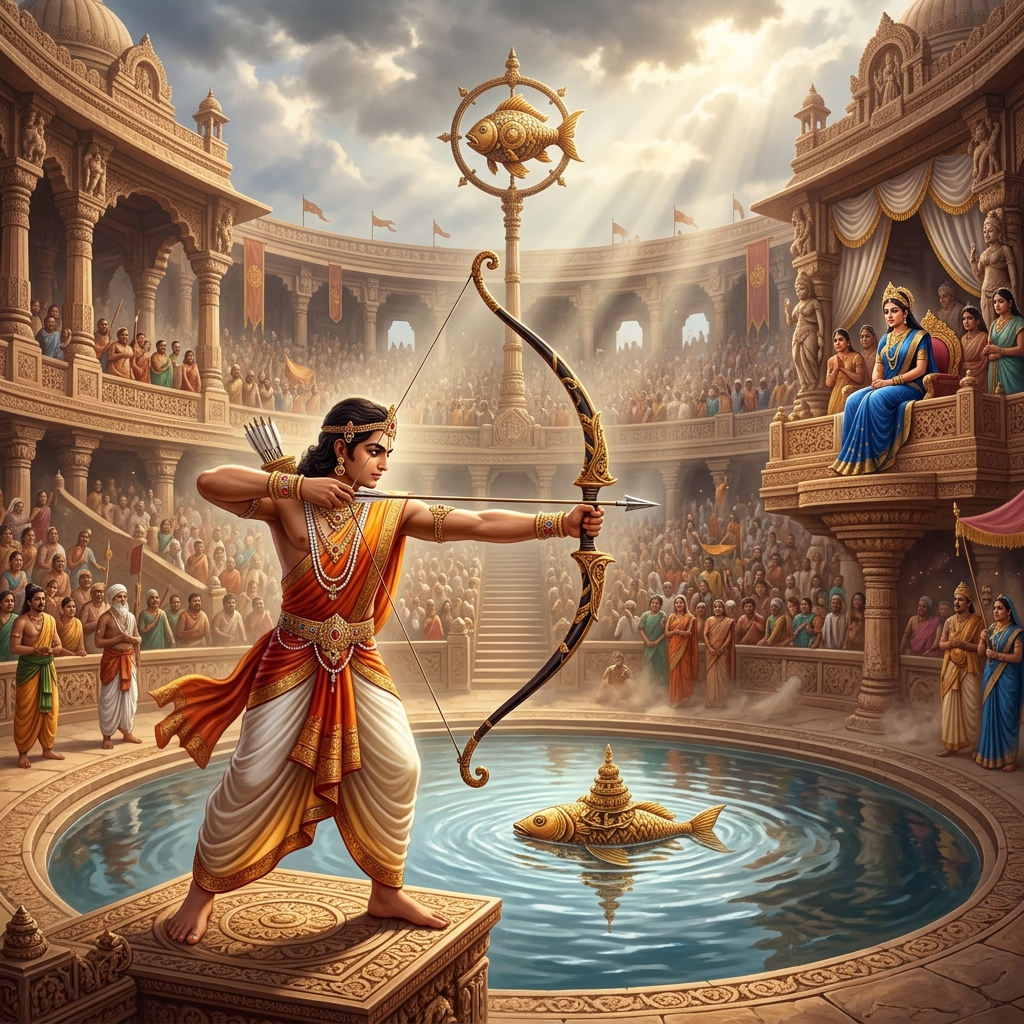
The bow had been strung and the mark had been struck and a poor brahmana out of the crowd had walked away with the daughter of Drupada, and by the time the truth came out he was not a brahmana at all but Arjuna, and behind him stood four brothers and a mother whose careless word from behind a doorway had given one bride to five sons. That belongs to the telling of the swayamvara.
What followed it was worse than the swayamvara, and quieter.
Drupada sat in his hall at Kampilya with the marriage gifts already stacked along the wall, and he was a man being handed a gift and an insult in the same package. He had wanted Arjuna. He had built the whole contest to catch Arjuna. He had got Arjuna, and four others with him.
'Say it again,' he said. 'Say it slowly, so that I hear it as you mean it and not as it sounds.'
'Draupadi will be the wife of all five of us,' said Yudhishthira. 'It is our mother's word, and our practice has always been to share equally whatever comes to us.'
'She is not alms in a bowl.'
'No,' said Yudhishthira. 'She is a queen, and she will be a queen five times over.'
Dhrishtadyumna stood behind his father's chair with his hand tight on the back of it, saying nothing, because his sister had come out of the fire alongside him and he did not know what to say.
'One woman to one man is the rule of the world,' Drupada said. 'A woman with many husbands is a word I will not speak in my own house about my own daughter. You are asking me to publish my child's dishonor to every court from the sea to the mountains. Kunti, you are a mother. Tell me how you say this and sleep.'
Kunti did not answer, and Draupadi, standing where daughters stand, looked at the five of them and at her father and kept her face still.
The Argument in the Hall
They argued for the better part of a day, and it was the rare kind of argument in which everyone was speaking honestly.
'Dharma is subtle,' said Yudhishthira. 'I do not know its course entirely, but I have never taken a step off the road I was shown, and I am not taking one now. What our mother said, we do. That is a rule too, and it is older in our house than any other.'
'Custom is not a mother's slip of the tongue,' Drupada said. 'The learned have never approved this. Show me the precedent. Show me one house of good birth in which brothers held a wife in common and were not spoken of afterward with laughter.'
'The precedent exists,' Yudhishthira said. 'Jatila of the line of Gotama was the wife of seven sages, and Varkshi the ascetic's daughter was wife to ten brothers, and no one called those women fallen. What the great have done before is a path, and a path is not the less a path for being narrow.'
'Old stories.'
'All the stories we live by are old stories.'
Arjuna spoke once, and only to take the blame off everyone else. 'The mark was struck by my hand, king. If there is fault in this, set it against me and give her to my eldest brother, and I will be content. But do not set my brothers against each other over her. That would be the only real dishonor in this room.'
Drupada put his face in his hands. He was not a fool. He could see what stood in front of him, five men of a beauty and a bearing that his hall could barely contain, and every instinct of a king told him this was the alliance he had prayed for and the answer to Drona, and every instinct of a father told him to throw them out of the gate.
'Enough,' he said at last. 'Nothing will be decided today. Tomorrow we will sit again, and I will have counsel.'
That night the counsel arrived without being sent for. The gatekeeper came running to say that Vyasa was at the door.
What Vyasa Showed the King
The island-born sage came in with the dust of the road on him, greeted them all, and asked for a room with a door.
'You and I alone, king,' he said. 'The rest of you will hear it afterward.'
When the door was shut, Vyasa sat on the bare floor and told him a story.
'In an age before this one, Indra the lord of the gods went along the bank of the Ganga and found a young woman sitting there weeping, and where her tears fell into the water they turned to golden lotuses. He followed the lotuses upstream to their source and came to a mountain peak where a youth sat playing dice with a maiden, and Indra, who was Indra, said what he was accustomed to saying. He said: know that I am the lord of this universe.
'The youth went on with his game and did not look up. Indra said it again, louder. Then the youth looked up, and Indra could not move, because the youth was Shiva, and the maiden beside him was Uma.
'Shiva said: your pride is a heavy thing for so small a creature to carry. Move that stone at the mouth of the cave, and go in.
'Indra moved the stone, because he could not do otherwise, and went into the cave. Inside, in the cold and the dark, sat four beings, radiant as fire and mute as fire, and he knew every one of their faces, because every one of them was himself. Four Indras of four vanished ages, put away in the earth for the same fault, waiting.
'He was the fifth. Shiva's word laid them under the necessity of mortal birth, to be born on earth of the gods themselves and to do the work that ends an age. They asked, and it was granted, that the portions of Dharma, of Vayu, of Indra, and of the twin Ashvins would father them.
'Count them, Drupada. Count the men sitting in your hall.'
The king said nothing for a long time. Then he said: 'And the woman weeping by the river?'
The Maiden Who Asked Five Times
'That,' said Vyasa, 'is the other half, and it is the half that concerns your daughter.'
'Say it.'
'There was a rishi's daughter, beautiful and virtuous, and no man asked for her, and she had no one. So she went into the forest and did austerities until Shiva was pleased with her, and he came and stood before her and said: ask.
'She was young and she was frightened and the thing she wanted was the only thing in her mouth. She said: give me a husband endowed with every accomplishment. And having said it she said it again, and again, until she had said it five times over.
'Shiva said to her: you have asked five times for a husband, and so in the life that is coming to you, you will have five husbands, princes among men.
'She said: lord, I asked for one. I asked five times because my heart was full, not because I wanted five.
'And Shiva said: I have heard what you said, and what is spoken to a god is not a draft to be corrected. The word has gone out. It will be a blessing and not a stain, and you will be pure through all of it, and I give you that too.
'She is your daughter, Drupada. She was not born, she was taken out of your fire full grown, as her brother was, and you know that better than any man alive because you stood at the altar and watched it. Sri herself, the goddess of fortune, came into that girl when she rose out of the flame, and she was appointed to those five before either you or they existed in these bodies.'
Drupada's hands were shaking, which had not happened to him in battle.
'Sage,' he said, 'a man cannot govern his house by things he cannot see. You are asking me to believe a story.'
'No,' said Vyasa, and rose, and put his hand on the king's head. 'I am not asking that. Look.'
The Marriage Sealed
The room stayed the room, and the five men were still sitting in the hall beyond the wall, and yet Drupada saw them.
He saw them as they had been. Five forms of unbearable brightness, crowned, each one carrying the thunderbolt, each one the lord of a world that had come and gone. He saw the cave in the mountain and the stone at its mouth. He saw a woman of surpassing beauty standing among the five, made of the same light, belonging to them the way a flame belongs to five lamps lit from it. And he understood, in the way that has nothing to do with being persuaded, that the thing he had spent a day calling a disgrace had been arranged before the making of his kingdom.
When it passed he was on the floor with his forehead on the stone.
'Nothing is impossible with the gods,' he said. 'Whatever destiny has ordained must come to pass. The knot that I could not untie was never mine to untie. Let it be done as it was fixed.'
So the marriage went forward, and Kampilya kept festival for days. Fires were lit and the priests chanted, and Draupadi was given to the five, taking the hand of Yudhishthira first and then of each brother in turn on each of five days, and the kings who had come for the swayamvara and gone away laughing were sent the news with formal courtesy.
Draupadi herself said little through it. Once, before the fires, Vyasa spoke to her privately, and afterward she carried herself like someone who has been told the name of the thing she is inside of.
Only one more matter remained, and it was settled later by the sage Narada, who came to the brothers with the terrible tale of Sunda and Upasunda and left them with a rule to live by, so that the one thing capable of dividing five men who could not be divided would never be given the chance.
Dharma Lesson
Drupada judges by the rule and finds an outrage; Vyasa opens his eyes and he finds an appointment kept. The story does not abolish the rule, it shows that a rule is a summary of ordinary causes, and that some causes are not ordinary. What looks like scandal from inside one lifetime may be the oldest order in the world quietly settling an old account, and the wise learn to ask what they are not seeing before they call a thing shameful.