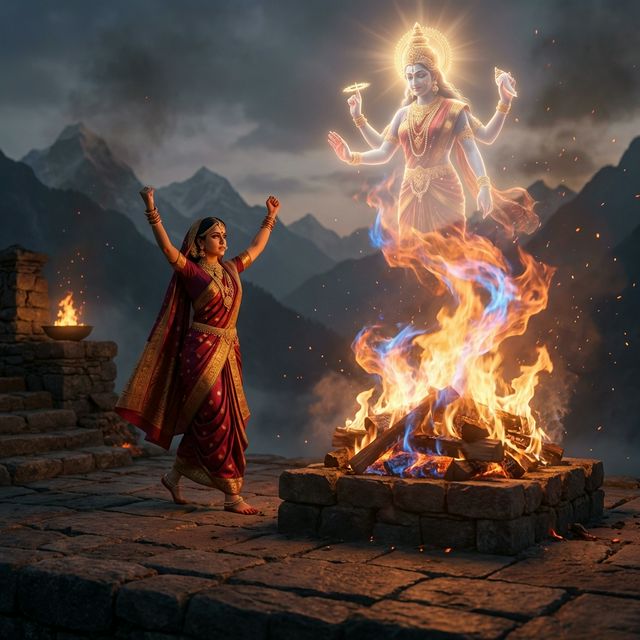
The Fire-Born and the Woman Who Became a Man
Drupada's Children, Drona's Old Feud, and Amba's Vow Across Lives
The Promise Made in Childhood
Long before there were kings to wrong one another, there were two boys at the hermitage of the sage Bharadvaja, beside the upper waters where the forest met the foothills. One was Drupada, a prince of Panchala, sent to study the sciences and the scriptures as princes were. The other was Drona, Bharadvaja's own son, a Brahmin boy with nothing in the world but his father's learning and his own quick mind.
They were inseparable. They rose together before the sun to gather the firewood and the sacred kusha grass. They recited the Vedas side by side until the words ran together in their mouths. They wrestled in the river shallows and lay in the long grass afterward telling each other what their lives would be. Drupada, who had a kingdom waiting for him, was generous in the easy way of those who have much. "When I am king," he told Drona more than once, "whatever is mine will be yours also. My wealth, my horses, my elephants - half of all of it. We will divide it as we divide this bread. You have only to come and ask."
Drona believed him. Why would he not? They were closer than brothers, and a kshatriya's word, even a boy's word, was supposed to be a thing of iron. He folded the promise away in his heart and kept it there for years, the way a poor man keeps a single jewel against a hard season.
In time their studies ended, as studies do. Drupada returned to Panchala, and when his father died he ascended the throne and became a great king, lord of a fertile country watered by many rivers, master of armies and treasuries. Drona remained behind among the sages. He married, and continued the austere life of a Brahmin who lives on what the forest and the charity of others provide.
The years carried the two boys far apart - one into the burdens and intoxications of power, the other into the quiet poverty of the spirit. Neither could yet see how a half-forgotten promise, made by children in the grass, would one day grow into a fire-pit, a sacrifice, and the deaths of warriors beyond counting.
A King Who Forgot a Friend
Poverty in those days had a face, and Drona came to know it well. The famine years pressed on the hermitage. His wife grew thin. His son Ashwatthama, still small, cried for milk - and there was no milk. Drona watched the boy drink water whitened with flour and laugh, thinking it was the real thing, and something in the father broke quietly.
It was then he thought of Drupada. Fifteen years had passed since they had spoken, but the boyhood oath still lived in Drona's memory bright as the morning they had sworn it. He was a proud man and he did not like to beg, but this would not be begging. He would go to his friend, who was now a great king, and claim the share that had been freely promised. Among kshatriyas a promise was a debt. He had only to present it.
He walked the long road to Panchala in his one patched robe, his feet bare, dust to the knees. He passed through the gates of the splendid city of Kampilya, past the elephants and the guardsmen, and asked to be admitted to the king. After some waiting he was let in, and he walked the length of the great hall toward the throne where Drupada sat in gold and garlands, surrounded by ministers.
Drona's face was lit with the old gladness. "Drupada," he said, opening his arms, "do you know me? It is Drona, your friend."
The king looked down at the gaunt Brahmin in his beggar's cloth, and his face did not soften. He laughed instead, a short laugh meant to be heard by the court. "Drona? The poor boy from Bharadvaja's ashram, who used to trot behind me? I remember the name. But what business has a man like you with a king? You speak to me of friendship. Foolish Brahmin - friendship exists only between equals. A king and a beggar cannot be friends. A rich man and a poor man, a learned warrior and a hermit who lives on alms - what is there between them? The boyhood we shared is gone. I owe you nothing. If you have come for charity, name it, and my steward will see you fed at the gate like any other supplicant."
The hall was very quiet. Drona stood without moving while the words went into him. He had come asking for a friend and found a stranger on a throne. He did not argue. He did not beg. He turned, walked the long length of the hall under the eyes of the court, and went out through the gates of Kampilya the way he had come. But as he walked the dusty road home, he made a vow of his own, cold and exact: he would have his answer to that laugh, and Drupada would learn the cost of it.
Half a Kingdom in Revenge
Drona did not go back to the hermitage to grieve. He went instead to Hastinapura, the city of the Kurus, where the royal princes - the sons of blind Dhritarashtra and the sons of dead Pandu - were in need of a master of arms. Drona's skill in weapons was already a legend among those who knew. He was taken into the household of the Kurus and made teacher to the princes, both the hundred Kauravas and the five Pandavas. In his hands the boys grew into the finest warriors of the age. Among them one shone above all the rest in archery: Arjuna, third of the Pandavas, who served his teacher with such devotion that Drona loved him as a second son.
When the princes' training was complete, Drona at last named his teacher's fee, the guru-dakshina that custom owed him. He gathered his strongest students and told them what he wanted. "Go into Panchala. Defeat King Drupada in battle. Take him alive, bind him, and bring him to me. That is the only payment I will accept."
The princes marched. The Kauravas went in first, headlong and boastful, and Drupada's army threw them back in disorder. Then the Pandavas advanced in earnest. Arjuna broke the Panchala host as a flood breaks a dam. He shattered Drupada's chariot, scattered his guard, and at the end it was Bhima, the strongest of men, who seized the king himself and dragged him living from the wreck. They bound him and marched him across his own conquered city to the place where Drona stood waiting.
The two old friends looked at each other for a long moment without speaking, one in chains and one in the plain robe of a Brahmin who had at last been answered.
"You told me," Drona said quietly, "that friendship can exist only between equals - that a king cannot be the friend of a poor man. You were right, and I have set the matter straight. I have taken from you the northern half of your kingdom, the land beyond the river Ganga. The southern half I leave to you. Now we are equals - each of us a king over half a realm - and so we may be friends again, as you said. Go home, friend Drupada." He cut the king's bonds with his own hand and let him walk free.
It was mercy, and it was the cruelest stroke of all. Drupada returned to his halved court alive, unharmed, and utterly humiliated. The shame of it settled on him like an illness that would not lift. He had been spared, and the sparing was worse than any wound.
The Search for a Son Born to Kill
From that day Drupada had one purpose only, and it ate at him sleeping and waking. He did not seek to rebuild his armies; he knew armies were not the answer. Drona could not be beaten by ordinary force. What Drupada wanted now was a son - a son destined and shaped by the gods for a single deed: the death of Drona. And he wanted, too, a daughter so beautiful and so fated that through her his line would be bound forever into the great houses of the earth.
He set out on a pilgrimage that was really a hunt. He wandered through the Brahmin settlements along the rivers, seeking sages of such power that they could call a child not from a womb but from the sacred fire itself, a child made to a measure he would name. It was a terrible request, for the deed he wanted that child to do was the killing of a Brahmin and a teacher, the gravest of sins. Sage after sage heard him out and refused. They would not lend their tapas, the merit of a lifetime's austerity, to so dark an end.
At last, in a forest hermitage, Drupada found two Brahmin brothers, Yaja and Upayaja, who lived by the strictest vows. He approached Upayaja first, the more austere of the two, serving him humbly for a year, tending his fire and his needs, and promising vast herds of cattle and wealth without limit. Upayaja would not be bought. "Wealth is nothing to me," he said. "Go to my elder brother Yaja. His vows are looser than mine. He may do what you ask."
Drupada went to Yaja and made the same plea, the same offering of cattle and gold. Yaja was tempted by the promised wealth and, after some thought, agreed - though he insisted that his stricter brother Upayaja assist in the rite, for without his power the sacrifice could not succeed. Upayaja, bound by the duty of a younger brother and perhaps by fate, consented to take his place among the priests.
So the great sacrifice was prepared. It was the Putrakameshti, the rite performed to obtain a child, but raised to an awful intensity by the brothers' knowledge and Drupada's hunger. Hundreds of Brahmins were summoned to assist. A vast fire-pit was dug in the courtyard of the palace and lined with the proper woods. The ghee, the grains, the offerings were gathered. For days the chanting did not stop, day or night, and the smoke of the offerings rose over Kampilya like a standing pillar, and the whole kingdom knew that its king was calling something out of the fire.
Two Children Rise From the Flames
On the final day the rite reached its climax. The priests had fasted and chanted until their voices were worn to threads. Yaja stood at the head of the fire-pit and poured the last great oblation of ghee into the flames, calling out the formula of summoning in a voice that shook. Upayaja, beside him, recited the answering verse, the response without which the offering would fall to nothing. At that moment a queen had been brought near, that the fire's gift might pass through her into the royal line, but she was not yet purified for it, and Yaja, who would not wait, declared the rite would yield its fruit regardless. The fire leapt up taller than the surrounding trees, white at its heart, and the assembled Brahmins drew back from the heat.
From the heart of that fire a man stepped out. He was already fully grown, a warrior in the prime of his strength, clad in golden armor that seemed itself made of flame, a sword at his hip and a great bow across his back. His hair was the color of fire and his skin the color of burnished copper, and a crown sat upon his brow as though he had been born wearing it. He walked out of the flames the way a man walks through an open door, unburned, his eyes calm. A voice from the unseen sky named him in the hearing of all: "This child, born to bring fear to Drona, shall be called Dhrishtadyumna. He shall be the death of that teacher, and the glory of the house of Panchala."
The Brahmins cried out in awe. Drupada's heart filled to bursting; the son of his vow had come.
Then, before the wonder had passed, the fire surged a second time, and out of it stepped a woman. She too was full-grown, and her beauty silenced the courtyard as the warrior's coming had not. Her skin was dark as a storm-cloud, deep and lustrous; her hair fell black and waving to her hips; her eyes were long and her body fragrant, so that those near her said afterward that a sweetness like blue lotus carried for a great distance. The sky-voice spoke again: "This dark and lovely maiden, Krishnaa, born of the same fire, shall grow to be the foremost of women. For a great purpose the gods have made her, and through her the kshatriyas of the earth shall be brought to their destruction. By her shall the will of the gods be accomplished in time."
Drupada had not asked for a daughter. He stood astonished. But he gathered her to him with bewildered joy, for she had come unbidden out of the same sacred flame that had given him his son, sent for some design larger than his quarrel with Drona. He named her Draupadi, the daughter of Drupada, though by her dark splendor men would also call her Krishnaa all her life. Two children of fire now stood before him, and the kingdom rejoiced, not knowing that they had been born not for joy but for an ending.
The Princess Who Was Refused by Everyone
While the children of fire grew toward their destinies, another thread of fate had been spinning for far longer, away to the east in the land of Kashi, and it would in time be woven into the same loom.
Years before, the great Bhishma - grand-uncle of the Kuru princes, the warrior who had sworn lifelong celibacy and the renunciation of the throne so that his father might marry - had gone to win brides for his young half-brother Vichitravirya. The king of Kashi was holding a svayamvara for his three daughters, Amba, Ambika, and Ambalika, where the princesses would choose husbands from among the assembled kings. Bhishma, deciding to win the brides by force as a warrior might, drove his chariot into the gathering, challenged the assembled suitors, defeated them all, and carried off the three princesses to Hastinapura for his brother.
But Amba, the eldest, had already given her heart. Before the svayamvara she had silently chosen King Salwa of Saubha, and he had chosen her in return. When she told Bhishma of this, the old warrior, scrupulous in all matters of honor, would not force a marriage on an unwilling woman who loved another. He freed her at once and sent her, with honor and an escort, back to Salwa.
But Salwa would not have her. "Bhishma carried you off in his chariot before the eyes of all the kings," he said. "You were his prize, won by his arm. I cannot take to wife a woman another man has already claimed." The fact that nothing had passed between her and Bhishma meant nothing to Salwa's pride. He turned her away at his own gate.
Amba went back, then, to Hastinapura, and stood before Bhishma. "You took me from my svayamvara," she said. "Because of you Salwa rejects me. The fault is yours, and so the duty is yours. Marry me, or restore me to the life you took from me." But Bhishma was bound by his terrible vow of celibacy and could not wed her, nor could his brother now that she had named her love for another. He offered her every protection and provision, a household of her own, anything but the one thing she demanded. Refused by Salwa, refused by Bhishma, unable to return to her father, Amba found herself a woman with no place in the world, and all of it, in her eyes, the doing of one man.
Amba's Penance and the Boon of Death
From rejection Amba turned to revenge, and revenge became the whole of her life. She left Hastinapura on foot and wandered among the forest ashrams, going from sage to sage and crying out for a champion who would kill Bhishma, or for a means to kill him herself. The hermits pitied her, but Bhishma was beloved and nearly unconquerable, and none would take up her cause.
At last she came to Parashurama, the dread Brahmin-warrior who had himself been Bhishma's own teacher in arms. When he heard her story his anger rose, and he agreed to compel his former pupil to take her, or to die. Parashurama summoned Bhishma to the field of Kurukshetra, and there teacher and student fought one of the most terrible duels ever seen. For twenty-three days they exchanged celestial weapons, neither able to overcome the other, the very gods watching from the sky. On the last day Bhishma made ready to loose a weapon so dreadful it might have consumed the world, but the ancestors and the sages intervened and stayed his hand, and Parashurama at last laid down his bow, unable to defeat his pupil. "I have done what I can, child," he told Amba. "Bhishma is beyond me. Make your peace."
But Amba would not make peace. If no man and no demigod could give her Bhishma's death, she would wring it from heaven by her own suffering. She went into the forest and gave herself to a penance so severe that it frightened the seasons - standing in the rivers through the cold, fasting until her body was a shadow, holding her vows through years of austerity until the heat of her tapas troubled the gods themselves. At last Shiva, the great lord of destruction, appeared before her.
"Ask," he said.
"I ask for the death of Bhishma," said Amba. "By my own hand."
"You shall have it," said Shiva. "In a life to come you yourself shall slay him. You will be reborn into the house of Drupada of Panchala. Born a woman, you shall become a man, a mighty warrior and bowman, and you shall be the cause of Bhishma's fall, for he will not lift his weapon against one who was born a woman. Remembering all of this even in your new birth, you shall accomplish your vow."
Amba did not wait for the slow turning of one life into the next. She gathered wood with her own hands and built a pyre at the edge of the river. She climbed onto it and set it alight herself, declaring as the flames took her that she lived and died for the destruction of Bhishma. So the princess of Kashi, who had been burned by rejection in her life, ended that life in fire, and passed on toward the body the gods had promised her.
Shikhandini, Raised as a Son
Amba was reborn, as Shiva had foretold, into the household of Drupada of Panchala - the very king whose fire-children were already growing toward their own destinies. Some years after Dhrishtadyumna and Draupadi had stepped from the flames, Drupada's queen bore a child, and that child carried within her the soul and the memory of Amba.
The child was born a girl, and she was named Shikhandini. But Drupada had long before this done penances of his own to Shiva, asking for a child who would bring about the death of Bhishma, and the god had told him that a daughter would be born to him who would in time become a son. So when Shikhandini was born, Drupada and his queen, trusting in Shiva's word, resolved to raise her as a boy. They told no one the truth. They proclaimed that a son had been born to the house of Panchala, and they reared the child as a prince - teaching her the writing and the arts, the riding and the archery and the handling of every weapon, all the skills of a kshatriya warrior. Drona himself, it is said, instructed the supposed prince in arms along with the others, never knowing what fate this pupil carried.
Shikhandini grew tall and skilled and brave, in every outward way a young man. And when the time came, her father, keeping up the appearance and perhaps daring to believe the god's word fully, arranged a marriage for the prince - a bride was sought from the king of Dasarna, and a princess of that house was given to Shikhandini as a wife.
The new bride, in the privacy of marriage, soon discovered the truth: that the prince she had been wedded to was, in body, a woman. Shamed and furious, she sent word back to her father. The king of Dasarna was outraged at the insult to his daughter and to his house. He sent envoys to Drupada with bitter accusations, and behind the envoys he gathered his army, declaring that he would make war on Panchala for the deception. Drupada, for all his trust in Shiva, found himself caught in a crisis he could not easily explain, and the kingdom braced for an invasion sprung from a secret no one could speak aloud.
The Exchange in the Forest
Shikhandini saw that her secret had brought her father to the edge of ruin and war, and the weight of it was unbearable. Believing herself the cause of all the coming sorrow, she resolved to take her own life rather than let Panchala be destroyed for her sake. In despair she left the city and wandered alone into a deep and lonely forest, intending to die there unseen.
That forest was the dwelling of a Yaksha named Sthuna, a powerful and wealthy spirit of the woods, who lived in a fine mansion hidden among the trees. As Shikhandini wandered, weak and wretched and resolved on death, the Yaksha became aware of her grief and came out to her. "Why do you waste away in this place?" he asked. "Tell me your sorrow. I am a Yaksha able to grant boons. Whatever you need, I will try to give."
Shikhandini, at first afraid to hope, at last poured out the whole of her tale: how she had been born a woman and raised as a man, married to a princess, and how the discovery now threatened her father's kingdom with war. "There is no cure for my trouble," she said, "unless I could be made a man in truth. If only I were truly male, my father would be saved and the war averted. That is the one thing that could end this grief."
Sthuna, moved by her plight and by his own kind nature, made an extraordinary offer. "I will exchange my sex with yours," he said, "for a time. Take my manhood, and give me your womanhood, on one condition: that you return it to me when your need has passed. For a season you shall be a man, and I shall be a woman in your place." Shikhandini agreed gladly and swore to keep the bargain. By the Yaksha's power the exchange was made: she became a man in body as well as in mind and memory, and Sthuna took on her female form and waited in the forest.
Now truly Shikhandi, a man, he returned in triumph to Kampilya. Drupada sent reassurances to the king of Dasarna and invited him to satisfy himself of the truth; trustworthy people examined the prince and confirmed that Shikhandi was indeed a man. The Dasarna king, ashamed of his accusation, withdrew his army and made peace, and the threatened war dissolved. Shikhandini's penance of despair had ended in the very transformation the gods had promised.
Later the lord of the Yakshas, Kubera, passing that way, found his servant Sthuna shamed in a woman's body and cursed him to remain so. But Sthuna, who had acted out of mercy, was granted that the curse would last only until Shikhandi's death; then his manhood would return to him. So Shikhandi lived out his life a man, and the Yaksha waited, and both were content.
The Fall of Bhishma
The years turned, the quarrels of the Kuru house deepened, and at last the great war came, drawing every thread of these old destinies onto a single field at Kurukshetra. The Pandavas, who had won Draupadi at her svayamvara and made her their common queen, stood with Panchala at their side. Dhrishtadyumna, the fire-born son, was made supreme commander of their whole army. And Shikhandi, once Amba, rode among the Panchala warriors, carrying without knowing it the vow burned into him across two lives.
For nine days Bhishma led the Kaurava host and could not be stopped. He was the grandsire of both armies, the greatest warrior alive, and he had a boon that he could choose the hour of his own death; while he stood, the Pandavas could not win. On the night before the tenth day, the Pandavas went secretly to Bhishma himself and asked him, with terrible courtesy, how he might be brought down. The old man, who longed in his heart for the war to end, told them the truth. "I will not raise my weapon," he said, "against a woman, or against one who was born a woman, or one who bears a woman's name. Shikhandi was born a woman, though now he is a man. Set him before me, and behind him let Arjuna strike. I will not fight Shikhandi. So you may bring me down."
And so it was done. On the tenth day Shikhandi was placed at the front of Arjuna's chariot, and they drove straight at Bhishma. The old warrior, true to his word, saw in the advancing figure the one who had been born a woman - and lowered his great bow, and would not loose a single arrow at him. Behind Shikhandi, Arjuna drew and drew again, and his arrows came in an unbroken stream. They struck Bhishma in every part of his body until there was scarcely a fingerbreadth of him unpierced.
At last the grandsire fell from his chariot. But so dense were the arrows standing in his flesh that his body did not touch the ground; he lay suspended upon a bed of arrows, his head unsupported, and there, choosing still the hour of his passing, he lingered. The unconquerable Bhishma had fallen, and the man who had made it possible was the soul of the woman he had once wronged. After two lives and a long penance and a journey through fire and forest and the mercy of a Yaksha, Amba's vow was kept.
The Fall of Drona
Five more days the war raged after Bhishma's fall, and the second great vow of Drupada's house came due. With the grandsire gone, Drona took up the command of the Kaurava army, and under him the slaughter grew worse than ever. The old teacher, master of every weapon, scattered the Pandava ranks like a forest fire. None could stand long before him - none but the man born from the fire for this very purpose.
To bring Drona down, the Pandavas resorted at last to a grievous stratagem. They knew the teacher loved his son Ashwatthama beyond all things and would lay down his arms only at word of that son's death. An elephant named Ashwatthama was killed on the field, and the cry went up that Ashwatthama was dead. When Drona, stricken, turned to Yudhishthira - whose word was famed never to be false - the eldest Pandava answered that Ashwatthama was dead, adding under his breath that it was the elephant, words swallowed by the noise of the army so that Drona heard only the killing truth.
The grief of it broke the old man. Believing his son slain, Drona let his weapons fall, sat down upon the floor of his chariot, and gave himself up to meditation, withdrawing his spirit from the battle and the world. In that undefended moment Dhrishtadyumna, the fire-born, the son Drupada had called out of the flames for precisely this, leapt onto the chariot with his sword drawn. Despite the cries of those around him, despite the horror of striking a Brahmin and a teacher at his prayers, he seized the old man and struck off his head, fulfilling the destiny written into him before his birth.
So fell Drona, by the hand of the child of fire, and Drupada's long account against the friend who had laughed at him was at last closed. But neither vengeance brought peace. Drupada himself had already been slain in the fighting by Drona before the teacher's own fall, so that the king did not live to see his vow completed by his son's hand. And the killing of Drona by trickery and the murder of a meditating Brahmin would draw down a terrible answer in the nights to come.
Threads of Fate, Woven and Cut
When the great war ended, the children of fire and the soul reborn from fire had each accomplished the single deed for which destiny had shaped them - and each, having spent that purpose, was cut from the loom.
On the last dreadful night, after Duryodhana had fallen and only three Kaurava warriors remained alive, Ashwatthama, the son of Drona, came into the sleeping Pandava camp in the dark to avenge his father. He went from tent to tent killing the sleepers, and he found Dhrishtadyumna in his bed. The fire-born warrior, who had slain Drona, woke to find Drona's son upon him, and begged to die by the sword as a kshatriya should; but Ashwatthama, remembering how his father had been struck down at his prayers, would grant him no clean death. He killed him with his hands and feet as one might kill a beast. The same night the sons of Draupadi were slaughtered in their sleep. Of the children Draupadi had borne, none survived; the dark daughter of the fire, who had been named the cause of the kshatriyas' destruction, lived to see that destruction reach even into her own children's beds, and her grief was beyond telling.
Shikhandi too fell to Ashwatthama's sword that night, and with his death the Yaksha Sthuna, far away, was at last released from his curse and restored to his own form, as had been promised. The soul that had once been Amba, princess of Kashi, having toppled Bhishma and seen her two-life vow fulfilled, passed at last out of the world that had refused her.
Looking back across the whole long tale, one can see the single design in it. A king's laugh in a throne-room, a teacher's cold revenge, a sacrifice that called a warrior and a maiden out of fire; a princess refused by every man, burned on her own pyre, reborn to become a man through a forest spirit's mercy - all of these separate sorrows had been threads, drawn from far apart and slowly braided together by fate, until they met on the field of Kurukshetra and became the instruments by which the old order of the world was brought to its appointed end. Dhrishtadyumna was born to kill Drona, and did. Shikhandi was reborn to bring down Bhishma, and did. Draupadi was sent to be the cause through which the age itself would turn, and was. The fire that gave them and the fire that took Amba were, in the end, the same fire - the burning by which one age is consumed so that another may begin.
Dharma Lesson
Some vows take more than one life to keep. Amba burned herself on a riverbank and came back as a man with a bow. Drupada's two children stepped out of a fire-pit grown, knowing already what they had been born to do. Drona's casual cruelty to a hungry old friend made an enemy who could not be killed and a king whose children's only purpose was his destruction. Every act has children of its own.