What the City Was Saying
The princes were grown, and the city had made up its mind.
Yudhishthira had been anointed heir, and Hastinapura had taken to him the way a household takes to a steward who does not steal. He heard petitions himself and heard them to the end. He did not raise his voice at men who could not raise theirs back. His brothers were spoken of in the same breath: the strong one, the archer, the two courteous twins. In the market a grain seller would say to another, without lowering his voice, that the days were coming when they would be governed properly.
Duryodhana stood at a lattice above the street with his uncle beside him and listened until he could not stand it, and then he went to his father.
"Father," he said, "go down and listen to your own city. They are already counting the years until you are gone. They speak of your nephew as if he is the sun and of your sons as if we are the weather."
Shakuni said nothing at all, which he had found was the most useful thing a man could say in that room.
Dhritarashtra sat in the dark he had always sat in. The boys' quarrels he knew about, the wrestling and the river and the food that had gone wrong, and that is another story; he had let each of them pass because a father who cannot see is grateful for the things he need not look at. But this was different. This was the crown moving. He had held it as a regent holds a coat for a man who has stepped out, and he had let himself want it, and now the city was telling him whose coat it was.
He did not sleep. Toward morning he called for a messenger, and the name he gave was not the name of his brother.
The Man He Sent For
Vidura was in the palace. He was always in the palace. He was the one man in Hastinapura who could be relied upon to tell the king the truth at the cost of his own comfort, and the counsel he would one day give this same king, the long teaching on restraint and the ruin that greed prepares, is remembered as one of the great instructions of the epic. Dhritarashtra had only to send along a corridor.
Instead he sent for Kanika.
Kanika was a brahmana of the harsher science, a master of the arthashastra as it is studied by men who are not sentimental about it, learned in the rod and the rope and the ways in which a state stays a state. He came in, made his obeisance, and sat, and he did not begin by asking what the Pandavas had done wrong. He asked one question.
"Are they stronger than your sons, or weaker?"
"Stronger," the king said.
"Then this is a short conversation with a long tail," said Kanika. "Hear the science, king, and do not blame the science for what it says. A ruler is one who stands with the rod raised. If he sets it down he is a private person with a large house. Never let your weakness be visible. Draw it in as the tortoise draws in its limbs, and let no one know which of your limbs is lame.
"Wait as the heron waits, standing in the shallows without moving for as long as it takes. Strike as the wolf strikes, in a rush and from the side. Be resolute as the lion. And when the moment comes, do not delay it by an hour, because an enemy who is weak today has relatives who will be here tomorrow.
"Trust no one. Not your friend. Not your brother. Not your teacher. Not your son. Trust the untrustworthy not at all and the trustworthy not entirely, for the man closest to you is the only one positioned to ruin you. Speak sweetly to him before you strike. Speak sweetly while striking. And when he has fallen, weep for him where people can see."
The Jackal in the Forest
"You are troubled," Kanika said, "because these are your kinsmen. Let me tell you what a jackal did, and then tell me what troubles you.
"In a forest there lived five who called each other friends: a tiger, a mouse, a wolf, a mongoose, and a jackal, and the jackal was the only one of them who had studied policy. They saw a deer, strong and fast, and none of them could take it. They sat down and the jackal spoke.
"'Tiger, you are tired of trying and failing, and it is beneath you. Mouse, go tonight while the deer sleeps and gnaw through its feet. Then the tiger has only to walk up to it.'
"It was done exactly so. The deer lay dead in the grass, and there was meat enough for five, and the jackal wanted it for one.
"He went to the tiger. 'Eat, by all means. Though I should tell you the mouse has been going about saying he brought down the deer by his own strength and that you are welcome to his leavings.' The tiger's pride shut his mouth for him, and he walked away and did not come back.
"He went to the mouse. 'Take care. The mongoose has tasted this carcass and says it is poisoned by the tiger's claws, and he has gone to fetch the others to share it.' The mouse went into its hole and stayed there.
"He went to the wolf. 'Run. The tiger is returning in a temper and he is looking for you.' The wolf ran.
"He went to the mongoose, and this time he did not lie. 'I have driven off the tiger, the wolf, and the mouse. If you want a share, come and take it from me first.' The mongoose looked at him and thought better of it and left.
"And the jackal, who had not run down the deer, and had not killed the deer, ate the deer.
"That, king, is the whole of the science in one animal. Not one of those four was defeated. Each of them was handed a reason to leave."
Dhritarashtra sat very still, and did not tell him to stop.
The Thorn and the Debt
"Now the hard part," said Kanika, "since you have not stopped me.
"A fire left with one spark alive, a debt left with one coin unpaid, a sickness left with one symptom, and an enemy left with one friend: these four are the same thing. Each of them is small, and each of them is patient, and each of them comes back grown. There is no such thing as an enemy who is nearly finished. There is only an enemy who is finished and an enemy who is resting.
"A thorn must come out entire. Leave the tip in the flesh and you have not saved the man pain, you have arranged for him to have it later, and by then it will be a wound with a name.
"Strike the strong before he is strong. Once he stands up, policy is over and you are simply in a war. If your enemy has committed no fault, then it is your business to see that a fault appears, for a man cannot be moved against without a reason, and reasons can be provided. And if conciliation fails, and gifts fail, and the setting of one against another fails, then a king uses what is left to him. Poison in the cup. Fire in the roof at night. A servant already paid. The world will call it a misfortune, and you will be sorry in public, and the throne will be steady.
"Weep, king. Weep loudly at the funeral of a man you have killed. The tears cost nothing and they buy the silence of everyone at the pyre."
He stopped. The lamps had burned low, and in the whole telling he had never once raised his voice.
"You may object," Kanika said, "that this is cruel. It is not cruel or kind. It is a description of what works, the way a physician's book describes what a poison does. I have given you the science. The science has no opinion about what you do next."
He rose, took his fee, and went out of the palace, and he does not appear again.
A Court Gets the Advice It Goes Looking For
Dhritarashtra sat in the dark after the door closed and did not send for his brother.
That is the whole of the king's decision, and everything that follows is in it. Vidura was three corridors away. Vidura would have said that a man's enemies are made in his own house, that the fever of wanting more than one's share is the only disease that kills kings, that a ruler who cannot be just to his nephews will not be able to be just to anyone. Dhritarashtra knew every word of it in advance. That is precisely why he sent the messenger the other way. He did not want counsel. He wanted permission, and he had gone shopping for the man who sold it.
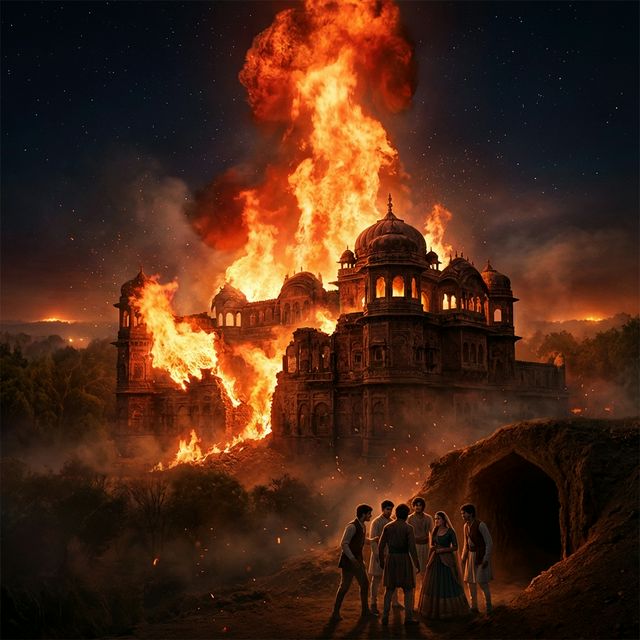
What Kanika had left in that room did not stay in it. Duryodhana had it within a day, and Shakuni had it before Duryodhana, and in their hands the science stopped being a discourse and became a schedule. Strike the strong before he rises. Have a fault appear where there is none. Fire in the roof at night. Within a few seasons there was a lacquered guest-house at Varanavata built for a family that had been sent there for their own safety, and that is another story.
Long afterward, on a night when he could not sleep either, this same king would call for Vidura at last and receive the other niti, the one about self-restraint and truth and the ruin a man prepares with his own hands, and he would praise it warmly and act on none of it. The two teachings sit in the epic like a face and its reflection in dark water.
Neither counsellor forced anything. Kanika described a road. Vidura described a road. The king walked one of them for forty years and lost a hundred sons at the end of it, and the first step was not the lac house and not the dice. The first step was a messenger sent down the wrong corridor, on a morning when a frightened man decided which kind of advice he wished to hear.
Dharma Lesson
Kanika taught nothing Dhritarashtra had not already half decided; he only supplied the vocabulary. The choice that ruined the Kuru house was not the counsel but the summons, the moment a king who could have called for Vidura called instead for the man whose science would agree with him. Advice does not corrupt a court. A court reveals itself by whom it sends for.