A Question About True Dharma
One evening in the forest of exile, Yudhishthira sat with the sage Markandeya and turned over in his mind a question that troubled him. He had given his life to dharma - to truth, to duty, to right conduct - and dharma had repaid him with a lost kingdom and years in the wilderness. Meanwhile men of no learning and small piety seemed to prosper.
"Holy one," he asked, "who truly knows dharma? Is it the learned brahmin deep in his scriptures? Is it the ascetic burning with the heat of his penance? Or can a plain man, who has read nothing and renounced nothing, understand righteousness better than they?"
Markandeya smiled, for it was the question he loved best. "Let me tell you," he said, "of a proud young brahmin named Kaushika, who thought that learning and penance had made him great - and of the two ordinary people who taught him that he knew nothing at all about dharma. One was a humble wife at her cooking. The other was a seller of meat in the marketplace of Mithila. Listen, son of Kunti, and learn where wisdom truly hides."
The brothers leaned in, and the old sage began the tale of the righteous butcher.
The Crane and the Glance of Fire
There was once (said Markandeya) a young brahmin named Kaushika, devout and learned, who left his home and his aging parents to live in the forest and devote himself wholly to study and austerity. He recited the holy texts faithfully, kept strict vows, and grew in spiritual power, and he was not unaware of it. A quiet pride began to gather in him like sediment in still water.
One morning Kaushika sat beneath a tree reciting the scriptures when a crane perched in the branches above let droppings fall upon him. Annoyed, the brahmin looked up at the bird with a flash of anger - and such was the heat of his accumulated penance that the mere wrathful glance struck the crane dead, and it tumbled scorched to the ground at his feet.
Kaushika stared at the small burnt body, and a feeling rose in him that was not quite shame and not quite wonder. He grieved a little for the bird, but beneath the grief swelled a great satisfaction. "See the power that is in me," he thought. "My penance has made me strong enough to kill with a look." And with that thought feeding his pride, he rose and went, as was his custom, to the nearby village to beg his daily food.
The Wife Who Made Him Wait
Kaushika came to a certain house and called for alms. From within a woman's voice answered, asking him to wait a moment, for she was busy. The brahmin stood at the door, and the housewife went on cleaning the vessel she was scouring. Just then her husband returned home, tired and hungry from his work, and the wife at once set aside everything else. She brought him water to wash, gave him a seat, served him his meal, and tended to his every need with patient care before she turned back to anything else.
Kaushika waited at the door, and as he waited his old enemy returned: anger rose hot in his chest at being kept standing while a mere householder was served first. When at last the woman came out with his alms, he was glaring, ready to scold her for her disrespect to a brahmin and an ascetic.
But before he could speak, the woman looked at him calmly and said something that stopped the words in his throat. "Be patient with me, holy one. I am no crane, to be burnt up by your angry glance. Your wrath has no power over a woman who does her duty."
Kaushika went cold. He had told no one of the crane. No one living could have known of it. That this ordinary wife, who had never left her threshold, should know what he had done that very morning in the depths of the forest - it shook the proud brahmin to his roots.
The Wife's Teaching
Amazed, Kaushika begged the woman to explain how she knew of the crane, and how she had come by such knowledge though she lived only as a wife in a small house. She answered with a gentle plainness that humbled him further.
"I know no scriptures and I keep no great penances," she said. "I have only one discipline. I serve my husband and my household faithfully, with a whole and willing heart, as my duty requires. That is my dharma, and the steady performance of it has given me whatever sight I have. There is no austerity higher than the honest doing of one's own duty."
Then she looked at him keenly. "You think yourself wise and holy, brahmin, because you have left the world to study and to fast. But you have neglected the first of your duties. You have aging parents at home whom you abandoned to feed your own pursuit of merit. A man who deserts those he is bound to serve, and calls it religion, has not understood dharma at all."
Kaushika stood rebuked and silent, for every word found its mark. "But if you wish truly to learn what dharma is," the woman went on, "do not take it from me. Go to the city of Mithila, in the kingdom of the Videhas. There, in the marketplace, you will find a seller of meat, a butcher by trade. Humble though his calling is, he is a knower of dharma such as you have never met. Go and learn from him."
Kaushika bowed to the housewife - he, the proud brahmin, bowing to a woman at her cooking pots - and set out at once for Mithila.
The Butcher in the Marketplace
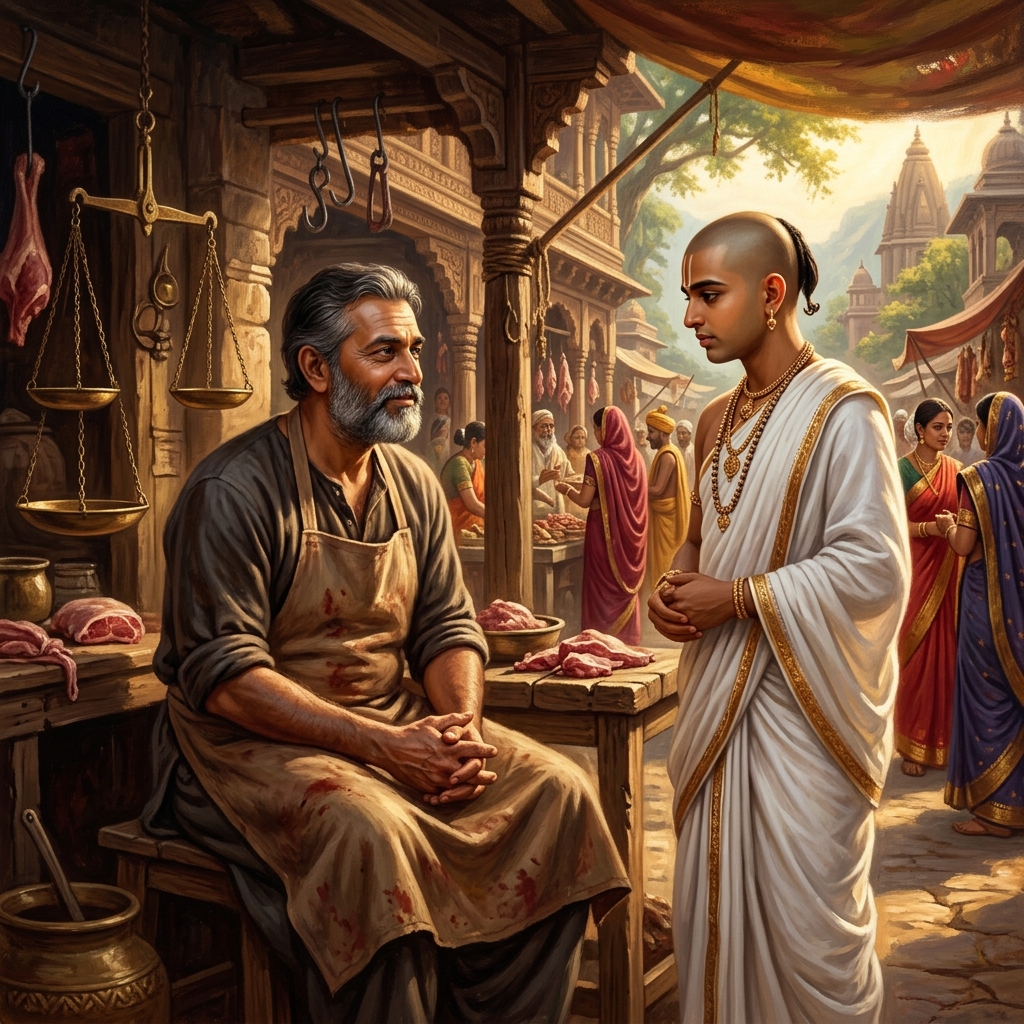
Kaushika journeyed to the great city of Mithila and made his way to the marketplace, and there, among the stalls, he found the man the woman had named: a butcher, cutting and selling portions of meat, his hands and his apron stained with the work of his trade. The brahmin's heart recoiled. That dharma should be learned from such a man, in such a place, surrounded by the carcasses of his trade, seemed to him almost an insult.
But before he could even decide whether to speak, the butcher set down his knife, looked up through the crowd straight at the newcomer, and called out, "Welcome, holy brahmin. I know why you have come. The chaste and faithful wife who sent you to me told you to seek me here. I know all of it. Wait but a little, until I have finished my work, and we will speak."
Once more Kaushika was struck dumb with astonishment, for again a plain working person had read his secret history at a glance. He understood now that he had wandered into the presence of a wisdom that did not live where he had always looked for it - not in forests and scriptures and fasting, but here, in a marketplace, in the hands of a man who killed and sold meat for his living. He waited humbly until the butcher had served his customers and closed his stall, and then the butcher took the brahmin home with him.
The Dharma of One's Own Work
When they had sat down together, Kaushika could not keep back the question that troubled him most. "You seem a wise and righteous man," he said, "and yet you follow a cruel trade. You kill animals and sell their flesh. How can a knower of dharma do such bloody work?"
The butcher answered without shame and without pride. "This trade was my father's and his father's before him; I was born into it. I did not choose it, but it is the work that has fallen to me, and so it is my duty, and I do it as well and as honestly as I can. I do not cheat my customers; I do not kill for cruelty or for sport; I harm no one beyond what my calling requires. A man's own duty, however lowly it appears, performed faithfully and without complaint, is the path of righteousness for him. It is far better to do one's own duty imperfectly than to abandon it and take up another that looks finer."
He went on, and his words were the heart of his teaching. "Dharma is not one thing for all people. The duty of a king is not the duty of a sage; the duty of a wife is not the duty of a warrior; the duty of a butcher is not the duty of a brahmin. Each must walk the path laid before him by his birth and his circumstance, doing the work of his station with a pure heart and no attachment to its fruits. The actions themselves do not bind a man. What binds him is the desire, the anger, the pride he brings to them."
Kaushika listened, and felt the proud edifice of his learning quietly coming apart.
Action Without Attachment
The butcher spoke on, and the brahmin who had come to teach sat and learned. "No man can live in this world without action," said the butcher. "To live is to act, and every action sends ripples outward, some of which must cause harm. The farmer's plough cuts the worm; the very breath we draw destroys small lives unseen. There is no perfect purity to be found by fleeing the world, for the world clings to us wherever we go. The wise man does not torment himself trying to escape all action. He acts as his duty requires, with self-control, without greed, without anger, surrendering the results to a higher order - and so he remains untouched and unbound by what he does."
"Anger and desire are the true enemies," he said, "not work and not the world. The man who has mastered his own mind, who is calm in success and in failure, who speaks the truth and wishes harm to none and keeps to his appointed task, has reached the heart of dharma, though he never read a verse of scripture. And the man who has memorized every text but has not conquered his pride and his temper has reached nothing at all."
Kaushika remembered the crane he had burnt in a flash of rage, and the satisfaction he had taken in it, and his face grew hot with the memory. Here was a butcher, his hands red with the day's trade, who had clearly mastered the very things that he, the holy ascetic, had not.
Honor Your Father and Mother
Then the butcher led Kaushika into the inner rooms of his house, and there the brahmin saw how the man lived. The butcher's old father and mother dwelt with him, and he tended them like living gods. With his own hands he bathed them, fed them, dressed them, and saw to their every comfort before he took anything for himself. He rose before them and rested after them, and his whole household turned, gladly, around their care.
"These two," the butcher told him, "are my chief deities. I keep no shrine greater than they are. The gods in their heaven I worship from afar, but my father and my mother are the gods set before my eyes, and to serve them is the highest of all my worship. The man who neglects his living parents to seek God in the forest is a fool who walks past the temple to look for it elsewhere."
The words went into Kaushika like a blade, for they were the very thing the housewife had said, and the very thing he had done. He had left his own old parents alone and grieving to chase merit in the wilderness, and had thought himself holy for it. Now he saw the truth: that he had abandoned the first and plainest of his duties, and that no amount of fasting or recitation could make up for it. All his penance had been raised upon a cracked foundation.
The Brahmin Goes Home
Kaushika rose and bowed low before the butcher, all his pride gone out of him like air from a punctured skin. "You have taught me," he said, "what all my years of study never showed me. I came thinking myself wise and you lowly, and I leave knowing that you are my teacher and I the ignorant pupil. I am grateful."
The butcher only smiled and sent him on his way with a blessing. "Go home, brahmin," he said. "Serve your father and your mother while they yet live. Do the duty that lies nearest your hand, and do it without anger and without pride, and you will not need to go searching the forests for dharma. It was always waiting at your own door."
So Kaushika returned to the home he had deserted. He went to his aged parents, who had grieved for him all the while, and he fell at their feet and begged their forgiveness, and from that day he served them with a devoted heart for the rest of their lives. He had set out to become holy by leaving the world, and had learned instead that holiness was made of the small, faithful, unglamorous duties he had run away from.
Where Wisdom Truly Hides
Markandeya let the tale settle into the firelit silence, and then he turned to Yudhishthira.
"There is your answer, son of Kunti. A wife at her cooking and a butcher in his marketplace understood dharma more deeply than a learned brahmin burning with penance - because they had grasped the one thing he had missed. Dharma is not where a man stands or what trade he plies or how much scripture he can recite. It is the faithful, selfless doing of the duty that birth and circumstance have set before him, with a heart free of anger, greed, and pride.
"Do not measure righteousness by appearances, and do not despise any honest calling. The seller of meat may be a sage, and the man of vows may be a fool. And the first temple any of us is given to tend is not in the forest, but in our own home, in the faces of those we are bound to serve."
Yudhishthira bowed his head, comforted and instructed at once. For he saw that the trials of his exile, borne with patience and without bitterness, were themselves his dharma, and that there was no austerity higher than to do, day by day, the hard duty set before him. And that, the deathless sage told him, was the wisdom of the righteous butcher of Mithila.
Dharma Lesson
True righteousness is not measured by birth, learning, or penance, but by the faithful, selfless performance of one's own duty with a heart free of anger, greed, and pride. A butcher who serves his parents and does honest work may be wiser than an ascetic burning with austerity. The duty nearest your hand is the holiest path you are given.