What the Weapons Cost
They had waited five years for him on that mountain, and when Arjuna finally came down out of the sky in Indra's chariot the first thing his brothers wanted was not the weapons.
'Show us those later,' said Bhima. 'Tell us what you did with them.'
So Arjuna sat down on Gandhamadana in the evening, with Yudhishthira and Draupadi and the twins around the fire, and told it in order, the way it had happened to him.
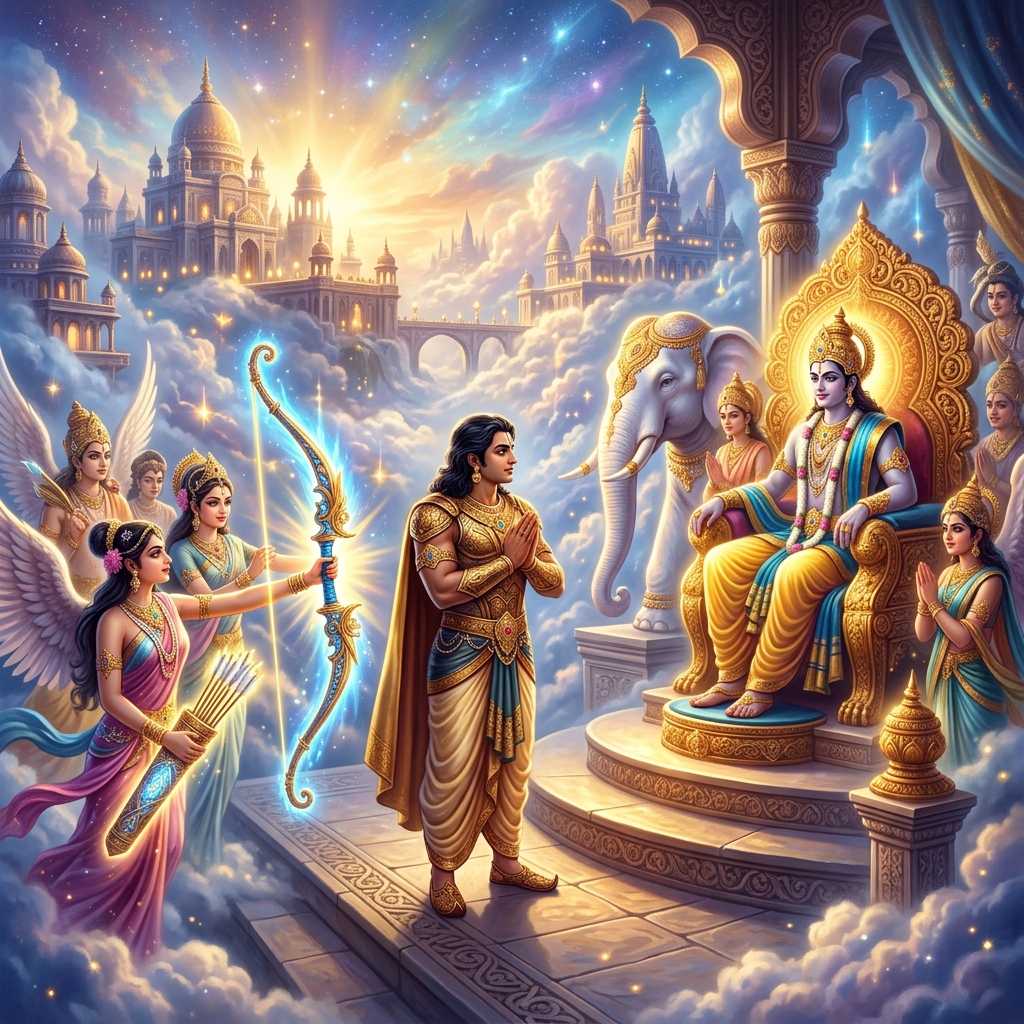
He had gone up to Amaravati as a student and a guest. He described the city briefly, because the city was not the story: streets that had no use for lamps, the flowering trees that had come up out of the churning of the ocean, and his own father moving over on the throne to seat him in front of the whole assembly, which he had not been able to look at directly for some time afterwards. He had learned the astras there weapon by weapon, each with its mantra of calling and its mantra of withdrawal. Chitrasena the gandharva had been set to teach him music and the beating of time in the hours when he was not being taught to burn things, and Chitrasena had been a good teacher and better company. There was one year of that stay he did not describe to his brothers at all, and a curse he had taken out of it that he would one day be glad of.
Then the teaching ended, and there was the matter of the fee.
'A teacher is owed,' Arjuna said. 'So I asked what my father wanted. I expected to be told to give something up. I had been in that city long enough to think that gods take their payment in renunciation.'
'And?' said Yudhishthira.
'He asked me for a war,' said Arjuna.
The Fee, and the Road Down
Indra did not make a speech of it. He named the debt the way a king names a border dispute.
'There is a people called the Nivatakavachas,' he said. 'Danavas. Thirty million of them, in a fortified city under the sea. They were my enemies before your line had a name. They took an austerity to the grandsire and were granted the only boon that matters: no god may kill them. I have gone to Brahma about it twice. Twice I have been told that the boon stands, and that the remedy is a man.'
'And I am the man,' Arjuna said.
'You are my son, you carry my weapons, and you are mortal,' said Indra. 'All three were necessary. This is not a favour I am begging of you, Partha. It is the fee. The astras were not given to you to be carried about. Take my chariot and my driver, and go and see what it is you have been given.'
So Matali came, who had driven Indra through every war the gods had ever fought, and the chariot came with him. Arjuna, who had thought himself a fair judge of charioteers, said afterwards that he spent the first part of that journey doing nothing but watching the man's hands.
They went out over the water until there was nothing else in any direction. Then the chariot went down.
'The sea did not part the way a river parts,' Arjuna told his brothers. 'It stood up on both sides of us and stayed standing, and we drove along the floor of it. There were shapes down there that have no names on land. There were mountains under the water with forests growing on them. And there was a road, because thirty million of anything must come and go somehow.'
At the end of that road stood the city of the Nivatakavachas: walled, lit, towered, with gardens and water channels and gates, a place built by people who had been promised they were safe.
'It was beautiful,' said Arjuna. 'I want that said. It was a city, and they lived in it.'
The Battle by Illusion
He blew the conch first. Devadatta went off against the floor of the sea and the sound came back at him off the walls of the city, and the water shook, and the whole gate of the place emptied out at once.
They came in a mass and they came well armed, and the first hour was an ordinary war, if anything with those numbers in it can be called ordinary. Arjuna stood in the chariot with Gandiva and did what he had been trained since boyhood to do, and Matali took the horses through the press as though the ranks were only weather. Danavas fell. More came out of the gate behind them. It became clear early that killing thirty million enemies one at a time would take longer than the age of the world.
Then they stopped fighting like an army.
The water above went black, and it was not the dark of the deep sea. It was a made dark, a dark that got inside the chariot and sat on the horses. Arjuna could not see Matali's back in front of him. Out of it came stones, first the size of fists and then the size of houses, a rain of rock that would have flattened the chariot and everything standing in it.
'That was the first time I used them,' he said. 'Not in practice. Not against a target my father had set up for me. I called the weapon of the wind, and the wind went out of the bow and took the whole falling mountain of it sideways into the sea.'
After the stones came water, a flood inside a flood, and he dried it. After the water came fire in sheets, and he answered fire with fire. They raised illusory mountains across the road and he broke them open. They made a thousand copies of each of themselves, so that every enemy he shot was a picture, and he used the weapon that is kept for exactly that, and the pictures went out like blown lamps, and the real ones were standing behind them where they had been all along.
'One after another,' he told his brothers. 'Each weapon for the thing it was made for. I understood that evening what my father had really been doing. He was not charging me. He was making me learn the arsenal by spending it.'
The City in the Sky
The fortress under the sea was finished by evening. Matali turned the horses for home, and on the way up Arjuna saw a thing he took at first for a cloud with lamps inside it.
'What is that?'
'That,' said Matali, 'is Hiranyapura, the golden city. It belongs to the sons of Puloma and to the Kalakeyas, and it was made for them by an austerity, and it is not fixed anywhere. It goes up into the air. It goes down into the earth. It goes under water. That is why it is still there. Your father has never been able to keep hold of it long enough to strike it.'
'Is it under a boon as well?'
'It is proof against gods,' said Matali, 'which you are not.'
So they went at it. The city saw the chariot coming and its people came out into the open sky to meet it, and for a while it was the same war again at a different altitude: arrows, numbers, illusions. Then the city itself moved. It went up, and Arjuna followed it up. It went down into the earth and came out again through water, and the chariot went after it through all of that, and somewhere in the middle of it Arjuna understood that he could go on shooting into that place for a year and never finish.
He had one weapon he had not used. It had not come from his father.
'I called the Raudra,' he said, and stopped for a moment. 'The one Shiva gave me on the mountain, when he came at me as a hunter. I did not want to use it. You do not aim a thing like that at a city.'
He used it. The golden city came apart in the air and fell, towers and gardens and gates and all of it, and what came down was not a fortress any more.
'I have destroyed a city,' Arjuna said. 'That is a sentence I am able to say now. I would rather not have learned how.'
The Vajra, and What He Brought Back
Amaravati took him back like a victory.
The gods came out. Indra came down off the throne in front of the whole assembly and put his arms around him, and said what the assembly had come to hear: that the Nivatakavachas had stood against heaven for an age and were gone in a day, that Hiranyapura had been outside the reach of the gods and was rubble on the ground, that the fee was paid in full and then some. Chitrasena, who had taught him to keep time with his hands, said he had never expected to see a student of his praised twice in one hall for two such different skills.
Then Indra gave him the thunderbolt.
'He put the vajra into my hands,' Arjuna said, 'and told me that with it, and with the rest of what I was carrying, nobody on earth would be able to stand in front of me. That was the moment the whole thing arrived. Not the battle. The praise.'
Yudhishthira asked him what he meant by that.
'A man who has only been taught weapons thinks of them as a kind of wealth,' Arjuna said. 'You keep them. You count them over. You feel rich. My father made certain that would not happen to me. Before he would let me come home he made me spend them on a real place with real people inside it, and then made me stand there afterwards while the sea closed over the top of it. I know now what each of these does to a field. I know how long it takes. I know that there is no version of using one where you get to be somewhere else while it happens.'
He looked into the fire for a while.
'He charged me the fee in advance,' he said, 'and I have thought about that ever since. Perhaps he only wanted his enemies dead. But an arsenal that has cost you nothing is a temptation, and one that has already been paid for in a war you did not choose is a weight you carry with your eyes open.'
'And when you use them next?' said Yudhishthira.
'Then it will not be a surprise to me,' said Arjuna. 'That is the only mercy in it.'
Dharma Lesson
Power is never free, and the honest teachers charge for it before they hand it over rather than after. Indra makes Arjuna spend the divine weapons on a real war against a real city, so that his son comes home knowing precisely what each of them does to living people instead of treasuring them as ornaments. The mercy hidden inside that cruelty is knowledge. When the arsenal is opened again on the field at Kurukshetra, Arjuna will not be able to tell himself that he did not know.