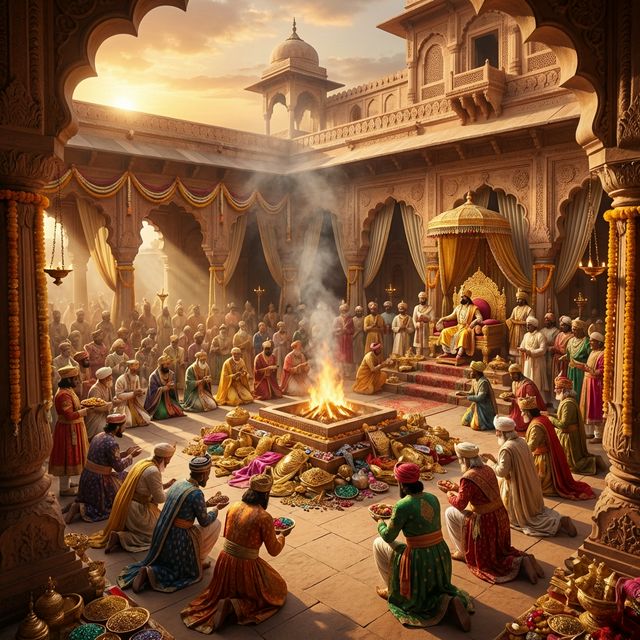
The Question in Maya's Hall
The hall Maya had built for the Pandavas was unlike anything raised by human hands. Its floors were crystal so perfectly poured that they seemed to run like water, and here and there pools of real water lay so still and clear that they seemed to be floors. Pillars of gold and lapis caught the light and threw it back in colors that had no names. Kings who came to pay tribute at the rajasuya walked its length with their eyes cast down, dazzled, and some, it was said, had stepped into the false water and been laughed at by the assembled court.
Yudhishthira sat at the heart of this wonder one quiet evening, and for the first time in his reign he allowed himself a private pride. He thought of the sabhas of other kings he had heard of, of Duryodhana's hall in Hastinapura, of the courts of Panchala and Magadha, and none of them, he judged, could stand beside what the demon architect had built for him.
It was then that Narada arrived, as he so often did, unannounced and unhurried, the wandering sage who carried news between the three worlds. Yudhishthira rose at once and gave him the honors due a guest of his station, and when they were seated he could not help but ask the question sitting behind his pride. Had the sage, in all his travels among gods and men, ever seen a sabha to equal this one?
Narada studied the hall for a long moment, the moving water, the light without a visible sun, and then he smiled in the way of a man who has been asked a smaller question than the one that matters. A king who wonders whether his hall is the finest in creation, he said gently, has not yet traveled far enough beyond his own gate. There were five sabhas in the three worlds that no mortal eye but his had entered, the halls of the lokapalas, the guardians of the world, and Kubera's and Brahma's besides. If the king wished, he would describe them.
Yudhishthira, chastened and curious at once, begged him to begin.
Sudharma, the Hall That Moves With Indra
The first hall, Narada said, belonged to Indra, lord of the heavens, and it was called Sudharma. It had been built by no single craftsman but had come into being with the god himself, and it moved through the sky wherever Indra willed it, so that it was never fixed to any ground and needed no sun, for it was filled with a light of its own that never dimmed and never tired the eye.
Within it sat the great gods in their ranks, the Maruts who ride the storm, the Vasus who guard the elements, the twin Ashvins bright as dawn, and the sages who had won their place through austerity so fierce it had burned away their mortality. Apsaras danced there without weariness, and gandharvas played music that other music only imitated. The hall was vast enough to hold every god at once and never felt crowded, for it grew, Narada said, exactly as large as the honor gathered within it required.
Yudhishthira asked whether any king of the earth had ever been given a seat in that company, and Narada's answer came without hesitation. Only one. Harishchandra, who had kept his word through the loss of his kingdom, his wife, his son, and his own freedom, and had never once let a lie cross his lips to buy back any of it, sat now beside Indra as an equal among the immortals, the sole mortal king so honored.
Yudhishthira said nothing, but the sage saw the words land. A hall of crystal and false water, however wondrous, was not the same thing as a seat beside Indra, and no architect, however skilled, however even a captured demon, could build a king that seat. Only the king himself could earn it, the way Harishchandra had, one truth at a time, with nothing left to lose.
The Hall Where the Dead Kings Sit
The second hall, Narada continued, belonged to Yama, and though he was the lord of death, his sabha held nothing of the gloom that mortals imagined for it. It was built of Yama's own radiance, warm rather than cold, and within it sat not the judged and the punished but the honored dead, the kings and sages who had kept dharma through their lives and now kept Yama's court as his companions and ministers, free from age, from grief, from every hunger and thirst that had troubled them in the world of the living.
Yudhishthira's breath caught, and before Narada could go further the king asked the question he could not hold back. Was his father there? Was Pandu among the honored dead in Yama's hall?
Narada nodded. Pandu sat there among the kings who had ruled with justice, welcomed as a companion by Yama himself, and the sage had spoken with him not long before coming to Indraprastha. There was a message in that meeting, Narada said, though he would return to it once the telling of the five halls was complete. For now it was enough to know that the father Yudhishthira had lost so young to a hunter's curse sat honored among the great dead, at peace in a hall no less wondrous than Indra's own.
Yudhishthira's eyes were wet, and for a moment the crystal floor beneath him, the pride he had felt in it only an hour before, seemed a very small thing indeed beside the thought of his father seated among kings who had never once wavered from the right path, however hard the world had made it.
Beneath the Waters, Amid the Perfume
The third hall, Narada went on, was Varuna's, lord of the waters, and it lay beneath the ocean itself, built of coral and pearl that needed no sun to shine, for the water above it turned every ray of daylight into a soft and endless blue glow. Nagas coiled about its pillars, their hoods spread in ornament rather than menace, and daityas who had once made war on the gods now sat there too, bound to Varuna by old treaties, serving at his feasts as kin rather than as captives, proof that even the fiercest enmity could, in time, be set down.
The fourth hall belonged to Kubera, keeper of the world's wealth, and it stood upon the slopes of Kailasa, its walls worked in gold and its floors scattered with lotus blossoms that never wilted. Perfume drifted through it always, carried on a wind that seemed to come from every direction and none, and yakshas and kinnaras filled it with singing that never repeated itself twice. Yet for all its riches, Narada said, nothing in Kubera's hall was hoarded. Every jewel and every note of music there existed only to praise the god who guarded it, wealth turned wholly toward honor rather than possession, which was the one lesson in that hall worth carrying home.
Yudhishthira listened to both descriptions in silence, turning them over. His own hall, splendid as it was, held wonders meant chiefly to dazzle. He wondered, listening to Narada describe Kubera's perfumed halls, what his own wealth was actually for.
Brahma's Hall, Which Has No Fixed Shape
The fifth hall, Narada said, was the one he could least describe, for it belonged to Brahma, the creator, and it had no fixed measure that could be told the way the others could. A young soul who entered it saw it small; an old and weathered one saw it vast beyond counting. The impure could not perceive it at all, walking through its light as though through empty air, while the pure saw it filled with radiance that answered exactly to the merit they had earned in their own lives. Even the greatest sages who had entered it, Narada admitted, could not agree on what they had seen there, for the hall showed each of them a different truth, and he would not pretend to a certainty he did not have.
This, the sage said, was why he had begun by asking whether the king had traveled beyond his own gate. A hall built by hands, even a demon's skilled hands, remained only a hall. The seat beside a god was earned the way Harishchandra had earned his beside Indra, through truth kept at the cost of everything else. And a place of honor among the dead was kept the way Pandu kept his among Yama's court, through a life spent in dharma rather than in splendor.
And there was the message, Narada said at last. Pandu, seeing the sage bound once more for the earth, had asked him to carry word to his son: that the great sacrifice, the rajasuya, still waited to be completed, and that its glory would raise his father's own honor higher still among the kings who sat with Yama. Yudhishthira rose from his seat in Maya's hall, the pride of an hour before entirely gone, replaced now with a resolve worth far more than crystal or gold.
Dharma Lesson
A hall raised by even the greatest craftsman is still only stone and light; the seat beside a god is earned by truth, as Harishchandra earned his beside Indra, and honor among the dead is kept by dharma alone, as Pandu keeps his among Yama's kings. Splendor borrowed from a demon's hand cannot buy what a single unbroken vow can.