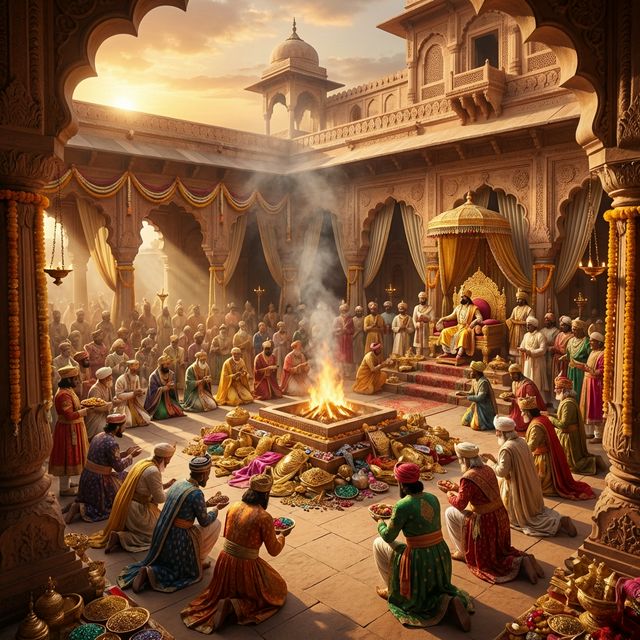
A Kinsman's Welcome in Chedi
With Jarasandha dead in the wrestling ground of Magadha and his kingdom now a friend rather than a threat, Yudhishthira sent his brothers to the four quarters of the earth to gather tribute for the rajasuya. To Bhima fell the east, the wide country of the Ganga's lower reaches, thick with forest kingdoms and river trade. He set out from Indraprastha with a modest host, for the east, he had been told, would open more often at a kinsman's word than at the point of a mace.
His first great halt was Chedi, ruled by Shishupala, son of Kunti's sister Shrutashrava and so a cousin to the Pandavas by blood, whatever venom he would later spit at Krishna in the Kuru sabha itself. In these earlier days the kinship still held its old warmth. Shishupala rode out to meet Bhima's column himself, embraced him at the gate of his capital, and would not let him leave for thirty days.
"You are Kunti's son and my mother's nephew," Shishupala said, seating Bhima at his own right hand at the evening feast. "Whatever Chedi has, it has because the house of Pandu has not forgotten us. Take what you need for Yudhishthira's sacrifice, and take it as a gift, not a tax."
For a month Bhima ate at Shishupala's table, watched dancers in the Chedi style, and let his soldiers rest before the harder marches ahead. When he left, elephants loaded with gold, gems and fine cloth followed him east, given freely, tribute that had cost no arrow and no life. It was the gentlest chapter of his digvijaya, and Bhima, not a man given to patience, would remember it fondly when the iron roads began.
The Duel at Anga
East of Chedi lay Anga, the kingdom Duryodhana had once given to Karna out of love and defiance, crowning a charioteer's son a king in the full sight of the Kuru court. Bhima had not forgotten that day in the tournament ground, nor had Karna forgotten the insults Bhima had thrown at him there. When Bhima's army crossed into Anga's borders, Karna did not send tribute. He sent his chariot.
The two met on a field outside the capital, and for the first time since their boyhood rivalry the enmity found open ground to spend itself. Karna's arrows came in unbroken lines, testing Bhima's guard, precise and merciless as the archer himself. Bhima answered with the crude, overwhelming strength that was his own art, driving his chariot close, breaking Karna's bow twice, forcing him again and again to fall back and restring.
"You fight for a throne Duryodhana threw you like a bone to a dog," Bhima called across the closing distance, "and still you fight well. Yield it, and keep your life to spend on better causes."
Karna did not answer with words. He answered with a volley that grazed Bhima's shoulder guard, and the duel went on past midday, chariot wheels churning the field to dust, until at last Bhima's mace shattered Karna's chariot pole and left him standing weaponless in the wreck of it. Custom stayed Bhima's hand from a killing blow against a disarmed man. Karna, breathing hard, bowed his head rather than his knee, and sent gold and elephants after Bhima's retreating column, tribute paid in the coin of a defeat neither man would ever quite forgive.
Vanga and Pundra Broken
Beyond Anga the land grew wetter and stranger to Kuru eyes, veined with river channels and thick with rice fields, the kingdoms of Vanga and Pundra ruled by lords who had never sent a single elephant west to Hastinapura or Indraprastha. Here there was no kinsman's gate to ride through and no famous rival waiting with a bow. There was only resistance, and Bhima met it as bluntly as it came.
The king of Vanga fielded his army in the delta marshes, trusting the ground to slow a western host unused to fighting knee deep in water. Bhima did not slow. He waded his front ranks through the marsh himself, mace in hand, and broke the Vanga line before its archers could find their footing to loose a second volley. The king surrendered before nightfall, his capital untouched, his treasury opened without a torch laid to it.
Pundra fell in much the same fashion, its ruler more stubborn than wise, holding his walls for three days against a siege he could not hope to win before sending envoys with tribute and an apology dressed as diplomacy. Further on, in the Suhma country between the two, lesser chieftains simply opened their granaries and gates the moment Bhima's banners appeared on the horizon, having heard by then how swiftly Anga's proud archer-king had been humbled.
Bhima took the surrenders as he had taken Karna's, without burning what he did not need to burn. Each broken king kept his crown and his city. What they no longer kept for themselves was the wealth that would now travel west, and the debt of having been invited, alive and reigning, to witness Yudhishthira crowned emperor at the sacrifice their submission had helped pay for.
The Pearl Coast of Tamralipta
The road's last stretch brought Bhima to Tamralipta, the great port where the Ganga finally surrendered itself to the sea. No army waited for him here. Tamralipta lived by trade, not by the sword, and its rulers understood before Bhima's herald had finished speaking that a war fleet from the interior would ruin in an afternoon what generations of merchants had built.
The port opened its warehouses instead. Bhima walked among stacks of goods that had never been seen in Indraprastha's markets: pearls fished from beds far out past the river mouth, bolts of silk carried up the coast from lands further east still, silver worked into ornaments in patterns no Kuru smith would recognize. Ships from across the sea rode at anchor in the harbor, their captains watching the foreign general with wary curiosity.
"Take what pleases the emperor's sacrifice," the port's chief merchant told him, laying out chests before Bhima's officers, "and let Tamralipta keep trading. We have never held a spear against anyone who did not first hold one against us."
Bhima, who had spent a month fighting through marsh and duel and siege to reach this shore, found there was nothing left here to conquer, only to accept. He loaded his elephants with pearls and silk and silver until the beasts strained under the weight, and stood for a while at the tide line watching the sea he had marched an entire kingdom's width to reach, the eastern edge of the world the rajasuya's ambition meant to gather in.
The Unhurried March Home
The march back to Indraprastha was in no hurry, and Bhima, for once, did not press it to be. Behind him traveled a column longer than the one he had set out with: Chedi's gifts, Anga's tribute paid in gold rather than in Karna's blood, the opened treasuries of Vanga and Pundra, and now the pearls and silver of Tamralipta, all of it bound for a sacrifice that had not yet been lit.
What struck the officers riding beside him, and what would strike the chroniclers of the sabha parva long after, was how few of the eastern kings had lost anything but pride. Shishupala remained lord of Chedi, richer in honor than he had been before. Karna still wore Anga's crown, his rivalry with Bhima sharpened rather than ended. The kings of Vanga and Pundra still sat their thrones, their names now written on the guest lists Yudhishthira's heralds were already drafting.
"We did not come east to empty kingdoms," Bhima said to a lieutenant who marveled at how many crowns remained on how many heads. "We came to fill Yudhishthira's yajna hall with every king who might otherwise have doubted his right to it. A throne is worth more standing, sworn to my brother's sacrifice, than broken and forgotten."
That, in the end, was the shape of the digvijaya the epic remembered: not annihilation but federation, an emperor's authority proven by how many defeated rivals chose, or were made, to attend his crowning rather than mourn their own ruin. The wealth of the Ganga's mouths would reach Indraprastha well ahead of Bhima himself, who took the long way home, in no rush to trade the open eastern roads for the walls of a capital he had helped make an empire's capital indeed.
Dharma Lesson
A rajasuya's true conquest is not slaughter but submission that leaves kings alive to honor the sacrifice they were beaten into attending. Bhima's road shows two faces of the same dharma: kinship yields tribute through feasting where blood need not be shed, and where kinship fails, strength must still be tempered by mercy, so the defeated become guests rather than corpses. Power spent without appetite for more blood than the purpose requires is what makes an empire rather than a massacre.