The Four Directions
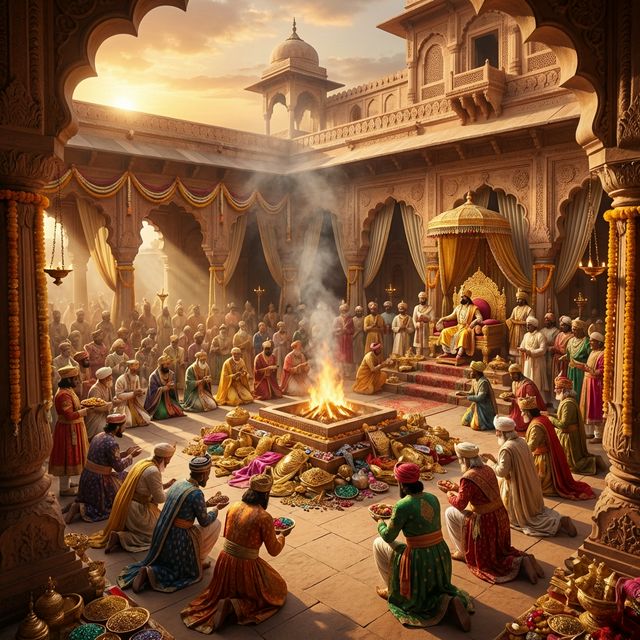
Jarasandha was dead, the kings he had penned at Girivraja for sacrifice walked free, and Yudhishthira's road to the rajasuya lay open. But the imperial sacrifice cannot be performed on goodwill. Its entire meaning is that every quarter of the earth has acknowledged the man who offers it; a king who performs it without that acknowledgment performs a lie in front of the fire.
So the four brothers were sent out, one to each direction, to gather the world's consent and the tribute that proved it. Bhima took the east. Sahadeva took the south, where the sea kingdoms lay. Nakula took the west, the desert roads and the Yadava country. To Arjuna, Yudhishthira gave the north, and everyone in the hall understood what that meant.
The north was not a direction. It was a wall. Beyond the Kuru lands the plain gave out into hills, and beyond the hills the passes, and beyond the passes a country of ice and stone whose peoples had never in living memory paid tribute to anybody of the plains, because no army from the plains had ever reached them and still been an army when it arrived. Those kings did not need to defy Hastinapura. Distance defied it on their behalf.
'Take a force you can feed,' Yudhishthira said, 'and go no further than you can come back from.'
Arjuna took the Gandiva and the inexhaustible quivers, the chariot Agni had given him and the ape-bannered standard, and marched north with a picked army in the good season. The last flat country ran out beneath his wheels within a fortnight. Ahead of him stood the first of the hill kingdoms, the country of the Kulindas, where the rivers come down cold and fast out of the snow and every town sits on a shoulder of rock.
The Hill Kings
The Kulindas fought the way hill people fight, which is to say they did not stand in the open and lose everything at once. They held the throats of their valleys, rolled stone down on the column, shot from ridges and vanished into folds of the mountain, and made Arjuna's cavalry useless in the first three days.
He answered with the one thing hill country cannot argue with. The Gandiva outranged anything the Kulindas could place on a ridge, and Arjuna could clear a defended crest without ever climbing it. He swept the heights before he moved the column beneath them, took the fortified towns one after another, and did it without burning the valleys, which he could easily have done and which the hill kings had fully expected.
That restraint did more work than the arrows. When the Kulinda chiefs came down to his camp they came to negotiate rather than to grovel, and Arjuna received them as kings. He asked for their acknowledgment of Yudhishthira, and for tribute of what their country actually possessed: gold washed out of the rivers, wool, hides, mountain horses, honey. He asked for nothing that would empty a granary before winter.
'Send it to Indraprastha for the sacrifice,' he told them, 'and send men to stand in the hall and watch it offered. My brother does not want your country. He wants your presence.'
The Anartas came in after them, and the Kalakutas, and the ruler of Sakala, and chiefs whose names the heralds had to be taught before they could announce them. The northern march turned into a procession that widened as it went, each yielding king riding along in it with his own men behind him, until Arjuna's army was less an invading force than a moving assembly of the mountains.
Then a messenger came in from the eastern road, and the procession halted.
Eight Days Against the Elephant King
Bhagadatta ruled Pragjyotisha at the eastern end of the Himalaya, a kingdom of forest and river and elephant, and he was the oldest king then living whom anyone in the north still feared. He had been a friend of Pandu. He was called, and called himself, the friend of Indra. He fought from the neck of an elephant with a skill nobody born after him ever matched, and his mount alone had broken armies. He was by then an old man with failing eyes, which changed nothing at all.
He sent no tribute. He sent word that he would meet Arjuna in the field, and he did.
The fighting lasted eight days. It was the hardest of the whole campaign and the only part of it Arjuna afterward cared to speak about. Bhagadatta's elephants went through the Pandava lines the way water goes through sand. His archery came down from the height of the beast's neck at an angle no shield answers well, and the old king had a soldier's patience and could not be drawn into a mistake. Arjuna could not break him. Bhagadatta could not finish Arjuna. For eight days the two of them ground against each other in the river country while the elephants screamed.
On the ninth morning Bhagadatta lowered his bow and laughed.
'Son of Pandu,' he called across the field, 'you fight like the god I call my friend, and I see whose son you are. Ask me for tribute and I will give it gladly, because I cannot be conquered and I will not be discourteous. But do not ask me to call your brother my master. I am far too old to take a master now.'
'Then be my father's friend,' Arjuna answered, 'and come to the sacrifice.'
The old king sent gold and elephants, perfumes and horses of the eastern breed, and came himself when the time arrived. The two of them would meet again years later at Kurukshetra, on opposite sides, and that meeting ended very differently; but that belongs to another telling.
Beyond the Passes
Arjuna turned west again along the mountain wall and came into Kashmira, the valley of lakes and saffron ringed about with snow, whose princes had grown comfortable in the belief that they could not be reached. They were reached. The valley kings and the seven chiefs of the border, the Lohas and the hill clans and the Daradas beyond them, were fought wherever they chose to fight and were beaten, and their tribute went into the growing train behind the army: saffron, crystal, walnut wood, wool of a fineness the plains had no word for, and horses.
Then the passes. Beyond Kashmira the road climbed out of the world Arjuna knew, into stone country where the horses failed and the men bled at the nose, and up onto the high plateaus of the Bahlikas, who bred horses and did not surrender easily. The Bahlikas cost him a hard fight and gave, in the end, the richest tribute of the campaign: horses with the speed of the wind, dappled and black-spotted, the breed that plains kings paid fortunes for and rarely saw. The Kambojas came in after them, and beyond the Kamboja country the Rishikas, whose cavalry Arjuna beat in a battle later poets compared to the old war of the gods and the demons, and who sent him eight thousand horses of a shade the tribute clerks could only write down as parrot green.
Nobody of the plains had ever walked through the country he was now walking through. There were no roads that deserved the name. Villages sat under glaciers. The tribute came in bales of fur, in blocks of salt, in gold dug rather than washed, in the black yak tails that would fan an emperor at his consecration.
At every camp the heralds read out to the assembled kings whose sacrifice this was, and every night Arjuna sent riders south with the count. And still, ahead of him, the ground went up.
The Voices at Uttarakuru
North of the last inhabited pass lies the country called Uttarakuru, which the maps of the plains marked and then said nothing further about. It is the land of the northern Kurus, where the trees give men what they need without being planted, where there is no old age, no sickness and no lie, and where the dead of great merit are said to be born. It is not a kingdom. It is a reward.
Arjuna brought his army to the edge of it across a snowfield with no track in it, and formed for the crossing, because the north had been given to him and he had not yet finished the north.
Then the guardians of that country spoke to him, and there was nobody there.
'Turn back,' the voices said, out of the empty air above the snow, and they were not angry. 'Son of Kunti, this land is not to be seen with those eyes. Nothing here can be conquered, because nothing here can be taken. Whatever you did to enter would only close it. Go home. You have finished.'
Arjuna stood a long while looking at a country he could not enter. Then he saluted the empty air with the formal courtesy of a man addressing a king.
'I ask nothing of Uttarakuru but what my brother's sacrifice requires,' he said. 'Acknowledge that Yudhishthira, son of Dharma, is emperor, and I will not set a foot across.'
And the invisible country paid him. Tribute came out of the air and lay upon the snow at the army's feet: cloth of a weave the priests afterward could not identify, ornaments of divine make, jewels, and heaps of the soft northern gems, given without a face to give them and without one word of submission, only of assent.
The train that came down into the plains that season took days to pass a given point. Gold, elephants, furs, wool, salt, the black yak tails, the parrot-green horses of the Rishikas, and behind it all the kings of the entire northern quarter riding in to sit in Yudhishthira's hall. Arjuna came in last and laid the whole of it at his brother's feet, and the rajasuya, which needed the world's consent and now held a quarter of it, could begin.
Dharma Lesson
The rajasuya cannot be performed by force alone, which is why Arjuna's conquest is measured in acknowledgments rather than annexations: he takes tribute and leaves thrones standing. Bhagadatta yields out of respect and not defeat, and Uttarakuru gives its assent without ever being entered. Both teach the same limit, that there are things a bow can win and things it can only be lowered before. Sovereignty that knows where to stop is what the world consents to call empire.