Direct Me to It
In the forest of Naimisha, where the sages had settled in for a sacrifice that would run twelve years, Sauti came to the part of the tale that everyone waits for, the flight for the nectar, and did not begin with the flight.
The snakes had named their price. They held Vinata as their slave, and they would free her, they said, on the day her son brought them the amrita out of heaven. Garuda had heard the condition and accepted it. He was newly hatched and already the size of a mountain, and he had one practical difficulty before he could do anything at all.
He went to his mother.
"I shall go to bring the amrita," he said. "I desire to eat something on the way. Direct me to it."
It is worth stopping on that sentence. He is about to fight the entire host of heaven for the drink of immortality, and the first thing he says to his mother is that he is hungry and does not know what he is allowed to eat.
Vinata answered him carefully, because she was a slave and afraid, and because she loved him.
"In a remote region in the midst of the ocean," she said, "the Nishadas have their fair home. Eat the thousands of Nishadas that live there, and bring the amrita."
Then she said the thing she had summoned him for.
"But let your heart never be set on taking the life of a brahmana. Of all creatures a brahmana must not be slain. He is like fire. A brahmana, when angry, becomes like fire or the sun, like poison or an edged weapon. He is the master of all creatures, the first-born of them, the foremost of the four orders, the father of all. Neither Agni nor Surya can consume so much as a brahmana of rigid vows can, when he is angry. He is never to be slain by you, my child. Not even in anger."
How to Know a Brahmana
Garuda took the prohibition seriously, which meant he had a practical question about it, and he asked it plainly.
"Mother, of what form is a brahmana? Of what behaviour, and of what prowess? Does he shine like fire, or is he of tranquil mien? Tell your inquiring son the auspicious signs by which I may recognise a brahmana."
It is not a foolish question. He was going to swallow a town. He would be eating in the dark, at speed, by the thousand, and he wanted a mark he could read from the inside.
Vinata gave him one, and it is the strangest identification test in all the scriptures.
"Know him as the best among brahmanas," she said, "who, having entered your throat, would torture you like a fish-hook or burn you like blazing charcoal."
And because she was a mother, and because it mattered more than anything else she would say to him that day, she said it once more in the simplest words she had. "Know him as a good brahmana who would not be digested in your stomach."
So the sign was not a thread, or a shaven head, or a manner of speech. The sign was pain. He would know he had done wrong by the fact that it was already happening.
Then she blessed him. She knew the incomparable strength of her son perfectly well, and she blessed him anyway, because the snakes had cheated her and she was sick with grief and there was nothing else left for her to give.
"Let Marut protect your wings," she said, "and Surya and Soma your back; let Agni protect your head, and the Vasus your whole body. And I shall sit here, engaged in ceremonies for your welfare. Go, child, in safety, and accomplish your purpose."
Garuda stretched his wings and went up into the sky.
The Town in the Sea
He came down on the Nishadas hungry, like a second Yama.
The wind of his descent raised a quantity of dust that spread across the whole firmament and blotted out the sky over the island. It sucked water up out of the ocean. It shook the trees on the mountains along the coast. The fishermen of that town, who had done nothing to anyone but fish, came out of their houses into a darkness full of grit with the sea standing up behind them.
Then Garuda put his mouth over the principal thoroughfares of the town, and opened it wider, increasing the orifice at will, until every road out of that place ran into it.
They ran the way they had to run. Blinded by the dust, unable to see what was in front of them, they went by the thousand into the wide cleft of the bird's mouth as birds in great affliction ascend into the sky when the trees of a forest are shaken by wind. There was no fight in it and no sport. It was a mouth put across a road and a town poured into it.
And then the lord of all rangers of the sky closed his mouth, and innumerable Nishadas who followed the occupation of fishermen were dead in the closing.
He had done exactly what his mother told him. He had eaten a nation.
And he was still hungry. That is the detail the story insists on, and everything that follows turns on it. Garuda swallowed thousands of lives and stood on the emptied island with his appetite entirely unsatisfied, no fuller than when he began, which ought to have told the snakes something about the creature they had sent on an errand.
The Coal in the Throat
Something in his throat had begun to burn.
It was not like the rest of it. A brahmana had been in that town with his wife, and the two of them had gone in with the crowd, and now the man was sitting in the bird's gullet like a piece of flaming charcoal, exactly as Vinata had said he would.
Garuda did not hesitate for the length of a wingbeat.
"O best of brahmanas," he said, "come out quickly from my mouth, which I am opening for you. A brahmana must never be slain by me, even if he should be always engaged in sinful practices."
Notice the clause. Garuda does not know this man. He is not making an exception for a saint. He is stating the rule as his mother gave it to him: whatever this particular brahmana is or has done, whatever his conduct, he is not to be killed, and that is the end of the matter.
The man in his throat, burning and in no position to bargain, bargained anyway.
"Let this woman of the Nishada caste, who is my wife, also come out with me."
He had married one of the fishing people. She was of the very caste Garuda had been sent to devour, and she was on the wrong side of the only rule protecting her husband, and he would not leave without her.
"Take the woman of the Nishada caste with you," said Garuda, "and come out at once. Save yourself without delay, since you have not yet been digested by the heat of my stomach."
So the brahmana came out with his wife on his arm, out of the throat of the creature that had just eaten her entire people, and he praised the bird as he went, and the two of them walked away wherever they pleased.
Garuda, fleet as thought, stretched his wings and rose again, still empty.
His Father's First Question
High up, he saw his father, and his father saw him, and Kasyapa hailed him from below.
The great Rishi had begotten the birds and the snakes both, on Vinata and on Kadru, and had watched the quarrel between his two wives poison two whole races, and he asked his son none of the large questions. He asked what a father asks.
"Child, is it well with you? Do you get enough food every day? Is there food in plenty for you in the world of men?"
Garuda came down beside the water where the sage sat, and made his answers properly, as he had been taught.
"My mother is well. So is my brother, and so am I. But father, I do not always get enough to eat, and for that my peace is incomplete. The snakes have sent me to fetch the excellent amrita. I shall fetch it today, to release my mother from her bondage. She told me to eat the Nishadas. I have eaten them by thousands, and my hunger is not appeased."
He said the last part without boasting. It was a report of a fact he did not understand about himself.
"Therefore, worshipful one, point out to me some other food, by eating which I may be strong enough to bring away the amrita by force. Show me something that will appease my hunger and my thirst."
Kasyapa did not send him back to the world of men. He turned and looked at the water in front of them, a wide, clear, sacred lake with birds of every kind standing along its edges, and he told his son to watch it for a while.
"This lake you see is sacred," he said. "It has been heard of even in the heavens. There is an elephant here, with his face downwards, who continually drags a tortoise, his elder brother. I shall tell you in detail about their hostility in a former life. Listen while I tell you why they are here."
Two Brothers and a Patrimony
"There was of old a great Rishi named Vibhavasu," said Kasyapa. "He was exceedingly wrathful. He had a younger brother named Supratika, and Supratika was averse to keeping the family wealth jointly with his brother. He would always speak of partition. It was the only subject he had. Divide the property, he said. Give me my share and let each of us hold what is his."
For a while the elder brother argued. Then one day he stopped arguing and said what he actually thought, and it is the heart of the whole story.
"It is from great foolishness," said Vibhavasu, "that persons blinded by love of wealth always desire to make a partition of their patrimony. After effecting a partition they fight with each other, deluded by wealth. Then enemies in the guise of friends cause estrangements between ignorant and selfish men once they have become separated in wealth, and by pointing out faults they confirm the quarrel, so that the two soon fall, one by one. Absolute ruin very soon overtakes the separated. For these reasons the wise never speak approvingly of partition among brothers, who, when divided, no longer regard the most authoritative Sastras and live always in fear of each other."
He had made the case exactly, and having made it he broke it, because he was a man of enormous ascetic power and no patience at all.
"But since you, Supratika, disregarding my advice, impelled by the desire of separation, always wish to make an arrangement about the property - you shall become an elephant."
Supratika, already changing, answered him in kind.
"And you shall become a tortoise, moving in the midst of the waters."
"So on account of wealth," said Kasyapa, "those two fools, Supratika and Vibhavasu, became by each other's curse an elephant and a tortoise. Through their own wrath they have both become inferior animals. And they are still engaged in hostilities with each other, proud of their excessive strength and the weight of their bodies, doing here in this lake what they were doing then, according to their former enmity."
The Weight of Two Bodies
"Look there," said Kasyapa. "One of them is coming even now."
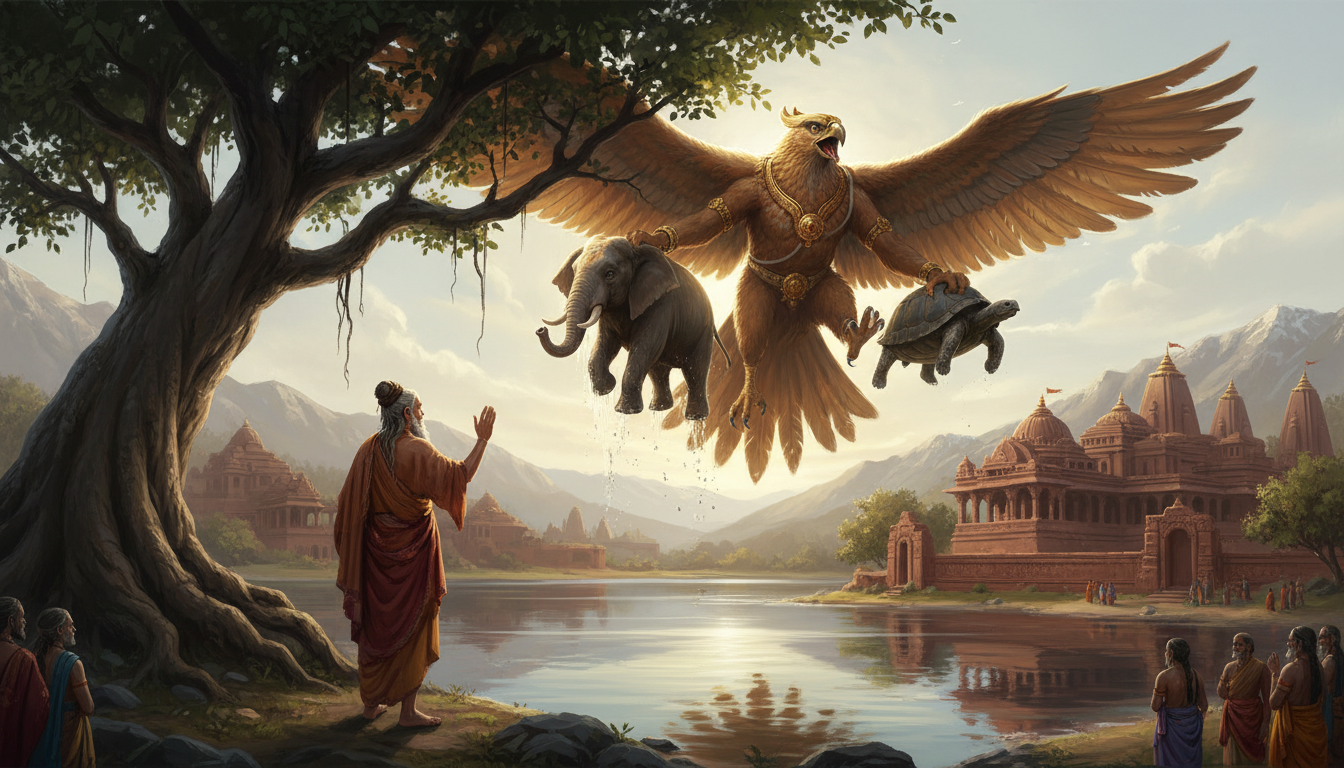
The elephant came down to the water, handsome and huge, six yojanas in height and twice that measure round. And hearing his roar the tortoise came up out of the lake, three yojanas high and ten around, and the water heaved and broke apart as he rose.
The elephant saw him and curled his trunk and went straight in. What followed was not a fight between animals so much as two landscapes colliding. With his tusks and the fore-part of his trunk, with his tail and his feet, the elephant churned that lake until the fishes were flung out of it; and the tortoise came forward with his head upraised for the encounter, driving through the churn, as unwilling to give way as he had been in his first life when the whole argument was about a house and a portion of land.
They had been at it for ages. Neither had ever won. Each had exactly what he had demanded of the other, which was separation, and each had spent an age discovering what separation was worth.
"Eat them both," said Kasyapa, "mad as they are, bent on slaying each other, and then accomplish the task you desire. Eat that fierce elephant, which looks like a huge mountain and resembles a mass of dark clouds, and bring away the amrita."
And having said it, the father blessed his son for the war he was flying into.
"Blessed be you when you are in combat with the gods. Let water pitchers filled to the brim, and brahmanas, and kine, and every auspicious object bless you, oviparous one. And when you are engaged with the deities in battle, let the Riks, the Yajus and the Samas, and the sacred sacrificial butter, and all the mysteries, constitute your strength."
One in Each Claw
Garuda went down to the side of the lake. It was clear water with birds of every kind all around it, and two vast beasts in the middle of it trying to kill each other, and he remembered his father's words and did not hesitate.
He took the elephant in one claw and the tortoise in the other and rose straight up into the air with both.
So the brothers were finally separated, and finally together, in the grip of a third party who had no interest in their case at all. They went up over the lake in the feet of a bird, one in each hand, held apart at last after an age of grappling, and neither of them, so far as the story records, ever stopped fighting.
He flew looking for somewhere to sit down and eat, and what he found first was a sacred place called Alamva, full of divine trees. But the wind off his wings struck those trees and they began to shake with fear, and their boughs were gold and they knew what they were worth, and they were afraid of breaking. Garuda saw it. These were trees that granted every wish anyone asked of them, quaking under the draught of him, and he turned aside and left them alone and went on to others.
Those others were gigantic. They carried fruits of gold and silver on branches of precious gems, and the sea washed their roots. And among them stood one enormous banian, grown to a size beyond the rest, which spoke to the bird coming toward it with the fleetness of thought.
"Sit on this large branch of mine," said the banian, "which extends a hundred yojanas, and eat your elephant and your tortoise."
The Bough Gives Way
He came down on it, that best of birds, swift and with a body like a mountain, and the bough took his weight for exactly as long as it took him to settle.
Then the branch, a hundred yojanas of it, thick with leaves and the resort of thousands of winged creatures, shook once and broke.
Garuda cast his eyes around in wonder, and saw what he had done.
Hanging from that same bough, head downwards, were the Valakhilya Rishis, sages the size of a man's thumb, engaged in ascetic penances and entirely unaware that anything had landed above them. If the branch fell, they would be killed. All of them, at once, by an accident.
He was carrying two full-grown beasts in his claws and the whole quarrel of two lifetimes with them, and he was hungry enough to eat a nation and still be hungry. What he did was tighten his grip on the elephant and the tortoise so that they would not slip, and then take the broken hundred-yojana bough into his beak, and lift.
And he rose on his wings, holding all of it, and did not put any of it down.
The Rishis, hanging upside down beneath him, watched a thing being done that was beyond the power of the gods, and they gave the bird a name for it.
"As this ranger of the skies rises on his wings bearing a heavy burden," they said, "let this foremost of birds, who has snakes for his food, be called Garuda, the bearer of heavy weight."
So he went out over the world with the branch in his mouth and the sages beneath it, looking for anywhere at all that he could set his burden down without killing someone, and came at last to the mountain Gandhamadana, where his father was sitting in his devotions and rose to meet him.
And all that way, in the two claws of the bearer of heavy weight, an elder brother and a younger brother went on struggling against each other, exactly as they had on the day one of them first said the word partition, and neither of them had learned one thing in an age.
Dharma Lesson
Brothers who divide a house in suspicion end up as animals fighting in the same water forever, and neither of them wins. Vibhavasu could state the whole argument against partition perfectly and still lost his temper at the end of it, which is the warning inside the warning. Garuda, who could have eaten anything, spared a brahmana because a rule held even when nobody was watching.