Fuel for the Fire
At the hermitage of the sage Kashyapa, preparations were under way for a great sacrifice, and every hand within reach had been put to gathering what the rite required: wood for the fire, water for the offerings, leaves and grasses for the smaller needs a sacrifice always turns out to have. Among those laboring were the Valakhilyas, a company of sages no bigger than a human thumb, ancient and learned and utterly without physical strength to match their learning.
A single leaf of the palasha tree was, for a company of that size, a genuine burden, and the sages carried it between them with the effort other beings might spend hauling a felled trunk. Their path back to the sacrificial ground crossed a stretch of earth churned by cattle, and in one deep hoofprint, still brimming with the last rain, the entire company slipped and went under, struggling in water that would not have wet an ordinary traveler's ankle.
It was at this exact moment that Indra, king of the gods, happened to pass by. He saw thumb-sized sages drowning in a hoofprint, found the sight absurd rather than urgent, and laughed outright before striding on without lifting a finger to help. To Indra, ruler of storms and wielder of the thunderbolt, the whole scene was scarcely worth a second glance, a small mishap involving small beings, forgotten as soon as it was behind him.
He did not yet know that a joke costs nothing to the one who tells it and everything to the one it is told about, and that the Valakhilyas, however small, were not the kind of sages who would let an insult like that simply evaporate.
A Vow to Make Another King
Soaked, humiliated, and furious in the particular way that dignity wounded by laughter can be, the Valakhilyas gathered themselves and went to Kashyapa, host of the sacrifice they had nearly drowned serving. They told him what Indra had done, and announced what they intended to do about it: they would perform a sacrifice of their own, a counter-rite aimed at producing a being who could unseat Indra outright, a second and greater Indra, lord not of the sky but of every creature with wings.
This was not an idle threat. The Valakhilyas were sages whose austerities carried real weight in the order of the world, and a vow of that kind, once spoken and begun, was not the sort of thing that simply faded once tempers cooled. Kashyapa, who understood better than most what such sages could accomplish when wronged, did not try to talk them out of their anger. He let them begin the sacrifice they had announced, watching as it gathered the kind of power that eventually has to be answered by someone.
The rite itself asked nothing extravagant of them, no more wood or water than the sacrifice they had already been serving, but it was fed by an intention sharpened past anything a merely offended traveler could have mustered, and that intention was the whole of its strength.
Word of what the thumb-sized sages were attempting did not stay contained to Kashyapa's hermitage for long. It reached Amaravati, the city of the gods, and it reached Indra himself, who discovered that the joke he had already forgotten had, in the time it took him to walk on, become a rival being on its way to being born.
Indra Runs to Kashyapa
Indra's laughter did not survive the news. A king who had never had to defend his throne against anything but demons and rival gods found the prospect of losing it to the unplanned consequence of his own idle mockery far harder to dismiss than the mockery itself had been. He left Amaravati at once and came to Kashyapa's hermitage, no longer laughing, to beg the sage to turn the Valakhilyas from their course.
Kashyapa went to the sages on Indra's behalf, and found them unmoved by any appeal to spare the current king of heaven his throne. What the Valakhilyas would not do, however firmly Indra or even Kashyapa pressed them, was take back a vow already spoken. A vow, once made by sages of their standing, was not a thing to be casually withdrawn merely because the one who had provoked it was now frightened rather than amused; unsaying it would have made the whole of their austerity meaningless, a threat with no weight behind it the next time some greater power thought them too small to matter, and thumb-sized sages had already spent a lifetime being thought too small to matter.
What they would consider was a different kind of settlement. The sacrifice's fruit did not have to fall exactly where their first anger had aimed it. It could be redirected toward an end that punished Indra's mockery without literally dragging him from his seat, and it was this narrower opening, rather than any change of heart in the sages themselves, that Kashyapa now had to work with.
The Fruit Diverted
Brahma himself is said to have taken a hand in shaping the compromise, since a promise made by sages of the Valakhilyas' rank could not simply be waved away even by the gods who feared its outcome, but could still be guided toward a form that cost heaven less. The king the sages had vowed to create would still be born, would still surpass Indra in strength, and would still hold a dominion no other creature could challenge, but his kingdom would be the sky's winged creatures rather than the sky itself, and his birth would come through a mother already waiting for exactly this kind of son.
That mother was Vinata, still living out her sentence as Kadru's slave, still carrying within her second egg the son promised to end that servitude, a son who had so far shown no sign of hatching. The fruit of the Valakhilyas' sacrifice was turned toward that waiting egg, joined to what was already growing inside it, so that the being born from it would be, in the same act, both Vinata's long-promised deliverer and the king of birds the thumb-sized sages had sworn to raise up against Indra's mockery.
The sages accepted the arrangement, since it kept their vow intact in substance even as it moved its target, and Indra accepted it because it was, after everything, the best terms his own laughter had left him room to negotiate. Nothing about the compromise erased what had already happened at the hoofprint. It only decided what would be made of it.
The King the Joke Made
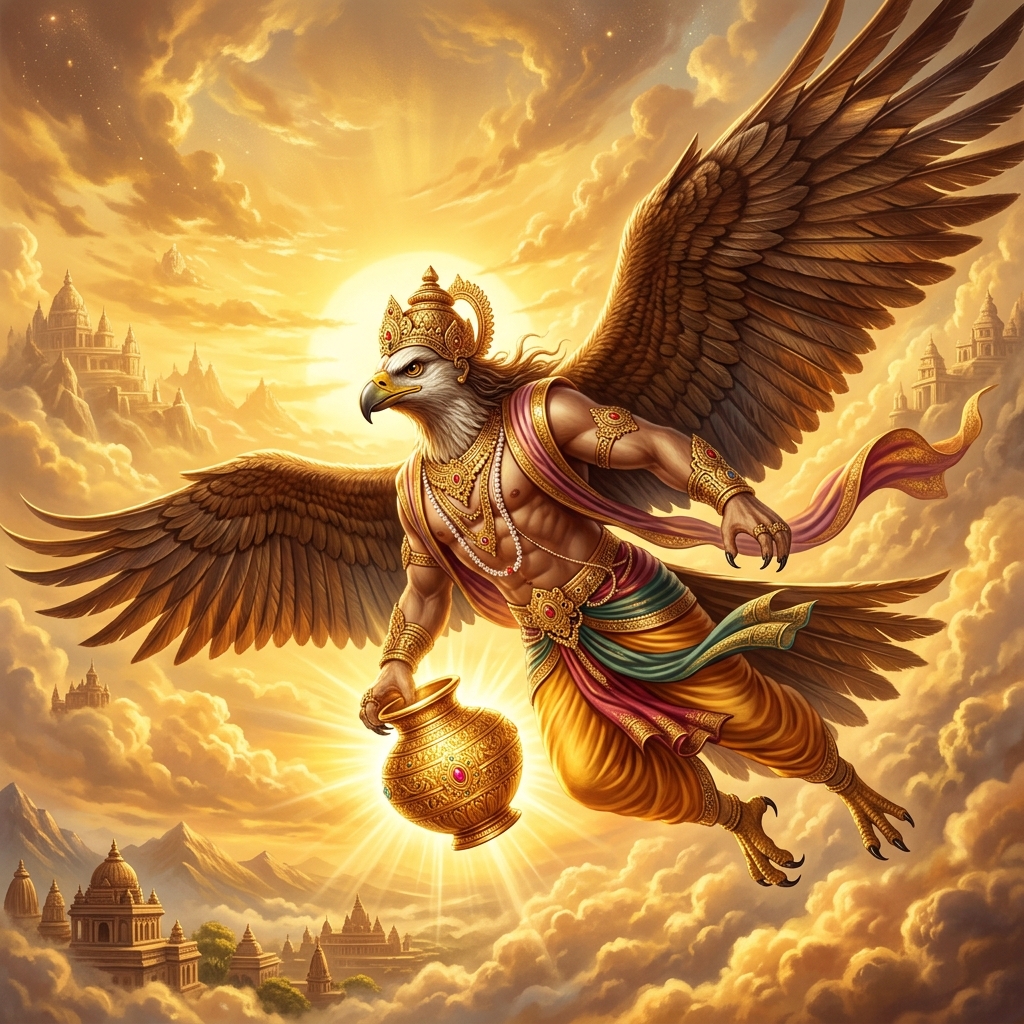
When Vinata's second egg finally broke open, what emerged answered every term of the Valakhilyas' vow at once: a bird of such size and radiance that the other gods, seeing him for the first time, mistook him briefly for a fire come to consume the world. This was Garuda, and he grew into exactly what thumb-sized sages, drowning in a hoofprint, had sworn to produce out of pure wounded pride, a king before whom every winged creature bowed and beside whom even Indra's own thunderbolt was, in due course, shown to carry less final authority.
Indra kept his throne in Amaravati, and nothing in the story pretends otherwise. But he kept it now as a ruler who had learned, at some cost, that the being who could have unseated him existed and had chosen, or been persuaded, to hold a different kingdom instead. That is a very different position from never having been threatened at all, and it is worth setting beside indra_ants, another story in which Indra is humbled, not by mockery repaid but by simply being shown how many Indras have already come and gone across the ages, a humiliation of scale rather than of consequence.
Here the humiliation was neither cosmic nor abstract. It began with a god who could not be bothered to notice sages small enough to drown in a hoofprint, and it ended with those same sages producing, out of nothing but their own outraged dignity, the king of birds. A throwaway joke, told by someone too large to imagine it mattering, had turned out to be the whole life's occasion for someone small enough that it did.
Dharma Lesson
Indra's laughter cost him nothing in the moment and very nearly cost him his throne, because he mistook the smallness of the Valakhilyas' bodies for the smallness of their claim on being treated with respect. The story does not let power excuse carelessness merely because the ones on the receiving end happen to be thumb sized. Garuda exists at all only because a joke, once told, cannot be unheard by the one it wounds.