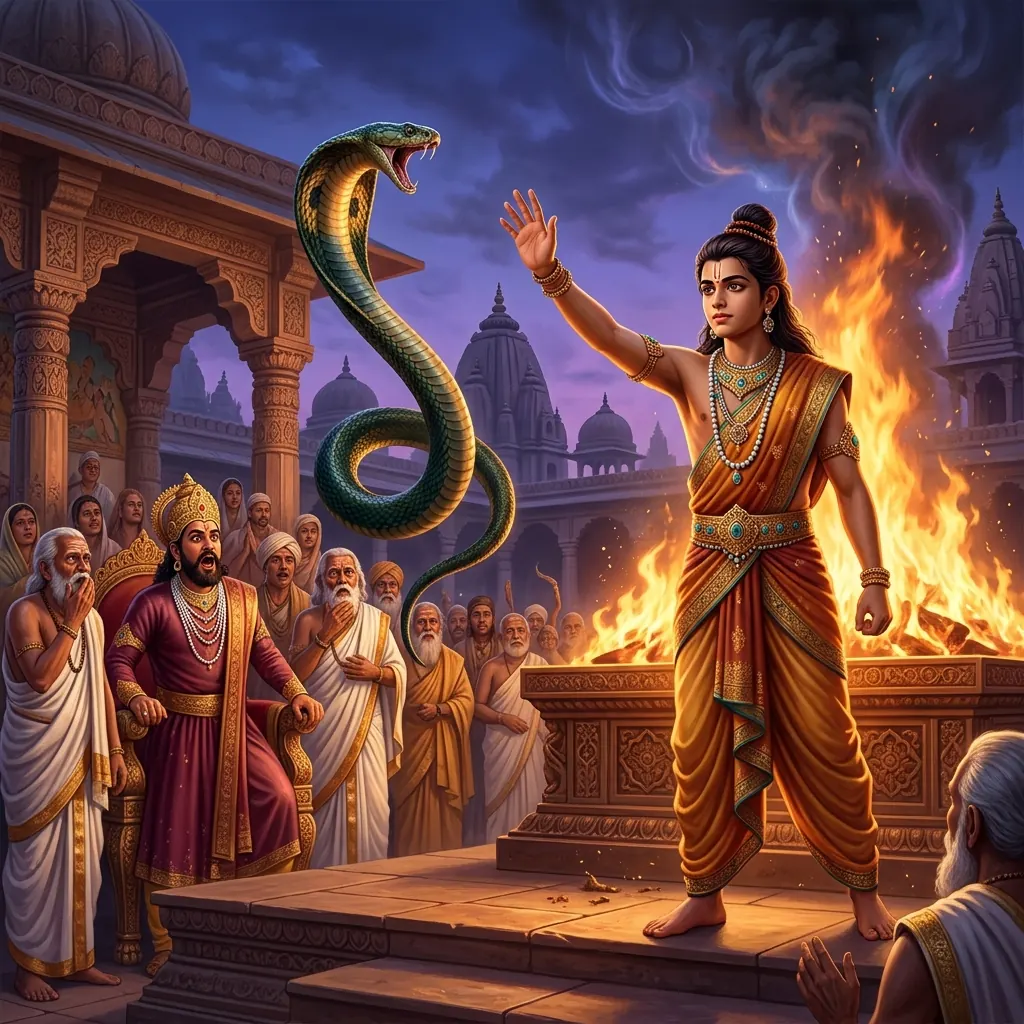
The Doom Announced
Nagaloka lay beneath the roots of the world, its halls floored with lapis and lit by gems that needed no sun, and it was here, in the greatest of those halls, that Vasuki, king of all serpents, called his brothers to sit.
He did not soften what he had to tell them. Their mother Kadru had lost a wager to her sister Vinata over the color of a single horse's tail, and rather than accept the shame of it honestly, she had ordered her thousand sons to hide the truth by turning themselves black and clinging to the tail like hairs. Most of them had refused a lie that ugly, even to spare their mother's pride. For that refusal, Kadru had cursed her own children: in an age not yet come, a king named Janamejaya would light a sacrificial fire vast enough to call every serpent under heaven into it by name, and there, in flame she would not live to see, her sons would die. Only Shesha, who had turned away from his mother and his brothers to live in hard austerity, stood apart from them, and Brahma had blessed him for it.
"The curse is not a threat," Vasuki said, and his voice carried to the farthest coils in the hall. "It is a fact spoken by a mother who meant every word of it, and a mother's curse, even an unjust one, does not fail. I have not gathered you to grieve. I have gathered you to decide what a doomed people does with the years it still has."
Silence held the hall a moment, thousands of hooded heads turned toward their king, waiting to see who among them would speak first into the dark that had just been named aloud.
Six Voices
The first to speak was old and wanted no part of fangs at all. Become brahmins, he said - shed the hood and the scale, walk among men learning the Veda and wearing the sacred thread, and when the king's line finally moves toward this sacrifice, beg mercy from them as kin of the wise rather than as prey.
A second disagreed before the first had finished. Begging bought nothing from a king already primed by prophecy to hate them; better to bite first, to end the royal line that would one day light the fire, before it ever had the chance to grow into the man who lit it.
A third proposed something quieter: poison the priests. No sacrifice moves forward without hands that know the mantras exactly; take those hands, one generation before they are needed, and the ritual dies with them, no serpent blood spilled at all.
A fourth wanted the fire pit itself drowned - flood the ground where it would be dug, curse the soil, turn the very earth against the rite before the first brick of the altar was laid.
A fifth, boldest of all, suggested they steal into the sacrifice by night, carry off its ladles, or go in their thousands to bite everyone present and fill the rite with terror.
Vasuki listened to each in turn without interrupting, his hood lowered, weighing brahminhood against poison, flood against theft and terror. None of the six answers satisfied him completely, and he said so plainly, because a threatened people, he had learned, owes itself honesty before it owes itself comfort.
Takshaka's Answer
It was Takshaka who spoke loudest and last, and would not be seated again once he had risen.
"Hiding is a slow death dressed up as patience," he said. "Begging is worse - it asks our enemies to be kinder than the curse that names them our enemies in the first place. I say we strike before the fire is ever built. No king unborn can light a sacrifice he never lives to order. No priest can chant a rite over ashes that are his own."
A murmur of approval moved through the younger coils in the hall, the ones who had grown up already knowing themselves condemned and wanted, more than survival, simply to stop being afraid.
Vasuki let the murmur pass before he answered it. "And when it is known, as it will be known, that serpents killed a king in his cradle to escape a fire they had not yet been called to, what will that prove, Takshaka, except that Kadru's sons were exactly the venomous, faithless race the curse already assumes us to be? A curse answered with the very crime it predicts does not break the curse. It signs it."
"Then what would you have us do, brother? Recite hymns and wait for the flame?"
"I would have us find out," Vasuki said, "whether a doom spoken once by an angry mother is truly the same as a doom that cannot be moved by anything at all. I have not heard that answer yet tonight, from you or from anyone."
It was then that a small voice, young enough that its hood had not yet darkened to its full color, asked to be heard.
The Boy Who Remembers
The council turned, mildly startled, to a naga barely out of his first skin: Elapatra, too young by every measure to have earned a place in this hall, let alone a turn to speak in it.
"I was there," he said, "though none of you would have counted me as there at all. When our mother's curse was first spoken, in Brahma's own presence, I was frightened and crept up into her lap. From there I heard the sorrowing gods question the Grandfather, and I heard every word of his answer, because a child in its mother's lap is listened to by no one, and so hears everything."
"And what did the Grandfather say?" Vasuki asked, very quietly now.
"That he had let the curse stand. The serpents had grown too many, cruel and full of poison, and for the good of all creatures he did not stop Kadru. But the wicked ones would perish, not those who follow dharma. And he said one thing more, which I have carried since before I could speak it back. A hermit will be born to this age, an ascetic named Jaratkaru, wandering and unmarried by his own strict vow, who will only take a wife who shares his own name and who is given to him freely, asking nothing in return. If a serpent's daughter can be found and kept ready to be that wife, their son will grow learned in every rite there is, and on the very day the sacrificial fire is at its height, he will stand before the king and ask a boon no king can refuse a Brahmin his own priests have praised, and by that asking, he will put the fire out."
The hall had gone entirely silent, poison and flood and flight all forgotten at once.
The Daughter They Would Give
Vasuki sat with that a long time before he spoke again, and when he did, the fire had gone out of his own voice, replaced by something steadier.
"Then we have our answer," he said, "and it is not one any of you proposed tonight, though I thank you all for trying. We will not become brahmins to beg for mercy we are not owed. We will not poison priests or drown a fire not yet dug, and we will not creep into a sacrifice by night to steal its ladles. We will do the hardest thing a frightened people can do, which is nothing at all, except wait, and keep one promise ready."
He turned then to his own sister, whom the boy had named, a serpent maiden who shared, by no accident anyone in that hall now believed, the very name the prophecy required: Jaratkaru. "She will not be given in marriage to any comfortable match among our own kind," Vasuki said. "She will be kept free until the day a wandering ascetic of that same name comes asking for a wife by alms, wanting nothing but the name itself as dowry. On that day, whatever season it falls in, she goes to him without hesitation and without a single condition attached."
Takshaka said nothing more that night, though he did not look convinced. Whether the boy born of that marriage, a son later called Astika, truly stood one day between his mother's kin and Janamejaya's fire is a story the Nagas would tell for generations after, in full, elsewhere. What the council of that night decided, in the end, was simpler than any curse or any counter to it: a people can be saved by the one daughter it is willing, when the moment comes, to give away.
Dharma Lesson
Vasuki's council shows a people choosing patience over vengeance, trusting a prophecy they cannot verify rather than a poison they can strike with today. Takshaka's counsel of force is heard and set aside, not because it lacks courage, but because a curse spoken by a grieving mother cannot be answered with another wrong. In the end the Nagas survive not by their fangs but by the one daughter they are willing to give away.