The Pole Raised for a Friend
A king who came down from his penance, and the festival he left behind
The King Who Put Down His Arms
There was a king of the name of Uparichara, of the Paurava race, called also Vasu, and he was devoted to virtue and very much addicted to hunting.
He had taken the kingdom of Chedi under instructions from Indra, and it was an excellent and delightful country and he ruled it well. Then, some time after, he did a thing that kings do not usually do while they are winning. He gave up the use of arms altogether. He put the bow away, went out of the city to a secluded retreat, and began to practise the most severe austerities that a man in a body can practise.
Nobody had defeated him. Nothing had been taken from him. He had simply concluded, in the middle of a successful reign, that the higher work was the other one, and he went off to do it with the same thoroughness he had brought to the conquest of a kingdom, sitting alone in his retreat, wearing his penance down into the ground the way a river wears a stone.
He kept the one appetite. He was very much addicted to hunting, and that is set down about him at the start, before anything else is, because it is the detail that will matter most at the end of his story and it is the one thing he never gave up.
And because he was good at penance, and because austerity in this world is a heat that rises, the celestials began to watch him, and after a while the celestials began to be nervous.
The Gods Come Down With a Request
The gods came down to him with Indra at their head, and they came because they had decided he was after the headship of heaven.
It was not an unreasonable fear. That is what such penances are usually for. A mortal who sits long enough and burns hard enough may ask for anything at the end of it, and there was nothing in the ordinances to stop a man of Vasu's discipline from asking for Indra's own chair, and Indra had lost that chair before.
So they became objects of his sight, and they did not threaten him and did not bargain with him. They asked him, in soft speeches, to come back and do something duller.
"O lord of the earth," said the gods, "you should take care so that virtue may not sustain a diminution on earth. Protected by you, virtue itself will in return protect the universe."
It is a small speech and it turns the whole of this story. They did not tell him his penance was wrong. They told him what it was costing while he sat there. Down below him were roads and courts and granaries and a country that had been given a good king and had just lost him to a superior ambition, and the gods, who had come prepared to defend heaven, were reduced to pointing that out.
And Vasu, who had gone into the woods to become greater than a king, heard them out and did not argue and did not bargain for anything in exchange. He got up. He left the retreat where he had been sitting and walked back down to the country he had put behind him, and by that one turning he lost whatever the penance had been about to buy him and gained the friendship of the god who had come to stop him.
Though I Am of Heaven and You of Earth
Then Indra spoke to him alone, and what he said was not the speech of a god to a worshipper. It was the speech of one man to another whose company he wants.
"O king, protect virtue on earth attentively and rigidly. Being virtuous, you shall for all time behold, in after life, many sacred regions. And though I am of Heaven, and you are of earth, yet are you my friend, and dear to me.
"Dwell in that region on earth which is delightful, and abounds in animals, and is sacred, and full of wealth and corn, and well protected like heaven; of agreeable climate, graced with every object of enjoyment, and blessed with fertility. O monarch of Chedi, this your dominion is full of riches, of gems and precious stones, and contains besides much mineral wealth.
"The cities and towns of this region are all devoted to virtue. The people are honest and contented; they never lie even in jest. Sons never divide their wealth with their fathers and are ever mindful of the welfare of their parents. Lean cattle are never yoked to the plough or the cart or engaged in carrying merchandise; on the other hand, they are well fed and fattened. In Chedi the four orders are always engaged in their respective vocations."
It is a curious catalogue for a god to recite to a king about the king's own country, and it is the catalogue of everything Vasu had been going to leave behind him. The honest markets, the fattened oxen, the old men whose sons look after them, the men who will not lie even for a joke: none of it is miraculous, and all of it is fragile, and every item on the list exists because somebody has been governing well and would stop existing within a generation if nobody did.
"Let nothing be unknown to you," Indra finished, "that happens in the three worlds."
The Crystal Car and the Unfading Garland
Having asked for the work, Indra equipped him for it, and the gifts were three, and each of them was a tool and not an ornament.
"I shall give you a crystal car, such as the celestials alone are capable of possessing, that carries its rider through mid air. You alone, of all mortals on earth, riding upon that best of cars, shall course through mid air like a celestial endued with a physical frame."
"I shall also give you a triumphal garland of unfading lotuses, wearing which, in battle, you shall not be wounded by weapons. And, O king, this blessed and incomparable garland, widely known on earth as Indra's garland, shall be your distinctive badge."
A car to see the country from above, so that nothing that happens in it can be hidden from the man responsible for it. A garland so that the man responsible cannot be killed while doing the work. And a bamboo pole, which the slayer of Vritra gave him last and almost as an afterthought, for the protection of the honest and the peaceable.
When Vasu took his seat in that crystal car and coursed through the sky, the Gandharvas and the Apsaras came out and flew beside him, and men on the ground looking up gave him the name he is known by ever afterwards. Uparichara: the one who moves above. He had gone into the forest to rise out of the world and had been sent back into the world and given the sky as an instrument of government.
The Pole Planted After a Year
The pole sat by for a year before he used it.
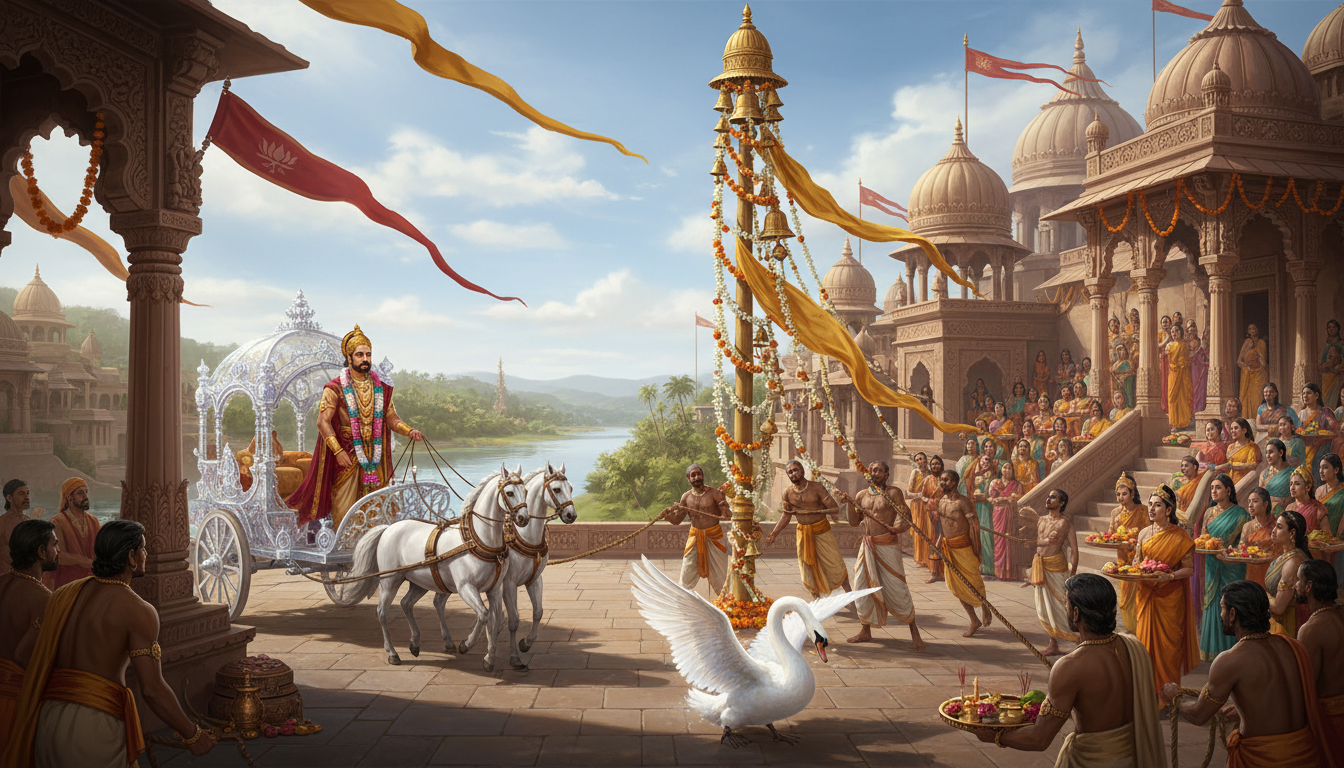
Then, after the expiry of that year, the king planted it in the ground, for the purpose of worshipping the giver of it. He set it upright in the earth in the sight of his people, and decked it with golden cloth, and with scents, and with garlands, and with various ornaments, and worshipped Vasava in due form with the garlands and the ornaments upon it.
Consider what he had chosen to put up. Not a statue of the god, and not a temple, and not a monument to the king who was friends with him. A bamboo pole, which is the cheapest and most ordinary thing in any village in that country, the pole a man cuts to prop a roof or fence a yard. It had been given to him for the protection of the honest and the peaceable, and once a year he set it up in the open and hung gold on it, so that everyone in Chedi could see plainly what their king considered worth honouring.
And he waited a year to do it. The pole was in his hands from the day of the gift, and he did not raise it in the first flush of having been visited by the gods. He let a full round of seasons pass, a sowing and a harvest and a dry spell and a rain, and set it up only when he had spent a year actually doing the work the gods had asked of him and had something to be grateful for.
From that time forth, O monarch, all kings, following Vasu's example, began to plant a pole for the celebration of Indra's worship, and to deck it as he had decked it, with cloth and scents and garlands and ornaments. He had not founded a doctrine or a dynasty of priests. He had started a habit, and the habit outlived him by ages, in countries whose kings could not have said who Uparichara was.
The Swan That Came to the Worship
And the god, for the gratification of the illustrious Vasu, assuming the form of a swan, came himself to accept the worship thus offered.
He did not come in the chariot of heaven with the thunderbolt in his hand, and he did not come in a voice out of a cloud. He came as a white bird, and came down at the foot of a decorated pole in a provincial capital, and took what was offered there, in the middle of the crowd, and nobody in that crowd but the king knew what had landed.
Beholding the auspicious worship made by Vasu, first of monarchs, the god was delighted, and said to him:
"Those men, and kings also, who will worship me and joyously observe this festival of mine, as the king of Chedi has done, shall have glory and victory for their countries and their kingdoms. Their cities also shall expand, and shall be ever in joy."
There is a shape to that visit worth marking. Indra had given him a car nobody else on earth possessed and a garland that no weapon could pass, and had called him friend, and when the friend put up a decorated stick in his honour the god came down in the body of a bird to stand at the foot of it. Gods in this book are not usually so easily pleased. This one was pleased because the worship had been arranged by a man who had given up something real in order to be in a position to arrange it.
So the festivity of Sakra passed into the calendar of the world, and those who observe it with gifts of land, of gems and of precious stones become the respected of the earth. King Vasu, blessed thus by the gratified Maghavat, went on bestowing boons and performing great sacrifices and keeping the festival year after year, and from Chedi he ruled the whole world virtuously, and Indra respected him.
And he had put down his austerities to do it. The penance he abandoned would have cost him only his own comfort. What he took up instead cost him every day of the rest of his life.
Five Sons and Five Countries
Vasu had five sons of great energy and immeasurable prowess, and as an emperor may, he installed them as governors of various provinces rather than keeping them at home to quarrel over one throne.
His son Vrihadratha he installed in Magadha, and that one was known by the name of Maharatha, the great car warrior, and out of his line in time would come the king who chained eighty six other kings in his own city and had to be pulled apart with hands to be stopped. Another son was Pratyagraha. Another was Kusamva, who was also called Manivahana. The two others were Mavella, and Yadu of great prowess, invincible in battle, whose name went down through a house that this history has not finished with either.
These were the sons of that royal sage of mighty energy, and the five of them planted kingdoms and towns after their own names and founded separate dynasties that lasted for long ages. The map of half this epic is their inheritance. Vasu had been asked to keep virtue from sustaining a diminution on earth, and what he actually did with the request was to spread out five capable men across five countries and let each of them be responsible for what he could see.
A man who had once decided that the government of one country was beneath his ambition had ended by seeding five of them, and by putting his sons in places from which they could not conveniently come home and fight one another.
The Mountain That Took the River
By his capital there flowed a river called Suktimati, and it was that river the city was named for, and the whole country drank from it.
And that river was once attacked by a life endued mountain called Kolahala, maddened by lust.
The mountains of that age were not only stone. Kolahala had a life in him and a will, and what he wanted he took, and he came down upon the water and closed himself around her, and held her. A river that is held stops arriving. Downstream of that embrace the channel went dry, and the fields along it, and the wells that fed off it, and the city.
And Suktimati was not a symbol to the people of that capital. She was the water. Everything in that country that grew, and everybody in it who drank, was downstream of the place where a mountain had sat down on her.
Vasu, beholding the foul attempt, struck the mountain with his foot.
That is the entire account of the rescue. No army was raised, no weapon was drawn, no boon was called in. The king who had been given a garland that made him proof against weapons and a car that carried him over the world walked up to a living mountain and kicked it, and by the indentation caused by Vasu's stamp the river came out of the embraces of Kolahala and ran free again into her own bed.
The pole that stood dressed in gold in his capital had been given to him for the protection of the honest and the peaceable, and here was the protection, delivered in person, on behalf of a river.
What the River Gave Him
But the mountain had begotten upon the river two children that were twins, and they were born of that violence, and the river had them on her hands.
And the river, grateful to Vasu for having set her free from Kolahala's embraces, gave them both to him.
He took them. He did not send them away for the manner of their getting, which was no fault of theirs, and he did not put them out to be raised quietly somewhere in the country under other names. He brought a mountain's children into his own house and gave them the two highest places in it. He made the son the generalissimo of all his forces, and gave the boy born of a mountain's assault the command of the armies of Chedi, and the daughter, who was called Girika, he wedded himself and made his queen.
That is where this part of it ends and another part begins. Girika, after her season, purified herself by a bath and came to her lord and told him her state. And that very day the Pitris of Vasu came to that best of monarchs and asked him to kill deer for their Sraddha, and the king, thinking that the command of the Pitris must not be disobeyed, went out hunting with his mind on Girika alone, who was beautiful like another Sri; and the season being spring, the woods he rode into were as delightful as the gardens of the king of the Gandharvas. What happened in those woods gave the world Satyavati, and the Kuru line, and Vyasa, and this book, and it is told elsewhere.
And the pole went on standing. That is the odd durability of this reign. The crystal car is not heard of again after him, and the garland of unfading lotuses passes out of the story, and the kingdom of Chedi in later ages belongs to men who bear no resemblance to the king who came down from his penance to look after it. What survived was the cheapest thing he was given: a stick set upright in the ground once a year, dressed in gold cloth, in front of whoever cared to come and look at it.
What belongs here is the pole. He had gone into the forest to become something more than a king, and heaven itself talked him out of it and sent him back down with a car, a garland, and a length of bamboo. He raised the bamboo once a year in the sight of his people and hung gold on it, and a god came in the shape of a bird to stand beside it, and the kings of the earth are raising it still. Rule kept as a friendship with heaven asks more of a man than any penance he gives up to take it.
Dharma Lesson
Rule kept as a friendship with heaven asks more of a king than the penance he gave up to take it. Vasu's austerity would have cost him only his own comfort; the government he came back to do cost him every day that followed. The honest market and the fattened ox and the river running in its own bed are not miracles, and they last only as long as somebody is willing to come down from the mountain and see to them.