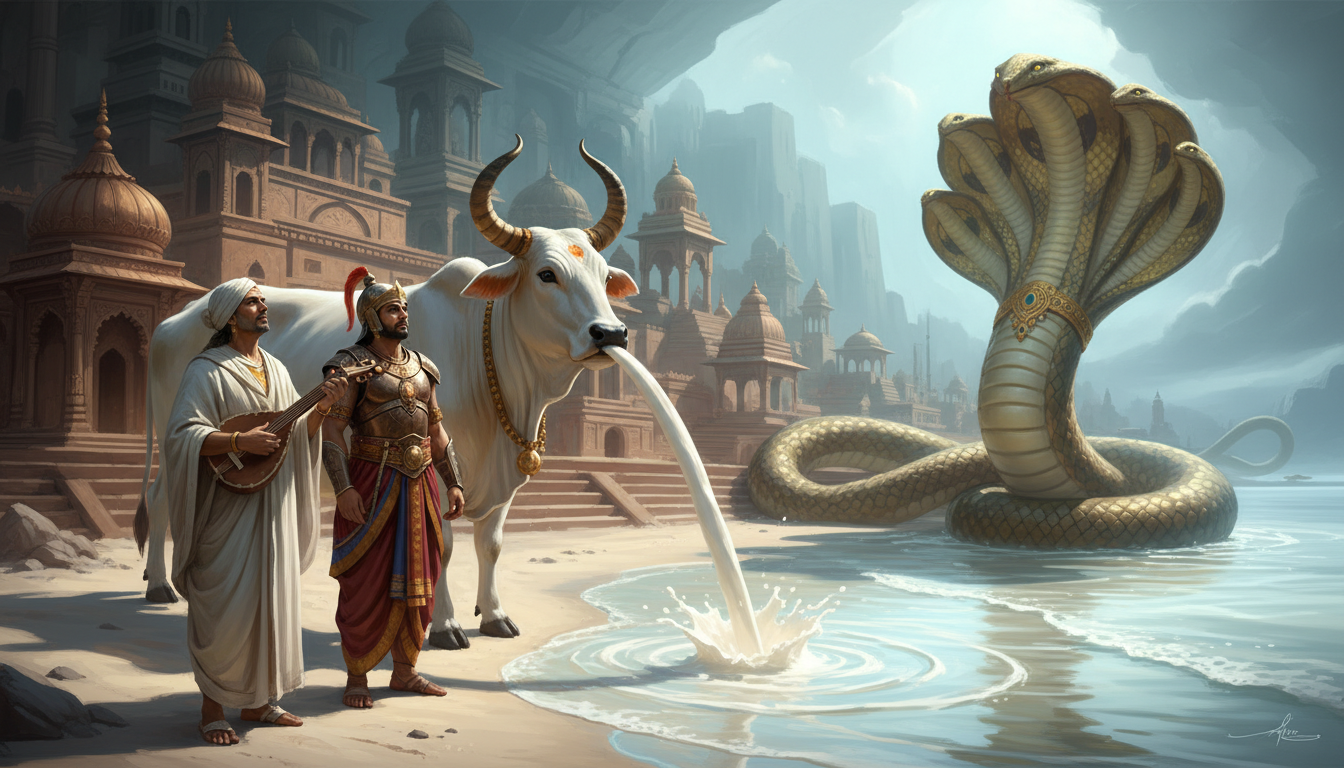
The Cow at the Bottom of the World
Surabhi, the four cows of the quarters, and the cities beneath Patala
Nothing Here Suits Me
Kanwa was telling this in the Kuru assembly, to a prince who had just been advised for the third time that morning to make peace, and who was not listening.
"Matali, the charioteer of Indra," he said, "had a daughter named Gunakesi, and he had searched the world of the gods and the world of men for a husband worthy of her and had found nobody. So he went down into the nether regions, and on the road he met Narada, who was going to visit Varuna, and the two went together."
They came, after the halls of the Lord of the waters, to Hiranyapura, and Narada stopped and put out his hand at the sight of it as a man does when he wants another man to look properly.
"This foremost of cities belongs to the Daityas and the Danavas," he said, "and it possesses a hundred different kinds of illusion. It was built here in Patala with great care by the divine artificer and planned by the Danava Maya. Look at the houses. They are silver and gold. They are decked with lapis lazuli and coral, made effulgent with the lustre of Arkasphatika and the radiance of the gem called Vajrasara, and some of them seem to have been made out of the shine of the Padmaraga stones alone. It cannot be said what material they are built of. Here dwell the Kalakhanjas who sprang from Vishnu, and the Yatudhanas who sprang from the feet of Brahman, and the Nivatakavachas whom Sakra has never been able to conquer. You yourself, O Matali, with your son Gomukha, have had to turn your chariot and retreat before them more than once. See if any bridegroom may be had here."
Matali looked for a while at the trees that moved of their own will and yielded whatever fruit was asked of them.
"It behoves me not to do anything disagreeable to the dwellers of heaven," he said. "The gods and the Danavas are brothers and they are always at war. How can I make an alliance with our enemies? Let us go elsewhere. And I will say this to you plainly, holy one: I know your heart. It is ever set on fomenting quarrels."
Narada laughed and took him further down.
The Region That Belongs to the Birds
The next stratum was full of wings.
"This region belongs to the birds," said Narada, "all of whom possess excellent feathers. They subsist on snakes. They never feel any fatigue, O charioteer, in putting forth their prowess, or in making journeys, or in bearing burdens. This whole race has multiplied from the six sons of Garuda, and their names are Sumukha, Sunaman, Sunetra, Suvarchas, Suanch, and that prince of birds called Suvala. Born in Kasyapa's line, enhancing the glory of Vinata's race, the foremost of their species have by begetting children founded and increased a thousand dynasties of birds, and every one of those dynasties is noble in its blood."
Matali watched them come and go. They were beautiful. They wore the auspicious whirl called Sreevatsa on their breasts, they were rich, and they were plainly powerful.
"By their acts they may be said to belong to the Kshatriya order," Narada said, "but they are all without any compassion, because they subsist upon snakes. And mark this, O Matali, for it is the thing worth carrying away from this level: they never attain to spiritual enlightenment. Not one of them. Not the greatest of them. They cannot, in consequence of their preying upon their own kinsmen."
"Kinsmen," Matali said. "The snakes?"
"Kasyapa is father to both. The birds and the snakes came out of the same house. They have been eating each other since the beginning, and each generation of them is stronger than the last and no nearer to heaven than the first."
High above the two of them a bird went over with something living twisting in its feet, and neither of them said anything for a moment.
The Roll of the Feathered Chiefs
"This race is much regarded," Narada went on, "in consequence of the favour shown to it by Vishnu. They all worship Vishnu. Vishnu is their protector. Vishnu always dwells in their hearts, and Vishnu is their great refuge. I will now enumerate the chiefs by their names. Listen."
And he named them, and it took him a long time, because there is no short way to do it: Suvarnachuda and Nagasin, Daruna, Chandatundaka, Anala, Vaisalaksha, Kundalin, Pankajit, Vajraviskambha, Vainateya, Vamana, Vatavega, Disachakshu, Nimisha and Animisha, Trirava and Saptarava, Valmiki, Dipaka, Daityadwipa, Saridwipa, Sarasa, Padmaketana, Sumukha, Chitraketu, Chitravara, Anagha, Meshahrit, Kumuda, Daksha, Sarpanta, Somabhojana, Gurubhara, Kapota, Suryanetra, Chirantaka, Vishnudharman, Kumara, Parivarha, Hari, Suswara, Madhuparka, Hemavarna, Malaya, Matariswan, Nisakara and Divakara.
"These sons of Garuda that I have named," he said, "dwell in only a single province of this region. I have mentioned only those that have won distinction by might, by fame and by achievement. There are others, and I have not counted them, and nobody has."
Matali had listened to all of it with the patience of a man who spends his working life waiting for other people to finish.
"They are magnificent," he said. "They are also merciless, by your own account, and my daughter is not going to be given to a house that cannot be saved. If you like none here yourself, holy one, then neither do I."
"Come, then," said Narada. "We will go hence. I will take you to another region, where you may yet find an eligible husband for your daughter."
The Seventh Stratum
They went down again, and the light changed, and the noise of wings fell away behind them until there was none of it left.
On the way they passed the level where the celestial elephant Airavata takes up cool water for the benefit of the universe, to impart it to the clouds, which Indra afterwards pours down as rain and is thanked for. They passed the waters where creatures pierced by the rays of the sun die during the day and revive at night, when the moon rises and lays them over with Amrita by means of the rays that are his arms. They passed the place where many sinful Danavas, deprived of their prosperity by Vasava, live confined and afflicted by Time, and Matali, who had driven the chariot at some of those battles, did not look down.
"The region where we now are," said Narada, "is called Rasatala, and it is the seventh stratum below the Earth."
Matali had driven the chariot of the king of the gods through the three worlds and across the fields of more than one war between them, and he had not been here. Very few had. There is a great deal of talk in Swarga about the heights and almost none about the depths, and the reason for that, as he was about to be shown, is not that the depths are poor.
"What is kept here?" he asked.
"The mother," said Narada. "Here dwells Surabhi, the mother of all kine, and I would have you understand before you look at her that everything you have ever eaten and everything you have ever poured into a fire came out of this place, and that no god in Swarga thinks about it once a year."
They went on down toward the smell of milk.
Born of the Amrita
"She was born of the Amrita," said Narada. "In days of old the faultless Surabhi sprang from the mouth of the Grandsire himself, when he was gratified with drinking the Amrita and vomited forth the best things that are. That is her origin. She came out of the mouth of Brahman on a surfeit of nectar, and she has been standing here ever since.
"She always yields milk, and that milk is the essence of all the best things of the earth. It is excellent, and it is of one taste, and yet it springs from the essence of the six different kinds of taste that men talk of. Whatever a creature lives on, she has already made."
Matali looked at her a long time.
"She is not adorned," he said.
"No. She is not adorned, and she is not praised, and she is not asked. Consider, O charioteer, what she is doing at this moment while the gods you drive for are being fanned. The milk she yields becomes Swaha unto those that live on Swaha. It becomes Swadha unto those that live on Swadha. It becomes Amrita unto those that live on Amrita. Every offering poured into every fire in the three worlds, and every oblation to the fathers, and the drink of the immortals themselves, are one substance, and the substance is standing in front of you chewing."
One Jet of Spilt Milk
Narada took him to the edge of it then, and Matali saw an ocean where he had expected a floor.
"A single jet only of her milk," said Narada, "falling on the earth, created what is known as the sacred and excellent Milky Ocean. Not a river. Not a lake. That. It was spilt. Nobody was pouring it out for a purpose. It fell, and there it is."
The verge of it all round was covered with white foam that lay like a belt of flowers where the water met the shore, and there were men living in the foam.
"Those are the best of ascetics," Narada said, "and they are known by the name of the Foam-drinkers. They dwell around this ocean subsisting on that foam only. They are called Foam-drinkers because they live, O Matali, on nothing else whatsoever save that foam. They are engaged in the practice of the severest of austerities. The very gods are known to fear them."
"Fear them," Matali repeated. "Men who eat spilt milk."
"Men who need nothing," said Narada. "That is the whole of what frightens heaven. A being who cannot be bought with a boon and cannot be starved out is the one kind of being against whom Sakra has no policy. Look at them. They do not look up when the charioteer of Indra walks by."
They did not.
The Four Who Hold the Quarters
"From her," said Narada, "are born four other kine, and they support the four quarters, and therefore they are called the supporters of the quarters, the Dikpalis. You have been driving over them all your life."
He named them the way a man names the corners of his own house.
"Born of Surabhi herself, she who supports the eastern quarter is called Surupa. She who supports the southern quarter is called Hansika. That illustrious cow of universal form, O Matali, who supports the western quarter, the quarter ruled by Varuna, is known by the name of Subhadra. And the northern quarter, which comprises the region of virtue and is called after Kuvera the Lord of treasures, is supported by the cow named Sarva-kamadugha, who yields all desires."
Matali, who had spent his life among things that are looked at, considered the four of them, who are not.
"There is no shrine to them above," he said.
"There is no shrine to them anywhere. A quarter of the world is standing on each of them and they are asked for nothing and given nothing and thanked by nobody, and if any one of the four grew tired for the space of a breath, the gods would find out what a quarter of the world weighs. It is the habit of the high, O Matali, to believe that they are held up by their own merit. They are held up by four cows in the seventh cellar of the house."
What the Churning Really Took
"You were there for the churning," Narada said. "Tell me what came out of it."
"The gods united with the Asuras," said Matali, "and made the mountain Mandara their pole, and churned the waters of the ocean. We obtained the wine called Varuni. We obtained Lakshmi, the goddess of prosperity and grace. We obtained the Amrita. We obtained that prince of steeds Uchchaisravas, and that best of gems, Kaustubha. I have driven the horse. I have seen the gem worn."
"And the waters?"
"The waters were the ocean."
"Those waters, O Matali, that yielded all these precious things," said Narada, "had every one of them been mixed with the milk of these four cows. That is what was in the vessel before ever a mountain was set in it. The gods and the Asuras pulled on a snake for a thousand years and quarrelled over the prize afterwards and are quarrelling over it still, and not one of the two parties has ever come down here to see where the stuff in the churn came from."
Matali said nothing for a while. He was a charioteer; he had a professional interest in what a thing rests on.
"The horse I drive," he said at last, "came out of her milk."
"The horse you drive, and the wine your masters drink at the end of a war, and the wealth they measure each other by, and the nectar that makes them what they are. Yes."
The Couplet They Sing Down There
There is a couplet, Kanwa said, that was sung by the dwellers of Rasatala in days of old, and it is still heard recited in the world by persons of learning, and Narada recited it there at the bottom of everything with the Milky Ocean behind him.
"Neither in the region of the Nagas," he said, "nor in Swarga, nor in Vimana, nor in Tripishtapa, is residence so happy as in Rasatala."
Matali turned the thing over.
"They are the lowest," he said. "Seven strata down. No one comes here. There are no festivals held over them and no hymns addressed to them and nothing whatever is expected of the three worlds on their behalf."
"And they say there is no happier address in creation, and they have been saying it since before your master was king. Understand what you are hearing, O charioteer. The creatures nearest the bottom of the world are the ones least eager to be anywhere else. It is the ones at the top who cannot be still. It is heaven that quarrels over the churn."
"That is a hard thing to carry back up."
"Carry it anyway," said Narada. "Now come. There is a city below this one that you will want to see, and I have not forgotten your daughter."
Bhogavati, and the Youth Standing Behind Aryaka
"This foremost of cities that you behold," said Narada, "which resembles the Amaravati of the chief of the celestials himself, is known by the name of Bhogavati. It is ruled over by Vasuki, the king of the Nagas. And that Shesha dwells here, who in consequence of his ascetic austerities of the foremost order is able to support this earth with all her vastness. His body is like a white mountain. He is decked in celestial ornaments. He has a thousand heads, his tongues are blazing like flames of fire, and he is endued with great strength."
Matali stood and looked at the coils of the one who was holding up the ground he had been driving over for an age, and who was doing it, like Surabhi, without being asked.
"There dwell here in happiness innumerable Nagas, the sons of Surasa," Narada said, "possessed of diverse forms and decked with ornaments of every kind, bearing the signs of gems, of the Swastika, of circles and of drinking vessels. Some have a thousand heads, some five hundred, some seven faces, some three, some two. Their bodies resemble mountains stretched over the earth. They are uncountable even within a single race of them. Hear a few of the famous: Vasuki, Takshaka, Karkotaka, Dhananjaya, Kaliya, Nahusha, Aswatara, Mani, Elapatra, Aryaka, Nandaka, Airavata, Sankha, Nanda and Upanandaka, Kumuda, Pundarika, Karavira, Dilipa, Sankha-sirsha, Jyotishka, Aparajita, Kauravya, Dharana, Jaya. These and many others are among the sons of Kasyapa. See, O Matali, if there is anybody here whom you can elect."
But Matali had stopped listening some sentences earlier. He had been looking at one person the whole time.
"Of what race is he the delighter," he said, "that comely youth of great radiance who stands before Aryaka of Kauravya's line? Who is his father and who is his mother? In consequence of his intelligence, his patience, his beauty and his youth, holy one, my heart has been drawn to him. That youth will make the best of husbands for my Gunakesi."
And Narada, well pleased, told him: born in the race of Airavata, that prince of Nagas is named Sumukha. He is the favourite grandson of Aryaka and the daughter's son of Vamana, and his father was the Naga called Chikura, who was slain not long before by the son of Vinata.
"Then it is settled on my side," Matali said. "Make the endeavour, O Muni. I am pleased at the thought of bestowing my daughter here."
So the charioteer of heaven, having gone down through the region of the merciless birds and past the mother of all cattle and the four cows that hold up the quarters, chose his son-in-law in the cellar of the world, out of a house whose men were being eaten by the house of the birds; and Kanwa, having told that much to a prince who wanted a war, went on to what happened next.
Dharma Lesson
The world stands on things that are never seen and never thanked, and four cows in the seventh cellar hold up the quarters that heaven believes it holds up by its own merit. The gods and the Asuras quarrel over what came out of the churn and never ask what was in the vessel first. The creatures nearest the bottom are the ones least eager to be anywhere else.