The Pupil Who Was a Prophecy
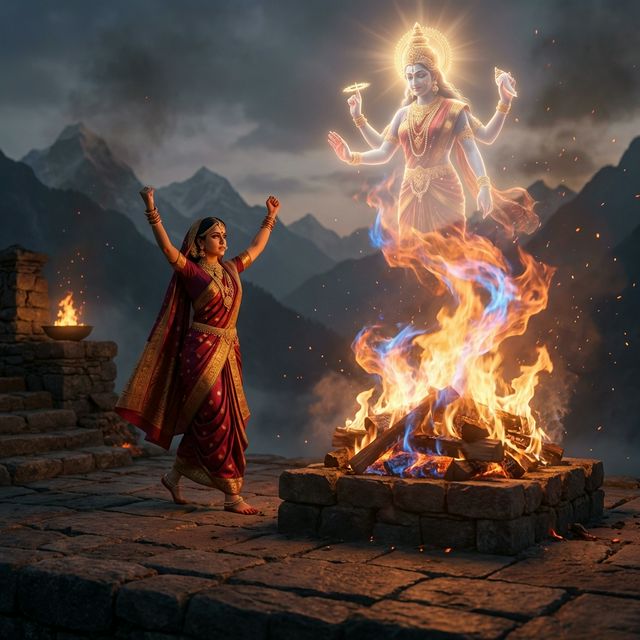
He came out of a fire. That is the plain account of it: King Drupada, halved and humiliated, bought a sacrifice from two Brahmin brothers and out of the flames of it walked a young man already grown, already armored, already holding a bow, with a voice from the sky naming him the death of Drona - and a girl came after him, and that is told elsewhere.
What the sky did not explain was what to do with him in the meantime.
Drupada's court at Kampilya had a prince who could not be taught what he already knew and could not be sent where he most needed to go. For the sciences of arms had one supreme master in that age, and every ruler in the land knew his name, and it was the name of the man the fire had promised to kill.
So Drupada, with the particular shamelessness of a father who has spent everything on revenge, sent his son to Drona.
And Drona took him.
He took him into his own house in the city of the Kurus and taught him as he taught the sons of kings: the drawing and the loosing, the handling of the chariot, the ordering of troops, the great arrays and how to break them. He held nothing back. The other students watched it and could not understand. The whole world had heard the voice from the fire. Drona had heard it himself.
When he was asked, the teacher gave the only answer he ever gave.
"He came to me as a student," Drona said. "A man who comes for knowledge and is turned away because of what he may one day do with it - by what dharma do I turn him away? Fate has already been settled. It was settled before this boy could hold a bow. My duty is what remains to me, and my duty is to teach. If I am to die by his hand, let it be a hand I trained. That much, at least, is mine."
Dhrishtadyumna learned everything. He learned it from the man he was made to destroy, and he never once, in all the years afterward, spoke of his teacher with contempt.
The Consecration at Upaplavya
Thirteen years later the armies gathered at Upaplavya, and the question that had to be settled before anything else was who would command them.
Seven akshauhinis had come in for the Pandavas: horse, foot, elephants, chariots, kings out of every quarter of the earth with their own banners and their own opinions. Yudhishthira named seven leaders for the seven divisions - Drupada and Virata, both old and both crowned; Satyaki of the Vrishnis; Chekitana; Dhrishtaketu of the Chedis; Bhima; and Drupada's son. Then he asked the harder question. One of the seven had to stand over the other six.
The hall put forward names. Virata had ruled before some of the men in the room were born. Drupada had fought Drona's pupils and survived. Satyaki was Krishna's own kinsman.
It was Krishna who spoke the name they were circling.
"Every man here can lead an army," he said. "Only one of them was made for the enemy we are actually facing. Bhishma commands against us, and after Bhishma, Drona - and the field will be decided by whether the man giving our orders is afraid of Drona. Dhrishtadyumna is not. He cannot be. He was born out of fire for exactly this. Set him at the head."
So the youngest of the seven was consecrated senapati over kings who had been reigning while he was still learning the arrays, and the eldest of them did not object; Drupada, who had bought his son from the fire for one purpose, watched him raised over his own head and was content.
Dhrishtadyumna took the water and the oath. He did not make a speech about vengeance. He gave the order of march, the watchword, the disposition of the camp, and the hour they would move; and he told the assembled kings a thing that was not entirely welcome.
"From tomorrow there are no heroes in this army," he said. "There are wings, and a center, and a plan. A man who wins his own battle and loses his place in the line has done me more harm than the enemy. I will answer for the war. You will answer for your position in it."
Eighteen Days of Holding the Line
Command in that war was mostly arithmetic performed at a gallop.
Each dawn the enemy's array went up on the far side of the plain - a crane one day, a hawk the next, a wheel, a needle, a sea - and each dawn Dhrishtadyumna had to read it from his chariot and answer it before the horns went. He drew up the Krauncha on the first morning and the Vajra after it, and a half-moon, and a circle, and once, against Drona's own arrangement, a formation he built out of nothing while the dust was already rising. He shifted Bhima to whichever wing was thinnest. He fed reserves into gaps he could see and, more often, into gaps he had guessed at from the direction of the noise.
The individual duels of those days belong to the days themselves. The general's war was quieter and more exhausting: keeping seven proud armies inside one plan.
That was the true labor. His kings were men who had spent their lives being the most important person on any field they stood on. They wanted single combats. They wanted the enemy champion, by name, in front of witnesses. Dhrishtadyumna spent eighteen days telling great warriors that they could not have what they wanted, and being obeyed, which was in its way a stranger thing than anything the fire had done.
He fought as hard as any of them. He met Drona in the field again and again, and again and again the teacher broke his bow, killed his horses, drove him off the field alive - and never once pursued him to finish it. Everyone on both sides watched this happen and drew their own conclusions.
The worst hour was the thirteenth day. The array closed, a boy went into it alone, and the general of seven armies stood outside a wheel of iron and could not open it. He tried. Six of them tried. When it was over and Abhimanyu was dead in the middle of it, Dhrishtadyumna rode along his own broken line rallying men who had stopped believing in the plan, and did not permit himself to grieve until the horns had sounded and the field was dark.
The Deed He Was Made For
By the fifteenth day Drona had killed Drupada. The old king went down in the press and his son heard of it in the middle of an engagement, and the war stopped being a profession.
What happened at the end of that day is told in full elsewhere: the invincible teacher, the news of a death and a name, the bow laid down, the old man sitting in his chariot with his eyes shut, and Dhrishtadyumna coming up the step with a sword.
The field went silent. Then it went loud.
Arjuna reached him first, and Arjuna was not gentle. "You had him alive," he shouted. "He had put down his weapons. He was sitting in yoga. He was a Brahmin, he was my teacher and yours, and you took his head off in front of the army. Bring him to me alive, I told you. Alive. Even his enemies would have honored him. What have you made of us?"
Satyaki came in on Arjuna's side and said worse, and reached for a weapon, and men had to get between them.
Dhrishtadyumna did not apologize. He never did, then or afterward.
"You want the man dead and the deed clean," he said. "There is no such arrangement. That man burned my father's honor out of him, halved his kingdom, and killed him on this field four hours ago. He made himself a weapon-master among a hundred thousand corpses; ask the sons of the kings he emptied out of their chariots today whether he was a Brahmin. I was born out of a fire for this. Not for glory - for this. The sky said so before I could speak. If it is a sin, it is my sin and I will carry it, and I would do it again in front of more witnesses. You may all keep your hands clean. Somebody in this army had to have dirty ones, and I was made for the work."
He wiped the sword, gave the order to withdraw to camp, and rode back at the head of the line as if the day had been ordinary.
What Destiny Pays
Three days more and it was finished. Karna fell, and Shalya, and Duryodhana lay in the mud by the lake with his thighs broken, and the war that Dhrishtadyumna had been appointed to run came to its end with his side standing on the field.
He had done everything asked of him. He had commanded seven armies for eighteen days without losing the plan, held kings in their places, kept the line together on the days it should have broken, and performed the single act his existence had been purchased for. He was, that evening, the most successful man in the world.
The Pandavas went with Krishna to the river to pass the night away from the camp, as it happened, and left the victory in their general's keeping. Dhrishtadyumna slept in the Panchala quarter among his own men, in a camp full of tired soldiers who had already put away their weapons because there was no longer anyone to fight.
In the dark Ashwatthama came in through the gate, found him on his bed, dragged him down by the hair and throttled him with hands and heels while he begged for a sword and was not given one.
In the morning Draupadi sat down on the ground before her husbands and would not rise. Her father was dead, her brother was dead, her sons were dead, and the man who had killed them was the son of the man her brother had killed - the fire had come all the way around to where it started.
That is what the epic makes of him. He was not a wicked man and not a small one; he was competent, disciplined, unafraid, and he governed an impossible army better than anyone else alive could have. But he was made for a purpose, and a purpose is not the same thing as a life. He never had a season that was his own, never a choice that was not already decided in a fire-pit at Kampilya before he drew breath - and when the appointed act was done, destiny had no further use for him and paid him what it pays: a rope of hands in the dark, and no weapon within reach.
Dharma Lesson
Dhrishtadyumna was told what he was for before he was old enough to want anything else, and he spent his life carrying it. Being the appointed instrument of a destiny does not relieve a man of the sin of the act; it only removes his choice about committing it. He did the deed the fire made him for, defended it without flinching, and was killed for it in his sleep - which is what destiny usually pays.