The Man From Kampilya
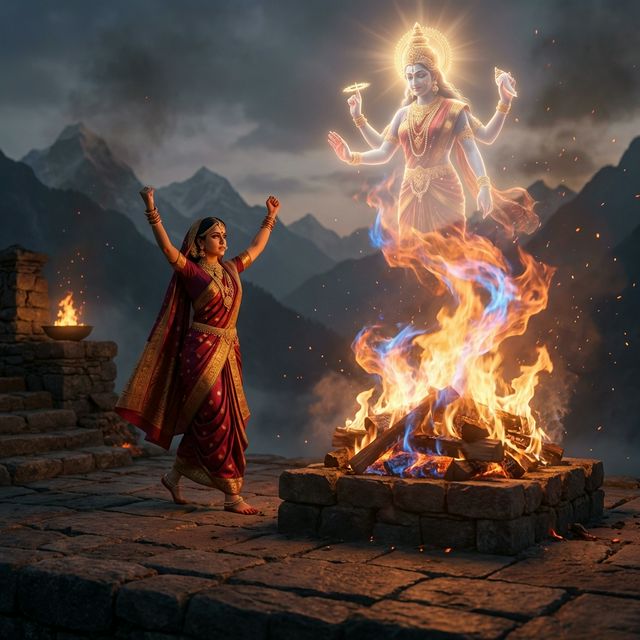
The story behind him was known to everyone and understood by almost no one: a wronged princess of Kashi who burned herself to be born again in Drupada's house for the destruction of Bhishma, and a night in a forest when a yaksha traded away his own manhood and took a woman's in exchange. Both of those are told in their own places.
What is less often told is the ordinary man left standing at the end of them.
By the year of the war, Shikhandi was a prince of Panchala in early middle age. He had learned arms from Drona along with everyone else of his generation. He held a command in his father's forces, he had a wife and a son named Kshatradeva, and he ran his household and his troops competently and without noise. His younger brother Dhrishtadyumna had come out of a fire fully grown to a voice from heaven; Shikhandi had arrived by the longer road, through a girlhood, a marriage that nearly started a war, an exile into the woods, and a bargain with a forest spirit.
He remembered the other life. That was the part nobody could make comfortable conversation about. He remembered standing in a king's hall as a woman with nowhere left to go, and he remembered the years of penance afterward, and the fire he had walked into on purpose. Two existences had been spent assembling one weapon, and the weapon was him, and it had exactly one target.
When Drupada took the field for the Pandavas, Shikhandi came with him at the head of an akshauhini, and no one in either camp was in any doubt about why he was there.
"You understand what will be asked of you," his father said on the road to Upaplavya.
"I have understood it since before you found me," Shikhandi said. "I would like it to be asked soon. I have been carrying it a long time."
What Both Armies Said
On the eve of the fighting, Duryodhana asked the grandsire to count the warriors of both sides and rate them, and Bhishma went through the list until he came to a name he dealt with differently from all the others.
"Drupada's son Shikhandi is a maharatha," Bhishma said, "and he will come at me, and he will not be resisted. He was born a woman and afterward became a man. I know what he was. I will not strike him, I will not shoot at him, I will not raise a weapon against him if he stands in front of me with a bow in his hands and kills me where I sit. That is my vow. Everything else on this field I can answer."
He meant it as a soldier's disclosure - a commander telling his king the one hole in his own armor. What it did was hand both armies a subject.
After that the word went along the lines the way words do. Kaurava charioteers called it across the dust. Men in Shikhandi's own division said it more quietly, which was worse, and stopped when he rode past. He was a maharatha in his own right, trained by the greatest teacher of the age, and there was no morning of that war on which he was not primarily a curiosity.
He answered none of it. He was seen, in those first days, to be a careful officer - his line straight, his flanks tight, his men fed. He fought where his brother put him, took wounds, gave them, and did not once ride out looking for the old man in the white chariot before he was ordered to.
Only once, when Arjuna came to his tent to speak about the tenth day and began, awkwardly, to phrase the thing delicately, did Shikhandi cut him off.
"Say it plainly," he said. "You want me in front of your chariot because he will not shoot a man he thinks is a woman. That is the whole of my use. I have known it for two lives, Arjuna. You do not need to be gentle with me about it. Only be certain that you can shoot straight past my shoulder, because I intend to be very close to him."
The Tenth Morning
They put him at the point.
The whole Pandava order that morning was built around one chariot: Shikhandi in the lead, Arjuna behind and slightly to the side, Bhima and Satyaki and Dhrishtadyumna on the wings to peel away everything that tried to come between them, and behind that the mass of the army pushing them forward like water behind a wedge. The Kauravas understood the shape of it at once and threw everything they had against the head of the spear - Duhshasana came, and Kripa, and the Trigartas - and the wings held them off, and the wedge kept moving.
And then the ground opened in front of him and there was the white chariot, the white horses, the white umbrella, the old man with the palm banner, killing Panchalas by the hundred with a serenity that had already lasted nine days.
Shikhandi drew and loosed. The arrows went home. Bhishma turned his head, and saw him, and smiled - and lowered his bow.
He did not lower it in fear. That was the thing Shikhandi carried away from the morning and never entirely put down. The grandsire looked at him with something that was almost affection, the way a man looks at an appointment he has kept, and set the great bow across his knees, and said something to Duhshasana about arrows that did not hurt.
Shikhandi went on shooting into him. The shafts stood in the old man's chest like reeds in a bank and did not stop him being what he was, and everyone on that part of the field could see that Shikhandi alone would have needed a week.
But the bow was down. And behind Shikhandi's shoulder, close enough that the fletchings passed his ear, Arjuna began to shoot.
How that ended - the couch of arrows, the pillow, the water, the long autumn wait for the sun to turn - belongs to the grandsire's own story. Shikhandi did not stay for the end of it. When the Kaurava line broke and the horns went, he was still standing in his chariot at the head of the wedge with his hands shaking, forty-two years old and two lifetimes long, entirely finished.
Eight Days of Nothing In Particular
The war did not stop to notice. Drona took the command in the morning, the arrays went up again, and Dhrishtadyumna sent his brother to the left wing.
There were eight days left, and nobody needed Shikhandi for anything except soldiering.
He did it. He held the position he was given. On the day of the wheel he was one of the six who battered at the mouth of it and could not get through, and he grieved for Abhimanyu along with the rest of them and was not asked to do anything special about it. When the plan required a body between Drona and the king, he was the body: for several days running his standing order was the plainest one in the army, which was to stay near Yudhishthira and see that nothing reached him. He guarded a man who was not in much danger, in the middle of a field where everyone else was making a name.
He fought Ashwatthama more than once and came off badly and went back the next day. He fought Kritavarma. He was wounded and dressed the wounds and had his chariot repaired at night. He took his turn escorting the wings of Arjuna's chariot with Satyaki. On the seventeenth day he was somewhere in the great confusion around Karna's advance, doing his job. The bards who came afterward to make songs out of that war did not find much in him to sing about for those eight days, because there was nothing in them but competence.
His father died in the meanwhile, killed by Drona. His brother killed Drona. Neither event turned toward him.
And this, in the end, is the strange dignity of the man. He had been assembled across two lifetimes for a single hour, and the hour had come and gone by the tenth morning, and the reasonable thing for a weapon to do afterward is to be put away. Shikhandi got up in the dark for eight more days, ate the same bad rations as the men, took his place in the line where his younger brother put him, and did the unremarkable work of the war without once suggesting that he had already done enough.
The Last Night in Camp
On the eighteenth evening it was over. Duryodhana lay by the lake with his thighs broken, the last of the Kaurava host was scattered, and the victors' camp lay out on the plain with its cooking fires lit and its weapons stacked.
Shikhandi was alive. That was, if anyone had troubled to think about it, remarkable: of all the men who had gone out on the first morning intending to settle something personal, he was among the very few who had settled it and survived to see the war finish. Both of his lives had been spent on a debt owed by a man who had been lying on a bed of arrows for eight days and was not yet dead.
The Pandavas were away at the river that night with Krishna. The Panchala quarter slept.
Ashwatthama came in through the gate in the dark, and by the time he reached the place where Shikhandi lay he had already killed Dhrishtadyumna, and he killed Shikhandi too with a sword before the man was fully awake.
So the weapon was put away, without ceremony, eight days after it had been used.
What the epic leaves with us is not the tenth morning. Everyone remembers the tenth morning. It is the eight days after it - the guarding of a king who did not need guarding, the wing held, the chariot mended at midnight, the taunts absorbed without answer - that make Shikhandi something more than the instrument of another woman's rage. He had been given a single purpose by fate and had every excuse, once it was discharged, to consider himself finished. He reported for duty instead.
A life shaped for one moment will spend most of itself outside that moment. What it does there is the only part of it that was ever really its own.
Dharma Lesson
A person built for one moment still has to live all the other ones. Shikhandi spent two lifetimes reaching a single morning, and when the morning was over there were eight days of ordinary duty left, which he performed without complaint and without applause. The war measured him by his usefulness in a single hour; dharma measured him by the hours nobody was watching.