The Promise Comes Due
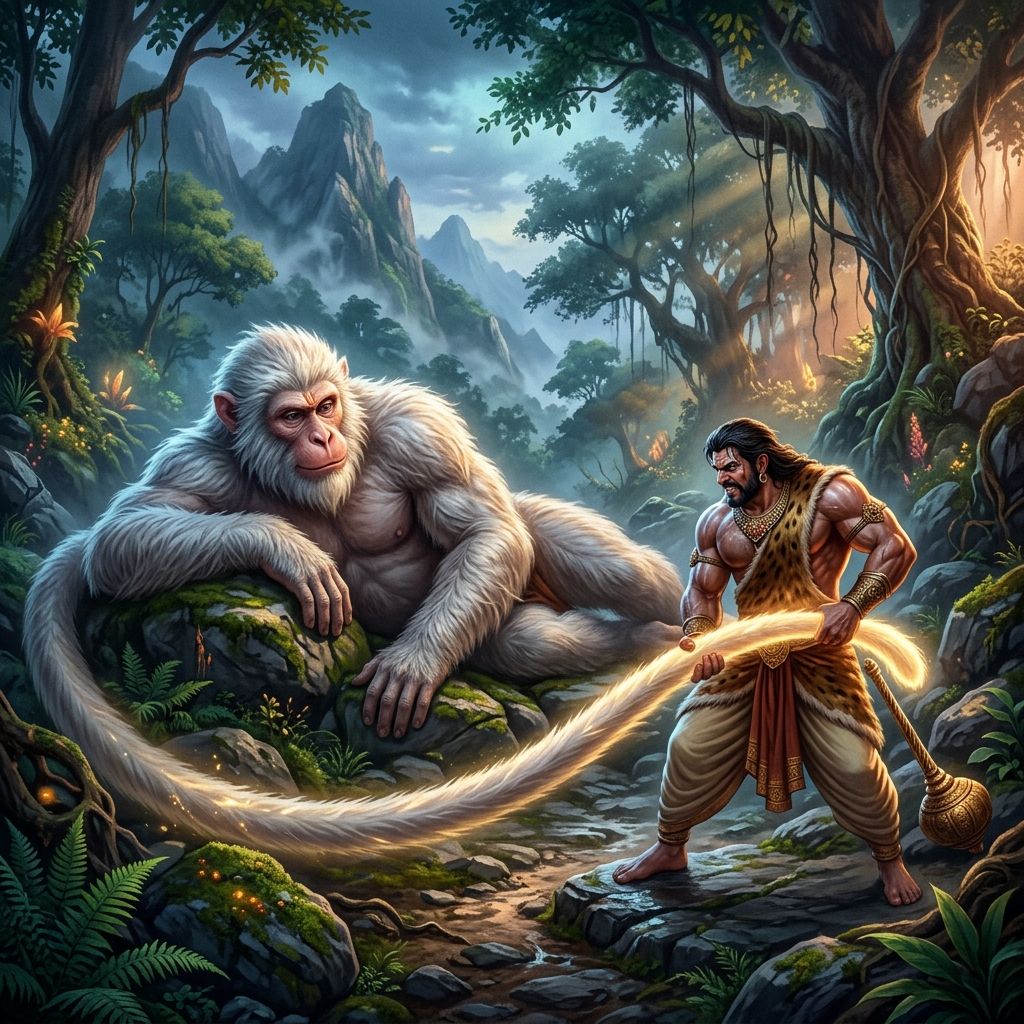
Years before the armies gathered at Kurukshetra, on the pine-scented slopes of Gandhamadana, Bhima had gone searching for a flower for Draupadi and found his path blocked by an old monkey who would not move his tail from the road. The monkey had been Hanuman, elder son of the wind, and before he let Bhima pass he had made a promise: when the day of war came for the Pandavas, he would ride ahead of them and make their enemies afraid (hanuman_bhima_story - one clause).
That day had come. Krishna, standing as charioteer at Arjuna's side, looked up at the tall staff of the war-chariot and spoke a single word of invitation, and something vast and unseen settled onto the banner above them. To the armies watching from both sides, nothing appeared to change; the flag of Arjuna's chariot still showed the same devise it had always shown. But those standing nearest swore they felt the ground answer beneath their feet, as though an unbearable weight had been set down upon it without anything visibly falling.
'Brother,' Bhima said, looking across the field toward his brother's chariot, 'you have not forgotten us.'
Arjuna, gathering the reins of his bow, felt something cool and immense settle over the banner-pole above his head, like a mountain deciding to travel with him into battle. He asked Krishna what it was.
'An old debt,' Krishna said, smiling without turning around, 'paid at last, and paid to all of you, not only to Bhima.'
Around them the war-conches sounded, one after another down the long lines, and eighteen days of ruin began. But from that first note, the ape-banner of Arjuna's chariot carried something more than cloth and gold. It carried a promise made on a mountain, now walking onto a battlefield to be kept.
The Roar Before the Arrow
Every morning of that war, before Arjuna's first arrow left the string, a roar broke from the top of his chariot-banner that no soldier standing before it ever forgot. It was not the cry of a man, nor quite of a beast; tradition says it was the same roar Hanuman had once given on the shore of the ocean before he leaped for Lanka, a sound that had emptied forests then and now emptied ranks of an army before a single arrow had struck anyone at all.
Warriors who had stood unflinching against maces and axes felt something in their chests fail when that roar came. Horses reared and would not be driven forward. Elephants, trained through years of war-drill, turned and crashed back into their own lines. Chariot-fighters famous through half of Bharata found their hands shaking on the reins, unable to say why.
Arjuna noticed the pattern before he understood it. Again and again some enemy champion who should have met him with skill and nerve instead broke early, loosed a wild shot, or turned his chariot half around before the fight had properly begun. 'They are afraid of me,' he said once to Krishna, not quite believing his own words.
'They are afraid of what rides above you,' Krishna answered. 'You have only to finish what the roar begins.'
Day after day it went this way: the cry from the banner-top, and only after it the falling away of an enemy's nerve, and only after that Arjuna's bow doing its ordinary, terrible work. Bhima, fighting his own bloody road through the Kaurava ranks, said afterward that he could always judge how the eastern part of the field was going by whether he heard that roar or silence; roar meant Arjuna was already halfway to victory before he had drawn a single arrow. No one but Krishna, and perhaps Hanuman himself, understood how much of the eighteen days had been decided this way, invisibly, before the fighting properly began.
The Weight He Carried
There was a second labor no one on either side of the field could see, and this one Hanuman performed in complete silence.
Through eighteen days, celestial weapons were loosed at Arjuna's chariot that no chariot built by human hands could have survived intact. Great astras called down by warriors trained by Drona and by the gods themselves struck the car again and again; even the terrible shafts Karna loosed in his last hours found their mark against it, one clause of a duel far larger than the one being openly fought (karna_vadha), and the chariot did not so much as splinter.
Krishna alone seemed to know why. Before each impact he would sometimes glance upward at the banner, as if in quiet acknowledgment, and Arjuna, absorbed in his own fighting, rarely noticed that the blows he should have felt in his bones simply never arrived.
'How is it still standing?' Arjuna asked once, mid-battle, staring at the chariot's undamaged wheel after a strike that should have shattered it to splinters.
'Do not ask now,' Krishna said. 'Fight.'
What Arjuna could not see was Hanuman, unmoving atop the banner-staff, taking each weapon's force into himself and letting nothing of it pass down into the wood and leather below. It was not a warrior's work, glorious and visible, the kind sung about in victory. It was closer to a mountain absorbing a flood: patient, silent, thanklessly necessary, and utterly without reward. Through eighteen days he gave the war nothing anyone could point to and call heroism, and everything that let the more visible heroism of Arjuna's bow continue at all, day after day, without once failing.
Get Down First
When the last of the fighting on the eighteenth day had ended and the field around them had gone terribly quiet, Krishna turned the chariot away from the dead and drove it some distance off, toward open ground beyond the worst of the ruin. There he drew the horses to a halt.
'Get down,' he told Arjuna. 'Get down first, and walk a little way from the chariot before you turn around.'
Arjuna, exhausted past questioning, climbed down and did as he was told, though he could see no reason for it. Behind him he heard Krishna also step down, unhurried, and only then did Krishna turn to face the chariot they had ridden together for eighteen days.
'Now,' Krishna said, to no one Arjuna could see, 'it is finished. You may go.'
For a moment nothing happened, and Arjuna, glancing back, saw only the familiar shape of his own war-worn car, the ape-device on its banner faded with dust and blood. Then something vast seemed to lift away from it, the way heat lifts off stone at evening, and the chariot stood suddenly lighter, almost weightless, as if a great hand had been holding it down all this time and had only now let go.
'What have you done?' Arjuna asked, though some part of him had already begun to understand what he was seeing.
Krishna did not answer directly. 'Watch,' he said, 'and remember it was never the wood and the axle that carried you through this war.'
What Was Borne
Then, where nothing had been visible a moment before, Arjuna saw, or perhaps felt more than saw, an enormous shape unfold itself from the banner-staff, ancient and gold-eyed, and bow toward Krishna with the courtesy of an old soldier reporting the end of a long duty. It was Hanuman, made visible at last, and in the next instant he was simply no longer there.
In the same moment the chariot, which had carried Arjuna unbroken through eighteen days of the fiercest weapons two worlds could produce, collapsed into ash and burning splinters where it stood, as if struck by every one of those blows at once and only now, released, allowed itself to fall.
Arjuna stared at the wreckage, unable for a moment to speak. 'All this time,' he finally said, 'it was never the chariot that held.'
'It was never you alone, either,' Krishna said, 'though you fought as if it were. Bhima was promised a debt paid on a mountain path, and it was paid to all of you, every day of this war, in a form none of you were meant to see until it was over.'
Bhima, when he heard the story afterward from Arjuna, said nothing for a long while, then only that he had always known his brother kept his promises, and that a promise kept in silence was worth more than one kept where everyone could watch and praise it.
The chariot's ash settled slowly over the field. What had looked, for eighteen days, like the ordinary survival of one very fortunate warrior was revealed, in the single moment of its ending, to have been grace all along, doing its work exactly where no one thought to look, known at last only by what gave way the instant it withdrew.
Dharma Lesson
Grace often works invisibly, asking no credit and leaving no mark that can be praised while it labors. Hanuman's devotion to the Pandavas was proven not by any deed sung in the war's chronicles but by what gave way the instant he withdrew - the chariot itself. True service can be measured by what collapses without it, not by what is seen while it is present.