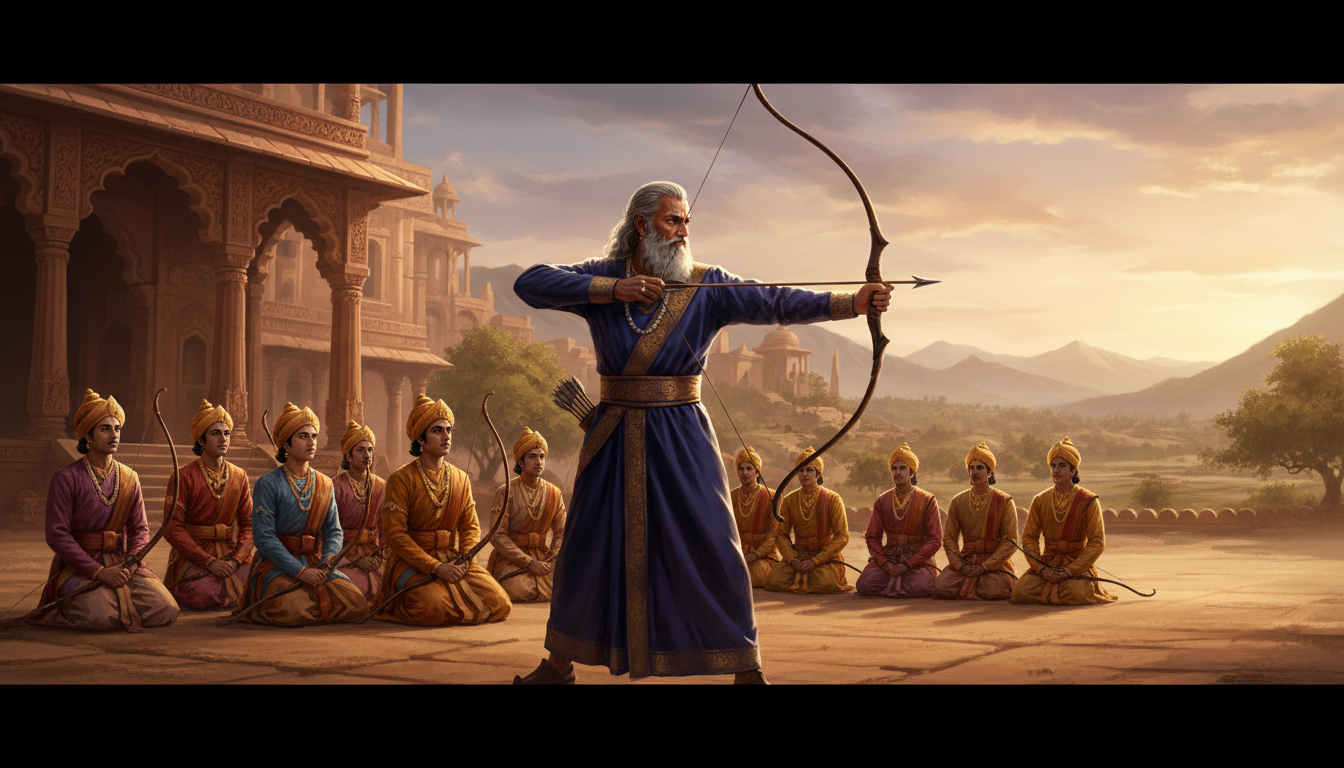
A Kingdom That Said Yes
Matsya was not a great kingdom by the measure of Hastinapura or Panchala, but it was, in the thirteenth year of the Pandavas' exile, the kingdom whose old king said yes when almost no one else in Aryavarta could afford to. Virata took into his court a dicing-master who called himself Kanka, a cook named Vallabha, a horse-trainer, a cattle-herder, and a dance instructor for the women's quarters, and asked no questions he did not need to ask, because a king nearing the end of his reign has learned when not to look too closely at gifts that seem too skilled for their stated trades.
That year of disguise, and the cattle raid the Kauravas launched against Matsya near its end, when young prince Uttara rode out boasting and came back only because his charioteer turned out to be Arjuna himself, are their own well-told stories (the year of disguise, uttara_gograhana). What matters here is what came after the disguise ended: Virata learned exactly whom he had sheltered, and instead of resenting the deception, he opened his house wider.
He offered his daughter Uttaraa in marriage to Arjuna, who declined the match for himself as her teacher and proposed instead his son Abhimanyu, sealing an alliance between Matsya and the Pandava cause that both sides understood, from the moment the wedding fires were lit, to be a declaration of war against Hastinapura (the wedding itself is told elsewhere). Virata was an old man making a young man's wager: that shelter given honestly would be repaid, and that the debt, once accepted, could not be taken back regardless of what it eventually cost him.
The Treasury of Upaplavya
When war became certain, it was Virata's own city of Upaplavya, and not Indraprastha or any grander capital, that hosted the council where the Pandavas' alliance took its final shape. Kings and princes who had married into or sworn friendship with the sons of Pandu gathered in Virata's halls: Drupada of Panchala, whose daughter Draupadi bound the two houses together, Krishna of the Yadavas, and a long train of lesser kings weighing whether to commit their armies to a cause that might still, at that late hour, end in negotiation instead of bloodshed.
Virata hosted all of it. An old king's palace is not built for armies, and Upaplavya groaned under the weight of what it was suddenly asked to provide: grain for soldiers who had not yet arrived, quarters for envoys arguing late into the night, gifts and provisions for a war council that consumed resources at a rate no single kingdom's revenues were meant to survive. He did not ration his hospitality to match his kingdom's modest size. He gave as though Matsya were Hastinapura itself, because he had already decided, in marrying his daughter into the Pandava line, that there was no version of the coming war in which he could hold anything back.
By the time the council closed and the armies began to move toward Kurukshetra, Virata's treasury had been spent in a cause that was not, strictly speaking, his own kingdom's fight. He was an old man who could have stayed neutral, watched from Matsya's borders, and let the great houses destroy each other without him. He chose instead to empty his coffers for a cause he believed just, understanding, in the way old kings often understand such things better than young ones, that the bill for that choice was only beginning.
The First Day's Cost
Virata marched his whole house to Kurukshetra: himself, his sons, his soldiers, everything Matsya had left after Upaplavya's council had drawn down its treasury. He was old enough that other kings might have excused him from the field, sent his generals in his place, but he had never been a king who let others pay debts he had incurred himself, and this was the largest debt of his life.
The first day of the eighteen-day war took his sons. Uttara, the same boy who had ridden out boasting against the Kaurava cattle raid a year before and been saved only by Arjuna's chariot-craft, fought now without that borrowed shelter and fell to Shalya, king of Madra, whose spear proved more than the young prince's courage could withstand (the day's full account belongs to Kurukshetra's first day). His brother Shveta died in the same day's fighting, cut down attempting to hold a line against Bhishma himself.
What matters in Virata's story is not the tactics of that day but what it meant for a father who was also, by then, a grandfather twice over through the child Uttaraa was carrying. He had given his daughter to the Pandava cause, his treasury to the war council, and now, on its very first day, the war took the two sons who might have carried his line forward without needing to depend on a grandchild not yet born. He kept fighting. There was no version of Virata's dharma that allowed him to leave the field because the field had already cost him so much; the cost, if anything, was the reason he could not leave it.
Two Old Kings, One Field
For two weeks after that first terrible day, Virata fought on beside Drupada of Panchala, another old king whose daughter had also married into the Pandava cause, whose kingdom had also committed everything it had to this war. The two of them were not young warriors seeking glory; they were rulers who had outlived the years when battle was a proving ground and had instead reached the years when it was simply an obligation, discharged because it could not honorably be refused.
They had been rivals once, in the way that neighboring kingdoms often are, their courts measuring each other's strength across years of uneasy peace. War at Kurukshetra dissolved whatever remained of that old rivalry. Fighting on the same side against the same overwhelming host, under the same commander Drona who led the Kaurava forces through the war's middle stretch, Virata and Drupada became something closer to comrades than either had likely expected to become in the last years of their lives.
Drona, commanding the Kaurava army in that phase of the war, marked both old kings as targets worth ending. On the fifteenth day, the two of them, Virata and Drupada, fell within the same span of fighting, cut down by Drona's arrows in an assault the guru pressed with the same exactness he had once used to teach archery to princes who would grow up to face each other across this very field. Two kingdoms, both old, both spent, both committed past any possibility of retreat, lost their kings on the same day, side by side, the way they had spent their last two weeks living.
What the House Kept
Matsya's line did not end at Kurukshetra, though by every ordinary reckoning it should have. Virata was dead, his treasury spent, both his sons killed on the war's opening day, and any lesser house would have simply vanished from the record the way so many allied kingdoms did in the war's aftermath, remembered only as names on a casualty count.
What kept the line alive was Uttaraa, Virata's daughter, married to Abhimanyu in the alliance her father had arranged before the war began. Abhimanyu himself did not survive Kurukshetra, cut down in the war's middle days, but Uttaraa carried his child through the fighting and its aftermath, and it was that child, Parikshit, born after the war had ended and the Kuru line had been reduced nearly to nothing, who would eventually inherit the throne the Pandavas had bled to reclaim.
Virata never lived to see it. He gave his daughter, his treasury, his sons, and finally his own life to a cause that, on the day he died beside Drupada under Drona's arrows, had not yet produced anything to show for the cost. The invoice for his hospitality had been presented in full, and he paid every line of it without asking for a discount he had never been offered.
What the story asks to be remembered is not the tactics of the raids or the wedding that sealed the alliance, both told fully elsewhere, but the shape of an old king's choice: that shelter, once given honestly to people who needed it, cannot be withdrawn when the bill arrives, however much larger that bill turns out to be than anyone could have guessed on the night a dicing-master and a cook first walked into his hall.
Dharma Lesson
Hospitality given fully, without hedging, becomes a debt the giver must eventually settle in full. Virata sheltered the Pandavas when almost no one else dared, and having chosen that side he paid for it with his treasury, his sons, and finally his own life, while his house survived only through the child his daughter carried. Dharma honored to its last consequence rarely spares the one who honors it; it only ensures the honoring was not wasted.