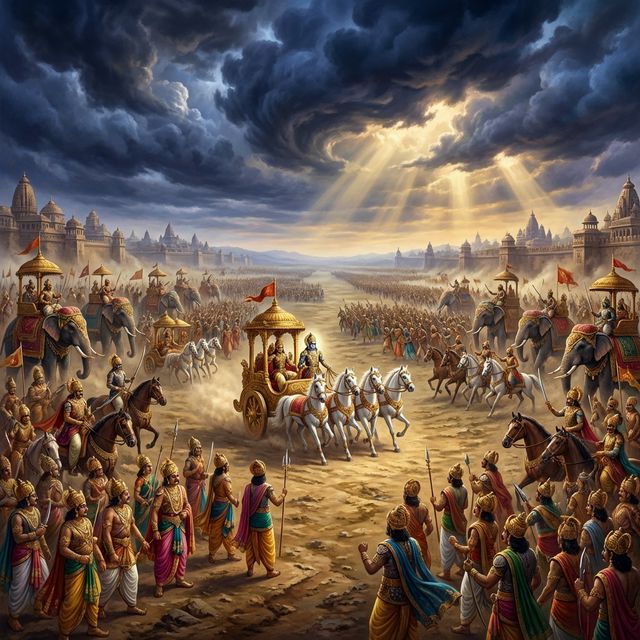
The Northern Herds Are Taken
The Kuru host came out of the north the next morning, and it did not come as a raiding party. Bhishma led the van with the palm-tree banner over him. Drona rode with his son Ashwatthama; Kripa brought the household troops; Karna came with the Anga chariots; and Duryodhana rode at the center of it all with the whole strength of Hastinapura at his back. Behind them the sky was brown with the dust of an army that had come to do far more than steal cows.
They fell upon the northern pastures of the Matsyas and swept them clean. There were no soldiers there. Every spear in the kingdom was two days' ride to the south, chasing Susharma home, and the herdsmen of the north had nothing but staves and their own legs.
One of them used his legs. He ran until his chest was raw and came into the city of Virata shouting for the king, and found the throne empty and the court in the middle of a victory garland.
"They have taken the cattle," he cried. "Sixty thousand head, and more. It is the Kurus, not the Trigartas. Bhishma is there under the palm tree. Drona is there, and his son. Kripa. Karna of Anga. Duryodhana himself. If we do not go out at once the herds are gone past the border and the wealth of the Matsyas with them."
The court looked at one another. The king was away. The commander of the armies had been dead a month. The soldiers were gone south. And in the whole of that hall there was no man of the royal house left standing but a boy.
The Boast of Prince Uttara
Prince Uttara was in the women's apartments when the news reached him, and he made the most of it. He stood among his mother's attendants with his hand on his sword-hilt and told them exactly what he would do.
"If I had a charioteer," said Uttara, "the Kurus would learn something today. I would go out against them alone and take back every cow, and Bhishma and Drona and Karna would say to each other, this is not Arjuna come back, this is Uttara. It is only that my driver was killed in the last campaign and I have found no one fit to hold my reins. Give me a charioteer worthy of me and I will empty the north of Kurus."
He said it three times, and each time it grew. The women praised him. And behind the queen's couch, Sairandhri the serving-woman, who braided hair and mixed perfumes and had once been an empress, looked up from her work.
"Prince," she said softly, "there is a person in this palace who used to be the charioteer of Arjuna himself. When the Pandavas burned the Khandava forest, it was that one who held the reins. Brihannala, who teaches your sister to dance. Let the princess ask, and Brihannala will drive you."
Uttara laughed, and then he stopped laughing, because his sister Uttaraa had already run off to ask. She came back leading the tall dance-teacher by the wrist, and there was a great deal of merriment in the women's quarters at the sight, the bangles, the long braid, the soft voice, the eunuch's robe.
"Can you drive?" said Uttara.
"I can hold a rein," said Brihannala.
They dressed the dancer in armor, and it went on wrong at first, the straps hanging loose, and the women laughed until they wept. Then the chariot went out of the gate with a boasting prince behind and a dancing-master at the horses' heads.
The Ocean of the Kurus
They found the Kurus drawn up beyond the northern pastures, and Uttara stopped talking.
It was not a raiding party on the horizon. It was an ocean. Rank behind rank of chariots stretched further than a man could count, with the standards of the greatest warriors alive lifted above them: the golden palm of Bhishma, the water-pot of Drona, the bull of Kripa, the lion's tail of Ashwatthama, the elephant-rope of Karna, the serpent of Duryodhana. The sun came off ten thousand spearheads at once. The sound of it, wheels and hooves and drums, came across the flat ground like weather.
Uttara's hands began to shake. "Turn back," he said. "Turn the chariot. Brihannala, turn it now. My hair is standing on end. Who could face that? Not I. My father took the whole army south and left me nothing. I will not go into that. Turn back."
"You told the women you would empty the north of Kurus," said Brihannala, without slowing. "They are still telling one another so. What will you say when you come home with the herds still taken?"
"Let them say what they like. I would rather be laughed at than dead."
And the prince of the Matsyas threw down his bow, jumped from the moving chariot, and ran across the open field with his long hair streaming out behind him.
What happened then, the Kuru host watched with astonishment. The charioteer, in a woman's robe with braid and bangles flying, leapt down and ran the boy to earth in fifty strides, caught him by the hair as a man catches a runaway colt, and brought him back to the chariot, weeping and pleading and offering gold.
"Be quiet," said Brihannala, setting him in the seat. "You are not going to fight. You are going to drive. Take the reins and do exactly as I tell you."
The Weapons in the Shami Tree
"Turn there," said Brihannala, and pointed away from the Kurus, to a solitary shami tree standing near the burning-ground beyond the pasture.
Something hung high in the branches of that tree, a long bundle wrapped in cloth and bound about with cords, and the herdsmen had never gone near it. There was a story that a corpse was tied up there, the body of some old woman of the household, hung in the branches according to a custom of that family, and the smell of it, they said, would sicken a man. Nobody had ever climbed to look.
"Bring that down," said Brihannala.
"That is a dead body," said Uttara.
"It is not."
The prince climbed, and cut the cords, and the bundle came down heavily, and when the wrappings fell away there were no bones inside. There were bows. Five of them, and quivers that did not empty, and swords in their sheaths, oiled and bright, and the smell that came off them was not death but sandal and steel.
Brihannala lifted one of the bows, a great bow with gold worked along its back, and strung it standing, and the note it made when the string was tested went out across the field like a struck bell. The horses shied. Away in the Kuru lines, heads turned.
"That is Gandiva," Uttara whispered. "Only one man carries Gandiva. Who are you?"
"I am Arjuna, the third son of Pandu," said the dance-teacher. "The cook in your father's kitchen is Bhima. The dice-player who sits by your father's throne is Yudhishthira, king of Indraprastha. Your groom and your cowherd are Nakula and Sahadeva. And the serving-woman who braids your mother's hair is Draupadi, daughter of Drupada. We have been thirteen years about this and today is the last day of it."
Uttara came down out of the tree and, without being told, took hold of the reins.
The Reckoning of the Years
Arjuna took the conch and blew, and the sound of Devadatta went over the pastures and struck the Kuru host like a wave.
In the Kuru lines the older men looked at one another. "That is no Matsya boy," said Drona. "There is only one throat that shell answers to."
Duryodhana was already shouting for the calendar. "Then he has broken the term. He has come out of hiding before the thirteenth year is finished, and by the compact they go back into the forest for twelve more years. Say it, grandfather. Say the count is short."
Bhishma did not shout. He counted on his fingers, slowly, the way an old man counts who has watched more years pass than anyone in that army.
"Reckon it properly," he said. "In every five years the moon runs short of the sun by two months, and those months are added back. Take thirteen years by the moon and you will find five months and twelve nights owed and paid. The term was completed, and it was completed some days ago. Arjuna has waited out the whole of it and come out on the far side, and he has come out with Gandiva in his hand. That is not a broken oath, Duryodhana. That is a debt discharged, and a debt now falling due on us."
Then the fighting began, and it was one man against an army. Kripa came first, and Arjuna cut his bow in three and killed his horses and left him standing, and would not strike him further, for Kripa had taught him to hold a bow when he was a child. Drona came next, and teacher and pupil shot at one another with a kind of terrible joy, and Arjuna sent his first arrows to touch his master's feet before he sent any at his chest. Ashwatthama fought longer than anyone. Karna came roaring for the duel he had wanted for twenty years, and lost his brother in the exchange, and was driven from the field bleeding.
Last of all the old palm-tree banner came forward, and Arjuna saluted it before he shot.
The Sleep of the Kuru Host
He and Bhishma fought as men fight who love each other and cannot say so. Arrow answered arrow until the air between the chariots was solid with them; Bhishma broke Arjuna's bowstring and Arjuna restrung it standing; Arjuna cut the old man's standard down and shot his charioteer's reins away, and the horses carried Bhishma out of the fight, and neither of them called it a defeat.
Then Duryodhana brought the whole host forward at once to bury the single chariot, and Arjuna ended the battle. He laid an arrow on Gandiva and spoke over it the Sammohana, the weapon of stupefaction, and let it go.
There was no thunder. There was only a great softness that came over that field like sleep coming over a child. The shouting stopped. Bows sagged in the hands that held them. Men who had been in mid-stride stood swaying with their eyes open and their minds gone somewhere quiet, and the chariots ran on a little way and halted, and the whole Kuru army stood there in the sunlight, harmless.
"Now," said Arjuna. "Uttara, get down and go among them, and take the upper garments from the champions. The white ones. Your sister and her companions want cloth for their dolls, and today they shall have the finest in the world." He caught the boy's arm as he went. "Bhishma you will not touch. He is not asleep. He is only being courteous. Go nowhere near him."
So the prince of the Matsyas walked through the greatest army on earth and gathered white silk off the shoulders of Drona and Kripa and Ashwatthama and Duryodhana, and came back with his arms full.
They turned the herds and drove them home, every animal of the sixty thousand.
"One more thing," said Arjuna, as the city walls came in sight. "When they ask who did this, it was you. You went out alone and you beat them back. Say nothing of me until I give you leave, or the whole thirteen years is spent for nothing on the last afternoon of it."
Dharma Lesson
A vow kept to its last hour is worth more than a vow kept for twelve years and abandoned on the thirteenth, and Bhishma's careful reckoning of the calendar shows that dharma is measured honestly or not at all. Arjuna salutes each of his teachers before he defeats them, proving that reverence and opposition can live in the same hand. And courage is not the absence of the fear that made Uttara run; it is what a man does after he is caught and set back in the chariot.
Common Questions
Who fought the entire Kuru army alone?
Arjuna, in the last days of the thirteenth year. Still in Brihannala's dress, he drove Prince Uttara's chariot to the northern pasture, took Gandiva back from the shami tree, and single-handedly turned back Bhishma, Drona, Kripa, Karna, Ashwatthama and Duryodhana to recover Virata's cattle.
What is the role of the shami tree in the Mahabharata?
The shami tree outside Virata's city is where the Pandavas hid their weapons for the year, wrapped as a corpse so that nobody would approach. Arjuna reclaiming Gandiva from it marks the end of the disguise, and the tree is still honored in Vijayadashami observances.
Why did Prince Uttara run away?
Uttara had boasted in the women's quarters that he would rout the Kurus if only he had a charioteer. Facing the real Kuru host he panicked and fled the chariot. Arjuna caught him, revealed his identity, and made the prince his charioteer instead, in which role Uttara held steady.
How was the thirteenth year judged complete?
Bhishma computed the calendar and declared that the required thirteen years, counted with the intercalary months, had run out before Arjuna revealed himself. By that reckoning the condition was satisfied and the Pandavas could reclaim their kingdom - which Duryodhana simply refused to concede.