Between the Hills and the Sea
South along the eastern coast, where the Mahendra hills rose in a long green wall between the interior plateau and the sea, lay Kalinga, a kingdom that measured its wealth in war elephants rather than horses or gold. Its rulers had held that coastline for generations, drawing tribute from the ports beneath the hills and fielding armies whose elephant divisions were feared from the Kalinga capital to the courts of Hastinapura itself.
Through Kalinga's heartland ran the Vaitarani, a river the tradition held sacred enough that the Pandavas, in their long years of forest exile, made a point of bathing in its waters during their pilgrimage among the eastern tirthas, one stop among hundreds on a wandering that took them the length of Bharatavarsha. The river's holiness did nothing to soften what would happen on Kalinga's soil in the years that followed; sacred ground and battlefield were, in the world of the epic, very often the same ground seen at different times.
Kalinga's old kings had never been drawn naturally into the quarrel between Hastinapura's two branches of cousins. Their loyalties, when the war came, would be decided less by conviction than by the accidents of marriage and conquest that had already bound their throne to Duryodhana's fortunes years before a single conch sounded at Kurukshetra. It was a land of elephants and old kings, proud and remote, that the coming war would nonetheless reach and consume as thoroughly as it consumed the kingdoms at the very center of the quarrel.
A Bride Taken by Force
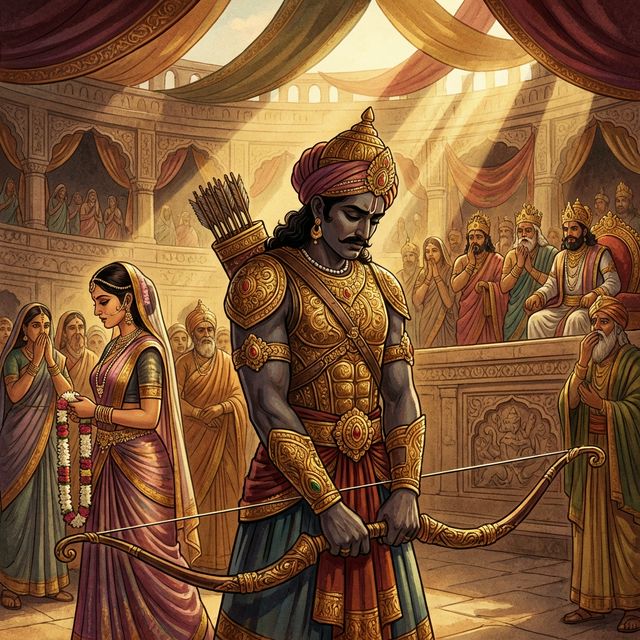
Long before the war, Kalinga's capital had hosted a swayamvara that Bhishma, in the years afterward, remembered as vividly as any battle. A princess of the Kalinga royal house stood ready to choose her husband from among assembled kings, and Duryodhana came among the suitors not to be chosen but to take. When the princess passed him over, he seized her by force before the assembled court, and it was Karna who stood at his back through the abduction, holding off the outraged kings of Kalinga and their allies while Duryodhana carried the bride away to become his queen.
It was the kind of act that the epic's world remembered as characteristic of Duryodhana more than exceptional: pride answered with violence, and violence made to look like triumph. For Karna it became one more debt of loyalty repaid to the friend who had first raised him from obscurity to a throne of his own, one more field on which his bow had guarded Duryodhana's ambitions rather than judged them.
Kalinga's royal house absorbed the insult as lesser kingdoms so often had to, unable to answer force with force against a prince who commanded Hastinapura's resources and Karna's bow together. Later, when Karna rode out on the campaign of conquest that gathered tribute for Duryodhana's ambitions, he came again to Kalinga and subdued it a second time, folding the kingdom more tightly still into the web of obligation that would one day summon its king to Kurukshetra. By the time war came, Kalinga's throne had long since stopped being its own to dispose of.
Shrutayush Marches to War
When the summons went out from Hastinapura calling every allied king to bring his forces to Kurukshetra, Kalinga's king Shrutayush did not hesitate, whatever private grievance his house still carried over the swayamvara his predecessors had watched Duryodhana defile. Debt and obligation ran deeper than resentment in the arithmetic of the epic's kings, and Kalinga had been bound to the Kaurava cause twice over, first by the marriage Duryodhana had forced and again by Karna's later campaign of conquest through its lands.
Shrutayush brought with him the one resource that made Kalinga worth courting as an ally: its war elephants, trained from birth for the shock of pitched battle, massive gray divisions that could break an infantry line the way a flood breaks a mud embankment. Alongside horsemen and footmen from the hill country between Mahendra and the coast, the Kalinga elephant corps took its place among the Kaurava host's most formidable divisions, a wall of trained beasts that Duryodhana's generals counted on to blunt whatever the Pandavas could throw against them.
For Shrutayush, marching north to a war that was not his own quarrel, there was little illusion about what he owed and to whom. His kingdom's fortunes had been tied to Hastinapura's ambitions since the day Karna's bow had guarded Duryodhana's abduction of a Kalinga princess, and a king who accepted that alliance's protection in peacetime could hardly refuse its summons in war. He rode to Kurukshetra at the head of his elephants, carrying a debt that the coming battle would settle in blood rather than tribute.
Bhima Among the Elephants
In the early days of the fighting at Kurukshetra, when both armies were still testing the shape of the war to come, the Kalinga elephant divisions advanced under Shrutayush's command with the confidence of a force that had never yet met its match on open ground. Massive and disciplined, trained to trample chariots and scatter infantry, they were exactly the weapon Duryodhana's generals had hoped for when they welcomed Kalinga into the alliance years before.
Bhima met them without hesitation. Of all the Pandavas, he alone fought with a strength suited to breaking beasts as much as men, and he waded into the Kalinga divisions the way he waded into every battle, mace in hand, indifferent to the scale of what stood against him. Elephant after elephant fell beneath his blows, their drivers cut down or thrown, their ordered ranks collapsing into a chaos of screaming animals and broken formations that no general, however skilled, could have held together once Bhima had found his rhythm among them.
The Kalinga troops who had marched south with such confidence found themselves fighting not a battle but a rout, their vaunted elephant corps, the pride of their kingdom for generations, dying around them faster than reinforcements from the rest of the Kaurava line could reach them. It was the kind of afternoon the war produced often in its early days, when a single Pandava warrior's fury could unmake in hours what a kingdom had spent generations building, and Kalinga's elephants, bred for the shock of battle, discovered that even they had met something they could not simply trample.
A King and His Princes Fall
By the time the sun began to set on that long afternoon, Kalinga's contribution to the Kaurava host had been all but erased. Shrutayush himself, king of the land between the Mahendra hills and the sea, fell to Bhima in the same slaughter that consumed his elephants, and beside him died the princes of his house, the sons who might have carried Kalinga's throne into whatever peace eventually followed the war.
It was a defeat as total as any single kingdom suffered in the early days at Kurukshetra, the kind that ended not merely a battle but very nearly a dynasty, since a king and his heirs together in one afternoon left Kalinga's succession as broken as its army. The debt that Shrutayush had marched north to honor, incurred first at a swayamvara his predecessors could not defend and renewed by Karna's later conquest, was paid in the end with his own life and the lives of the sons who should have outlived him. What remained of the Kalinga divisions, leaderless and scattered, fell back from the field in disarray, and word of the rout spread quickly through the rest of the Kaurava camp as a warning of what Bhima's strength could accomplish in a single afternoon of unrestrained fighting.
For Bhima, it was one victory among the many the war would demand of him before its end, remembered less for its drama than for its scale, an entire royal house and its famous elephant divisions broken in a single engagement. For Kalinga, it was the price of an alliance the kingdom had never truly chosen for itself, forced on it first by a bridegroom's violence and confirmed at last on a battlefield far from the rivers and hills that had been its home. The coast between the Mahendra hills and the sea would remember its king and princes, and the elephants bred for generations to carry a kingdom's pride into battle, all lost together before the war itself was even a third finished.
Dharma Lesson
Kalinga's fate shows how a kingdom's destiny can be set by a single act of a distant king's pride, long before its own people have any say in the war that follows. Loyalty bought at a wedding is still loyalty owed on a battlefield, and Shrutayush pays the debt his throne inherited in full.