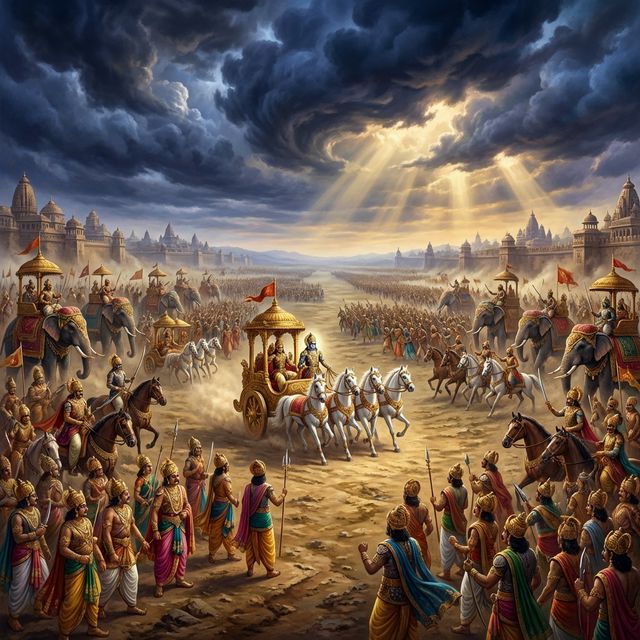
The Pairings of the Second Day
Arjuna goes at the grandsire, and the field breaks into nine duels
The Standard Like a Blazing Mountain
It was the second day of the war, and Sanjaya was telling it to a blind king in a hall in Hastinapur.
Bhishma had spent the morning holding Bhimasena off the sons of Dhritarashtra, and the whole line had come up behind him, and the noise of it was reaching the heavens. Then something changed on the Pandava side of the field, and Sanjaya, who had watched it happen, named the moment for the old man.
"Beholding his brothers and the other kings engaged in battle with Bhishma," he said, "Dhananjaya, with weapons upraised, rushed against the son of Ganga."
There were three things the Kaurava army heard and saw before Arjuna arrived, and Sanjaya listed them in the order they came.
First the blare of Panchajanya, the conch that Krishna blew from the driver's seat of that car. Then the twang of the bow Gandiva. And then, over the dust, the standard of Pritha's son.
"Hearing those, and seeing that, a great fear entered our hearts."
The standard bore the device of a lion's tail, and Sanjaya described it to a man who would never see it. It looked like a blazing mountain standing up in the sky. It was beautiful, and of celestial workmanship, and variegated with diverse hues, and it looked like a risen comet, and it could not be obstructed by trees. Whatever the car went through, the standard came through unbroken above it.
Then the bow itself came into view, and the men in the front ranks looked at the thing they had been hearing all morning. The back of its staff was decked with pure gold. In the middle of that grey field it looked, said Sanjaya, beautiful, like a flash of lightning in the midst of a mass of clouds in the firmament.
That was what was coming towards Bhishma. Everything that happened for the rest of the day happened because of it.
The Army That Melted
What the army heard next was not the bow.
It was the man. The shouts Arjuna uttered while he was slaying the combatants of that army seemed to resemble the loud roars of Indra himself, and the slaps of his palms against his leathern fences were frightfully loud, and both of those sounds carried further than any arrow he shot.
Then the arrows came. Like a roaring mass of clouds charged with lightning and aided by a raging tempest, Arjuna incessantly poured his arrowy showers on all sides, completely shrouding the ten points of the compass. Dhananjaya, possessed of terrible weapons, proceeded quickly towards the son of Ganga, and behind him the field stopped making sense.
"Deprived of four senses in consequence of his weapons," Sanjaya said, "we could not then distinguish the East from the West."
Men who cannot tell east from west do only one thing. Sanjaya put it plainly, and did not soften it for the father of the king whose troops these were. Their animals were tired. Their steeds were slain. Their hearts were depressed. Thoroughly confounded, huddling close to one another, they sought Bhishma's protection, and all of Dhritarashtra's sons went with them.
And in that battle Bhishma the son of Santanu became their protector. That is the whole of his part in this stretch of the fighting, and it is not a small one. The army did not rally around a plan or a formation. It ran to an old man and stood behind him.
The ones who did not reach him fell where they were. Struck with fear, car-warriors jumped down from their cars, and cavalry soldiers jumped down from the backs of their steeds, and the foot-soldiers, who had nowhere to jump down from, went down where they stood. Hearing the twang of Gandiva that resembled the roar of the thunder, all the warriors of that army were struck with fear and seemed, said Sanjaya, to melt away.
An army does not usually melt. It breaks, or it holds. This one was going soft in the middle while the sound was still travelling.
Fourteen Thousand Horse for Shakuni
Duryodhana's answer to that was cavalry, and a great deal of it.
Sanjaya counted the pieces as they moved up. Many huge and fleet steeds of the Kamvoja breed. Many thousands of Gopas, the cowherd fighters, with the large Gopayana force behind them. Then the Madras, the Sauviras, the Gandharas and the Trigartas, four allied peoples brought in together. Then the king of the Kalingas, surrounded by all the principal Kalingas, the coast men who had come north with their elephants and their own quarrel with Bhima. Then king Jayadratha, the ruler of the Sindhus, accompanied by all the kings who followed him, supported by a large force of diverse races with Dushasana at their head. And with all of that, fourteen thousand principal horsemen.
They were not sent at Arjuna. Urged by Duryodhana, that entire mass moved to surround the son of Suvala, in order to support him. Shakuni, the dice-player, the man whose counsel had produced this field, was given fourteen thousand horse and four nations to keep him standing.
While that wall was assembling, the Pandavas came in everywhere else.
"Then in that battle," Sanjaya said, "all the Pandavas, united together, and riding on separate cars and animals, began to slaughter thy troops."
That sentence is the hinge of the day. Riding on separate cars and animals. They did not come as one weight against one point, as the Kauravas had just done. They spread, each brother and each ally going to a different part of the line, and the day stopped being one battle and became a field full of duels being fought at the same time.
And the dust raised by the car-warriors and the steeds and the foot-soldiers, looking like a mass of clouds, made the field of battle exceedingly awful, so that men fighting the man in front of them could not see who was winning anywhere else.
Nine Pairings
This is how the field divided. Sanjaya named the pairs in order, and the order is worth keeping, because it is the shape of the second day.
Bhishma took Arjuna. He did not go at him alone. With a large force consisting of elephants, steeds and cars, and armed with lances and bearded darts and broad-headed shafts, Bhishma engaged in battle with the diadem-decked son of Pritha.
The king of Avanti engaged with the ruler of Kasi, two western kings on opposite sides of the quarrel, matched against each other while the great names were busy.
The ruler of the Sindhus engaged with Bhimasena. That is Jayadratha, who had once dragged Draupadi out of a forest hermitage and had been let go alive with five tufts of hair left on his head, standing now in front of the man who had shaved him.
King Yudhishthira, with his sons and his counsellors, engaged with Shalya, the famous chief of the Madras, his own uncle by marriage, who had come to the war intending to fight on the other side and had been tricked into this one.
Vikarna engaged with Sahadeva. Vikarna was the son of Dhritarashtra who had stood up in the assembly hall and said aloud that Draupadi had not been fairly won, and he was on the field that morning in his brother's colours.
Chitrasena, another of the hundred, engaged with Shikhandi.
The Matsyas, Virata's people, engaged with Duryodhana and with Shakuni.
Drupada and Chekitana, the Vrishni chief who had brought his own division for the Pandavas, and with them that mighty car-warrior Satyaki, engaged in battle with the high-souled Drona, who had his son Ashwatthama beside him. Three against the teacher and the teacher's son.
And Kripa and Kritavarma both rushed against Dhrishtadyumna, the general of the Pandava army, the man born out of a fire for the purpose of killing Drona.
"And thus," Sanjaya said, "all over the field, rushing bodies of horses, of elephants and cars, engaged with one another in battle."
Nine pairings, and after them no line at all.
A Darkness Lit by Edges
The sky behaved strangely while they fought, and Sanjaya reported it the way he reported the pairings, as a thing he had seen.
Although there were no clouds in the sky, yet flashes of lightning were seen. All the points of the compass were covered with dust. Fierce meteors were seen falling with a thundering noise. Violent winds blew, and a shower of dust fell from above, and the sun, covered by the dust raised by the troops, disappeared out of the firmament altogether.
So the second day went dark in the middle of itself, and the men in it went dark with it. Covered by that dust and battling with weapons, they were deprived of their senses, and struck at whatever was close.
What they could still hear was the metal. The sound made by weapons, all of them capable of penetrating through every armour and hurled from heroic arms, became one tremendous uproar with nothing in it that a man could pick out.
And what they could still see was only what shone. Weapons hurled from excellent arms and possessed of stellar brightness illumined the whole welkin, so that the light on that field came from the things being thrown at people. Variegated shields made of bull's hides and embossed with gold lay strewn all over the ground. Heads and limbs fell on every side, cut off with swords and scimitars possessed of solar effulgence.
That is a strange way to describe a slaughter, and Sanjaya knew it. He was describing a darkness lit entirely by edges. The sun was gone and the gold was still burning, on the shields that men had dropped and on the blades that were taking their arms off, and the only bright things left on the field of Kurukshetra were the ones doing the killing.
He did not stop to draw a lesson out of it for the king. He went straight on to the wreckage.
Lotus-Stalks Out of a Lake
The cars went first.
Great car-warriors, the wheels and axles and boxes of whose cars were broken, fell down on the ground with their steeds slain and their tall standards tumbling after them. Many were killed outright, and their horses, mangled with weapons, fell as they ran, still dragging the cars they were yoked to. In many places over the field excellent steeds, afflicted with arrows, their limbs mangled, ran loose with their traces on, dragging the car-yokes behind them, going nowhere.
Then the elephants got into it, and the elephants were worse.
Many car-warriors, with their charioteers and their steeds together, were crushed by single elephants endued with great strength. In the midst of those large forces, elephants scenting the odour of the temporal juice of their compeers began to snuff the breeze again and again, working themselves up. The whole field was strewn with slain elephants, deprived of life by broad-headed shafts, falling with the wooden edifices still on their backs and the guides still in them. Others were crushed by huge compeers urged forward by their own drivers, and went down with their standards and the warriors riding them.
Many car-shafts were broken in that battle by elephants using their trunks, each trunk like the trunk of Airavata, the prince of elephants. Car-warriors whose vehicles had been broken open were dragged down like branches of trees pulled down by tuskers, seized by the hair of the head, thrashed violently against the ground, and crushed into shapeless masses.
And other huge elephants, dragging cars that had become entangled with other cars, ran in all directions shrieking. Sanjaya gave the blind king one last picture to hold, and it was a peaceful one, which is why it is the worst thing in the account.
Those elephants, dragging those cars behind them, looked like others of their species dragging lotus-stalks out of a lake.
"And thus," he said, "was that vast field of battle strewn over with cavalry soldiers and foot-soldiers and great car-warriors and standards."
Dharma Lesson
A battle plan is a claim about who matters, and the second day makes both sides state theirs out loud. The Pandavas spread out, each man going to his own opponent, trusting the others to hold. Duryodhana takes fourteen thousand horsemen and four nations and spends them on a wall around Shakuni, the one man on that field who never had to stand in the open. An army will tell you what it truly values by what it protects when it is frightened, and it is worth noticing that the Kauravas, when they broke, ran to an old man who had told them the war was wrong.