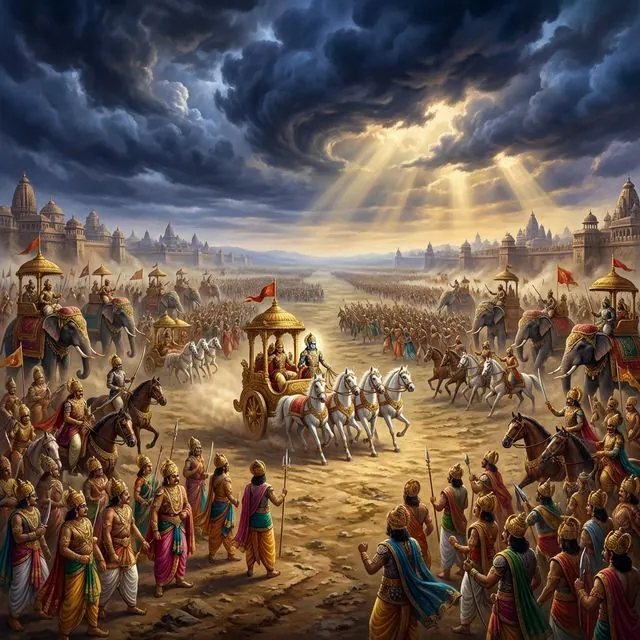
The Heron Takes Shape
Dhrishtadyumna had not slept. He had spent the night walking the lines with a torch and a scribe, and when the sky went grey over Kurukshetra he was already among the chariot captains, moving them like a man laying out stones.
"Yesterday we met them in a wall," he said, "and a wall is only as strong as the weakest span of it. Bhishma found that span in the first hour. Today we do not stand. Today we fly."
He drew them into the krauncha vyuha, the array of the heron, and from the high ground it was possible to see the bird take shape out of men. Arjuna stood at the very front with Krishna at the reins and the monkey banner over him. Drupada held the head with the Panchala divisions, and Kuntibhoja and the lord of Chedi were its two eyes. Yudhishthira rode at the back of the bird. Bhima held a wing with his mace across his knees, and Dhrishtadyumna, Abhimanyu, Satyaki and the sons of Draupadi rode in the wings with him, while Nakula and Sahadeva held the left wing. Virata guarded the rear with the Kekayas and the king of Kashi, where a broken formation bleeds first.
That is what a vyuha is. It is not a decoration. It is living geometry, a shape in which every man knows what is on his left and what is on his right and where he goes when the man in front of him falls, so that the army bends and does not tear.
Bhishma looked across the plain at the heron and understood at once what had happened in the Pandava camp overnight.
"They have found their commander," he said.
He answered it with a great array of his own, himself at its head under the palm banner, Drona following behind him, and Duryodhana with his brothers in the body. Then the conches went up on both sides, and the second day began with the two shapes walking into each other.
Grandfather and Grandson
"Take me to Bhishma," Arjuna said. "Yesterday he was allowed to stand where he pleased. Today he stands where I am."
Krishna turned the white horses, and the chariot went up the field through the Kaurava divisions the way a knife goes through cloth, and everything that tried to stop it was left behind in pieces. When it came out on the other side, the golden chariot with the palm banner was waiting for it.
What followed lasted the better part of the day.
They fought at first with clouds. Bhishma sent arrows in sheets that darkened the ground under both chariots, and Arjuna cut them out of the air, and the broken shafts fell so thickly that the horses were walking through them. Then they fought with named weapons, and men on both sides stopped their own killing to watch the sky burn between two chariots. Neither could open the other's guard, and neither, if the truth was to be told at nightfall, was trying with all of himself.
The grandsire's armour was cut through in a dozen places and the blood ran down the white silk. Arjuna's banner staff was split, his charioteer was struck, and Krishna's arms above the reins were bleeding.
"He is not tiring," Arjuna said. "He is a hundred years old and he is not tiring."
"He is not fighting for a kingdom," Krishna said. "There is nothing in him left to tire."
It ended, in the end, with neither of them the victor. Later that day, when Bhishma rode against Bhima among the Kalingas, Satyaki of the Vrishnis brought down the grandsire's charioteer with his arrows, and the horses of the golden chariot bolted with nobody holding them and carried the grandsire away from the field.
By then the Pandava wing had moved forward, and for the first time in the war the Kaurava host had given ground.
Bhima Among the Elephants
On the Pandava left the Kalinga divisions came down in a mass of elephants, and their king Shrutayu brought them on in ranks so deep that the men in front could not have turned back if they had wanted to.
Bhima had been waiting for exactly this.
He emptied his quiver into the leading beasts from the chariot, and when the Kalinga archers shot his horses out from under him he did not send for another chariot. From his horseless chariot he hurled his steel club and killed the Kalinga prince Shakradeva, then took up a sword and a shield marked with moons and stars, stepped down onto the field, and walked into the elephants on foot.
What happened after that was remembered by both armies in the same words: that he was gone from sight for a long time, and that they could follow him by the sound.
The sword came down and an animal the size of a house folded at the knees. He went under the tusks of the next and broke its foreleg and stepped aside as it came over. He climbed a fallen beast, jumped from its back to another, and killed the men in the howdah before it understood he was on it. The Kalinga foot soldiers who came to save their king went into the press after him and did not come out. Blood and the smell of it maddened the animals until they turned and ran back through their own ranks, and the ranks behind, packed too tight to open, went down under them.
Dhrishtadyumna drove into the wreck to find him, and Satyaki came up to guard their flanks.
Bhima climbed into Dhrishtadyumna's chariot at last, unrecognisable under what was on him, the sword still in his hand, and the first thing he did was ask for water.
The Kalinga contingent had ceased to exist. Their king lay in it with his elephants around him, and there was nothing left on that flank for Bhishma to build a line from.
Teacher and Fire-Born
Earlier that day, before the Kalingas came on, the beak of the heron came against Drona, and for the first time in the war the son of Drupada and the son of Bharadwaja looked at each other across open ground.
Every man near them knew what he was watching. Dhrishtadyumna had not been born; he had walked out of a sacrificial fire in armour with a bow already in his hand, and the voice that spoke over the flames had said what he was for. He was for this man. He had been made for this man. Drona had known it since the day it happened and had gone on teaching the boy's sister's husbands and had never once asked the gods to change it.
"Come, then," Drona said. "You have been coming a long time."
They fought, and the teacher won the exchange. Drona cut the bowstring, then the bow, then the second bow, then the banner. He killed the four horses one after another, unhurried, each with a single arrow, and he killed the charioteer of the prince of Panchala and shattered the club he hurled. Dhrishtadyumna came off the wreck with a sword and a shield and kept coming, and Drona held him back with a storm of arrows that rattled off the shield.
He did not kill him. He could have and he did not, and whether that was mercy or the prophecy holding his wrist nobody on that field could say.
Bhima arrived then, driving straight through Drona's guards, and took the prince up onto his own chariot while the arrows came off the floor around them, and carried him out. Behind them the Panchala divisions closed the gap and the beak of the heron went on.
The teacher stood and watched them go.
"There," he said to nobody, "goes the end of me," and turned his chariot back into the fighting.
The First Doubt
The sun went down on a field that looked nothing like the field of the evening before.
The Kaurava dead lay in windrows where the elephants had gone over their own infantry. Whole contingents had no captains left. The chariot yards were full of men waiting for wheels, and the physicians worked by torchlight in the open because there was no room in the tents.
Duryodhana rode along it and did not speak until he reached Bhishma's fire.
"Explain this to me," he said. "Yesterday you gave me the war. Today I have lost a king of Kalinga, his elephants, his sons, and I cannot count the divisions that are simply gone. Nothing changed on our side. What changed?"
"They did," Bhishma said. "Yesterday you were fighting frightened men in a line. Today you were fighting an army in a shape. That is Drupada's son. You laughed at his birth. I did not."
"Then break the shape."
"I intend to." The grandsire turned the arrow he was examining and set it aside. "But hear the rest of it, since you have asked. Bhima walked into the Kalinga elephants on foot and walked out. Arjuna held me from the third hour to the ninth and I could not finish him, and I have never in my life said that of any man. Krishna is on that chariot. Understand what you have chosen to fight."
Duryodhana stood by the fire for a while with his hands behind him.
"We have eleven," he said at last. "They have seven."
"Yes," Bhishma said. "And I have been counting the days since this morning, which I did not do yesterday."
Across the plain in the Pandava camp there was noise for the first time since the war began, men eating properly and telling each other what they had seen, and Yudhishthira went among them and let them talk. Krishna found Dhrishtadyumna alone at the edge of the light, still holding a broken shield.
"Tomorrow he will answer you with a bird of his own," Krishna said. "Be ready to answer that."
Dharma Lesson
Despair is answered by shape, not by shouting. Dhrishtadyumna does not give his army courage on the second morning; he gives it a form in which every man knows who stands beside him, and courage follows. And when teacher and destined killer meet at last, both fight well and neither triumphs, because a prophecy names an ending and says nothing about the days in between.